


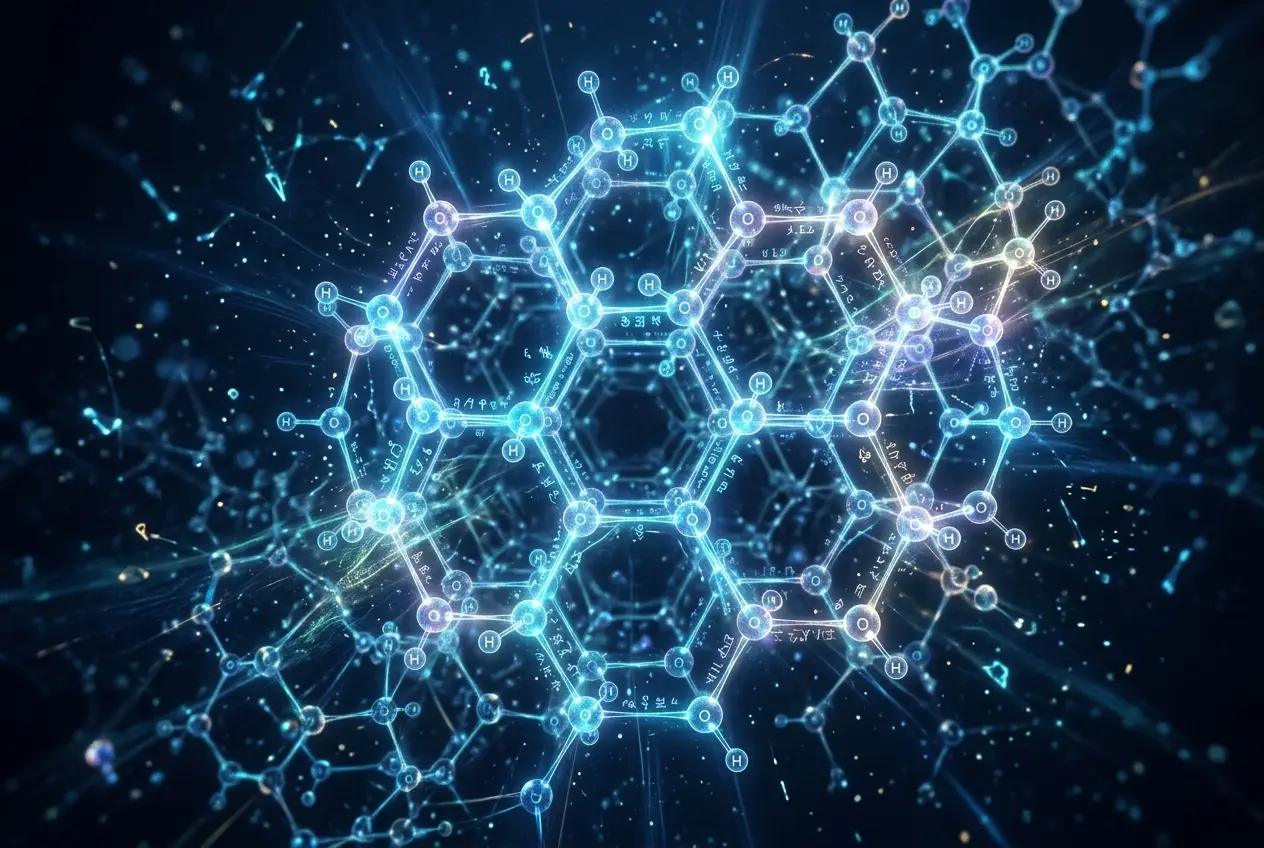
I’ve always been fascinated by the mundane, by the things we interact with daily but rarely stop to truly understand. Take water, for instance. It’s essential for life, it covers most of our planet, and yet, there are aspects of H₂O that continue to baffle even the most brilliant minds. We think we know water—it's just two hydrogen atoms and one oxygen atom, right? Simple. But what if I told you that some scientists are exploring a concept so radical it suggests water might possess a form of "memory," capable of retaining information about substances it once contained?
It sounds like something out of science fiction, or perhaps a New Age wellness retreat. But delve deeper, and you find a fascinating, if controversial, corner of scientific inquiry that asks: Does water have a hidden quantum life that allows it to "remember"? This isn't about magical thinking; it's about exploring the complex, often anomalous properties of water through the lens of quantum physics and curious phenomena.
The Enigma of Water: More Than Just H₂O
Water is arguably the most anomalous substance on Earth. Its properties defy typical chemical predictions. For example, it’s less dense as a solid (ice floats), it has an unusually high boiling point, and its heat capacity is exceptional. These aren't just quirks; they are fundamental to life as we know it. But beyond these well-established anomalies, some theories propose that water's molecular structure can be influenced and retain patterns from its environment.
At its core, water is a highly dynamic network. Its molecules are constantly forming and breaking hydrogen bonds—weak electrostatic attractions between water molecules. This constant dance creates a fluid, ever-changing structure. The mainstream scientific view holds that these structures are transient, quickly dissipating any "memory" of past interactions. However, a fringe but persistent line of inquiry suggests otherwise.
The Concept of Water Memory: A Deep Dive into Controversy
The idea of water memory gained significant public attention, primarily through the field of homeopathy, which posits that highly diluted substances can still have an effect because water "remembers" the original solute. Mainstream science largely dismisses homeopathy due to a lack of plausible mechanism and consistent experimental evidence beyond placebo effects. However, the underlying concept of water having a persistent structural memory has continued to intrigue a smaller group of researchers.
The scientific skepticism isn't unfounded. If water truly retained stable structures that could encode information, it would challenge fundamental principles of chemistry and physics, particularly thermodynamics. The constant thermal motion of water molecules, known as Brownian motion, is expected to quickly randomize any ordered structures, making long-term memory seem impossible.
However, some argue that we might be overlooking subtle, transient, or even quantum mechanical phenomena that could allow for such information retention.
"The strange properties of water are due to the hydrogen bond network. If we could understand this network fully, we might unlock secrets beyond our current understanding." – Unnamed materials scientist, in a discussion on water anomalies.
Quantum Mechanics: The Unseen Influencer?
This is where things get really interesting, stepping into the realm of quantum biology—a field that explores how quantum mechanical phenomena might play a role in biological processes. Could water’s strange properties be linked to quantum effects?
One area of speculation revolves around quantum coherence and quantum entanglement. In the quantum world, particles can exist in multiple states simultaneously (superposition) or become linked in a way that their fates are intertwined, regardless of distance (entanglement). While these phenomena are usually associated with isolated, extremely cold systems, there's growing evidence that quantum coherence might occur in warmer, "messy" biological environments, such as within proteins during photosynthesis.
Could the vast, dynamic network of water molecules, particularly in highly ordered systems like those found near cell membranes or even in bulk water, exhibit some form of transient quantum coherence? If so, could this coherence allow water to form more stable, information-carrying structures than previously thought?
- Quantum Coherence in Water: Imagine water molecules not just as individual units, but as part of a larger, vibrating quantum system. Some theories suggest that water molecules could synchronize their vibrations, creating collective states that are more stable and potentially capable of "storing" a vibrational imprint of dissolved substances. This isn't about storing bits like a computer, but rather subtle structural patterns or energy states.
- Structured Water and Clathrates: Water can form various exotic structures, like clathrates, which are cage-like molecular complexes that trap other molecules. While these are usually stable under specific conditions, the idea is that water might transiently form similar, ordered "micro-clathrates" or supramolecular structures that persist longer than standard hydrogen bond networks. These could, in theory, act as temporary scaffolds for information. More research into the fundamental physics of these structures can be found on Wikipedia's page on structured water.
For instance, the way water interacts with biological molecules is crucial. Proteins fold into specific shapes, and a significant part of that folding is driven by how they interact with surrounding water molecules. Could these water molecules, acting collectively, somehow influence or even stabilize these protein structures, potentially retaining an energetic "signature" of the solute that guided their initial arrangement? This ties into the broader discussion of how quantum effects might influence consciousness and other biological processes, as explored in articles like our own on whether humans possess quantum effects that influence consciousness.
Experimental Approaches and Challenges
Despite the intense scrutiny, researchers continue to explore the physical chemistry of water for unusual phenomena. Some studies use advanced spectroscopic techniques like Raman spectroscopy and Nuclear Magnetic Resonance (NMR) to look for long-range order or unusual relaxation times in water that has been exposed to specific solutes. The results are often subtle, difficult to replicate, and subject to intense debate.
One of the major challenges is the sheer complexity of water itself. It's difficult to isolate subtle structural changes from the constant thermal noise and rapid dynamics of its hydrogen bond network. Furthermore, the experiments must be incredibly precise, ruling out contamination or other conventional chemical interactions.
Table: Hypothesized Water States and Potential Information Storage
| Concept | Description | Mainstream Scientific View | Speculative Quantum Link |
|---|---|---|---|
| Transient Clusters | Water molecules forming short-lived groups due to hydrogen bonding. | Well-established, constantly forming and breaking. | Could exhibit momentary coherence or information "imprints." |
| Clathrate-like Structures | Cage-like structures trapping other molecules or organizing water itself. | Known for specific conditions (e.g., gas hydrates). | Might form meta-stable, information-carrying configurations. |
| Quantum Coherence Domains | Regions where water molecules' quantum states are synchronized. | Highly speculative for ambient conditions. | Could create stable, energetically distinct "memory units." |
| Vibrational Imprints | Water retaining specific vibrational patterns from a solute. | No known mechanism for long-term retention. | Might involve resonant energy transfer or persistent phonons. |
It's a field ripe with potential, yet fraught with the risk of misinterpretation. For those interested in the foundational science, understanding the nuances of water's molecular structure and interactions is key. Wikipedia offers an excellent starting point for the scientific properties of water.
Potential Future Tech: If Water Could "Compute"
Imagine, for a moment, that water could reliably store or process information. The implications would be revolutionary.
- Ultra-dense Data Storage: A single drop of water could theoretically hold an astronomical amount of data if its molecular configurations could be controlled and read. This would dwarf current data storage methods, moving us closer to ideas of living cells storing quantum data.
- Novel Drug Delivery: Water could be "programmed" to deliver specific therapeutic effects or carry information to biological systems, opening new avenues in medicine.
- Advanced Materials Science: Understanding and manipulating water’s structural memory could lead to new materials with unique properties, possibly even self-assembling structures.
- Environmental Sensing: Water could act as a universal sensor, recording the history of pollutants or other substances it has encountered.
This remains firmly in the speculative realm, but the very act of exploring such possibilities pushes the boundaries of our scientific understanding. It forces us to ask if our current models of reality are complete, especially when it comes to fundamental substances like water.
Conclusion: A Mystery Still Flowing
The question of whether water can "remember" is far from settled. Mainstream science largely says no, citing overwhelming evidence that molecular structures in liquid water are too dynamic to retain information long-term. Yet, the persistent anomalies of water and the tantalizing possibilities offered by quantum mechanics ensure that this fascinating question continues to bubble beneath the surface of scientific inquiry.
As we continue to unravel the complexities of our universe, from the vastness of space to the smallest subatomic particles, we must remain open to the idea that even the most familiar elements, like a simple glass of water, might harbor secrets we are only just beginning to comprehend. Perhaps one day, we'll discover that water is not just the cradle of life, but also a silent, quantum recorder of its history.




Conversation0
No comments yet. Be the first to share a thought — the best questions often become new stories.