I’ve always been fascinated by the invisible forces that shape our reality, especially those originating from the vastness of space. We often consider our digital devices—smartphones, laptops, massive data servers—to be incredibly robust, designed to store our most precious memories and critical information without fail. Yet, what if I told you there’s an incessant, high-energy barrage from beyond our planet that is constantly trying to corrupt them? What if these cosmic intrusions aren't just causing random glitches, but are subtly rewriting our digital past, creating "digital ghosts" in the machine?
It sounds like science fiction, doesn't it? A silent, unseen adversary from the cosmos, slowly eroding the very fabric of our digital existence. But the truth is, this isn't fiction. It’s a very real, well-documented phenomenon known as **soft errors**, caused primarily by cosmic rays.
### The Invisible Rain: What Are Cosmic Rays?
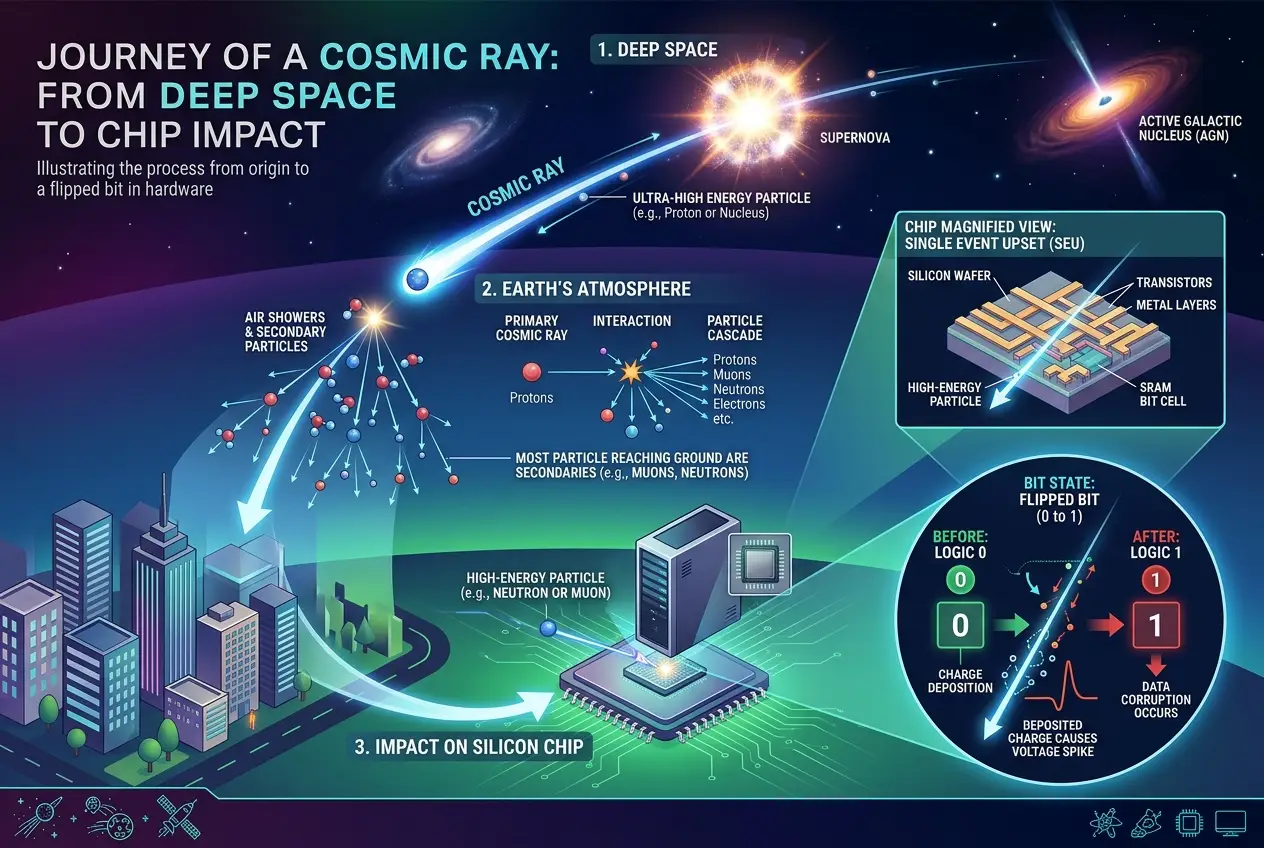
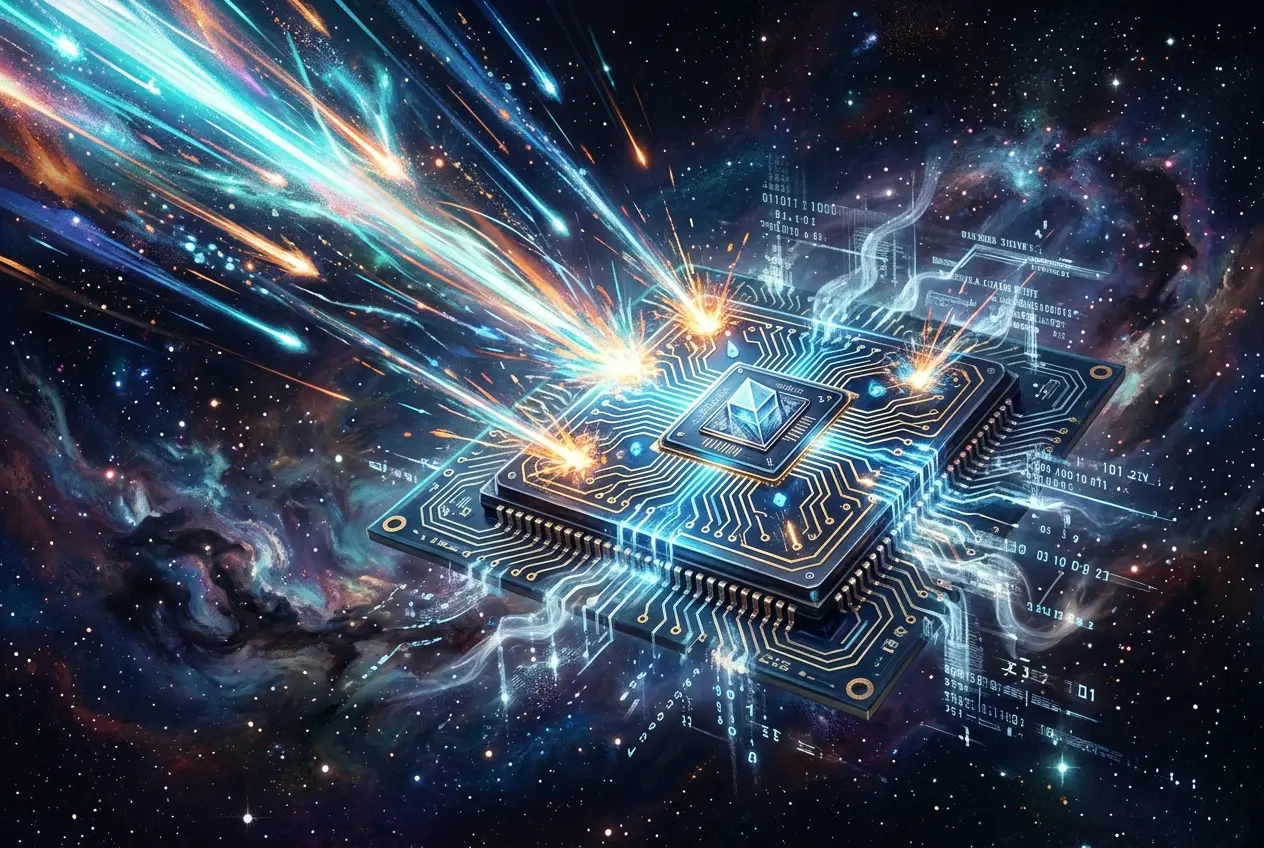
Imagine tiny, subatomic bullets traveling at nearly the speed of light, originating from supernovae, black holes, and other violent cosmic events across the galaxy. These are cosmic rays—not actually "rays" of light, but high-energy particles, predominantly protons and atomic nuclei. They constantly shower our planet, penetrating our atmosphere and, crucially, our technology.
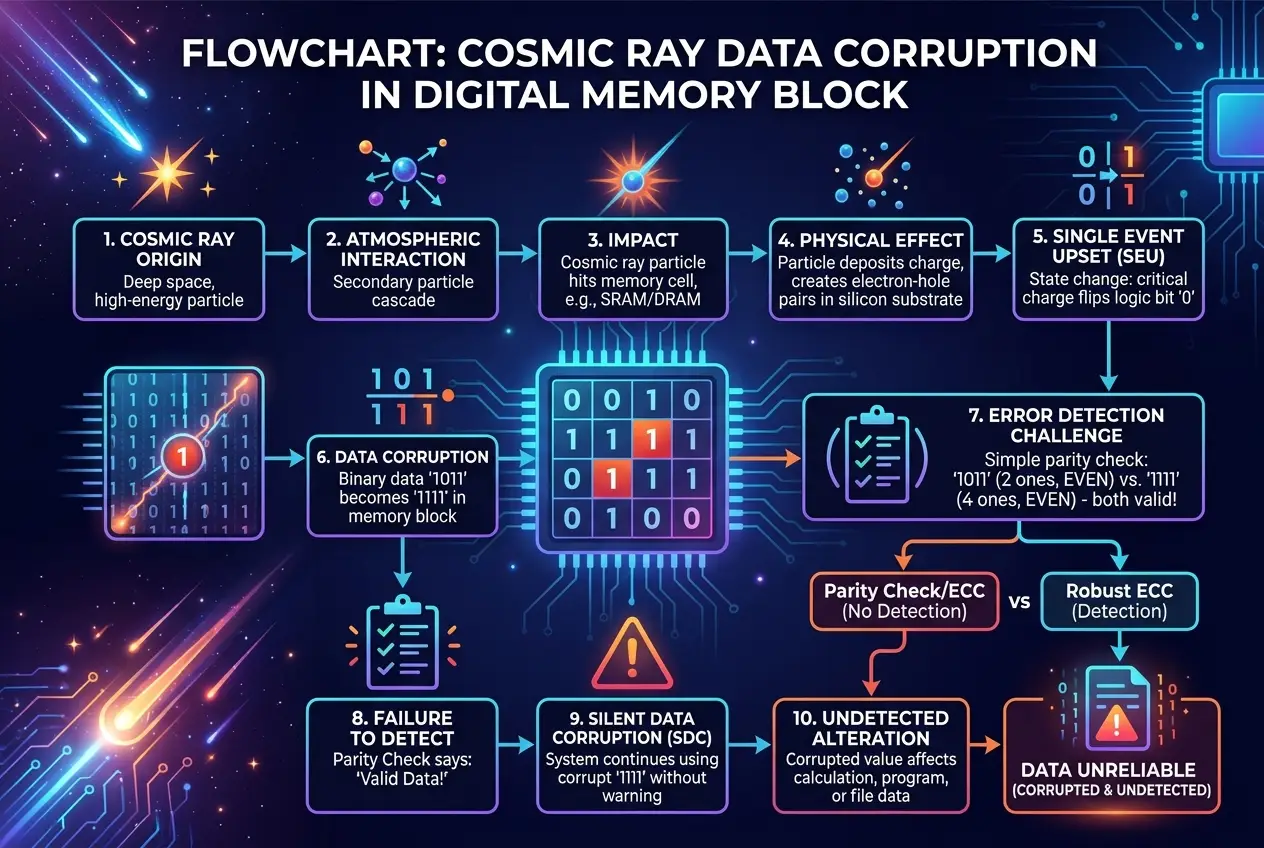
When these highly energetic particles slam into the silicon of our computer chips, they can disrupt the delicate balance of electrons that store information. A single hit can flip a bit—changing a 0 to a 1, or a 1 to a 0. Most of the time, these are isolated incidents, barely noticeable, perhaps a fleeting graphical anomaly on your screen or a minor error in a calculation. But what if these events accumulate? What if they impact critical data storage, altering memories, records, or even the training data for advanced AI systems?
### Soft Errors: The Silent Saboteurs of Our Digital World
The term "soft error" is key here. Unlike a "hard error," which signifies a permanent physical defect in hardware, a soft error is a transient, non-destructive data alteration. The hardware itself remains functional, but the data it processed or stored has been silently modified. These aren't catastrophic system failures, but rather subtle corruptions that can be much harder to detect and mitigate.
For most of us, these events are rare enough not to cause significant concern in daily use. Your phone might freeze once in a blue moon, or an app might crash. While many factors contribute to such glitches, cosmic rays are an undeniable, albeit often overlooked, culprit. However, in mission-critical systems—like those in spacecraft, medical devices, or large-scale data centers—the implications are far more serious.
Think about the Mars Curiosity rover. It's constantly bathed in cosmic radiation. To cope, it employs sophisticated error detection and correction (ECC) mechanisms. But even with these safeguards, scientists have reported instances of memory corruption attributed to cosmic rays. If cosmic rays can impact a purpose-built space device, what about the billions of consumer electronics on Earth?
### The Digital Memory Hole: Rewriting Our Past?
Our digital lives are built on layers of data: photos, videos, documents, financial records, emails, and more. Each piece of information is a sequence of bits. If cosmic rays are flipping bits, they are quite literally rewriting our digital past. It might manifest as a corrupted pixel in an old photograph, a minor alteration in a spreadsheet, or even a subtle shift in a historical document stored on a server.
Consider a large database of scientific research or historical archives. A soft error could alter a critical numerical value, a date, or even a single word, potentially leading to misinterpretations or erroneous conclusions down the line. The terrifying part is that these changes often go unnoticed unless specific checksums or validation routines are run, and even then, distinguishing a cosmic ray-induced error from a software bug or simple human input error can be challenging. For more on how our technology can display inexplicable behaviors, you might find our article on [Digital Anomalies: Can Computers Show Unexplained Behaviors?](https://www.curiositydiaries.com/blogs/are-digital-glitches-hints-of-parallel-worlds-2909) quite illuminating.
A 2012 study by researchers at the University of California, Berkeley, and the University of Illinois demonstrated how cosmic rays could affect terrestrial computers, leading to bit flips in memory. They calculated that a typical computer in a data center might experience one such error per month. Scale that up to millions of servers, and you have a constant stream of tiny, insidious corruptions.
### AI and the Quantum Realm: New Vulnerabilities?
As we move towards more advanced computing paradigms, the problem might even intensify. Quantum computers, while incredibly powerful, operate on the delicate states of qubits, which are notoriously susceptible to environmental interference. While cosmic rays aren't typically "quantum" in nature, their energy can certainly destabilize the fragile quantum states required for computation. Protecting these futuristic machines from such environmental noise is a monumental challenge.
Even for classical AI, the integrity of training data is paramount. Imagine an AI learning from a vast dataset that has been subtly altered by cosmic rays over time. Could these "digital ghosts" in the data lead to unforeseen biases, flawed decision-making, or even unexpected behaviors in the AI itself? We already grapple with the challenges of data integrity and bias; adding an unpredictable cosmic variable only complicates matters. The idea that even empty space might store some of our universe's lost data, as discussed in [Could Empty Space Hold the Universe’s Lost Data?](https://www.curiositydiaries.com/blogs/could-empty-space-hold-the-universes-lost-data-7037), makes the corruption of existing data even more poignant.
### Mitigation: Building Fortresses Against the Cosmos
So, how do we combat this invisible threat? The tech industry isn't sitting idle. Engineers employ several strategies to mitigate cosmic ray effects:
1. **Error-Correcting Code (ECC) Memory:** This specialized memory includes extra bits that store parity information, allowing the system to detect and often correct single-bit errors. This is common in servers and high-end workstations.
2. **Radiation Hardening:** For spacecraft and critical military applications, components are specifically designed and manufactured to be more resistant to radiation. This often involves using different materials or thicker shielding.
3. **Redundancy:** Data can be duplicated across multiple locations or systems. If one copy is corrupted, others can be used to restore the original.
4. **Software-Level Checks:** Regular checksums and validation routines can be implemented to verify data integrity.
Despite these efforts, the constant evolution of technology towards smaller, more dense transistors makes them even more susceptible to cosmic ray strikes. A smaller transistor requires less energy to flip its state, making it an easier target for these energetic particles. You can learn more about how subtle cosmic interactions can lead to technological glitches in our detailed article [Do Cosmic Rays Secretly Glitch Our Tech?](https://www.curiositydiaries.com/blogs/do-cosmic-rays-secretly-glitch-our-tech-3330).
### The Philosophical Angle: Trusting Our Digital Reality
The silent corruption of our digital memories by cosmic rays raises a fascinating, almost philosophical question: How much can we truly trust our digital reality? If our records, photographs, and scientific data are subject to random cosmic interference, what does that mean for our collective memory and knowledge? Are we perpetually living with a subtle, cosmic rewrite of history?
While the impact on an individual photo or document might seem minor, the cumulative effect across billions of devices and petabytes of data is a force we are only beginning to fully understand. It’s a reminder that even in our most advanced technological constructs, we remain intimately connected to the powerful, mysterious forces of the cosmos. As we dive deeper into the age of AI, where digital memory is the bedrock of learning and intelligence, understanding and mitigating these "digital ghosts" will become increasingly vital. The potential for such cosmic interference to subtly manipulate our perceived digital reality is a chilling thought, especially when considering the implications of advanced AI manipulating information, as explored in [Can AI Deepfakes Actually Manipulate Our Memories?](https://www.curiositydiaries.com/blogs/can-ai-deepfakes-actually-manipulate-our-memories-3019).
In a world where digital data is increasingly indistinguishable from reality, recognizing and preparing for these cosmic intrusions isn't just a technical challenge—it’s a fundamental quest to safeguard our truth.
**References:**
* Wikipedia: [Cosmic ray](https://en.wikipedia.org/wiki/Cosmic_ray)
* Wikipedia: [Soft error](https://en.wikipedia.org/wiki/Soft_error)
* Wikipedia: [Error correction code](https://en.wikipedia.org/wiki/Error_correction_code)
* Wikipedia: [Radiation hardening](https://en.wikipedia.org/wiki/Radiation_hardening)
Frequently Asked Questions
In this context, 'digital ghosts' refer to subtle, often unnoticed corruptions or alterations in digital data, such as a flipped bit (0 to 1 or vice versa), caused by cosmic ray strikes. These aren't system crashes but transient changes that can quietly rewrite parts of your digital memories or records.
The frequency varies greatly depending on the device, its location (altitude, shielding), and its design. For a typical computer in a data center, some studies suggest one bit flip per month. For consumer devices, it’s less common but still a persistent, low-level threat that accumulates across billions of devices.
Complete prevention is practically impossible due to the pervasive nature of cosmic rays. However, mitigation techniques like Error-Correcting Code (ECC) memory, radiation hardening for critical systems, data redundancy, and software-level checksums significantly reduce the likelihood and impact of these errors, making them manageable for most applications.
Generally, newer devices with smaller, more densely packed transistors are theoretically more susceptible. Smaller transistors require less energy to flip their state, making them easier targets for cosmic ray strikes. However, modern designs also incorporate advanced error correction features to counteract this.
Yes, absolutely. For AI, corrupted training data could lead to biases or incorrect model behavior. In critical infrastructure like power grids, financial systems, or spacecraft navigation, even a single bit flip in a crucial calculation could have serious, cascading consequences. This is why robust error mitigation is essential in these sectors.
Verified Expert
Alex Rivers
A professional researcher since age twelve, I delve into mysteries and ignite curiosity by presenting an array of compelling possibilities. I will heighten your curiosity, but by the end, you will possess profound knowledge.
Leave a Reply
Comments (0)
No approved comments yet. Be the first to share your thoughts!
 Join Us

 Unknown Author




























Leave a Reply
Comments (0)