


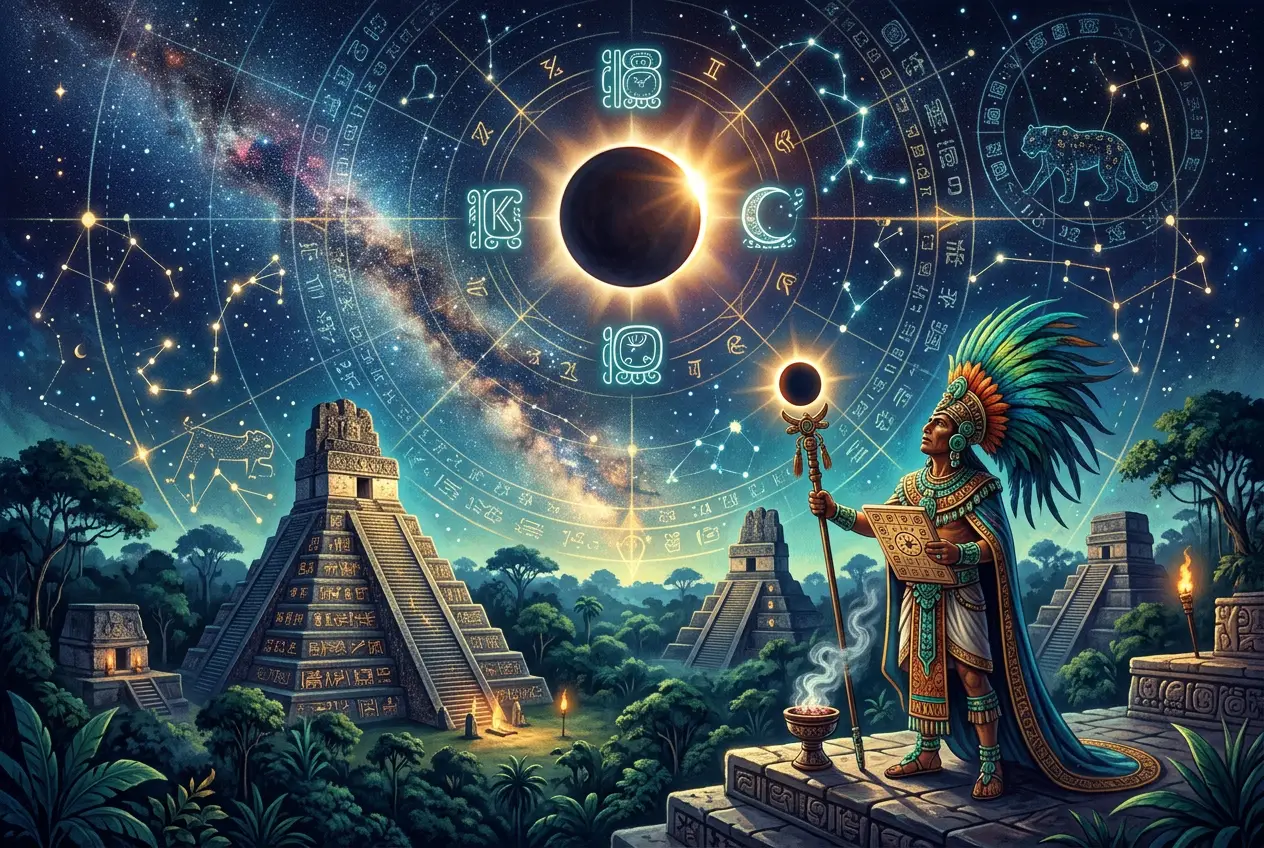
The year 2012 was a curious one, wasn't it? For months, even years, leading up to it, whispers of the "end of the world" circulated, fueled by interpretations of the ancient Maya Long Count calendar. I remember countless documentaries, articles, and even blockbuster movies dissecting this supposed prophecy. While the world didn't end, and life continued its steady march, the fascination wasn't in the doomsday predictions themselves, but in the sheer mathematical and astronomical sophistication of a civilization that could inspire such global speculation. It made me wonder: how could a culture, thousands of years ago, without telescopes or modern computing, develop such an incredibly precise calendar and seemingly "foresee" cosmic phenomena with uncanny accuracy?
It’s a question that echoes through the halls of history, a profound tech mystery that continues to intrigue scientists, archaeologists, and enthusiasts alike. The ancient Maya, flourishing in Mesoamerica for millennia, were not just skilled artists and architects; they were unparalleled astronomers and mathematicians, their temples and stelae testaments to a profound connection with the cosmos.
The Maya's Cosmic Canvas: More Than Just a Calendar
When we talk about the Maya, the conversation invariably turns to their calendrical systems. But it wasn't just a calendar; it was a complex interplay of several interconnected cycles, most notably the Tzolkʼin (a 260-day sacred calendar), the Haabʼ (a 365-day civil calendar), and the monumental Long Count. The Long Count calendar, a base-20 (vigesimal) system, meticulously tracked vast stretches of time, culminating in cycles that spanned thousands of years. It’s this calendar that predicted the famous 2012 "end date," which was actually the completion of a bʼakʼtun cycle, marking a significant transition rather than an apocalypse.
But how did they achieve such astronomical precision? Their observations were made with the naked eye, yet their calculations rivaled, and in some cases, surpassed those of many Old World civilizations equipped with more sophisticated instruments of their time. They tracked the movements of the Sun, Moon, and planets like Venus with incredible detail, noticing recurring patterns that allowed them to predict celestial events.
Decoding Celestial Mechanics: The Maya's "Algorithms"
The Maya priests, who served as astronomers, mathematicians, and diviners, were the custodians of this profound knowledge. Their observations weren't casual stargazing; they were systematic, meticulous, and deeply integrated into their spiritual and societal structures. They understood that the cosmos operated on predictable cycles, and by observing these cycles over generations, they could discern patterns that allowed for forecasting.
One of the most compelling examples of their foresight lies in their ability to predict solar and lunar eclipses. Eclipses are complex phenomena, requiring a deep understanding of the orbital mechanics of the Earth, Moon, and Sun. The Maya managed this with remarkable accuracy. The Dresden Codex, one of the few surviving Maya books, contains detailed tables dedicated to lunar and solar eclipse prediction. It lays out intervals of 177 and 148 days, which correspond to the synodic month, enabling them to identify dates when eclipses were likely to occur. This wasn't guesswork; it was a profound application of observed patterns. As outlined on Wikipedia, the codex includes tables that could be used to predict eclipses with high precision, demonstrating a complex understanding of celestial mechanics for their time. (Source: Wikipedia - Dresden Codex (opens in a new tab)).
The Dresden Codex also features extensive tables tracking the movement of Venus. Venus was incredibly significant to the Maya, associated with warfare and various deities. Their observations tracked its helical rise and set, its retrograde motion, and its 584-day synodic cycle over centuries. This information was used not just for religious ceremonies but potentially for planning military campaigns, underscoring how deeply integrated astronomy was into their daily lives and decision-making.
Ancient Observatories: Temples as Time-Tracking Devices
How did they gather such accurate data? Their cities themselves often functioned as massive observatories. Structures like El Caracol at Chichen Itza, with its unique round tower and specific windows, are thought to have been designed for astronomical observations, particularly of Venus. The alignments of their pyramids and other ceremonial buildings with solstices, equinoxes, and other celestial events are well-documented.
These architectural marvels acted as static instruments, allowing priests to mark the precise rising and setting points of celestial bodies over generations. It's a testament to their engineering prowess and their deep, systematic study of the heavens. For more on how ancient structures tracked cosmic movements, you might find our blog post on ancient alignments did structures track the cosmos particularly insightful.
"The Maya possessed a unique system of understanding time, not as a linear progression, but as an intricate web of cycles and repetitions, each echoing the grand celestial dance above." – A modern anthropologist reflecting on Maya cosmology.
The Mathematical Backbone: Zero and Vigesimal System
Central to the Maya's astronomical achievements was their advanced mathematical system. They developed the concept of zero independently, centuries before its widespread use in other parts of the world. Their vigesimal (base-20) number system, combined with positional notation, allowed them to perform calculations with immense numbers, crucial for tracking the vast cycles of their calendars. This sophistication allowed them to extrapolate patterns and predict events far into the future, and even far into the past.
It wasn't just about recording data; it was about processing it, identifying cycles within cycles, and understanding the mathematical relationships governing cosmic movements. This level of "data processing" for their era is truly remarkable. Some scholars have even drawn parallels between their calendrical complexities and early forms of data organization or even "cosmic calculators." To delve deeper into how ancient civilizations might have handled complex information, explore our article on the Phaistos Disc ancient data or lost code.
The Significance of Cosmic Foresight
The Maya's ability to foresee cosmic events wasn't just an intellectual exercise. It was deeply practical and spiritual. Predictions of eclipses, planetary movements, and the turning of calendar cycles informed agricultural practices, warfare, religious rituals, and the legitimacy of their rulers. A king who could accurately predict an eclipse, or whose reign coincided with a significant cosmic event, wielded immense power and divine authority.
Their understanding of the cosmos was a profound interweaving of science and spirituality, where the movements of celestial bodies were seen as reflections of divine will and earthly events. This holistic worldview allowed them to dedicate immense resources and generations of intellectual effort to astronomical observation, a testament to their cultural priorities. They established sophisticated systems that rivaled, and in some aspects, surpassed what other cultures achieved at comparable stages of technological development. For a fascinating comparison of ancient observational prowess, you might be interested in our piece on Gobekli Tepe first observatory or cosmic calculator.
Beyond Prediction: A Legacy of Wonder
So, did Maya priests truly "foresee" cosmic events? In a sense, yes, through diligent observation, advanced mathematics, and a profound understanding of cyclical patterns. They didn't have magic, but they had an incredibly sophisticated empirical science for their time. Their "cosmic computer" wasn't a mechanical device, but an intricate system of knowledge, observation, and calculation, meticulously preserved and passed down through generations of priest-astronomers.
Their legacy reminds us that ingenuity and intellectual curiosity are not bound by technological limitations. The Maya teach us that with keen observation, persistent dedication, and the courage to look up at the stars, humanity can unlock profound truths about our universe, even without the aid of modern instruments. Their achievements stand as a powerful testament to human potential and the enduring quest to understand our place in the cosmos. It leaves me, and hopefully you, with a renewed sense of wonder for the ancient world's intellectual giants.



Conversation0
No comments yet. Be the first to share a thought — the best questions often become new stories.