I sometimes wonder about the things we can’t perceive, the subtle whispers of existence that pass us by because we lack the right senses or tools. Imagine living in a world bustling with unseen activity, a constant dialogue happening just beneath the surface of our awareness. This thought often leads me to consider the most inaccessible, yet profoundly influential, part of our own planet: Earth's core.
For all our technological prowess, the core of our world remains an enigma, a realm of extreme pressures and temperatures that no human-made device has ever directly reached. It’s a place of unimaginable power, responsible for our planet’s protective magnetic shield, volcanic activity, and perhaps even deeper, more fundamental processes that we are only beginning to comprehend. But what if this deep heart of our planet isn't just a silent engine? What if it's constantly emitting "signals"—forms of energy, particles, or geological phenomena—that we’ve been missing, or misinterpreted, all along?
## The Inaccessible Heart of Our World
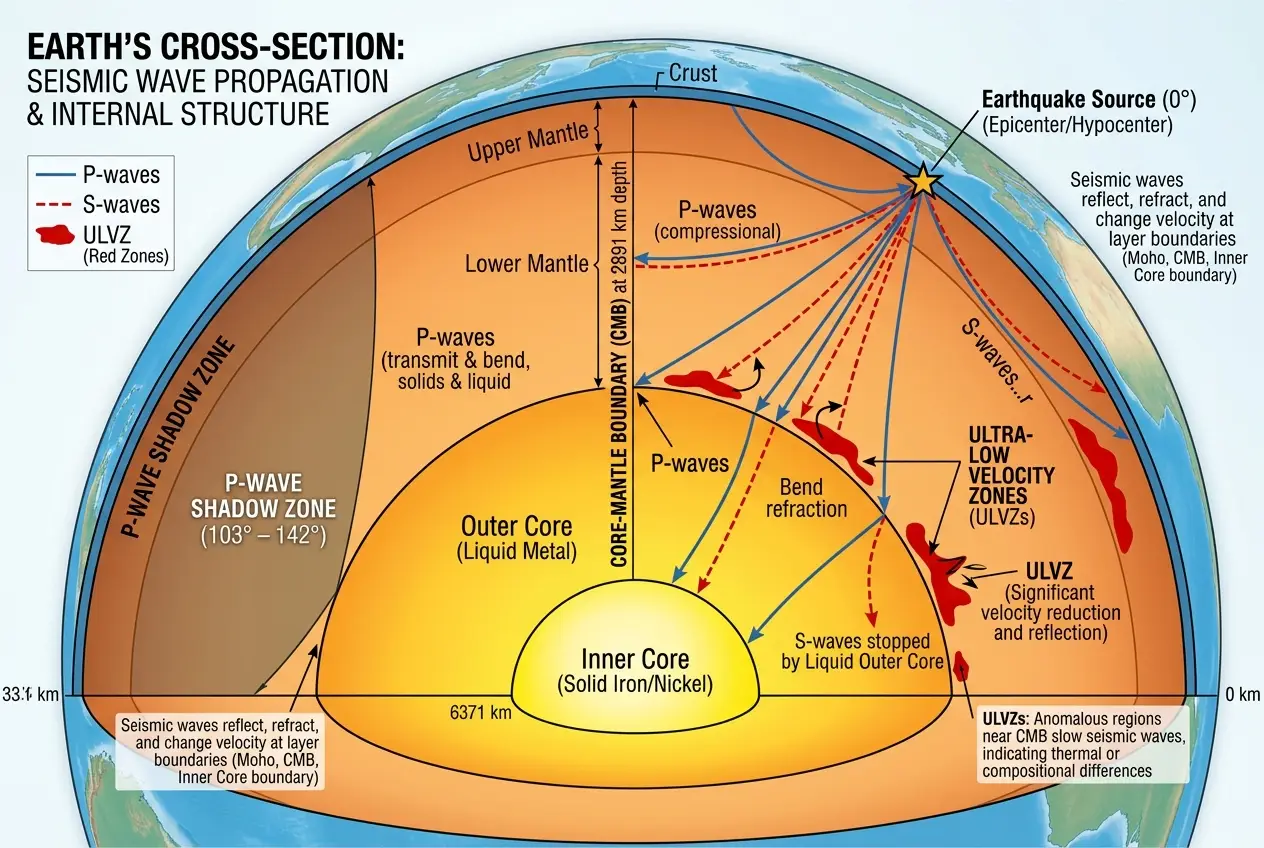
Our understanding of Earth's core is largely a feat of indirect detection. Seismic waves, generated by earthquakes, act as cosmic sonars, bouncing and refracting through the planet's layers to reveal its hidden structure. What they tell us is remarkable: a liquid outer core, primarily iron and nickel, churning violently, and a solid inner core, a sphere of compressed iron, almost as hot as the surface of the Sun. This dynamic system, known as the geodynamo, is what generates Earth’s magnetic field, shielding us from harmful solar radiation and allowing life to thrive.
But for all this knowledge, the core remains profoundly mysterious. Its precise composition, the exact nature of its convection currents, and its long-term evolution are still subjects of intense scientific debate. What if, within this crucible, there are processes at play that generate detectable phenomena far more complex than simple heat transfer or magnetic field generation? What if the core isn't just reacting to the rest of the planet, but actively "communicating" in ways we haven’t fully understood? To learn more about what fuels this incredible engine, you might be interested in reading our previous blog: [What Fuels Earth's Core? Unpacking Our Living Planet](https://curiositydiaries.com/blogs/what-fuels-earths-core-unpacking-our-living-planet-4849).
## Unseen Messengers: Geoneutrinos from the Deep
One of the most concrete examples of our planet's interior sending out "signals" comes in the form of **geoneutrinos**. These elusive, subatomic particles are the byproducts of radioactive decay within Earth's mantle and crust. Unlike other forms of radiation, neutrinos interact very weakly with matter, meaning they can stream directly from the planet's interior, carrying information about its composition and the heat-generating processes within.
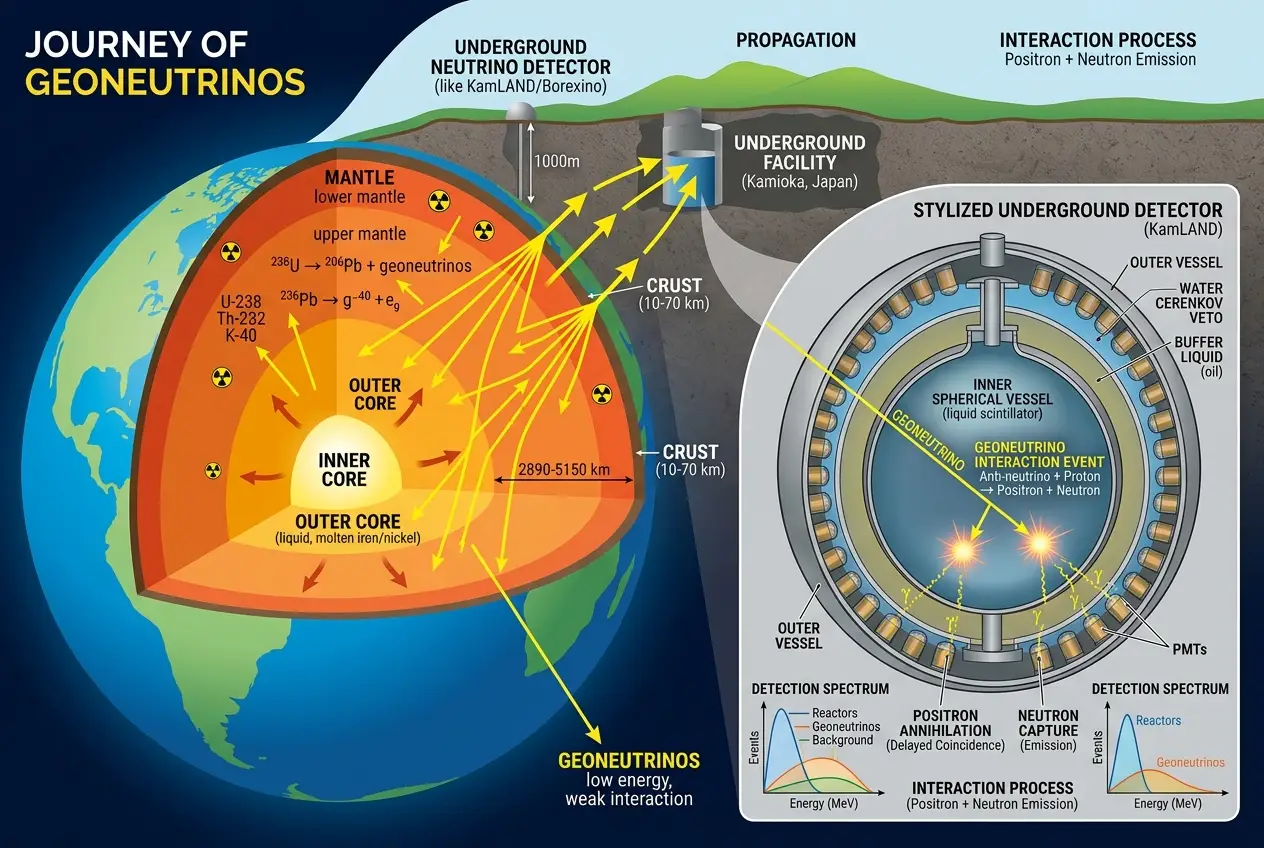
Detecting geoneutrinos is an immense challenge, requiring massive, shielded detectors deep underground to filter out cosmic rays. Experiments like KamLAND in Japan and Borexino in Italy have successfully measured these particles, providing direct evidence of radiogenic heat production deep within the Earth. The data collected from these "earth-listening" facilities is like receiving a faint but continuous broadcast from our planet's furnaces. It helps us understand the planet's thermal budget, giving scientists crucial insights into how much heat is generated by radioactive decay versus primordial heat left over from Earth's formation. Without these signals, our understanding of the planet's energy balance would be far less complete. For deeper insights into neutrinos, Wikipedia offers a comprehensive overview: [Neutrino on Wikipedia](https://en.wikipedia.org/wiki/Neutrino).
## Seismic Whispers and Deep Earth Anomalies
Beyond neutrinos, seismic waves offer another lens into the core's hidden life. While generally used to map static structures, subtle anomalies in how these waves travel through the deepest parts of the mantle and near the core-mantle boundary (CMB) suggest dynamic, perhaps even "communicative," processes.
Scientists have discovered Ultra-Low Velocity Zones (ULVZs) at the CMB, regions where seismic waves slow down significantly. These zones are thought to be areas of unusually hot, dense rock, possibly molten, hinting at material exchange between the core and mantle. Could these ULVZs be hotspots of activity, sending up plumes of material that influence processes higher up in the mantle and ultimately at the surface? Some theories even propose the existence of an "inner-inner core" or complex structures within the inner core itself, suggesting a more intricate internal structure than previously assumed. These findings imply a dynamic, almost living, system that constantly reshapes itself, with each seismic echo being a testament to its ongoing activity.
## The Grand Magnetic Dance: Core-Generated Signals
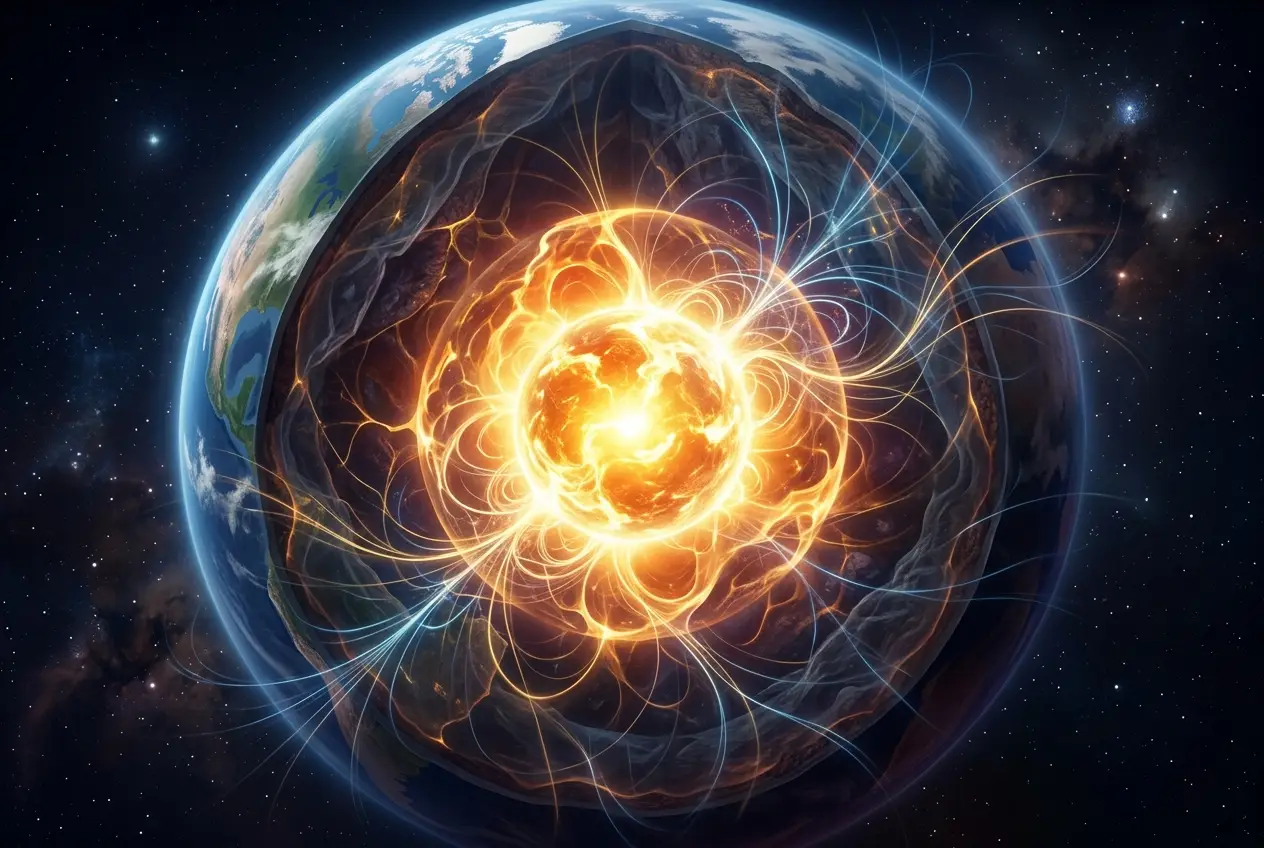
The most undeniable "signal" from Earth's core is its magnetic field. Powered by the churning liquid iron of the outer core, this geodynamo is not static. It constantly fluctuates, weakens, strengthens, and occasionally even reverses its polarity entirely—a phenomenon known as a **geomagnetic reversal**. These reversals, which have happened numerous times throughout Earth's history, aren't instantaneous events but rather gradual processes spanning thousands of years, during which the magnetic field weakens significantly, potentially exposing Earth to higher radiation levels.
Some researchers are now exploring if the core's activity might be tied to even broader geophysical phenomena. For instance, there's ongoing research into whether the core's rotation rate impacts Earth's overall rotation or length of day. Recently, I also learned about discussions on whether the inner core is slowing its rotation, which could have implications for the magnetic field. You can read more about this fascinating concept in our blog: [Is Earth's Core Slowing? A Cosmic Time Shift](https://curiositydiaries.com/blogs/is-earths-core-slowing-a-cosmic-time-shift-5994).
Could these colossal shifts in the geomagnetic field, driven by the core, be interpreted as a form of communication? A deep, planetary-scale rhythm that, if we could fully decode, might offer predictions about future geological events or even climate patterns? The very act of the magnetic field flipping could be seen as the core "resetting" itself, sending out a massive, planet-altering signal. Understanding these reversals is critical for predicting their impact on our technology and life itself. Wikipedia provides excellent details on this: [Geomagnetic Reversal on Wikipedia](https://en.wikipedia.org/wiki/Geomagnetic_reversal).
## Decoding the Core: Our Technological Quest
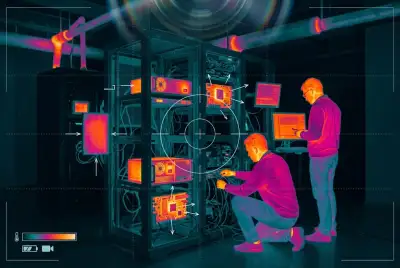
The quest to "listen" to Earth's core demands increasingly sophisticated technology. Beyond neutrino detectors and seismometers, scientists are exploring new frontiers:
* **Deep-Earth Boreholes:** While reaching the core is currently impossible, deeper drilling could allow us to study the mantle more directly and gather better data on heat flow and material composition closer to the CMB.
* **Advanced Seismic Networks:** Incorporating fiber optic cables for seismic sensing and deploying ocean-bottom seismometers can provide denser, higher-resolution data, allowing us to map the core's movements and anomalies with unprecedented clarity.
* **Gravitational Wave Detectors:** Though primarily designed for cosmic phenomena, future, more sensitive gravitational wave detectors *might* theoretically pick up subtle density changes or movements within Earth's core, offering an entirely new way to sense its dynamics.
* **Magnetotelluric Imaging:** This technique measures natural variations in Earth's electric and magnetic fields to image subsurface resistivity, offering insights into the composition and state of deep mantle and potentially even core boundary materials.
These technologies aim to transform our indirect observations into more direct "conversations" with our planet's hidden interior. The implications of truly understanding these signals are profound, from predicting seismic activity to refining our models of planetary evolution, and perhaps even unlocking new insights into Earth's habitability over geological timescales. For example, some theorize about the geomagnetism affecting memory – a curious idea explored in our blog: [Do Earth's Fields Hold Lost Memories? Decoding Geomagnetic Data](https://curiositydiaries.com/blogs/do-earths-fields-hold-lost-memories-decoding-geomagnetic-data-5093).
## The Enduring Mystery and Future Implications
The idea that Earth's core is sending signals we might be missing is both humbling and exhilarating. It reminds us that our planet is a complex, active entity with profound mysteries still locked within its depths. Whether these "signals" are purely physical phenomena like geoneutrinos and seismic echoes, or subtle, as-yet-undiscovered forms of energy or information, the pursuit of understanding them pushes the boundaries of science and technology.
Our planet’s core is far from a static, inert mass. It is a vibrant, dynamic engine of our world, constantly influencing everything from our compasses to the very air we breathe. As our tools become more sensitive and our theories more refined, I believe we will continue to decode more of its hidden messages, bringing us closer to understanding the true nature of our living planet. The question isn't whether the core is sending signals, but whether we're truly ready to listen.
Frequently Asked Questions
Geoneutrinos are subatomic particles produced by the radioactive decay of elements like uranium and thorium within Earth's mantle and crust. They are important because they are the only direct messengers from deep within our planet, providing crucial data on its internal composition and heat production, helping scientists understand Earth's thermal budget.
Scientists use indirect methods like seismology (studying how earthquake waves travel through Earth's layers) and massive underground neutrino detectors (like KamLAND and Borexino) to detect geoneutrinos. These techniques allow us to infer the core's structure, composition, and dynamic processes without direct access.
Yes, geomagnetic reversals are a significant 'signal' originating from the geodynamo in the Earth's outer core. These massive shifts, which occur over thousands of years, indicate profound changes in the core's dynamics and have significant implications for Earth's surface environment and technological infrastructure, reflecting a deep planetary rhythm.
The 'inner-inner core' is a hypothetical, even deeper region within the Earth's solid inner core, suggested by subtle seismic anomalies. Its potential existence implies a more complex layered structure and dynamic processes within the innermost part of our planet than previously thought, highlighting ongoing research into the core's intricate nature.
Future technologies include advanced seismic networks with fiber optic sensing, deeper boreholes to study the mantle more directly, magnetotelluric imaging for deep resistivity mapping, and potentially even highly sensitive gravitational wave detectors that could pick up subtle mass movements within the core. These innovations aim to provide more detailed insights into core activity.
Verified Expert
Alex Rivers
A professional researcher since age twelve, I delve into mysteries and ignite curiosity by presenting an array of compelling possibilities. I will heighten your curiosity, but by the end, you will possess profound knowledge.
Leave a Reply
Comments (0)
No approved comments yet. Be the first to share your thoughts!
 Join Us



 Unknown Author






























Leave a Reply
Comments (0)