


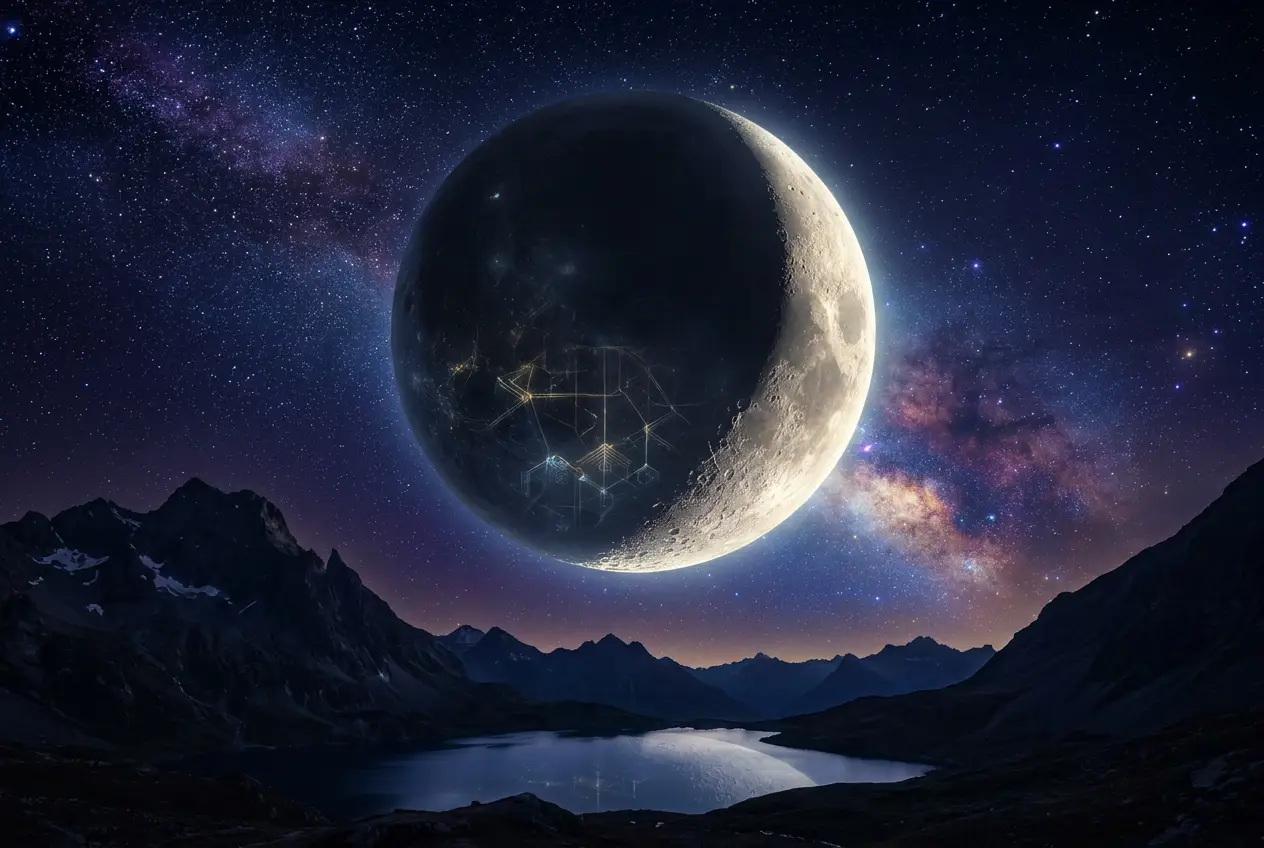
I remember staring up at the full moon as a child, its pockmarked face a canvas for countless stories. Was it made of cheese, as the nursery rhymes hinted? Or was it, as more adventurous tales suggested, a silent observer, perhaps even a forgotten outpost? As I grew older and delved deeper into science and space, the romantic notions gave way to scientific understanding—a barren, airless rock, scarred by billions of years of cosmic impacts. Yet, the Moon, our closest celestial neighbor, has always held onto an irresistible allure, a deep well of persistent questions that even our most advanced telescopes and lunar missions haven't fully quenched.
Recently, I’ve been fascinated by the persistent whispers and compelling photographic evidence that suggest there might be more to our Moon than meets the eye. These aren't wild conspiracy theories, but rather observations, sometimes fleeting, sometimes perplexing, that have fueled debates among scientists and enthusiasts alike: are some lunar anomalies merely optical illusions, or could they hint at something far more profound—perhaps even ancient, unexplained technology, or remnants of a civilization beyond our comprehension?
The Lure of Lunar Anomalies: A Historical Perspective
Humanity’s fascination with the Moon goes back millennia. Early astronomers, from Galileo with his crude telescope to more sophisticated observers of later centuries, meticulously mapped its surface, noting its mountains, craters, and vast plains. But alongside these recognized features, a peculiar set of observations began to emerge: Transient Lunar Phenomena (TLP). These are brief, localized changes in the Moon's appearance, such as flashes of light, glows, or changes in color. For centuries, these were dismissed as observational errors or atmospheric interference. However, as documented on Wikipedia, TLP have been reported by hundreds of independent observers and even captured on film, suggesting they are a real, albeit rare, phenomenon. What causes them? Most scientists attribute them to outgassing from the Moon's interior, seismic activity, or meteoroid impacts stirring up dust, but the exact mechanisms remain a subject of active research.
But beyond transient flashes, some observers have reported more enduring mysteries. Early lunar maps showed features that seemed to defy simple geological explanation. For instance, lunar domes, which are broad, low-relief shield volcanoes, were identified. While scientifically explained as specific types of volcanic activity (you can learn more about them on Wikipedia), their regular, often circular forms sometimes sparked discussions about whether they could be artificial, especially before high-resolution imaging confirmed their natural origins.
Unearthing the "Impossible": Geometric Structures and Photographic Puzzles
The Space Age brought unprecedented access to the Moon, first with probes, then with human landings. With every new image beamed back to Earth, new anomalies seemed to surface. Missions like the Lunar Orbiter and Apollo generated millions of photographs, and amateur researchers poring over these images began to point out features that appeared startlingly geometric or unnaturally arranged.
Consider the famous "Shard" and "Tower" anomalies. These are often cited as examples of structures that appear to jut out from the lunar surface with sharp, angular forms, unlike the expected smooth curves of natural formations. While scientists typically attribute these to tricks of light and shadow, combined with the low angle of the sun at the time the photographs were taken, the human eye often struggles to reconcile these images with purely natural explanations. Our brains are wired to find patterns, and sometimes, this leads to pareidolia, the psychological phenomenon of perceiving familiar patterns, like faces or shapes, in random stimuli. Wikipedia provides a fascinating insight into pareidolia and how it influences our perception.
Then there are claims of what some interpret as "cubes" or "monoliths" on the Moon, reminiscent of Arthur C. Clarke’s 2001: A Space Odyssey. These are typically isolated, rectangular-appearing objects captured in blurry or distant photographs. While compelling to the untrained eye, closer inspection with higher-resolution imagery (often from later missions) usually reveals them to be oddly shaped boulders or natural rock formations enhanced by photographic artifacts or extreme shadows.
The fascination with "anomalies" on celestial bodies isn't unique to the Moon. Just as we questioned the possibility of advanced ancient technologies on Earth, like those discussed in our blog on Could Ancient Temples Use Sound to Move Giant Stones?, the Moon presents its own set of "unexplained" architectural curiosities that often ignite the imagination.
The Scientific Lens: Debunking vs. Discovering
For every compelling "anomaly," there’s usually a robust scientific explanation. The primary tools for debunking many of these claims are:
- Lighting and Shadow: The angle of the sun on the lunar surface dramatically changes how features appear. A crater rim can look like a towering wall, and a low ridge can cast a long, dark shadow that mimics a geometric structure.
- Resolution and Perspective: Early lunar photography had limitations. What looks like a sharp "edge" in a low-resolution image often resolves into a jumble of rocks or a gentle slope when viewed with higher detail. The perspective of the camera also plays a crucial role.
- Geological Processes: The Moon has a complex geological history, including volcanism, impacts, and tectonic stresses (though less active than Earth). These processes can create surprisingly regular or unusual formations. For instance, some unusual linear features are simply fault lines or graben (collapsed valleys).
- Data Gaps and Imaging Artifacts: Sometimes, missing data in images, compression artifacts, or issues with the photographic equipment itself can create features that aren’t physically present on the Moon.
Dr. Sarah Russell, a planetary geologist, once put it eloquently: "The Moon is a canvas of natural forces, and while its beauty is often stark and simple, it also plays tricks on the eye. Our desire to find patterns, to find meaning, can sometimes lead us to see what isn't there, rather than appreciating the true, complex geology that is."
This isn't to say that all lunar mysteries are solved. The Moon still holds secrets. For example, the precise origin of the Moon itself is still debated among scientists, as is the full extent of its internal structure and seismic activity. The challenge lies in distinguishing between genuine scientific unknowns and interpretations driven by pattern recognition biases. When considering peculiar signals or observations, it's a bit like interpreting the "Cosmic Whisper" we discussed in our article about The Cosmic Whisper: Could The Wow Signal Be a Real Message From ET? – separating signal from noise is paramount.
Modern Exploration: The Age of Clarity
Today, missions like NASA's Lunar Reconnaissance Orbiter (LRO) provide unprecedented detail of the Moon's surface. LRO, detailed on Wikipedia, has been orbiting the Moon since 2009, capturing images at resolutions sharp enough to see objects as small as half a meter. Its data has allowed scientists to re-examine many of the historical "anomalies" with a clarity previously impossible. Most of the purported "structures" have been revealed to be natural features, albeit unusual ones, or simply optical illusions.
However, even with this deluge of data, the Moon continues to surprise us. The discovery of water ice in permanently shadowed craters, for instance, has revolutionized our understanding of lunar resources and potential future human missions. These are actual scientific discoveries that change our paradigms, rather than interpretations of ambiguous shapes.
The Enduring Mystery and Our Quest for Answers
So, are there unexplained technologies on the Moon? The overwhelming scientific consensus, backed by decades of data from multiple international missions, points to no. What we perceive as "anomalies" are almost invariably natural geological formations, tricks of light and shadow, or photographic artifacts.
Yet, the human drive to explore, to question, and to imagine is what propels us forward. The Moon remains a desolate, beautiful, and profoundly mysterious place. Its surface is a silent archive of cosmic history, and every new mission, every new data point, peels back another layer of its secrets. While we may not find ancient alien tech, we are finding evidence of incredible natural processes, valuable resources, and an environment that holds clues to the formation of our solar system.
The persistent curiosity about lunar anomalies serves as a testament to our innate desire to discover, to push the boundaries of what we know, and to look for signs of intelligence beyond our own, even if those signs are currently only in our imagination. Perhaps the true marvel isn't a hidden lunar structure, but the ingenuity of human technology that allows us to explore, photograph, and ultimately understand our silent, silvery companion.
Conclusion
Our Moon, though seemingly desolate, continues to captivate our imagination and scientific inquiry. While most so-called "anomalies" resolve into natural explanations under scrutiny, the very act of questioning and investigating them pushes the boundaries of our knowledge. The real thrill lies not in finding an alien base, but in the relentless pursuit of truth through scientific exploration, continually refining our understanding of the cosmos, one lunar crater at a time. This relentless quest for understanding the universe's most curious phenomena mirrors our journey to understand complex systems like Earth's own magnetic field, as discussed in Is Earth’s Magnetic Field Truly Flipping?. The universe constantly reminds us that the line between mystery and knowledge is perpetually shifting, and the Moon is no exception.
Conversation0
No comments yet. Be the first to share a thought — the best questions often become new stories.