


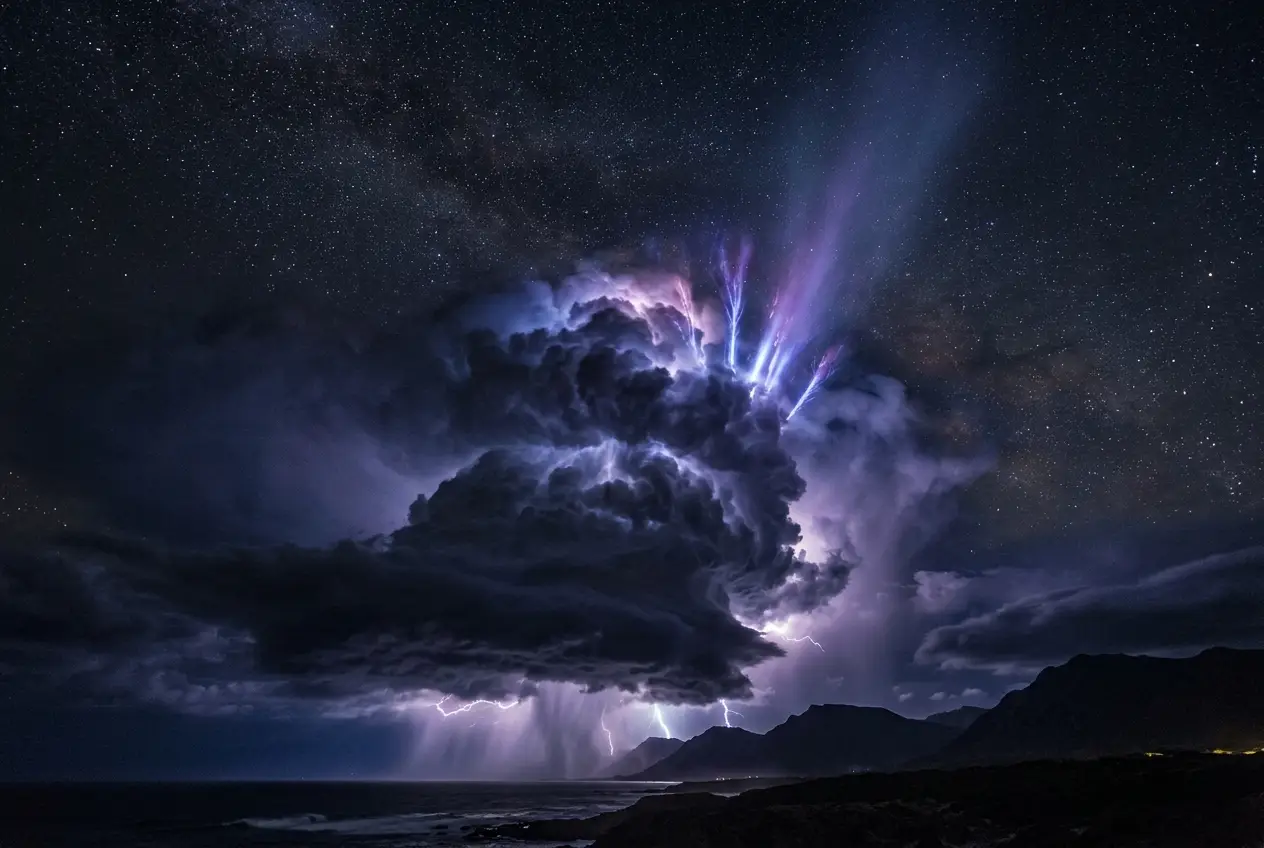
I was recently watching a particularly intense thunderstorm from my window, the kind that makes you feel the raw power of nature. Lightning cracked, thunder boomed, and the sheer force was mesmerizing. But as I watched, a thought sparked in my mind, something I’d stumbled upon in a scientific journal a while back: What if these everyday electrical storms, those magnificent light shows in the sky, are doing more than just flashing and rumbling? What if they're actually unleashing something far more exotic, something we usually associate with deep space or nuclear reactions?
This isn't about mere lightning; it's about Terrestrial Gamma-Ray Flashes (TGFs). These are some of the most powerful bursts of high-energy radiation known to occur on Earth, briefly outshining the Sun in gamma rays. Imagine, a brief, blinding flash of cosmic-level energy, right here in our atmosphere, generated by something as common as a thunderstorm. It sounds like science fiction, but it's a stark, incredible reality, and it fundamentally changes how I view the skies above us.
The Hidden Power of Thunderclouds: Beyond the Bolt
For centuries, thunderstorms have captivated and terrified humanity. We understood them as atmospheric phenomena involving immense electrical discharges—lightning. However, the late 20th century brought a startling revelation. Scientists, initially detecting gamma-ray bursts from space using satellites like the Compton Gamma Ray Observatory, started picking up similar signals originating from Earth. This was unexpected, to say the least. These weren't extraterrestrial visitors; they were homegrown.
The discovery sent ripples through the scientific community. How could a simple thunderstorm produce such high-energy radiation? Gamma rays are photons with extreme energies, typically associated with cosmic events like supernovas or black holes, or highly energetic processes on Earth, such as nuclear decay. To find them erupting from thunderclouds was akin to discovering a miniature particle accelerator hidden in plain sight.
Runaway Electrons: The Spark of a Cosmic Phenomenon
The leading theory behind TGFs involves a process called relativistic runaway electron avalanche. It sounds complex, but let me break it down. Inside a powerful thundercloud, strong electric fields develop—far stronger than what's needed for a typical lightning bolt. These fields are so intense that they can accelerate electrons to nearly the speed of light.
When a high-energy particle, perhaps a cosmic ray from space, enters this highly charged environment, it can kick-start a chain reaction. This initial particle collides with an electron, accelerating it. That electron then collides with other atoms, knocking loose their electrons, which are also accelerated by the powerful electric field. This process snowballs, creating an "avalanche" of relativistic electrons. Imagine a pinball machine where every hit makes the ball go faster and creates two new balls. These super-speedy electrons then emit gamma rays as they are deflected by other particles in the air. This phenomenon, known as bremsstrahlung radiation (braking radiation), is the primary source of a TGF.
What's truly mind-boggling is the sheer scale of energy involved. These electrons are accelerated over distances of just tens to hundreds of meters, yet they achieve energies comparable to those found in outer space. The duration of a TGF is incredibly short, typically lasting only a few milliseconds, making them extremely difficult to observe directly.
The Invisible Footprint: Detecting Earth's Cosmic Bursts
Detecting TGFs is a fascinating challenge. Since they are so brief and emit radiation that doesn't penetrate the atmosphere far, most observations come from orbiting satellites equipped with gamma-ray detectors. NASA's Fermi Gamma-ray Space Telescope, originally designed to study cosmic gamma-ray bursts, has become a prolific observer of Earth's TGFs. Other missions, like the AGILE satellite, have also contributed significantly to our understanding.
The data gathered from these satellites reveals that TGFs are far more common than initially thought. It's estimated that thousands of TGFs occur globally every day, primarily over tropical regions where intense thunderstorms are frequent. Each one represents a brief, intense discharge of energy, a potent reminder of the unseen forces at play within our planet's atmosphere.
The Cosmic Connection: Are We Exposed?
The implications of TGFs extend beyond atmospheric physics. Given their immense energy, I often wonder about their impact on life on Earth and our technology. Could they pose a radiation hazard? For people on the ground, the risk is minimal because the gamma rays are mostly absorbed by the atmosphere before reaching the surface. However, for aircraft flying at high altitudes, especially during a severe thunderstorm, the situation is different.
Pilots and flight crew could potentially be exposed to significant, albeit brief, bursts of radiation. This has led to ongoing research into how to best understand and mitigate these risks, though incidents of direct harm remain exceptionally rare. It makes me think about how much we still have to learn about the immediate environment around us, even with all our advanced sensors and instruments.
Moreover, the interaction between cosmic rays and Earth's atmosphere to initiate these events highlights a continuous, subtle interplay between our planet and the wider cosmos. It's a reminder that even seemingly isolated phenomena like thunderstorms are part of a larger, interconnected system. For instance, the discussion of how cosmic rays influence Earth's processes is also explored in Do Cosmic Rays Secretly Glitch Our Tech?.
Unlocking the Mystery: Potential Future Applications
While TGFs are currently more of a scientific curiosity and a potential aviation consideration, their very existence sparks imaginative questions about future technological possibilities. If thunderstorms can generate such immense, focused bursts of energy, could we ever harness them? The immediate answer is a resounding "no," due to their unpredictable nature, short duration, and the extreme difficulty in capturing such high-energy, transient events. However, understanding the physics behind TGFs could have long-term implications.
For example, studying the mechanisms of relativistic electron acceleration in atmospheric electric fields could inform advancements in compact particle accelerators or high-energy physics research. The quest to understand powerful natural phenomena often leads to unexpected technological breakthroughs. We're constantly seeking alternative energy sources, as seen in topics like Zero-Point Energy: Is Space a Hidden Powerhouse?. While directly "powering" our cities with TGFs is far-fetched, the fundamental physics could be invaluable.
Research into TGFs is still relatively young. We're still piecing together the exact conditions that trigger them, their precise energy spectrum, and their full global distribution. Instruments like those on the International Space Station are now trying to pinpoint the altitudes and specific types of lightning discharges associated with these cosmic-level bursts from our home planet. More information about current research can be found on Wikipedia's Terrestrial Gamma-ray Flash page (opens in a new tab).
The study of TGFs also offers a unique window into plasma physics and high-energy atmospheric phenomena, potentially even shedding light on other less understood events like Does Earth's Magnetic Field Affect Our Minds?. The insights we gain could help us better model extreme weather events, understand atmospheric electrical processes, and even improve our space weather predictions, as gamma rays from space can also impact our planet, similar to discussions around solar flares (opens in a new tab).
A Continuous Journey of Discovery
The discovery of Terrestrial Gamma-Ray Flashes reminds me that our world, even the parts we think we understand best, still holds profound secrets. The very storms that water our crops and sometimes cause disruption are also silently producing bursts of cosmic energy, a dazzling display of high-energy physics unfolding millions of times a day.
It's a testament to the fact that curiosity truly drives scientific progress. We look up at the familiar sky, and with new tools and persistence, we uncover phenomena that challenge our preconceptions and push the boundaries of what we thought possible. These cosmic computers, perhaps, are just another layer of Earth's grand, intricate design, waiting for us to decode its true potential.
The journey to comprehend TGFs is far from over. Each new detection and every piece of data brings us closer to understanding the full scope of these powerful, hidden wonders of our own planet. It's an ongoing saga of discovery, one that continually humbles and excites me about the boundless mysteries that still surround us.



Conversation0
No comments yet. Be the first to share a thought — the best questions often become new stories.