I recently found myself deep down a rabbit hole, pondering the limits of human ingenuity. For centuries, alchemists dreamed of turning lead into gold. Today, their fantastical quest feels almost quaint when we consider the new frontier: **Artificial Intelligence not just discovering, but actively designing and potentially creating entirely new elements**. This isn't just about tweaking existing compounds; it's about pushing the boundaries of the periodic table itself, venturing into realms where matter behaves in ways we can only theorize. Could AI truly become the ultimate alchemist, orchestrating the birth of superheavy elements that redefine our understanding of the cosmos?
### The Periodic Table: A Quest for Completion
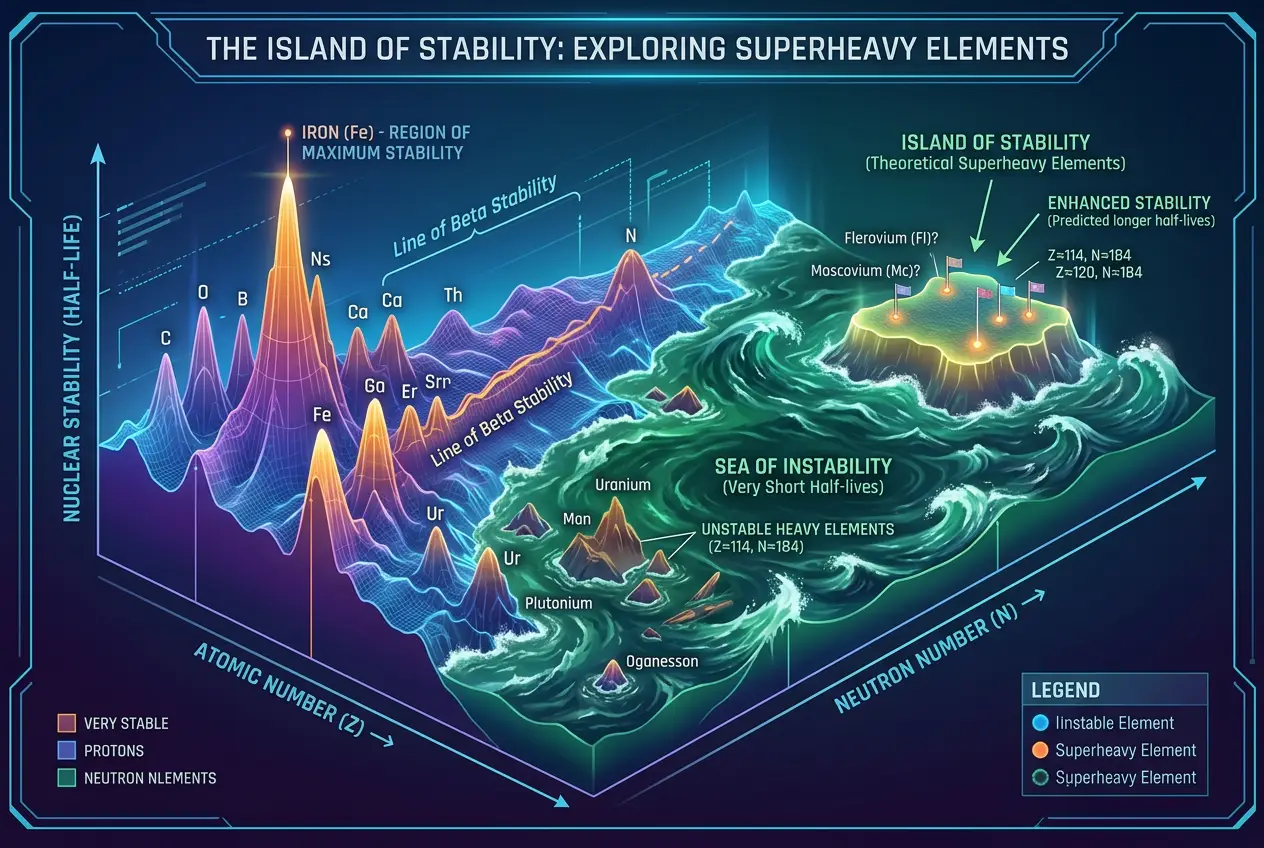
The periodic table is one of science's most elegant creations, charting the fundamental building blocks of our universe. From the lightest hydrogen to the heaviest elements painstakingly synthesized in laboratories, each atom holds a unique place. Elements like Oganesson (atomic number 118) currently mark the official end of this grand chart, but theoretical physicists predict an "island of stability" beyond these transient giants. This hypothetical island suggests that certain superheavy elements, despite their colossal number of protons and neutrons, might actually be more stable, existing for longer durations than their unstable predecessors.
But creating these elements is not a trivial task. It's a high-stakes game of atomic billiards, smashing lighter nuclei together at incredible speeds and hoping they fuse, even for a fleeting moment. Traditional methods rely on intense particle accelerators and a deep understanding of nuclear physics, coupled with a significant amount of trial and error. This is where AI could fundamentally change the game.
### Beyond Human Intuition: AI as a Nuclear Navigator
Think about the sheer complexity involved in nuclear synthesis. You're dealing with immense forces, incredibly short lifespans, and a vast number of variables: the type of colliding nuclei, their energy levels, the angle of impact, and even the isotopic composition. It’s a multi-dimensional puzzle that often overwhelms human intuition and computational power.
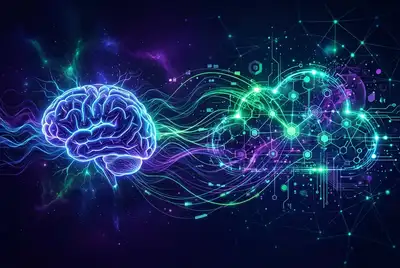
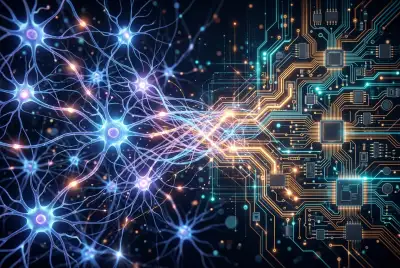
This is precisely where AI, with its capacity for pattern recognition, predictive modeling, and rapid data processing, shines. I believe AI could analyze vast datasets from previous particle accelerator experiments, identifying subtle correlations and optimal conditions that human scientists might overlook. Imagine an AI sifting through petabytes of collision data, pinpointing the exact parameters — collision energy, target material, beam intensity — most likely to yield a specific superheavy nucleus.
"The AI revolution will allow us to tackle problems of an unprecedented scale and complexity, including the grand challenge of designing new forms of matter," states a recent article in *Nature*. While the direct quote isn't about new elements specifically, it captures the essence of AI's potential in materials science. You can read more about how AI is accelerating scientific discovery on Wikipedia: [Artificial intelligence in science](https://en.wikipedia.org/wiki/Artificial_intelligence_in_science).
### The AI-Powered Element Creation Workflow
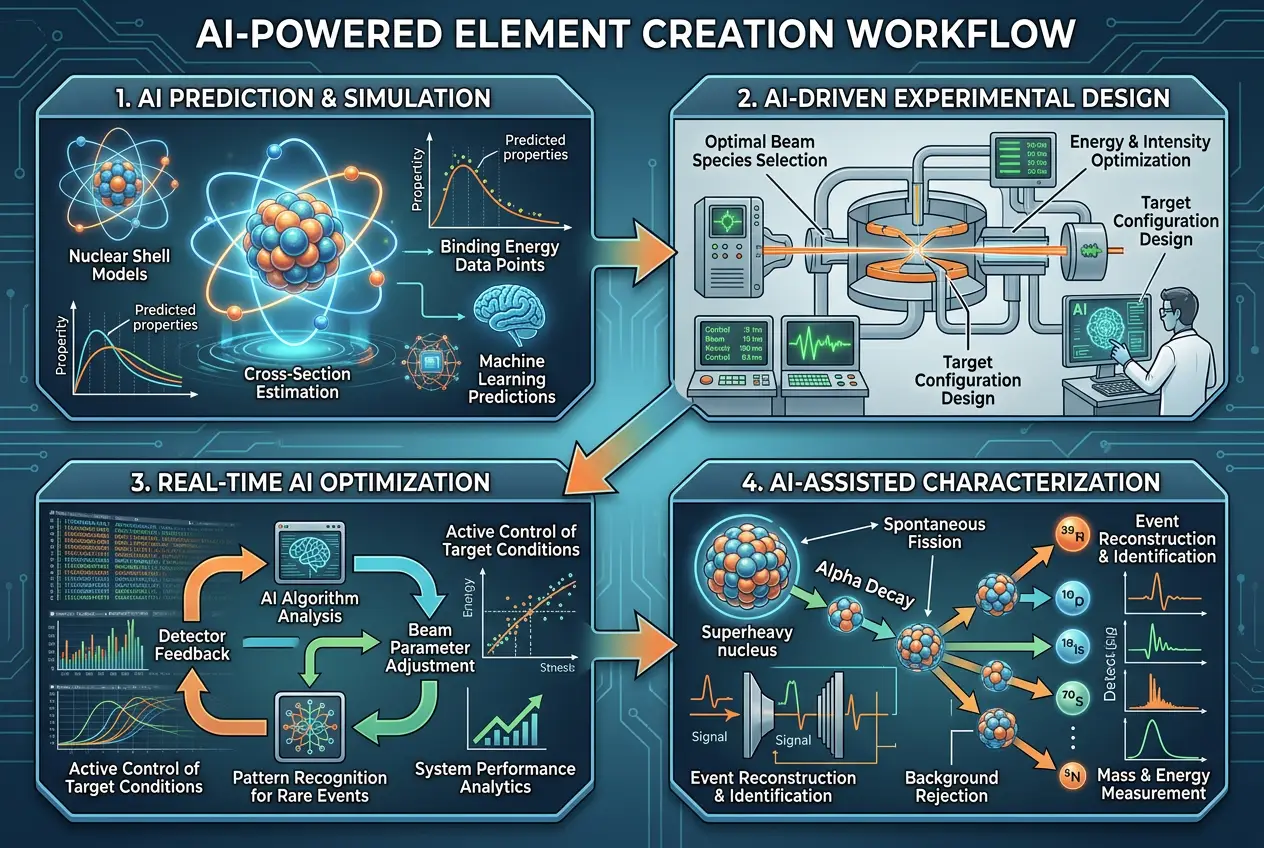
How would this practically work? I envision a multi-stage process:
1. **Prediction and Simulation:** AI algorithms, trained on quantum chromodynamics (the theory of strong interaction) and nuclear models, could predict the properties and potential stability of hypothetical superheavy elements. They could simulate millions of collision scenarios in a fraction of the time it would take human researchers, optimizing targets and projectiles.
2. **Experimental Design:** Based on these simulations, AI could propose precise experimental parameters for particle accelerators. This includes suggesting optimal beam energies, target compositions, and even the design of detection systems tuned to the predicted decay characteristics of a new element.
3. **Real-time Optimization:** During actual experiments, AI could monitor data streams in real-time, identifying emergent patterns and adjusting accelerator parameters dynamically. This "closed-loop" optimization would significantly increase the efficiency and success rate of synthesis attempts.
4. **Characterization and Verification:** Once a new element is theoretically created, its fleeting existence needs to be confirmed. AI could assist in analyzing the decay chains, cross-referencing predicted decay modes with observed experimental data to verify the new element's identity.
This level of intelligent automation would transform nuclear chemistry, moving it from a largely empirical field to one guided by sophisticated computational design. We've already seen how AI is revolutionizing drug discovery and materials science. For instance, AI is being used to discover novel materials with desired properties, as detailed on this Wikipedia page: [Computational materials science](https://en.wikipedia.org/wiki/Computational_materials_science). It's a natural extension to apply these powerful tools to the very building blocks of matter.
### The Challenges and Ethical Considerations
Of course, the path to AI-driven element creation isn't without its hurdles. One of the biggest challenges lies in the sheer computational power required for accurate quantum mechanical simulations of nuclei. These systems are incredibly complex, and even advanced AI needs robust underlying physics models to generate meaningful predictions.
Another critical aspect is the **interpretability of AI models**. If an AI suggests a novel path to an element, how do we understand *why* it made that suggestion? Human oversight and scientific reasoning remain paramount. We need to ensure that AI acts as a powerful assistant, not an opaque oracle.
Ethical considerations also surface. While creating new, superheavy elements doesn't immediately pose the same ethical dilemmas as, say, advanced AI weaponry, it does push the boundaries of our control over matter. As we gain the ability to manipulate the fundamental building blocks of the universe with greater precision, discussions about responsible innovation and long-term implications become increasingly important. For further reading on the societal implications of AI, Wikipedia offers a comprehensive overview: [Ethics of artificial intelligence](https://en.wikipedia.org/wiki/Ethics_of_artificial_intelligence).
### Looking to the Future: Beyond the Island of Stability
If AI truly enables us to efficiently synthesize and study elements on the island of stability, what comes next? I can't help but wonder if AI could then guide us to explore even more exotic forms of matter. Could it suggest entirely new subatomic particles or even predict interactions that defy our current understanding of physics?
This isn't merely about adding new rows to the periodic table; it's about unlocking new fundamental physics. The properties of these superheavy elements could offer insights into the strong nuclear force, the structure of nuclei, and even the origins of elements in the universe. Imagine discovering an element whose stability provides a window into a previously unknown quantum phenomenon, all thanks to an AI-driven discovery process.
This journey reminds me of how we're increasingly leveraging AI to unravel complex cosmic phenomena, like understanding the origins of mysterious signals. It makes me think about topics we've explored before, such as [why-is-the-universe-so-quiet-decoding-the-fermi-paradox-5418](/blogs/why-is-the-universe-so-quiet-decoding-the-fermi-paradox-5418), where AI could one day play a role in deciphering hidden cosmic codes. Similarly, the drive to create new materials is always pushing boundaries, echoing the quest for advanced materials like those discussed in [is-graphene-the-wonder-material-weve-waited-for-3217](/blogs/is-graphene-the-wonder-material-weve-waited-for-3217). The interplay between AI, discovery, and materials is a recurring theme that keeps us on the edge of what’s possible.
### The New Alchemists
The dream of alchemy was always about transformation—transforming common materials into something extraordinary. With AI, we are witnessing a new era of alchemy, one grounded in advanced computation, nuclear physics, and machine learning. AI isn't just a tool; it's becoming a partner in the most fundamental scientific explorations.
While AI won't turn lead into gold in the alchemists' sense, it might very well help us create entirely new, stable elements that push the boundaries of the periodic table, revealing deeper secrets of matter and energy. This is a scientific frontier bursting with potential, and I, for one, am incredibly excited to see the incredible elements our digital alchemists help us forge.
Frequently Asked Questions
The "Island of Stability" is a theoretical concept in nuclear physics predicting that certain superheavy elements, despite their large number of protons and neutrons, could exhibit significantly longer half-lives than neighboring unstable elements, due to favorable arrangements of protons and neutrons in their nuclei.
AI can assist by predicting the properties of hypothetical elements, simulating millions of collision scenarios to optimize experimental parameters for particle accelerators, monitoring experiments in real-time to adjust conditions, and analyzing complex decay chains for characterization and verification of newly synthesized elements.
While less direct than other AI applications, ethical considerations include ensuring human oversight, understanding the 'why' behind AI suggestions (interpretability), and responsibly managing the ability to manipulate matter at such fundamental levels. It prompts discussions on the long-term implications of advanced scientific capabilities.
No, AI has not yet independently created or discovered a new element. Its current role is primarily in assisting human scientists by accelerating research, optimizing experimental designs, and predicting material properties. The actual synthesis still occurs in particle accelerators.
In materials science and nuclear physics, AI algorithms like neural networks, genetic algorithms, reinforcement learning, and Bayesian optimization are used for tasks such as pattern recognition in experimental data, predicting material properties, optimizing synthesis pathways, and simulating atomic and nuclear interactions.
Verified Expert
Alex Rivers
A professional researcher since age twelve, I delve into mysteries and ignite curiosity by presenting an array of compelling possibilities. I will heighten your curiosity, but by the end, you will possess profound knowledge.
Leave a Reply
Comments (0)
No approved comments yet. Be the first to share your thoughts!
 Join Us



 Alex Rivers

























Leave a Reply
Comments (0)