I recently found myself captivated by a documentary exploring the future of robotics. It wasn't the sleek, metallic automatons that caught my attention, but a nascent field hinting at something far more profound: **robots that can heal themselves**. Imagine a world where machines aren't just built and maintained, but *grow*, *adapt*, and *repair* their own damage, much like living organisms. It sounds like something straight out of science fiction, doesn't it? Yet, the convergence of biology and engineering is pushing us towards a future where "living robots" – or at least, robots with living properties – are not just a dream, but a tangible, albeit distant, reality.
This isn't about simply replacing broken parts; it's about systems designed to intrinsically sense damage and initiate a complex healing process, mimicking nature's elegance. From microscopic xenobots crafted from frog cells to advanced materials with self-healing polymers, the frontier of self-repairing robotics is exploding with possibilities.
The Genesis of Self-Repair: Learning from Life
Life itself is the ultimate master of self-repair. Our skin heals cuts, bones mend fractures, and our immune systems constantly battle invaders, regenerating cells and tissues. For centuries, engineers have grappled with the inherent fragility of machines. A tiny fracture in a critical component, a frayed wire, or a dented chassis can lead to catastrophic failure. The traditional approach involves robust design, preventative maintenance, and ultimately, replacement. But what if we could imbue our creations with the same resilience we find in nature?
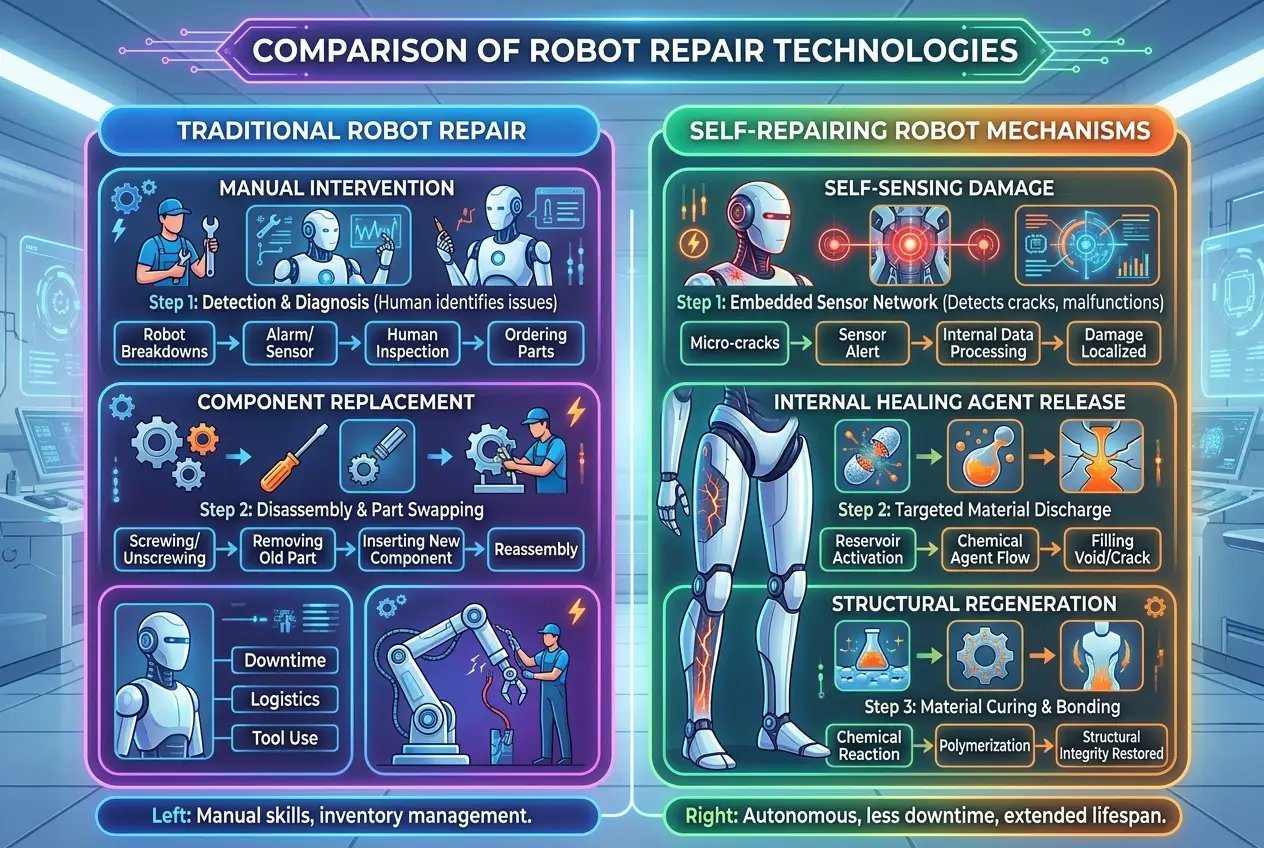
The concept of self-repairing systems isn't entirely new. Early attempts focused on materials that could "heal" micro-cracks using embedded capsules of healing agents. Think of a tiny blood clot forming in a material. While effective for passive damage, these solutions often lacked the dynamic, adaptive nature of biological repair. The real leap comes when we start integrating biological principles and even *living components* into robotic design.
Xenobots: The First Glimpse of 'Living' Robots
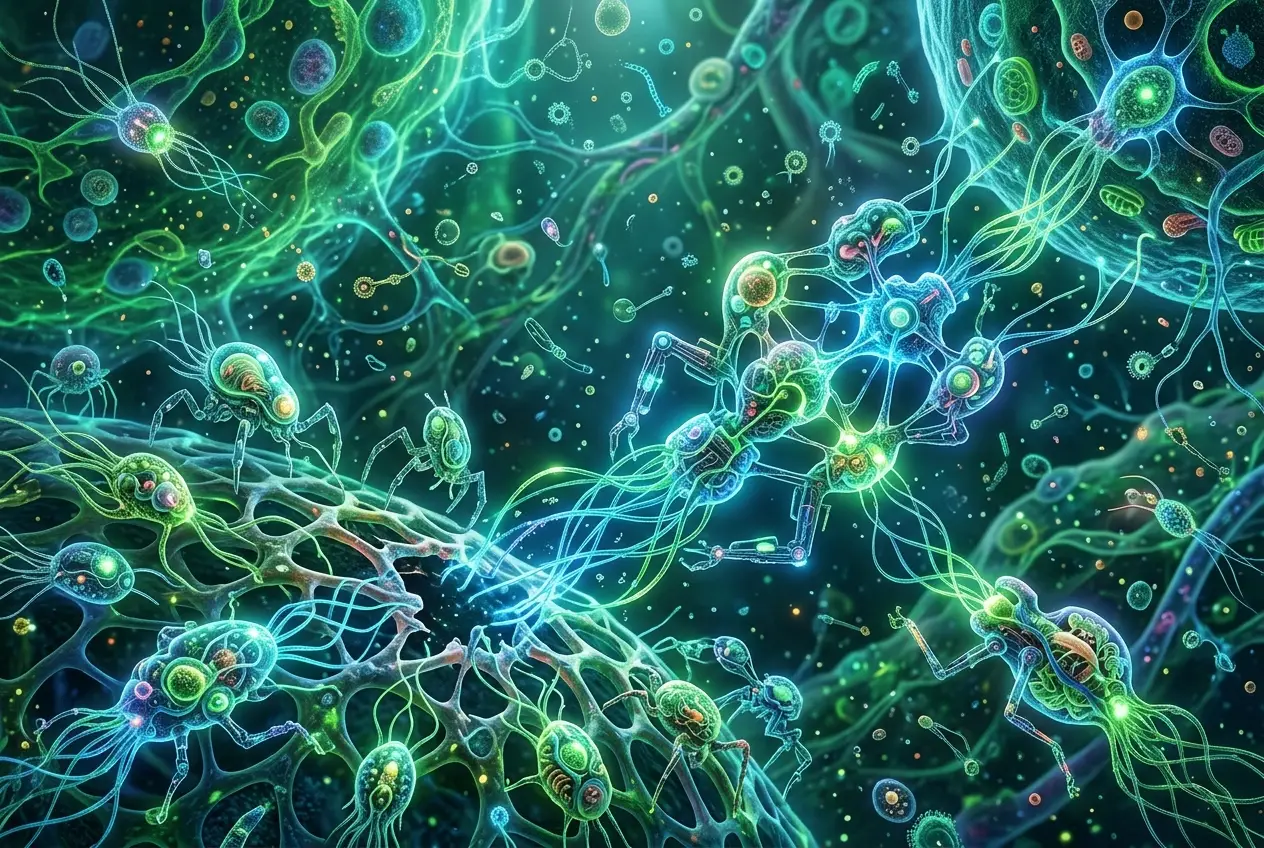
One of the most astonishing breakthroughs in this field arrived with the creation of **xenobots**. Developed by scientists at the University of Vermont and Tufts University, these aren't robots in the traditional sense. They are microscopic, programmable organisms assembled from the stem cells of African clawed frogs (Xenopus laevis) embryos. These tiny bio-machines, just a millimeter wide, can move, push payloads, and even self-assemble. Critically, when sliced, they can reform and continue their functions. This remarkable ability to self-repair is entirely biological, leveraging the inherent regenerative capacity of living cells.
I was genuinely astonished when I first learned about xenobots. They blur the lines between robot and organism, raising profound questions about what constitutes "life" and how we define "machine." As Professor Josh Bongard, one of the co-creators, noted, "These are novel living machines. They’re neither a traditional robot nor a known species of animal. It’s a new class of artifact: a programmable organism." You can read more about their fascinating discovery on
Wikipedia's Xenobot page.
Their potential is vast, ranging from targeted drug delivery within the human body to microplastic collection in oceans. However, their true significance lies in demonstrating that **biological building blocks can be engineered to perform robotic functions, including autonomous self-repair.**
Engineering Self-Healing Materials: The Foundation
Beyond purely biological constructs, significant strides are being made in engineering materials with intrinsic self-healing capabilities. These are crucial for more conventional robotics and infrastructure. Researchers are exploring several avenues:
* **Polymer-based Self-Healing:** Polymers (plastics) can be engineered with microcapsules containing healing agents. When a crack forms, the capsules rupture, releasing the agent which then polymerizes, effectively 'gluing' the crack shut.
* **Vascular Networks:** Inspired by biological circulatory systems, some materials incorporate intricate networks of microchannels filled with repair fluids. Damage to the material ruptures these channels, releasing the healing agent precisely where it's needed.
* **Reversible Bonds:** Certain materials can form and break chemical bonds reversibly. When damaged, applying external stimuli like heat or light can trigger these bonds to reform, repairing the material.
The progress in materials science is foundational. Imagine a drone wing that seals itself after a bird strike, or a bridge that automatically mends hairline fractures, preventing catastrophic failure. This isn't just about longevity; it's about resilience and reducing the need for constant human intervention, a key aspect of advanced autonomy. If you're curious about the general field of self-healing materials,
Wikipedia has a comprehensive overview.
| Self-Repairing Mechanism | Biological Inspiration | Robotic Application Potential | Current Challenges |
| :----------------------- | :--------------------------- | :-------------------------------------------------------------------- | :--------------------------------------------------- |
| **Xenobots** | Cellular regeneration | Drug delivery, toxic waste removal, bio-sensors | Scalability, programmability, ethical considerations |
| **Self-Healing Polymers**| Blood clotting, scar tissue | Drone components, flexible electronics, protective coatings | Limited repair cycles, agent storage, environmental factors |
| **Vascular Networks** | Circulatory system | Structural integrity for large robots, aerospace components | Complex fabrication, clogging, precise damage sensing |
| **Reversible Bonds** | Molecular self-assembly | Soft robotics, adaptable skins, reusable components | Energy input for repair, bond strength, multi-material integration |
The Role of AI and Advanced Sensing
True self-repair goes beyond material chemistry; it requires intelligence. This is where AI and advanced sensing come into play. A robot needs to:
1. **Sense Damage:** Identify the location and extent of damage. This could involve embedded sensors (strain gauges, thermal sensors, optical fibers) that detect anomalies.
2. **Diagnose:** Understand the nature of the damage and its potential impact on function.
3. **Plan Repair:** Determine the most effective repair strategy, drawing from a library of available healing mechanisms.
4. **Execute Repair:** Activate the appropriate self-healing process.
5. **Verify Repair:** Confirm that the repair was successful and functional integrity is restored.
I can envision a scenario where a robot equipped with a sophisticated AI system constantly monitors its structural integrity. If a micro-fracture is detected in a limb, the AI not only triggers the release of a healing polymer but also adjusts the robot's gait to minimize stress on the damaged area during the healing process. This kind of adaptive, intelligent repair is a significant step towards truly autonomous and resilient machines. This integration of AI and physical resilience also echoes some discussions we've had before about robots feeling phantom limbs, as seen in our blog on
Digital Anomalies: Can Computers Show Unexplained Behaviors?.
Soft Robotics and Bio-Inspired Design
The rise of **soft robotics** is particularly relevant to self-repair. Unlike rigid, metallic robots, soft robots are made from compliant materials, often silicones or hydrogels. Their inherent flexibility makes them less prone to catastrophic failure from impacts. When these soft materials are combined with self-healing properties, they unlock new levels of durability and adaptability.
Consider a soft robot designed to explore extreme environments or interact safely with humans. If it gets punctured or torn, its soft, self-healing skin could seal the wound, preventing fluid leakage or contamination. This biomimicry – taking inspiration from biological forms and functions – is a powerful design philosophy. From octopus arms to insect exoskeletons, nature offers countless blueprints for resilient and adaptive structures.
The Ethical and Philosophical Implications
As we venture deeper into this bio-tech future, several ethical and philosophical questions arise. If robots can heal themselves, adapt, and even reproduce (as seen with xenobots creating "baby" xenobots), how do we define their status? Are they merely advanced tools, or do they warrant a different classification?
The idea of programmable organisms also touches on the concept of life itself. Where do we draw the line? I believe these questions, while complex, are crucial to consider as the technology advances. We must ensure that our pursuit of technological marvels is balanced with careful ethical consideration, especially when we start blurring the boundaries between the living and the mechanical. For further reading on the ethics of AI and advanced robotics, I recommend exploring
Wikipedia's page on the Ethics of Artificial Intelligence.
The Road Ahead: Challenges and Opportunities
Despite the exciting progress, significant challenges remain. Scaling up self-repairing mechanisms for large, complex robots is difficult. The efficiency and speed of repair need to improve dramatically. Integrating diverse self-healing materials with advanced sensing and AI into a cohesive, functional system is a monumental engineering feat.
However, the opportunities are immense. Self-repairing robots could revolutionize:
* **Space Exploration:** Robots could autonomously repair damage from micrometeoroids or harsh radiation, vastly extending mission durations. We've often discussed advanced space tech, even wondering if
our solar system is hiding alien tech relics.
* **Deep-Sea Exploration:** Submersibles could mend hull breaches or system failures in inaccessible environments.
* **Disaster Response:** Robots could operate longer in hazardous conditions, repairing themselves as they navigate debris or radiation zones.
* **Manufacturing:** Machines could reduce downtime by self-diagnosing and repairing minor wear and tear.
I am optimistic that the fusion of biology, materials science, and AI will lead to a new generation of robots that are not just smart, but also remarkably resilient. The future of robotics isn't just about building faster or stronger machines; it's about building machines that can endure, adapt, and ultimately, live on their own terms. It’s a bold step into a future where our creations possess a touch of life’s own magic.
 Join Us



 Unknown Author
































Leave a Reply
Comments (0)