


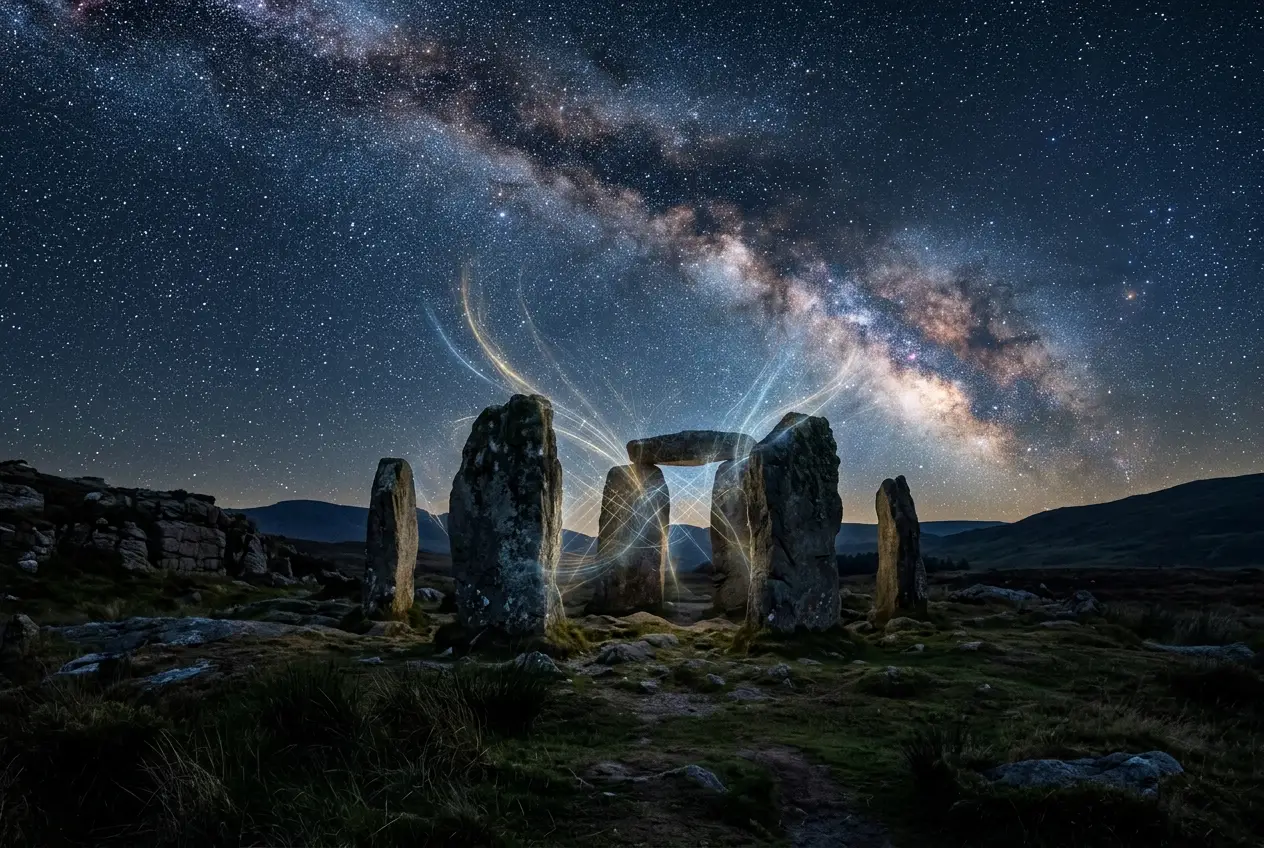
I remember a moment, years ago, standing before a vast, ancient stone circle. The air was still, but I felt a curious hum, a subtle vibration that seemed to emanate from the very earth beneath my feet. It wasn't my imagination; the site was known for its unusual acoustics. That experience planted a seed of wonder in my mind: could certain stones, certain geological formations, act as silent archives, resonating with information from our planet's deep past, perhaps even its cosmic journey? This isn't just a romantic notion; it’s a question that bridges ancient mysteries with cutting-edge science, exploring the possibility that nature itself might be a vast, slow-motion data recorder.
We often think of computers as silicon chips and complex algorithms, but what if nature had its own rudimentary, organic equivalents, especially when it comes to sound and vibration? Across the globe, from the prehistoric caves of France to the ceremonial sites of the Americas, we find what are colloquially known as "singing stones" or "resonant rocks." These aren't just ordinary rocks; they possess an uncanny ability to produce musical notes, bell-like tones, or deep, sustained vibrations when struck or even when interacting with natural forces. Could these ancient, sonorous formations be more than mere geological curiosities? Could they be revealing something profound about Earth's journey through the cosmos, a "cosmic history" encoded in stone?
The Ancient World's Acoustic Wonders: Lithophones and Resonant Sites
Humanity has long been fascinated by the sounds emitted by certain stones. Archaeologists have uncovered lithophones (literally "stone sounds") – naturally occurring rocks or shaped stones that produce distinct pitches when struck – in countless ancient cultures. From the Vietnamese đá khánh to the Irish clochán at the Giant's Causeway, these instruments were not just musical novelties; they were often found in ceremonial contexts, suggesting a deeper, perhaps spiritual or informational significance.
Consider the megalithic structures of prehistoric Europe, like Stonehenge or Newgrange. While their astronomical alignments are well-documented, a lesser-known aspect is their acoustic properties. Research has shown that some of these sites exhibit extraordinary resonance, amplifying certain frequencies or directing sound in unexpected ways. For instance, studies at Maeshowe in Orkney, Scotland, revealed that its chamber resonates powerfully at human vocal frequencies, creating an immersive, almost otherworldly auditory experience. Could this have been an intentional design, a way to enhance rituals or to interact with natural energies? The ancients might have been keenly aware of how these structures resonated with Earth's frequencies, a topic we've explored previously in our blog on whether ancient structures resonated with Earth's frequencies.
The Science of Sound in Stone: Piezoelectricity and Geomagnetic Fields
To understand how singing stones might hold "cosmic history," we need to delve into the science of how rocks interact with energy. Two key phenomena come to mind:
Piezoelectricity: The Rock's Electrical Voice
Certain crystalline rocks, like quartz – abundant in many geological formations – exhibit piezoelectricity. This remarkable property means that when subjected to mechanical stress (like striking or pressure from tectonic shifts), they generate an electrical charge. Conversely, when an electrical field is applied, they deform. Think about it: our ancestors striking a resonant quartz-rich stone might not just have produced a sound; they could have generated a tiny electrical pulse.
What if natural stresses – say, the slow, immense pressures within the Earth's crust, or even the subtle vibrations from distant seismic events – cause these piezoelectric rocks to generate continuous, albeit minute, electrical signals? These signals could theoretically be modulated by external influences, acting as a form of natural data input. Imagine cosmic rays, solar flares, or even geomagnetic field fluctuations interacting with these stressed crystals, leaving an energetic imprint. While highly speculative, the idea of rocks generating electrical signals in response to various forces opens up fascinating possibilities for natural data storage or transmission. You can read more about piezoelectricity on its Wikipedia page (opens in a new tab).
Earth's Geomagnetic Field and Cosmic Radiation
Our planet is constantly bathed in a complex interplay of energies: the Earth's own geomagnetic field, solar winds, and cosmic radiation. It's not a stretch to imagine that these forces could influence the physical properties and resonant frequencies of geological formations over vast stretches of time.
Some researchers propose that resonant rock formations might act as natural "antennae" or "transducers," interacting with and even slightly modulating these energy fields. If the subtle energies from space (like cosmic rays or solar particle events) can cause molecular changes or vibrational shifts in these rocks, then perhaps these changes are recorded in their resonant properties. Think of it like a very, very slow hard drive, with cosmic events acting as write operations.
The "Cosmic Computer" Analogy: More Than Just Sound?
The idea of "singing stones" revealing "cosmic history" pushes the boundary beyond mere acoustics. It hints at a deeper, more sophisticated natural system. What if these formations aren't just making sounds, but are responding to and reflecting complex environmental and cosmic data?
Imagine:
- Geological Memory: The internal structure and composition of rocks change over geological timescales, influenced by pressure, heat, and chemical reactions. Could these changes, modulated by cosmic influences, affect their resonant frequencies in a way that encodes a history?
- Natural Filtering: Just as a computer processor filters and processes data, certain resonant cavities or geological arrangements might selectively amplify or dampen specific frequencies, effectively "filtering" the chaotic input from the environment and highlighting certain "data points."
- Vibrational Data Storage: If piezoelectric effects allow rocks to convert mechanical stress into electrical signals, could the reverse also be true on a sub-atomic level, where subtle electromagnetic fluctuations from cosmic sources are "imprinted" as persistent vibrational states within the crystalline lattice? This is a highly theoretical concept, yet the notion of natural objects storing information has been discussed, particularly regarding ancient crystals storing Earth's forgotten histories.
Ancient Interpretations and Modern Echoes
Ancient cultures, lacking our scientific instruments, likely interpreted these phenomena through a spiritual or mythical lens. The sounds emanating from stones might have been seen as voices of gods, ancestors, or the Earth itself – conduits to profound knowledge. Shamans and priests might have attuned themselves to these vibrations, using them as aids for divination or healing, believing they were communicating with the cosmos. This aligns with historical discussions on how ancients might have programmed reality using sound.
Today, our understanding of geology, acoustics, and quantum mechanics offers new frameworks. We know that vibrations can carry information, and that materials can respond to external energies in complex ways. Modern seismology uses sound waves to map Earth's interior, and technologies like acoustic resonance spectroscopy analyze materials at a micro-level. Could a convergence of these fields allow us to "decode" the subtle messages within singing stones?
The Hunt for Geomagnetic Reversals in Stone
One concrete example of rocks recording Earth's history is paleomagnetism. Certain igneous and sedimentary rocks contain magnetic minerals that align themselves with Earth's magnetic field at the time of their formation. By studying these alignments, scientists can reconstruct the history of Earth's magnetic field, including its periodic reversals. This is a powerful record, and it shows that rocks do indeed store information about global phenomena, including those influenced by cosmic processes. Could other, more subtle cosmic data also be captured in ways we are only beginning to imagine? More on paleomagnetism can be found on its Wikipedia page (opens in a new tab).
Challenges and Future Possibilities
The biggest challenge in proving that singing stones reveal "cosmic history" lies in isolating and interpreting the "data." How would cosmic events translate into specific vibrational signatures? How could we differentiate between geological noise and a true cosmic imprint?
However, future advancements in acousto-optics, quantum sensing, and advanced material analysis might provide the tools. Imagine sensors capable of detecting infinitesimally small changes in resonant frequencies or crystalline structures. We could potentially develop methodologies to analyze a stone's acoustic output not just for its immediate sound, but for its subtle modulations, its "overtones" that might be whispers from the past.
Conclusion: The Earth's Deep Resonances
The idea that singing stones might hold a vibrational record of Earth's cosmic history is certainly on the frontier of speculative science. Yet, it's rooted in verifiable phenomena like piezoelectricity, acoustic resonance, and the ability of rocks to record geological and geomagnetic changes. It compels us to look at the world around us with renewed curiosity, to listen not just to what we hear, but to what the Earth itself might be whispering through its deep, ancient resonances.
Perhaps the ancients, with their profound connection to nature and keen observational skills, intuitively sensed these hidden properties. They didn't have silicon chips, but they had an intimate understanding of their environment, perhaps perceiving Earth's own slow, geological "computer" processing the endless inputs from the universe. Unlocking these secrets might not only reveal forgotten cosmic events but also deepen our appreciation for the extraordinary complexity and mystery of our own planet. The quest continues to decipher these silent, stony echoes of time.




Conversation0
No comments yet. Be the first to share a thought — the best questions often become new stories.