


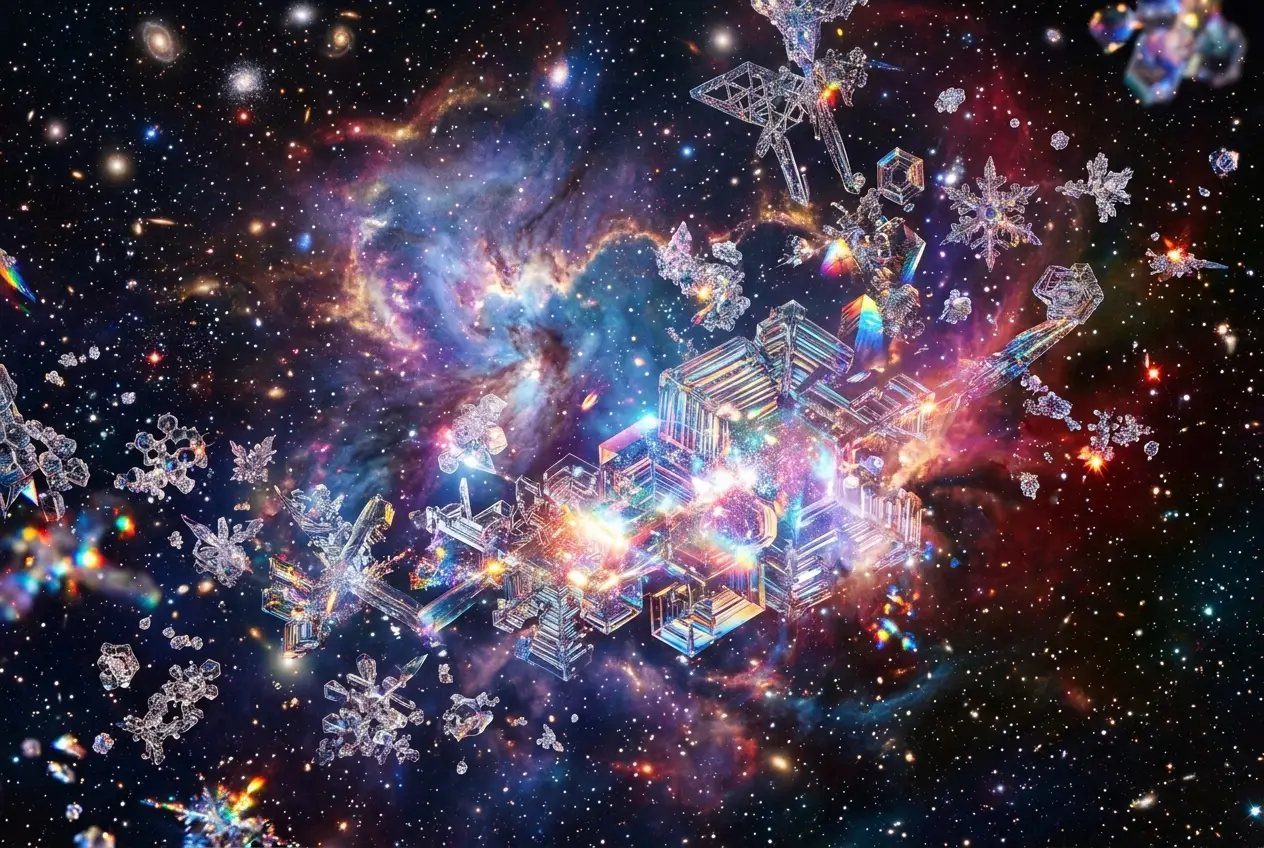
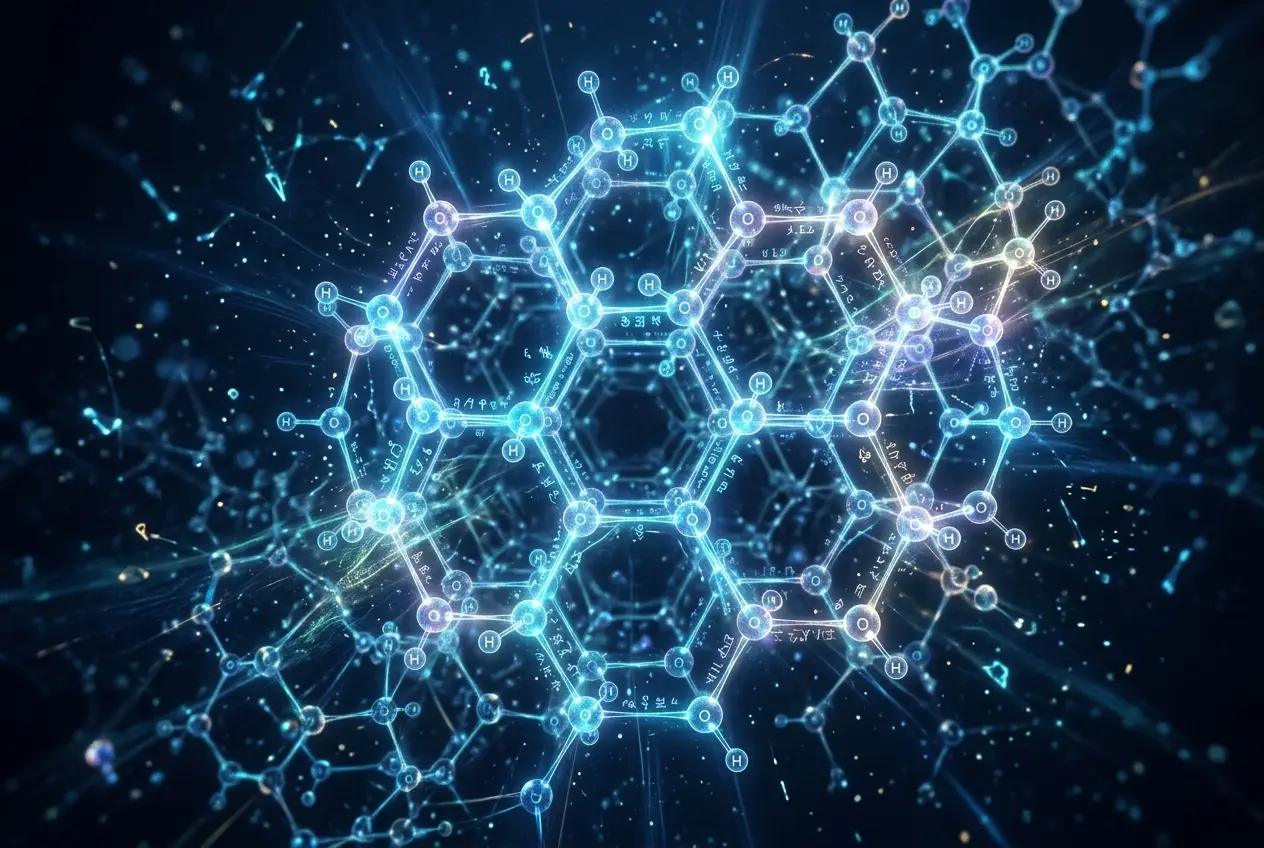
The universe, as I often reflect, is a boundless laboratory. Here on Earth, our geology, governed by familiar pressures, temperatures, and elemental compositions, creates a stunning array of minerals. We understand crystals as repeating patterns of atoms, strict symmetries that define their beauty and utility. But what if space, with its truly extreme conditions, forges structures that defy these fundamental rules? What if it creates "impossible" crystals, pushing the boundaries of what we thought was chemically and physically possible?
Recently, I was contemplating the vast, desolate stretches between stars – the nebulae, the protoplanetary disks, the hearts of dying suns. These are environments of unimaginable extremes: immense pressures, supercooled vacuums, intense radiation, and unique elemental mixtures we rarely encounter on our home planet. It struck me: these aren't just empty voids; they're crucibles for cosmic chemistry, potentially birthing structures that look less like diamond and more like something out of a science fiction novel.
Beyond the Periodic Grid: What Makes a Crystal 'Impossible'?
To understand an "impossible" crystal, we first need to grasp what a "possible" one is. For centuries, crystallography was built on the principle that crystals possess translational symmetry. This means their atomic structure repeats perfectly in three dimensions, like bricks in a wall. This leads to specific rotational symmetries – 2-fold, 3-fold, 4-fold, and 6-fold. You can rotate a cube by 90 degrees (4-fold) and it looks the same, or a hexagon by 60 degrees (6-fold).
However, in 1982, something remarkable happened: Dan Shechtman discovered quasicrystals. These materials exhibit rotational symmetries (like 5-fold) that were previously thought impossible for repeating crystal structures. Imagine trying to tile a floor with pentagons – they don't fit perfectly without gaps. Quasicrystals overcome this by having atomic structures that are ordered but not periodic. They fill space without repeating, like an intricate fractal pattern. This groundbreaking discovery earned Shechtman a Nobel Prize in Chemistry in 2011 and shattered a fundamental rule of crystallography. You can learn more about quasicrystals on Wikipedia: https://en.wikipedia.org/wiki/Quasicrystal (opens in a new tab).
If quasicrystals, once deemed impossible, can form, what other "impossible" structures might be lurking in the cosmos, waiting to be discovered?
Space: The Ultimate High-Pressure, Low-Temperature Forge
The conditions in space are radically different from Earth's crust. Consider the interior of a neutron star, where gravity crushes matter to densities exceeding that of an atomic nucleus. Or the ultra-cold vacuum of interstellar space, where temperatures plummet to near absolute zero. Such extremes can force atoms into configurations unimaginable on Earth.
1. Ultra-High Pressure Materials: Deep within super-Earths or gas giants, pressures are so immense they can alter the electron shells of atoms, forming exotic metallic states of elements that are insulators on Earth. Imagine metallic hydrogen, predicted to be a superconductor at room temperature. What if even stranger elements, like silicon or oxygen, adopt metallic phases under these cosmic pressures, forming crystals with radically different properties? Scientists use tools like the Diamond Anvil Cell on Earth to simulate these extreme pressures, pushing materials to their limits (see https://en.wikipedia.org/wiki/Diamond_anvil_cell (opens in a new tab)). But space offers far greater and more prolonged extremes.
2. Low-Temperature Quantum Crystals: In the near-absolute zero temperatures of deep space, quantum effects become dominant. We might see the formation of "quantum crystals" where atoms aren't just vibrating but are behaving like waves, their positions blurred by quantum mechanics. Could these conditions lead to super-hard, super-conducting, or even transparent metals that exist only in such frigid environments?
3. Radiation-Induced Structures: Stellar winds, cosmic rays, and intense X-ray bursts bombard matter in space. This radiation can knock atoms out of their lattices, creating defects, but in some cases, it could also provide the energy for unusual chemical bonds or drive the formation of entirely new crystalline arrangements that wouldn't otherwise be stable. I often wonder if some of the cosmic signals we detect, perhaps even those hinting at distant life or advanced civilizations, might be encoded within these uniquely formed crystals, much like digital memories on a hard drive. For more on cosmic data, check out our blog on how /blogs/do-exoplanets-hide-encoded-cosmic-histories-8164.
Evidence from the Stars: Meteorites and Stardust
We don't have to journey to distant stars to find hints of these cosmic crystals. Meteorites, fragments of asteroids and comets that fall to Earth, are our primary windows into extraterrestrial mineralogy. These space rocks often contain minerals that are rare or entirely absent on Earth, formed under conditions different from our planet's own. For example, some meteorites contain minerals with shock-induced structures, formed during high-velocity impacts in space. You can read more about meteorites on Wikipedia: https://en.wikipedia.org/wiki/Meteorite (opens in a new tab).
The very first naturally occurring quasicrystal was actually found in a meteorite, the Khatyrka meteorite, discovered in Russia. This extraterrestrial origin suggests that the conditions necessary for forming these "impossible" structures are more prevalent in the cosmos than we might assume. It opens up the possibility that other, even stranger, non-periodic or highly symmetrical crystalline phases could be common in interstellar dust clouds or within alien planetary bodies.
Pre-solar grains – tiny specks of stardust that predate our sun and are embedded in meteorites – also offer clues. These microscopic crystals formed in the atmospheres of ancient stars or in supernovae. They contain isotopic ratios and mineral phases that are distinct from anything found in our solar system, bearing the fingerprints of their alien stellar origins. This field of extraterrestrial materials is rich with discoveries, as documented on Wikipedia: https://en.wikipedia.org/wiki/Extraterrestrial_materials (opens in a new tab).
The Implications: From Materials Science to Cosmic Intelligence
The discovery of "impossible" crystals in space would have profound implications, resonating across various scientific and technological domains.
Revolutionizing Materials Science
If space can forge materials with novel symmetries or atomic arrangements, it could inspire a new era of materials science. Imagine engineering materials with extraordinary hardness, unprecedented electrical conductivity, or unique optical properties based on cosmic blueprints. Such materials could revolutionize everything from spacecraft shielding and advanced computing to energy storage. The fundamental properties of matter, like those explored in our article on /blogs/are-tiny-strings-the-universes-secret-code-1701, dictate how these structures form and behave.
Unlocking New Physics and Chemistry
The existence of entirely new crystal classes would challenge our current understanding of condensed matter physics and solid-state chemistry. It would force us to revise our models of atomic bonding and structural stability, expanding the periodic table of crystal structures, if you will. This could lead to a deeper comprehension of how matter behaves under extreme conditions, not just in space but potentially in unexplored regions of Earth's core.
Searching for Cosmic Life and Technology
From an astrobiological perspective, unique crystalline structures could serve as biosignatures or technosignatures. Could complex life forms evolve to utilize such "impossible" crystals in their biology, perhaps for enhanced sensory perception or energy generation? Or could advanced alien civilizations purposefully engineer such materials for technologies we can barely fathom? Thinking about how we perceive reality, I've often considered how unusual materials might affect perception, a topic touched upon in our article about /blogs/do-quantum-dots-see-other-dimensions-unpacking-hyper-vision-3853.
What if some anomalous phenomena we observe in space, like unusual light absorption or emission from distant objects, are not due to conventional astronomical processes but rather to the presence of vast structures made of these "impossible" crystals?
The Quest Continues: How Do We Find Them?
The hunt for these cosmic marvels is multifaceted. We continue to study meteorites and return samples from asteroids and comets, meticulously analyzing their compositions for anomalies. Telescopes equipped with advanced spectroscopes can probe the chemical makeup of exoplanets and interstellar clouds, looking for spectral signatures that don't match known terrestrial minerals.
Furthermore, laboratory simulations are crucial. By recreating the extreme pressures, temperatures, and radiation levels of space, scientists can attempt to synthesize these "impossible" crystals here on Earth, validating theoretical predictions and potentially discovering new materials in the process.
The universe, I believe, is far more creative than our current scientific models allow. The boundaries of physics and chemistry are constantly being expanded by new discoveries. The concept of "impossible" crystals forming in space is not just a fanciful notion; it's a testament to the endless possibilities that lie beyond our terrestrial understanding, urging us to keep observing, keep questioning, and keep exploring the ultimate cosmic laboratory.
Conclusion: A Universe of Unseen Wonders
The journey from thinking quasicrystals were impossible to finding them in meteorites is a powerful reminder of how much more there is to learn. Space is not just a void; it's a dynamic, extreme environment capable of forging matter into forms that challenge our very definitions of chemistry and structure. As we continue to gaze upward, both literally and metaphorically, I am confident that the cosmos will reveal even more profound secrets, pushing the boundaries of what we deem "possible" and inspiring the next generation of scientific discovery. The universe, in its infinite wisdom, holds countless wonders, and I, for one, can't wait to see what impossible crystals it reveals next.

Conversation0
No comments yet. Be the first to share a thought — the best questions often become new stories.