


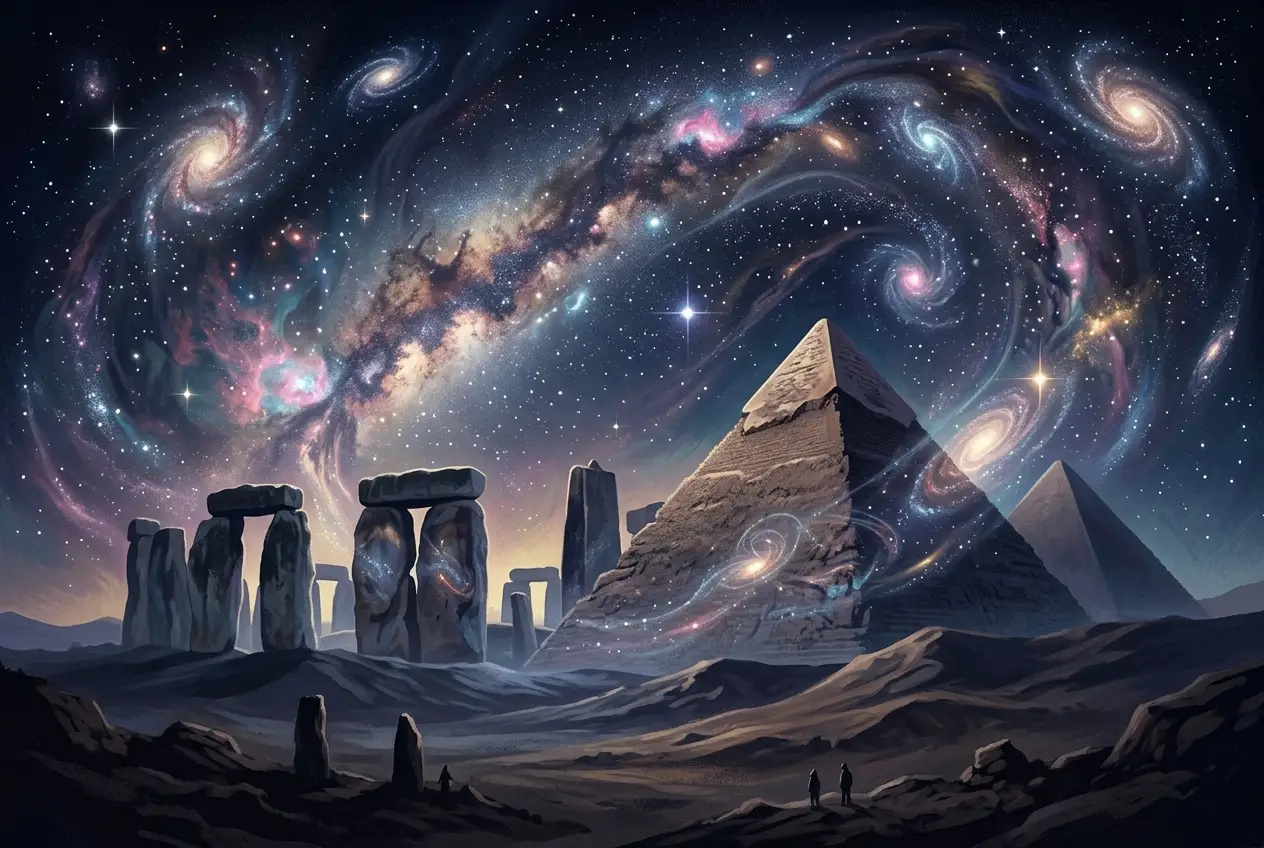
The night sky has always been humanity's oldest and grandest canvas. For millennia, our ancestors gazed upward, tracing constellations, charting the moon’s phases, and predicting eclipses. I often wonder what thoughts ran through their minds as they contemplated the twinkling pinpricks of light—were they merely celestial deities, or did they possess a deeper, almost unsettling understanding of the universe’s grand design, far beyond what we typically credit them with?
We marvel at the precision of the Antikythera Mechanism, a marvel of ancient Greek engineering that modeled celestial movements with astonishing accuracy. But what if their astronomical achievements weren't limited to our solar system? What if, buried in forgotten texts, obscured in megalithic alignments, or subtly encoded in their mythologies, lies evidence that ancient civilizations—without telescopes, without modern physics—somehow perceived structures as vast and distant as galaxies? It’s a bold thought, one that challenges our conventional timeline of scientific discovery, but the more I delve into the anomalies of ancient knowledge, the less impossible it seems.
The Conventional Narrative: A Universe Unveiled by Telescopes
For centuries, the prevailing scientific consensus has been that our understanding of galaxies began with Galileo's telescope in the early 17th century, revealing the true nature of the Milky Way, and later, Edwin Hubble's groundbreaking work in the 1920s, which confirmed the existence of galaxies beyond our own. Before these pivotal moments, the universe was largely perceived as a relatively small, star-filled sphere with Earth at its center, or at least, within a single star system.
This narrative holds immense truth, backed by empirical evidence. The telescope revolutionized astronomy, pulling back the veil on distant nebulae, many of which we now know to be independent galaxies. Yet, this linear progression leaves a lingering question: could there have been whispers, hints, or even intricate, albeit symbolic, representations of cosmic structures that predate this technological leap? Could some ancient minds, perhaps through prolonged observation, advanced mathematics, or even forms of consciousness we barely understand today, have glimpsed the unimaginable vastness beyond our immediate stellar neighborhood?
Unraveling the Clues: Beyond the Naked Eye
How could anyone map a galaxy without a telescope? This is the central paradox. Galaxies like Andromeda are faintly visible to the naked eye under extremely dark skies, appearing as a hazy smudge. While this smudge might have been noted, it hardly constitutes mapping. However, "mapping" in an ancient context might not mean a precise Cartesian coordinate system. It could mean recognizing patterns, understanding relationships, or even conceptually representing vast, spiral structures.
I've come across theories suggesting several avenues for potential "pre-telescopic" galactic awareness:
1. Advanced Naked-Eye Observation: Some ancient astronomers, particularly those in cultures with uninterrupted clear skies and generations of dedicated observation, might have developed an extraordinary acuity. Imagine observing the faint "cloud" of Andromeda year after year, noting its subtle movements or changes in appearance relative to foreground stars. This alone wouldn't map a galaxy, but it could certainly spark hypotheses about its nature as a distinct entity. For example, some historians argue that while not explicitly identified as a galaxy, cultures like the Persian astronomers or even earlier Mesopotamians meticulously charted the heavens, possibly noting these faint celestial "nebulosities" as objects of special interest. You can read more about early astronomy on Wikipedia's article on the history of astronomy (opens in a new tab).
2. Megalithic Alignments and Archaeoastronomy: Ancient structures like Stonehenge, Newgrange, or the Nazca Lines are well-known for their astronomical alignments, often marking solstices, equinoxes, or specific star risings. While most focus on our solar system, could some have been oriented towards broader cosmic patterns? I'm particularly fascinated by sites like the Caracol temple in Chichen Itza, whose windows align with certain celestial events. While this typically concerns planets or bright stars, the sheer scale and longevity of these observational sites suggest a profound dedication to understanding the cosmos. Could such long-term observational data, passed down through oral traditions or symbolic art, have accumulated insights into the Milky Way's broader shape or even the concept of other "island universes"? The depth of ancient astronomical knowledge is surprising; for instance, some ancient sites were believed to even process cosmic data, as explored in our blog: Did Ancient Sites Process Cosmic Data?
3. Symbolic Representations and Mythological Encoding: This is where the idea truly becomes intriguing. What if ancient "maps" weren't literal star charts but rather symbolic representations embedded in art, sacred geometry, or mythology? Many cultures have creation myths involving a cosmic egg, a swirling vortex, or a divine spindle. The Hindu concept of the "churning of the cosmic ocean" or some Aboriginal Australian "Dreamtime" stories describe structures that, when viewed through a modern lens, evoke spiral galaxies or vast cosmic webs. While speculative, the human mind's capacity for abstract thought, combined with deep observation, could have led to metaphorical insights that modern science later confirmed.
Consider the notion of the Cosmic Tree or World Axis found in many mythologies. This often depicts the universe as having a central column around which everything revolves, extending into infinite branches. While simplistic, it's a conceptual framework that could encompass an understanding of a larger, structured cosmos, perhaps even hinting at the galactic plane of the Milky Way. Our understanding of ancient cosmic interpretations is still evolving. Some theories even suggest that ancient cultures charted what we now call invisible stars: Did Ancient Cultures Chart Invisible Stars?
4. Esoteric Knowledge and Lost Technologies: This area borders on speculation, but it’s hard to ignore. What if certain elite groups or "mystery schools" in ancient civilizations possessed knowledge or even rudimentary technologies that allowed for enhanced perception of the heavens? The legend of lost civilizations, advanced in ways we can only guess, pops up repeatedly in human history. While mainstream archaeology often dismisses such claims, the persistent anomalies—like the Piri Reis Map, which seemingly depicts Antarctica before it was 'discovered' and without ice—keep the door ajar for the unexpected. Could this lost knowledge have included ways to "see" further into the cosmos, perhaps through optical devices lost to time or methods we no longer understand?
The Milky Way as a Blueprint:
If any galactic mapping occurred, it would most likely be of our own Milky Way galaxy. From Earth, we perceive the Milky Way as a hazy band of light across the night sky. But ancient astronomers would have noticed its structure – the central bulge, the disc, the dark rifts caused by dust clouds. Could their accumulated observations, perhaps using mathematical models derived from planetary motions, have allowed them to deduce its basic spiral shape?
The Vedas, ancient Indian scriptures, speak of celestial realms and cycles of cosmic creation and destruction. While not literal maps, some interpretations suggest an awareness of cyclical, large-scale cosmic processes that could conceptually align with the birth and death of stars within a galaxy. Similarly, ancient observatories, often viewed as cosmic clocks, played a crucial role in understanding celestial mechanics: Were Ancient Observatories Also Cosmic Clocks?. This dedication to understanding cosmic rhythm could have extended to larger structures.
Connecting the Dots: Modern Science Weighs In
Modern archaeoastronomy constantly uncovers new insights into our ancestors' astronomical prowess. While none have definitively proven galactic mapping, the sophistication of ancient skywatchers continues to impress. The ability of the Maya to predict eclipses and chart planetary cycles with incredible accuracy, or the calendrical systems of many cultures that tracked thousands of years, points to a civilization-wide dedication to astronomy.
If ancient cultures indeed had some conceptual understanding of galaxies, even without modern optics, it would force a fascinating re-evaluation of human intellectual history. It would suggest that the human mind, given enough time, focus, and perhaps an intuitive leap, can grasp concepts deemed impossible for its technological era. It reinforces the idea that knowledge isn't always a linear accumulation but can involve periods of extraordinary insight, sometimes lost to the sands of time.
Could it be that some of the ancient star maps, which we often interpret as local celestial charts, contain veiled references or symbols that hint at a broader, galactic understanding? Our blog on ancient star maps and cosmic events touches on this fascinating intersection of prediction and mapping: Did Ancient Star Maps Predict Cosmic Events?. The human quest to understand our place in the cosmos is an ancient one, and perhaps our ancestors ventured further than we ever imagined.
The Enduring Mystery
The question of whether ancient civilizations mapped galaxies remains an extraordinary "what if." While concrete evidence is elusive and the challenge of proving such a feat without direct records is immense, the possibility itself sparks my imagination. It forces us to confront our biases about what ancient people were capable of and opens up a universe of questions about lost knowledge and the true depth of human perception. Perhaps, as we continue to decode the symbolic language of our ancestors, we might yet uncover a cosmic chart that predates Galileo, etched not in glass, but in stone, myth, and the enduring human quest to understand the vast, swirling home we call the universe.



Conversation0
No comments yet. Be the first to share a thought — the best questions often become new stories.