The first time I saw it, I honestly couldn't believe my eyes. A crumpled paperclip, tossed aside and seemingly useless, suddenly straightened itself out with just a gentle warmth. It wasn't magic, nor some parlor trick. It was a demonstration of what we now call **Shape Memory Alloys (SMAs)**, or as I like to call them, "memory metals." Imagine a material that can remember its original form, no matter how much you bend, twist, or deform it, and snap back into place when triggered by something as simple as heat. It’s a concept that sounds straight out of science fiction, yet it’s a tangible reality, revolutionizing fields from medicine to aerospace.
For years, I've been fascinated by the hidden properties of materials, constantly asking myself if there's more to the inanimate world than meets the eye. These alloys suggest a profound capacity within matter itself – almost as if they store a form of information or a blueprint within their very atomic structure. This isn't just about a spring returning to its shape; it's about a complex transformation driven by a molecular memory, a phenomenon that challenges our everyday understanding of metal behavior.
### What Exactly Are Memory Metals?
At their core, memory metals are a class of alloys that can be deformed at one temperature and then return to their pre-deformed (parent) shape upon heating. The most famous example is **Nickel-Titanium (NiTi)**, often known by its trade name, Nitinol. This isn't your average metal; its unique properties stem from a reversible, solid-state phase transformation called a **martensitic transformation**.
Think of it like this: most metals have a rigid, unchanging crystalline structure at room temperature. SMAs, however, possess two stable crystal structures. At higher temperatures, they exist in a highly ordered, cubic phase called **austenite**. When cooled below a certain transition temperature, they transform into a more flexible, twinned monoclinic phase called **martensite**. It's in this martensitic phase that the magic happens. You can easily deform the material, causing these "twins" in its crystal lattice to reorient themselves. But crucially, the material hasn't lost its memory of the original austenitic shape.
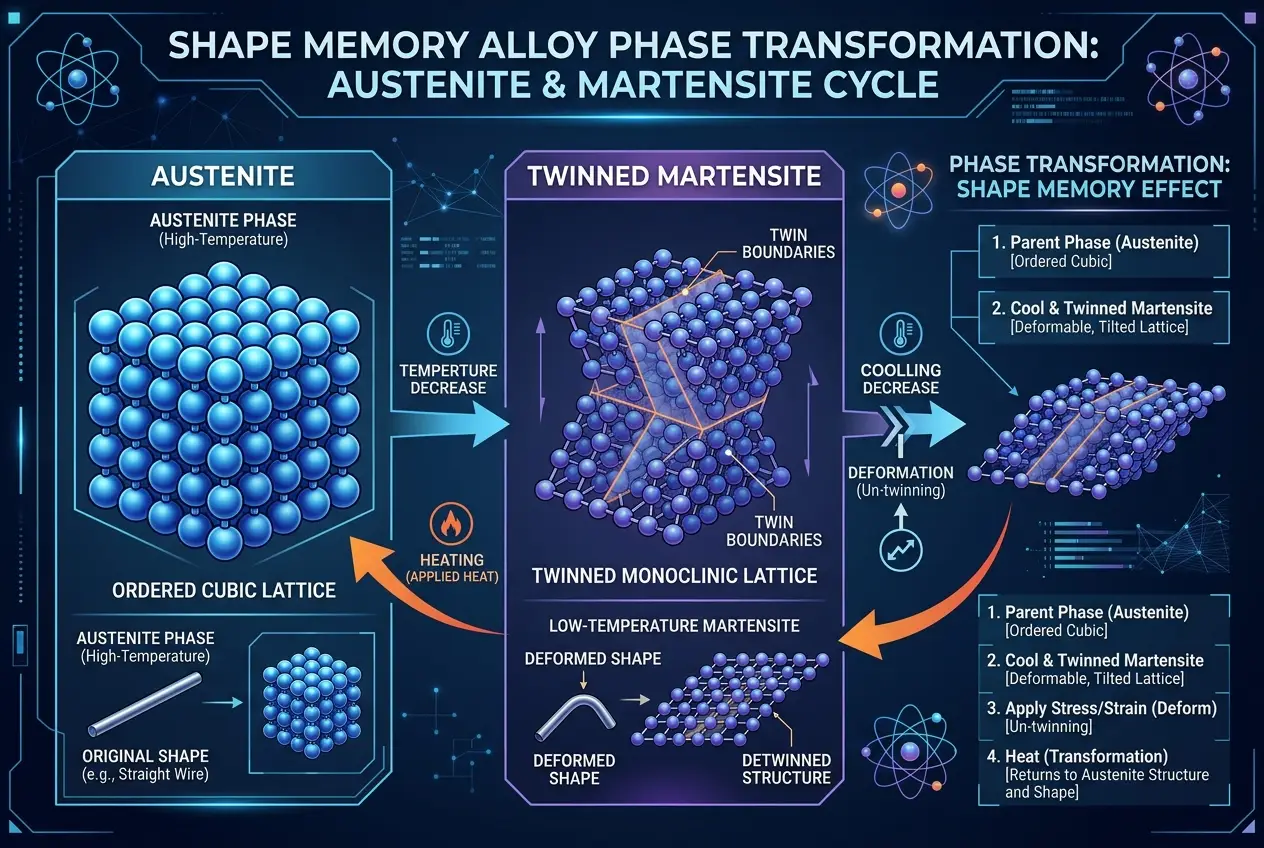
When you then heat the deformed martensite above its transformation temperature, it reverts back to the austenite phase, and in doing so, it “remembers” and recovers its original, programmed shape. This entire process is incredibly precise and repeatable, making these materials extraordinarily useful. It's not just a simple elastic recoil; it's a phase change that actively recovers a macroscopic shape, often exerting considerable force.
### A Brief History: From Discovery to Modern Wonders
The story of memory metals isn't new. The effect was first observed in gold-cadmium alloys in 1932 by Arne Ölander. However, it wasn't until the 1960s, with the discovery of NiTi at the Naval Ordnance Laboratory by William J. Buehler and Frederick Wang, that the full potential of these materials began to be understood. They were searching for new materials for aerospace applications and stumbled upon this remarkable property almost by accident. The name "Nitinol" itself is a blend of **Ni**ckel, **Ti**tanium, and **N**aval **O**rdnance **L**aboratory.
Initially, Nitinol was considered too expensive and difficult to process for widespread use. But persistent research and engineering breakthroughs have gradually brought it into the mainstream. Today, its applications are vast and often unseen, quietly working wonders in various high-tech fields. For those interested in the deeper scientific history of materials, Wikipedia offers a great overview of the [history of metallurgy](https://en.wikipedia.org/wiki/History_of_metallurgy).
### How Do Alloys "Store" Information?
The concept of "information storage" in materials isn't like storing data on a hard drive. Instead, it refers to the material's ability to retain a specific structural configuration as its default state. This isn't an active memory in the human sense, but rather a thermodynamic preference encoded in its crystal lattice.
When we talk about an alloy "remembering" its shape, we're delving into the intricate world of **crystallography** and **thermodynamics**. The "parent" shape is energetically favorable at higher temperatures (austenite phase). When cooled, the material enters the martensite phase, which can be easily deformed. However, the underlying atomic arrangement still holds the ghost of its original, more stable structure. Applying heat provides the necessary energy for the atoms to rearrange themselves back into that energetically preferred austenitic configuration, thereby restoring the macro-scale shape.
This isn't just limited to temperature. Researchers are now exploring **light-activated**, **magnetic-field-activated**, and even **electrically-activated** SMAs, opening up even more sophisticated ways for these materials to "remember" and perform tasks. It makes me wonder if ancient civilizations, perhaps through some unknown process, ever stumbled upon materials with similar, albeit simpler, self-actuating properties. We've explored some intriguing ideas about historical tech in our past blogs, like the possibility of [ancient architects using sound to move mountains](https://curiositydiaries.com/blogs/did-ancient-architects-use-sound-to-move-mountains-7101) or [the Roman Diodes](https://curiositydiaries.com/blogs/roman-diodes-did-ancient-artisans-craft-semiconductors-4128), but shape memory alloys add a different layer to the "smart materials" concept.
### Applications: Where Memory Metals Reshape Our World
The practical applications of memory metals are nothing short of transformative.
1. **Biomedical Devices:** This is where SMAs truly shine. Nitinol is biocompatible, corrosion-resistant, and can exert gentle, continuous force.
* **Stents:** Tiny Nitinol tubes can be compressed, inserted into arteries, and then expanded by body heat to hold vessels open.
* **Orthodontics:** Braces made of Nitinol wires provide constant, gentle pressure, reducing discomfort and speeding up treatment.
* **Surgical Tools:** Minimally invasive surgical instruments can be delivered in a compact form and then deploy inside the body. For more on how tech impacts health, you might enjoy our post on [nanobots repairing bodies from within](https://curiositydiaries.com/blogs/could-nanobots-repair-our-bodies-from-within-3681).
2. **Aerospace and Automotive:**
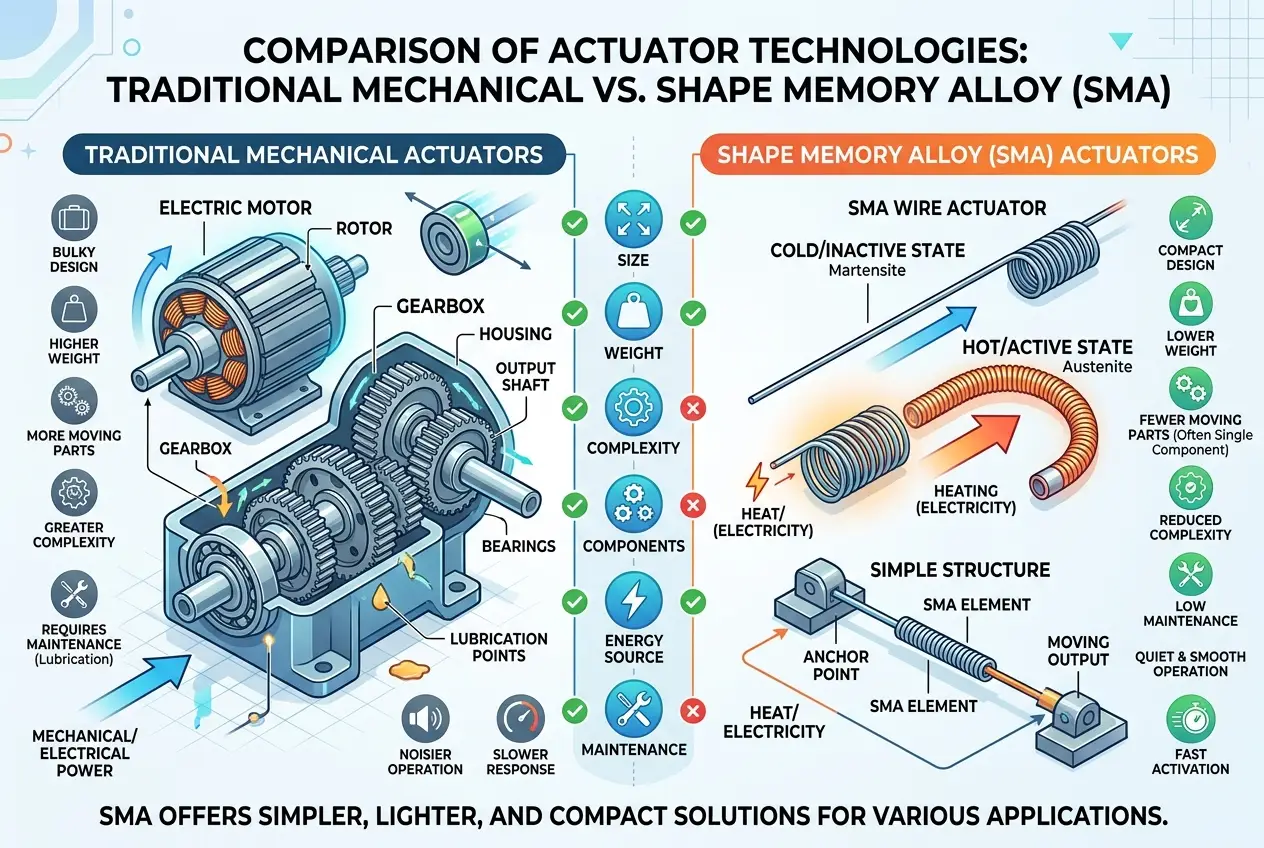
* **Actuators:** SMAs can replace heavier, more complex hydraulic or motor-driven systems for tasks like deploying solar panels on satellites or changing aerodynamic surfaces.
* **Adaptive Structures:** Wings that change shape in flight to optimize performance are no longer just a futuristic concept.
3. **Consumer Electronics:**
* **Smart Textiles:** Clothing that can adapt to temperature changes, becoming more breathable or insulating.
* **Phone Cameras:** Tiny Nitinol wires can be used for optical image stabilization or autofocus mechanisms.
4. **Robotics:**
* **Soft Robotics:** SMAs are crucial for creating robots that can change shape, grip delicate objects, or mimic biological movements, offering a stark contrast to rigid, traditional robots.
The versatility of these materials is astounding, indicating a future where our devices and even our infrastructure could become more adaptable and responsive.
### The Future: Beyond Simple Recall
The next frontier for memory metals involves moving beyond simple shape recovery. Researchers are exploring:
* **Multi-way Shape Memory Effect:** Materials that can remember not just one, but multiple shapes, transitioning between them based on temperature sequences.
* **Programmable Stiffness:** Alloys that can be soft and flexible at one moment and rigid the next, opening possibilities for adaptive protective gear or surgical tools.
* **Self-Healing Materials with Memory:** Imagine a component that not only repairs its cracks but also returns to its original form, merging two fascinating material properties. While similar to self-healing metals, this focuses on combining that with shape memory. Wikipedia details current [research on self-healing materials](https://en.wikipedia.org/wiki/Self-healing_material).
* **Hybrid Systems:** Combining SMAs with other smart materials like piezoelectrics or conductive polymers to create even more complex, responsive systems.
I believe these advancements hint at a future where materials are not just passive components but active participants in their environment, capable of sensing, adapting, and even performing tasks based on their intrinsic "memory." It pushes the boundaries of engineering and design, forcing us to rethink how we interact with the physical world. Perhaps one day, our homes might contain elements that automatically reconfigure based on our needs, or vehicles that adapt their form to environmental conditions, all thanks to the hidden information stored within their metallic structures.
### Conclusion: The Silent Revolution of Smart Materials
Memory metals are a prime example of how understanding the micro-scale behavior of atoms can lead to macro-scale technological revolutions. They are a testament to the fact that the universe continues to reveal its secrets, not just in the vastness of space or the complexities of AI, but also in the humble, everyday materials around us. These alloys remind me that even something as seemingly inert as metal can harbor incredible, hidden capabilities, waiting for our curiosity to unlock them. The "information" they store isn't digital, but it's a profound blueprint for functionality, silently shaping the future of technology, one bend and reshape at a time.
Frequently Asked Questions
The key difference lies in their crystalline structure and phase transformation. Regular metals typically have one stable crystal structure, while SMAs possess two: austenite (high temperature) and martensite (low temperature). SMAs can be deformed in the martensite phase and then revert to their original shape when heated back to the austenite phase, a property regular metals lack.
Yes, the most common Shape Memory Alloy, Nitinol (Nickel-Titanium), is known for its excellent biocompatibility and corrosion resistance, making it ideal for various medical applications like stents, orthodontic wires, and surgical instruments.
The 'memory' in memory metals refers to their ability to retain and recover a specific physical shape or structural configuration. It's an intrinsic thermodynamic property of their crystal lattice, a preference for a certain atomic arrangement, rather than an active, encoded digital bit of information like in a computer's memory.
While heat is the most common trigger, ongoing research is exploring other methods. Scientists are developing SMAs that can be activated by light, magnetic fields, or even electrical currents, expanding their potential applications in smart technologies.
Multi-way SMAs can remember and transition between several different shapes based on varying temperature sequences. Emerging applications include advanced robotics for complex movements, adaptive aerospace components that change form for different flight conditions, and smart medical devices capable of multiple controlled actions within the body.
Verified Expert
Alex Rivers
A professional researcher since age twelve, I delve into mysteries and ignite curiosity by presenting an array of compelling possibilities. I will heighten your curiosity, but by the end, you will possess profound knowledge.
Leave a Reply
Comments (0)
No approved comments yet. Be the first to share your thoughts!
 Join Us



 Unknown Author




































Leave a Reply
Comments (0)