


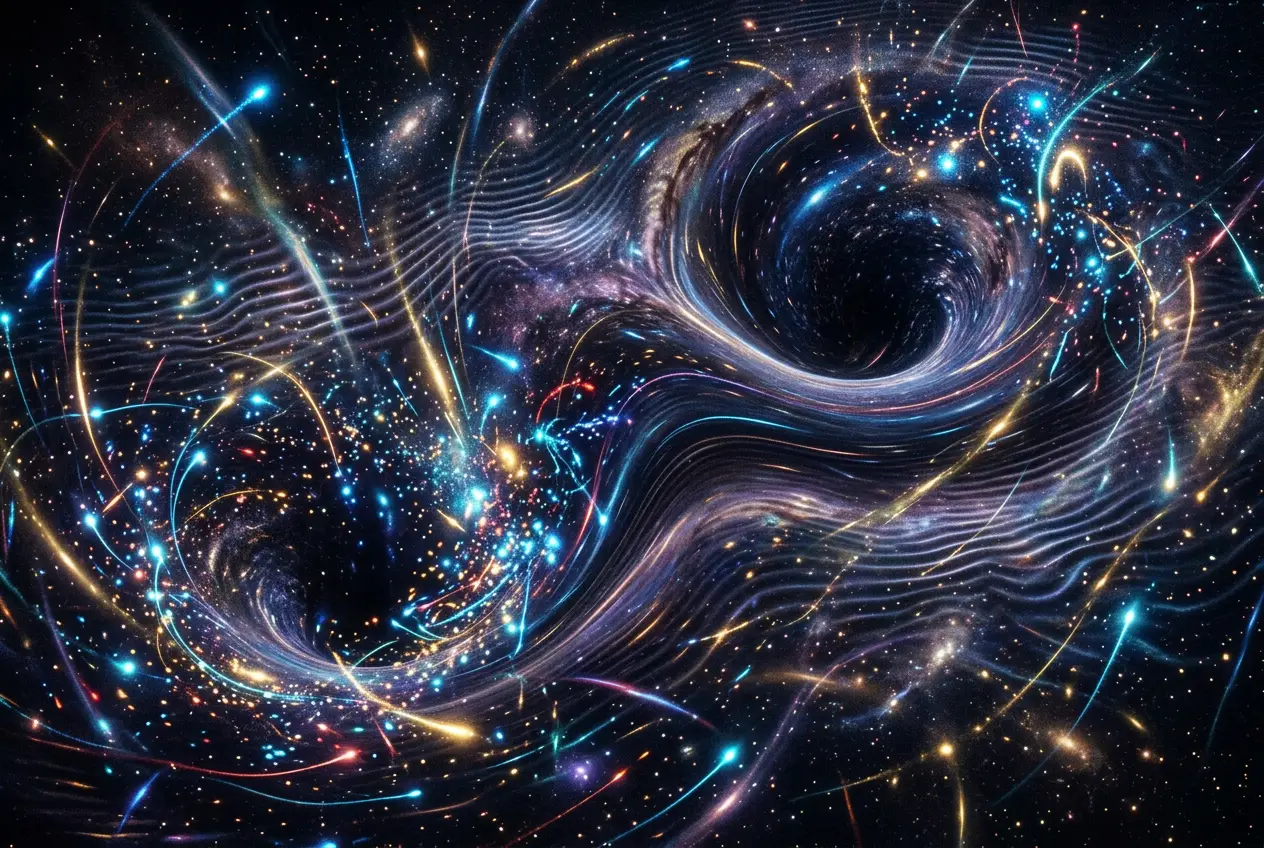
I was recently reflecting on the fundamental forces that govern our universe, and my mind kept circling back to gravity. It's the force that anchors us to Earth, keeps planets in orbit, and shapes entire galaxies. Yet, it remains the most enigmatic of the four fundamental forces, stubbornly resisting a full quantum description. Then, a thought struck me: what if our most revolutionary technological frontier, quantum computing, isn't just about faster calculations but holds a key to unraveling gravity itself—or even bending its rules?
It sounds like something out of a science fiction novel, I know. But as I dove deeper into the latest research, the lines between speculative theory and cutting-edge physics began to blur. We're talking about a realm where the impossible might just be waiting to be simulated, analyzed, and perhaps, eventually, manipulated.
The Enigma of Gravity in a Quantum World
For centuries, gravity has been the domain of classical physics, elegantly described by Isaac Newton and later, with mind-bending precision, by Albert Einstein's General Theory of Relativity. Einstein taught us that gravity isn't a force pulling objects together, but rather the curvature of spacetime caused by mass and energy. Planets orbit the sun not because they are "pulled," but because they are following the curves in spacetime created by the sun's immense mass. This model works beautifully on cosmic scales, predicting everything from the bending of light around massive objects to the existence of black holes.
However, when we zoom down to the infinitesimal world of subatomic particles, where quantum mechanics reigns supreme, General Relativity starts to falter. Quantum mechanics describes the universe in terms of probabilities, discrete energy levels, and bizarre phenomena like superposition and entanglement. It's the bedrock of modern electronics, lasers, and even the very quantum computers we're discussing. The challenge has always been how to reconcile these two vastly different descriptions of reality. How do you quantify gravity, a continuous warp in spacetime, in terms of discrete quantum packets? This quest for a "theory of everything" or quantum gravity has been one of the holy grails of physics for decades.
One of the leading candidates for quantum gravity is String Theory, which posits that fundamental particles aren't point-like but rather tiny, vibrating strings. Another approach is Loop Quantum Gravity, which suggests spacetime itself is granular, composed of discrete loops. These theories attempt to describe gravity as arising from interactions of hypothetical particles called gravitons—the quantum equivalent of photons for electromagnetic force. But gravitons have never been observed, and experimentally testing these theories is incredibly difficult, requiring energies far beyond what even the largest particle accelerators can generate.
How Quantum Computers Enter the Equation
This is where quantum computers offer a tantalizing new avenue. Unlike classical computers that process information using bits (0s or 1s), quantum computers use qubits which can exist in a superposition of both 0 and 1 simultaneously. This, along with quantum entanglement, allows them to process vast amounts of information in ways classical computers simply cannot.
Imagine trying to model the intricate interactions of countless subatomic particles, each influencing the spacetime around it, or simulating the behavior of a black hole at its event horizon where quantum effects are expected to become dominant. A classical supercomputer would quickly become overwhelmed by the exponential complexity. A quantum computer, however, is inherently designed to tackle such problems.
"Quantum computers are not just faster calculators; they are machines that can model quantum reality itself," explains Dr. John Preskill, a leading figure in quantum information science, in a 2018 lecture. "This makes them uniquely suited to probing the mysteries of quantum gravity."
Researchers are beginning to use quantum computers to:
- Simulate simplified models of quantum gravity: While a full simulation of the universe is still science fiction, quantum computers can handle toy models or simplified scenarios that exhibit properties of quantum gravity. This could help theorists test hypotheses about how spacetime behaves at the Planck scale (the smallest theoretical unit of length).
- Explore holographic principles: The holographic principle, a profound idea in theoretical physics, suggests that a description of a volume of space can be encoded on its boundary. It has deep connections to quantum gravity and black holes. Quantum computers could potentially simulate these holographic dualities, offering insights into the nature of spacetime itself.
- Understand black hole information paradox: One of the most perplexing problems in physics is what happens to information that falls into a black hole. Does it truly vanish, violating a fundamental principle of quantum mechanics? Quantum computers could simulate the complex quantum states near black holes, providing clues to this paradox. You can read more about this on Wikipedia's page on the Black Hole Information Paradox (opens in a new tab).
The Path to Manipulating Gravity?
Now, let’s address the elephant in the room: could quantum computing actually break gravity's rules? The idea isn't to build an anti-gravity device in the next decade, but rather to understand gravity so completely that we might one day find ways to subtly influence it.
If quantum computers can accurately model the quantum behavior of gravity, they might reveal entirely new mechanisms or hidden parameters. Consider these hypothetical scenarios:
- Harnessing exotic matter: Some theories suggest that exotic matter with negative mass or energy density could create "warp drives" or stable wormholes, effectively bending spacetime in extraordinary ways. While exotic matter remains theoretical, quantum simulations could explore its properties and the conditions under which it might exist or be created. This pursuit is not entirely unlike how scientists explore the properties of novel materials using quantum chemistry simulations today.
- Manipulating gravitons (if they exist): If gravitons are indeed the carriers of the gravitational force, understanding their quantum properties could theoretically lead to methods of influencing gravitational fields at a fundamental level. This is highly speculative, as detecting or manipulating individual gravitons is currently far beyond our technological capabilities.
- Revealing extra dimensions: Some theories, like braneworld cosmology, propose the existence of extra spatial dimensions beyond the three we perceive. Gravity, unlike other forces, might "leak" into these dimensions, explaining its comparative weakness. Quantum computers might help simulate the effects of these dimensions on gravitational interactions, potentially revealing ways to interact with them. You can delve deeper into theories of extra dimensions on their Wikipedia page (opens in a new tab).
Challenges and the Road Ahead
The journey is long and fraught with immense challenges. Building stable, large-scale quantum computers that can handle such complex simulations is still a monumental task. Current quantum computers are noisy and error-prone. Moreover, the theoretical frameworks for quantum gravity are still under development, and we don't yet have a complete, universally accepted theory to program into these machines.
Despite these hurdles, the potential is undeniable. Just as classical computers revolutionized fields from weather forecasting to drug discovery, quantum computers promise to unlock mysteries currently beyond our grasp. The insights gained from quantum simulations could not only lead to a unified theory of physics but might also open doors to technologies we can barely imagine. Could this lead to breakthroughs that redefine space travel or even our understanding of the universe? I believe it's entirely within the realm of possibility. The universe has always surprised us with its deeper truths, and quantum computing might be the tool we need to uncover the next one.
This incredible journey into the heart of quantum gravity and its potential interplay with quantum computing is shaping the future of both science and technology. It makes me think about how far we've come from early computational concepts, like the Antikythera mechanism, Greece's ancient cosmic computer, to systems that could one day manipulate the very fabric of spacetime. The pursuit of fundamental knowledge has always been a powerful driver of innovation. If you're interested in other mind-bending cosmic questions, I recommend checking out our blog on Does Dark Matter Hide a Universe We Can't See?
The implications are truly profound, reminding us that the boundaries of what's possible are constantly being redrawn. This isn't just about faster computations; it's about pushing the very limits of our comprehension and potentially gaining an unprecedented level of control over the natural world. For more details on the intersection of quantum computing and fundamental physics, Wikipedia's article on Quantum Gravity (opens in a new tab) is an excellent resource.
Conclusion
The idea that quantum computing could help us "break gravity's rules" is a bold one, rooted in the potential of these machines to simulate and understand the universe at its most fundamental level. While direct manipulation of gravity remains a distant dream, quantum computers offer humanity its best chance yet to solve the mystery of quantum gravity, potentially revealing new physical laws and phenomena that could, in turn, inspire revolutionary technologies. The future of physics, and perhaps our very interaction with the cosmos, may well lie within the qubits of these extraordinary machines.




Conversation0
No comments yet. Be the first to share a thought — the best questions often become new stories.