



I remember the first time I heard about the Antikythera Mechanism. It wasn't in a dry history book or an archaeology documentary. No, it was in a casual conversation, a "did you know?" moment that stopped me dead in my tracks. Someone mentioned an ancient Greek device, recovered from a shipwreck, capable of predicting eclipses and planetary movements with uncanny precision. My immediate thought was, "That can't be right. That sounds like something from a sci-fi novel, not 2,000 years ago." But as I delved deeper, I realized the truth was far more astonishing than fiction.
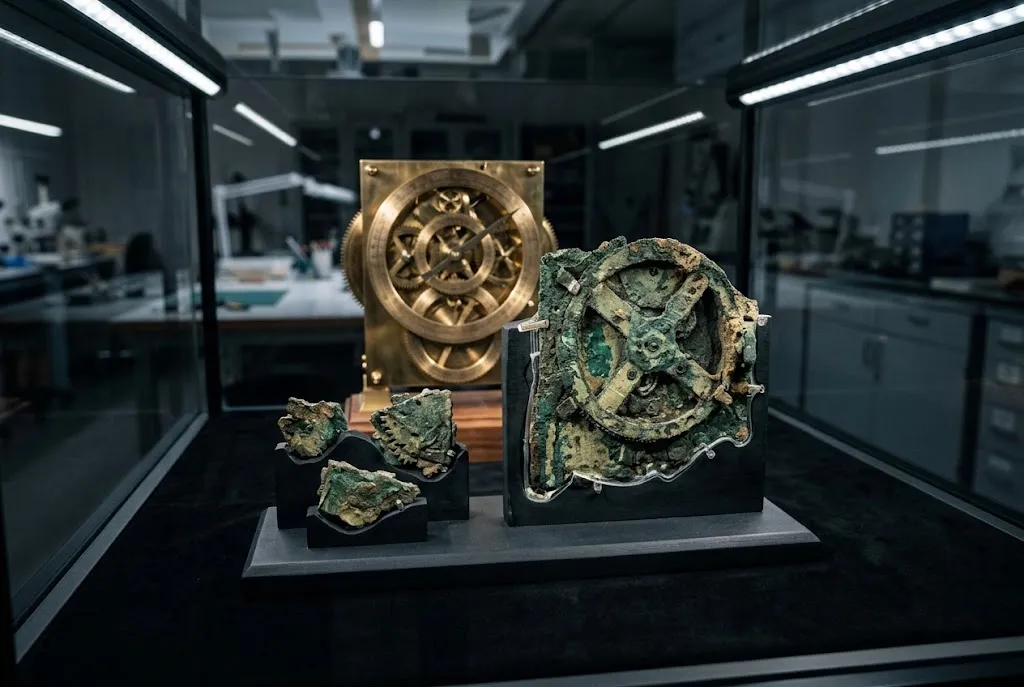
Imagine, for a moment, sailing the treacherous Aegean Sea around 60 BC. A Roman cargo ship, laden with treasures, succumbs to a violent storm near the island of Antikythera. It sinks, its secrets plunging into the dark, silent depths, destined to be forgotten for millennia. Fast forward to 1901. Sponge divers, braving the same waters, stumble upon the wreck. Among the statues, pottery, and jewelry, they find something truly extraordinary: a corroded lump of bronze and wood that, at first glance, seemed insignificant. Little did they know, they had unearthed what many now call the world's first analog computer – a device so sophisticated it rewrites our understanding of ancient Greek technological prowess.
The Unveiling of an Ancient Enigma
For decades after its discovery, the "lump" from the Antikythera shipwreck remained largely an enigma. It was fragile, fragmented, and encased in marine deposits. Early examination revealed gears, but the full extent of its complexity was hidden. It wasn't until advanced imaging techniques, like X-rays and 3D tomography, became available in the late 20th and early 21st centuries that the true genius of its creators began to emerge. What we found wasn't just a simple clockwork mechanism; it was a cosmic calculator, a testament to an astronomical and engineering brilliance previously thought impossible for its time.
More Than Just Gears: A Window to the Cosmos
At its heart, the Antikythera Mechanism is an orrery, a mechanical model of the solar system, but with a far greater functionality. It's built from at least 30 meshing bronze gears, some incredibly small and precise, allowing it to perform complex astronomical calculations. Think about that: a device conceived without electricity, without advanced metallurgy as we know it today, performing calculations that would stump most people even with a modern calculator.
What could this "cosmic computer" do?
- Predict Eclipses: It could accurately predict lunar and solar eclipses based on cycles like the Saros cycle. This was crucial for ancient societies, often seen as omens.
- Track Planetary Movements: While primarily geocentric (Earth-centered), it could calculate the positions of the Sun, Moon, and likely the five known planets (Mercury, Venus, Mars, Jupiter, and Saturn) against the backdrop of the stars.
- Calendar Tracking: It displayed the traditional Greek lunisolar calendar, essential for religious festivals and agricultural planning.
- Olympiad Cycle: Remarkably, one dial even tracked the four-year cycle of the Olympic Games and other Panhellenic games.
The intricacy is astounding. For instance, the Moon display utilized a differential gearing system to account for the Moon's elliptical orbit and varying speed, a phenomenon known as the first anomaly of the Moon. This is a concept that Isaac Newton would later elaborate on centuries later. The precision required to craft such gears, some just a few millimeters in diameter with triangular teeth, speaks volumes about the artisan's skill and the scientific knowledge base available. This level of craftsmanship hints at a deeper, more widespread technological sophistication in ancient Greece than previously assumed. Could other equally complex devices still lie undiscovered?
Who Built Such a Marvel?
The exact creator of the Antikythera Mechanism remains a mystery, adding to its allure. However, several brilliant minds of the Hellenistic period have been proposed:
- Archimedes: The legendary mathematician, physicist, engineer, and inventor from Syracuse. His mechanical genius, as evidenced by the Archimedes' screw and his siege engines, makes him a prime candidate. He's also credited with building a planetarium-like device.
- Hipparchus: A prominent Greek astronomer, geographer, and mathematician known for his star catalog and advancements in trigonometry. His astronomical data might have been incorporated into the mechanism.
- Posidonius: A stoic philosopher, astronomer, and geographer whose school on Rhodes was a center of scientific study, where such a device could have been conceived and constructed.
The sophisticated mathematics and astronomical understanding embedded in the mechanism strongly suggest a direct link to the greatest scientific minds of the Greek world. It wasn't just a fancy toy; it was a serious scientific instrument, likely used for teaching, demonstration, or perhaps even astrological predictions.
The Question of Lost Knowledge
One of the most perplexing aspects of the Antikythera Mechanism is its apparent isolation. No other device of comparable complexity from antiquity has been found. This raises profound questions: Was it a singular masterpiece, a "one-off" invention that faded into obscurity with its creator? Or was it part of a larger, lost tradition of advanced Hellenistic engineering that simply didn't survive the ravages of time?
Historian Derek J. de Solla Price, a pioneer in the study of the mechanism, eloquently described it as "a device more complex than any known instrument from antiquity... and indeed nothing quite like it is known again until the clockwork of the fourteenth century." This gap, nearly 1,500 years, highlights the profound loss of technological continuity. Could political upheaval, economic decline, or the shift in intellectual focus during the Roman Empire have contributed to this knowledge being forgotten? It’s a chilling thought that humanity might have reached similar technological heights far earlier if not for such interruptions. The resilience and innovation embedded in human history often amaze me, much like the scientific quest for self-healing metals shows our continuous drive to push boundaries.
Reshaping History and Our Understanding of "Ancient"
The discovery and subsequent decoding of the Antikythera Mechanism have fundamentally reshaped our understanding of ancient Greek science and technology. It forces us to reconsider the very definition of "ancient" and "primitive." The Greeks were not just philosophers and artists; they were engineers and scientists pushing the boundaries of what was possible, much like the minds behind the incredible feats of engineering in the early space race.
The mechanism itself is a marvel of differential gearing, a concept usually attributed to 16th-century horologists. Its very existence implies a sophisticated workshop with master craftsmen capable of precision metalworking, intricate assembly, and an understanding of kinematics that would impress even modern engineers. It suggests a level of abstract scientific thinking and practical application that was centuries ahead of its time. For a deeper dive into its mechanics, the Antikythera Mechanism Research Project website offers extensive details on its reconstruction and workings.
A Legacy of Curiosity
The Antikythera Mechanism isn't just an artifact; it's a testament to enduring human curiosity and ingenuity. It challenges our preconceptions, reminds us that history is often far more complex and surprising than we imagine, and leaves us wondering what other marvels might still lie hidden, waiting to be rediscovered. As I reflect on this ancient cosmic computer, I can't help but feel a profound connection to those brilliant minds of antiquity. Their desire to understand the cosmos, to predict its movements, mirrors our own modern quest for knowledge, from mapping distant galaxies to unraveling the secrets of artificial intelligence. It's a humbling reminder that the pursuit of understanding is a timeless human endeavor.
In conclusion, while the Ancient Greeks may not have built a "cosmic computer" in the modern sense of a digital, programmable machine, they absolutely crafted a device that performed highly complex astronomical calculations and predictions, serving as a functional analog computer. The Antikythera Mechanism stands as a singular, astounding achievement, a historical marvel that continues to inspire awe and fuel our imagination about the hidden depths of ancient innovation. It truly makes you say, "wow, I didn’t know this!"




Conversation0
No comments yet. Be the first to share a thought — the best questions often become new stories.