


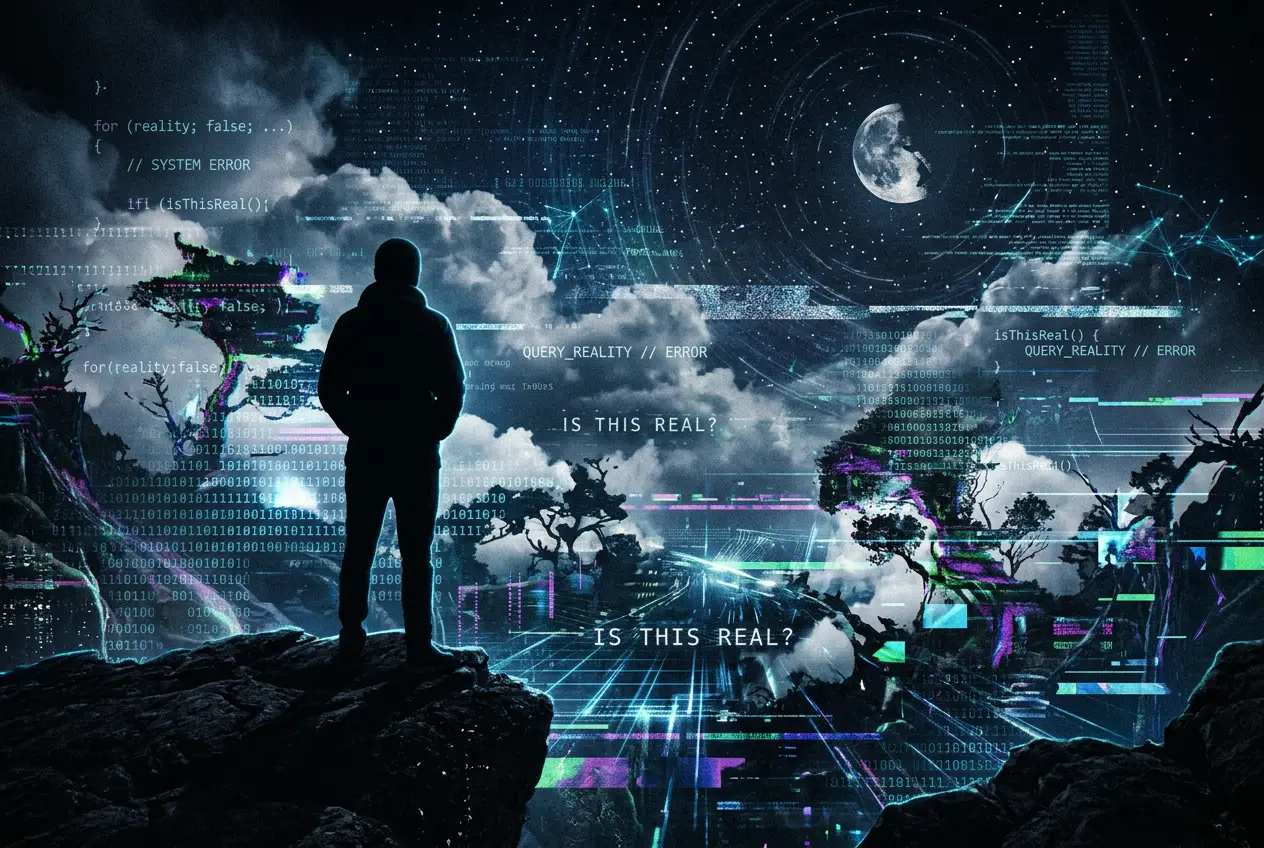
I remember the first time I truly wrestled with the idea that our entire existence might be nothing more than an elaborate computer program. It wasn't during a late-night movie marathon of The Matrix, though that film certainly amplified the concept. Instead, it was sparked by a quiet evening spent pondering the vastness of the cosmos and the seemingly impossible coincidences that govern our universe. The thought isn't new; philosophers have debated the nature of reality for millennia, but in our increasingly technologically advanced age, the simulation hypothesis has moved from the realm of pure philosophy to a topic of serious scientific and technological discussion.
What if everything we experience—the feeling of the wind on our skin, the taste of a morning coffee, the complexity of human emotions, the distant glimmer of stars—is just perfectly rendered code running on an alien supercomputer? It’s a mind-bending question, one that challenges our most fundamental assumptions about existence. Let's dive deep into this fascinating concept, exploring its origins, its scientific arguments, and why it continues to captivate thinkers across disciplines.
The Ancient Echoes of a Simulated Reality
The idea that our world isn't quite as real as it seems has a surprisingly long history. Plato, the ancient Greek philosopher, famously proposed his Allegory of the Cave. Imagine prisoners chained in a cave, seeing only shadows cast by objects passing in front of a fire behind them. To these prisoners, the shadows are their entire reality. They wouldn't know of the actual objects or the world outside the cave. This allegory, in essence, is an early philosophical precursor to the simulation hypothesis, suggesting that our perceived reality might just be a mere reflection or projection of a deeper, more fundamental truth.
Centuries later, René Descartes, in his Meditations on First Philosophy, pondered the existence of an "evil demon" or "evil genius" of utmost power and cunning, who had employed all his energies in deceiving him. This demon could create a reality so convincing that one could not distinguish it from true existence. These historical thought experiments laid the groundwork for questioning the very nature of perception and reality long before computers were even a distant dream.
The Modern Rebirth: Nick Bostrom's Argument
Fast forward to the 21st century, and the simulation hypothesis gained significant traction with the publication of philosopher Nick Bostrom's 2003 paper, "Are You Living in a Computer Simulation?". Bostrom's argument isn't about proving we are in a simulation, but rather suggesting that one of three possibilities must be true:
- Civilizations almost never reach a posthuman (technologically mature) stage: They either destroy themselves or fail to develop the necessary technology.
- Posthuman civilizations are not interested in running ancestor simulations: Perhaps they deem it unethical, uninteresting, or impractical.
- We are almost certainly living in a simulation.
Bostrom argues that if a civilization does reach a posthuman stage, its computing power would be immense. Such a civilization could run an astronomical number of detailed ancestor simulations – simulations of their evolutionary history, populated by conscious beings. If they run enough of these, the sheer number of simulated minds would far outweigh the number of "base-reality" minds. Thus, the statistical probability suggests that we are more likely to be one of the simulated minds than one of the original ones. You can read more about his fascinating work on the concept of the simulation hypothesis on Wikipedia.
The Scientific Angles: Where Physics Meets Code
While Bostrom's argument is primarily philosophical and probabilistic, modern physics offers some intriguing, albeit speculative, angles to consider the simulation hypothesis.
Quantum Mechanics and Observer Effect
One of the most perplexing aspects of quantum mechanics is the observer effect, where the act of observation seems to influence the state of a quantum system. Particles behave differently when measured compared to when they are not. Some theorists draw a parallel between this and how a computer simulation might operate: rendering details only when they are observed to save computational resources. If the universe were a simulation, it wouldn't need to render every single particle and every single detail constantly; it would only generate what's necessary for the current "players" or observers. This concept brings to mind similar discussions around the fundamental nature of reality, such as those explored in articles about the strange world of quantum entanglement. For more on the observer effect, refer to this Wikipedia article.
The "Pixels" of Reality: Discrete Nature
Could reality itself be pixelated? Some theories suggest that space-time might not be infinitely smooth but rather composed of tiny, discrete units, much like pixels on a screen or voxels in a 3D simulation. Theoretical physicist Stephen Wolfram, for instance, has explored the idea that the universe could be fundamentally computable, emerging from simple rules and cellular automata. If true, this could hint at a computational substrate underlying our reality. The Planck length and Planck time are considered the smallest possible units of length and time, respectively, suggesting a fundamental granularity to the universe that could be analogous to the smallest units of data in a digital environment.
Cosmic Rays and Glitches
Scientists constantly observe cosmic rays bombarding Earth. These high-energy particles interact with electronic circuits, sometimes causing "soft errors" or glitches in computer systems. Could similar, albeit extremely rare, "glitches" occur in our reality? Some proponents of the simulation hypothesis playfully suggest that unexplained anomalies or rare phenomena, like certain optical illusions or fleeting moments of déjà vu, could be tiny computational errors in our cosmic program. While highly speculative, it’s a thought that adds a layer of intrigue.
What Would Evidence Look Like?
If we were in a simulation, what kind of evidence might we discover?
- Computational Limits: Could there be fundamental limits to physics that resemble computational constraints? For example, the speed of light might be a "processing speed" limit within the simulation. Similarly, the finite resolution suggested by Planck units could be interpreted as the "pixel size" of our simulated reality.
- Mathematical Underpinnings: The universe is incredibly mathematical. From the orbits of planets to the structure of atoms, mathematics describes everything with astonishing precision. Some argue this is precisely what you'd expect from a simulated world built on algorithms and code.
- Code-like Structures: Could we detect patterns or recurring mathematical structures that seem too perfect to be natural, almost like embedded code? Some researchers have even looked for "error correction codes" in physical constants, similar to how data is protected against errors in digital systems.
The Philosophical and Ethical Minefield
If we accept the possibility of living in a simulation, the implications are profound.
- Meaning and Purpose: Does it diminish our lives if they are "just a simulation"? For many, the answer is no. Our experiences, emotions, and relationships are real within this reality, regardless of its ultimate nature. The pursuit of knowledge, love, and happiness remains paramount.
- The "Base Reality": What about the civilization running the simulation? Are they themselves simulated? This leads to the infinite regress problem, a hierarchy of simulations within simulations. At some point, there must be a "base reality" that isn't simulated, right? This reminds me of the deep philosophical questions explored in The Baghdad Battery: Could Ancient Iraqis Power a Lost Civilization? where we questioned the very limits of what ancient civilizations could achieve, pushing the boundaries of what we thought was possible.
- Ethical Implications: If we could create ancestor simulations, should we? What are our responsibilities to the conscious beings within them? This delves into questions of digital ethics and AI consciousness, themes often touched upon when considering advanced technologies like those that could potentially lead to Do Wormholes Really Connect Two Universes? Science vs Theory, where the very fabric of existence is questioned.
Are We Heading Towards Creating Our Own Simulations?
Perhaps the most compelling argument for the simulation hypothesis comes from our own technological trajectory. We are rapidly advancing in virtual reality, augmented reality, and artificial intelligence. Games like Minecraft and Grand Theft Auto already create vast, complex, rule-based worlds. Our computing power is growing exponentially.
Consider the progress:
- Early Video Games (1970s): Simple pixels, basic rules.
- Modern Video Games (2020s): Hyper-realistic graphics, complex AI, vast open worlds.
- Future Simulations (2050s+): With continued advancement, it's not unreasonable to imagine a future where our descendants could create simulations indistinguishable from reality, populated by conscious artificial intelligences. If we can, and if other civilizations could, then the probability argument gains weight.
This technological growth curve, documented by Moore's Law, suggests that if humanity doesn't self-destruct or encounter some insurmountable barrier, we will eventually possess the computational power to create such simulations. And if we can, it's plausible others already have.
The Ultimate Question: Does It Matter?
Whether we are simulated or not, our experiences are real to us. The love we share, the challenges we overcome, the beauty we perceive – these are all tangible within our framework of existence. The simulation hypothesis isn't meant to diminish our lives but rather to expand our understanding of what reality could be. It forces us to question, to explore, and to appreciate the intricate dance of laws and phenomena that govern our world.
Ultimately, the simulation hypothesis remains a profound thought experiment, a testament to humanity's endless curiosity. It’s a challenge to conventional thinking and an invitation to consider possibilities that stretch the very fabric of our understanding. Perhaps one day, we will find a definitive answer, or perhaps the beauty lies in the journey of asking the question itself.


Conversation0
No comments yet. Be the first to share a thought — the best questions often become new stories.