


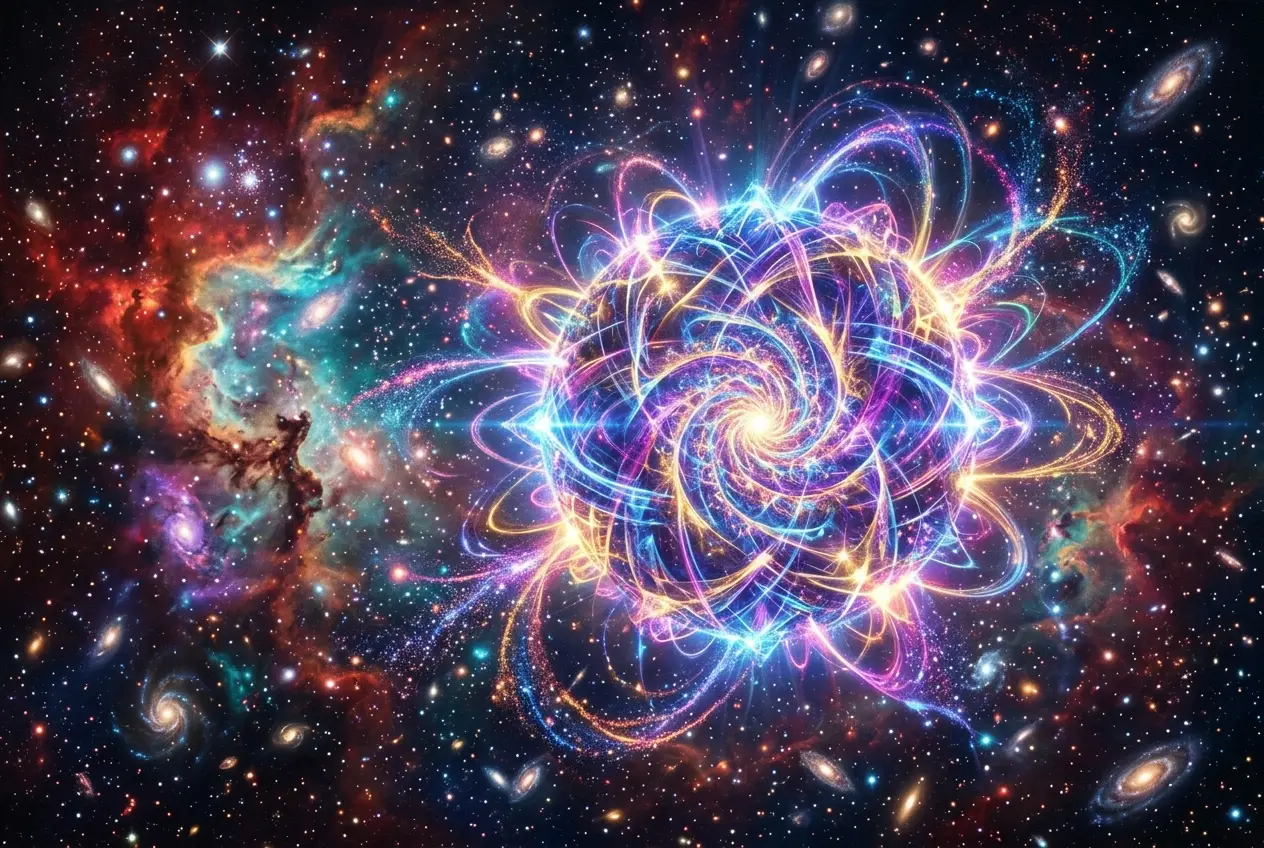
I’ve always been fascinated by the cosmos, believing that for every question answered, a dozen new mysteries emerge. Lately, I've been pondering something truly mind-bending: what if some stars out there are so strange, so extreme, that they defy the very laws of physics we thought we understood? It sounds like science fiction, doesn't it? But the truth, as I’ve come to learn, is that our universe is a far stranger place than we often imagine, constantly pushing the boundaries of what we deem "possible."
Imagine a star that's not just big, but so gargantuan it redefines the very concept of stellar size. Or one that burns with an internal structure so bizarre it challenges our understanding of nuclear fusion. These aren’t just hypothetical musings; astronomers are grappling with observations and theoretical predictions that hint at the existence of "impossible" stars—celestial bodies that stretch, or even seem to break, the foundational principles of astrophysics.
The Stellar Textbook: What We Thought We Knew
Before diving into the impossible, let’s briefly revisit what our standard model of stars tells us. Most stars, like our Sun, are cosmic furnaces fueled by nuclear fusion, primarily converting hydrogen into helium in their cores. Their life cycles are remarkably predictable: they form from collapsing gas clouds, burn through their fuel, expand into red giants, and then either collapse into white dwarfs, neutron stars, or explode as supernovae, leaving behind neutron stars or black holes. This stellar evolution is governed by fundamental physics—gravity, electromagnetism, and the strong and weak nuclear forces. The mass, temperature, and composition of a star largely dictate its fate, leading to distinct classifications: main sequence stars, red giants, white dwarfs, neutron stars, and black holes.
However, the universe has a knack for throwing curveballs. Over the decades, observations and theoretical models have begun to suggest that there might be exceptions—stars that don’t quite fit the mold, pushing the very limits of our stellar classification and physical understanding.
Quasistars: Black Holes in Stellar Clothing?
One of the most intriguing candidates for an "impossible" star is the quasistar. Imagine a star so massive that its core collapses into a black hole while its outer layers are still very much present, inflated to immense sizes, sustained by the energy released as gas falls into the central black hole. This isn't your typical star burning hydrogen; it's a cosmic hybrid.
Quasistars are purely theoretical entities, believed to have existed only in the very early universe. They would have been short-lived, perhaps only a few million years, but incredibly bright—millions of times more luminous than our Sun, and potentially thousands of times larger. Their formation would require huge amounts of gas to collapse directly into a black hole without first forming a normal star, a scenario thought plausible in the dense, gas-rich environments of the early cosmos. These hypothetical behemoths could be the precursors to the supermassive black holes we observe at the centers of galaxies today.
The physics here is extreme. Instead of fusion, the primary energy source is accretion onto a central black hole. The sheer size and luminosity, combined with a black hole core, make quasistars a fascinating challenge to the conventional definition of a "star." For more on the dynamics of cosmic giants, you might want to read about how black holes store universes lost data.
Thorne-Zytkow Objects: Stars Within Stars
Another astonishing candidate is the Thorne-Zytkow Object (TZO). This is a truly bizarre concept: a red giant or supergiant star with a neutron star nestled deep inside its core. Think of it like a cosmic turducken. Neutron stars are incredibly dense remnants of supernovae, typically having a mass greater than our Sun but a diameter of only about 20 kilometers.
How would such an object form? The prevailing theory is that it happens in a close binary star system. When the more massive star in the pair explodes as a supernova, it leaves behind a neutron star. If the companion star then evolves into a red giant, its outer layers can engulf the neutron star. Over time, the neutron star spirals inward due to drag forces, eventually merging with the red giant's core.
The presence of a neutron star dramatically alters the red giant’s internal dynamics and nucleosynthesis. Instead of normal hydrogen fusion, the neutron star's intense gravity and compact nature can drive unique nuclear reactions, producing unusual elemental abundances at the surface. For years, TZOs were purely theoretical. However, in 2014, astronomers announced a strong candidate: HV 2112 in the Small Magellanic Cloud. While not definitively confirmed, its peculiar surface composition—rich in lithium, molybdenum, and rubidium—matches predictions for a TZO. This potential discovery offers tantalizing evidence that stars can indeed harbor such extreme, nested structures, challenging our understanding of stellar mergers and exotic matter. The physics governing such extreme matter configurations is still being explored, linking to discussions on whether exotic matter could power faster-than-light travel.
Dark Stars: Powered by Dark Matter?
Venturing into even more speculative territory, we encounter the concept of dark stars. These aren't stars that are just dim; they are hypothesized to be stars that draw their energy not from nuclear fusion, but from the annihilation of dark matter particles in their cores.
According to this theory, dark stars would have formed in the early universe when high concentrations of dark matter accumulated in the centers of protogalaxies. If sufficiently dense, these dark matter particles could have annihilated with each other, releasing energy that would prevent the collapse of the surrounding ordinary matter into a conventional, fusion-powered star.
These dark stars would be enormous, cool, and incredibly luminous, potentially observable through their distinct spectral signatures or their unusual brightness without the expected fusion products. They would also be composed primarily of hydrogen and helium, but their energy source would be fundamentally different. While still theoretical, the search for dark matter continues to be a frontier in physics, and the possibility of dark stars offers a novel way to potentially detect its effects. Learning about dark matter and its potential cosmic role is a compelling journey, like exploring whether dark matter is sending us cryptic messages.
Population III Stars: The Universe's First Giants
While not "impossible" in the sense of breaking known physics, Population III stars represent a class of stars that were so different from modern stars that they challenge our current observational capabilities and push the limits of stellar modeling. These were the very first stars to form in the universe, shortly after the Big Bang, composed almost exclusively of hydrogen and helium, with virtually no heavier elements (which astronomers call "metals").
Because there were no heavier elements to help cool the primordial gas clouds, Population III stars are thought to have formed much more massively than stars today—hundreds or even thousands of times the mass of our Sun. These gargantuan stars would have burned incredibly hot and bright, lived very short lives (a few million years), and then exploded as hypernovae, enriching the early universe with the first heavy elements.
Observing Population III stars directly is extremely difficult due to their immense distance and short lifetimes. However, their existence is crucial for explaining the presence of heavier elements in later generations of stars and galaxies. Scientists are using powerful telescopes like the James Webb Space Telescope to search for their indirect signatures or the very first galaxies they illuminated. The physics of these primordial stars provides critical clues about the universe's evolution. For more on the early universe, see Wikipedia on Population III stars.
Challenging Our Cosmic Assumptions
The existence, or even the strong theoretical possibility, of quasistars, Thorne-Zytkow Objects, dark stars, and supermassive Population III stars forces us to re-evaluate our fundamental assumptions about what constitutes a "star" and how stellar evolution unfolds. They highlight that our current understanding, while robust for the vast majority of observed stars, might be incomplete when pushed to the extremes of mass, density, or exotic composition.
These celestial anomalies serve as powerful reminders of the universe's boundless complexity. They're not just curious footnotes in astronomy; they represent active frontiers of research where theoretical predictions meet cutting-edge observations. Each potential discovery of an "impossible" star offers an opportunity to refine our physical models, test the limits of general relativity and quantum mechanics, and perhaps even uncover new particles or forces. The truth is that the universe is constantly challenging us, urging us to look beyond the obvious and embrace the truly extraordinary.
As I look up at the night sky, I can't help but feel a profound sense of wonder at the thought that somewhere out there, a star might be glowing in a way we never thought possible, quietly breaking the rules and rewriting the cosmic playbook. What other secrets do the stars hold? The journey to uncover them is just beginning.
&faqs;{"faqs":[{"id":1,"question":"What makes a star 'impossible' by current physics standards?","answer":"A star is considered 'impossible' if its observed or theoretically predicted properties (like its energy source, internal structure, or extreme mass) cannot be explained by our current standard models of stellar physics, which rely primarily on nuclear fusion and gravitational collapse."},{"id":2,"question":"Have any 'impossible' stars been definitively confirmed?","answer":"As of now, no 'impossible' stars have been definitively confirmed. Thorne-Zytkow Objects have a strong candidate (HV 2112), but full confirmation is pending. Quasistars and dark stars remain theoretical, though they provide compelling areas for research and observation."},{"id":3,"question":"How would we detect a dark star if it doesn't use nuclear fusion?","answer":"Detecting a dark star would be challenging, but astronomers might look for indirect evidence. For instance, their unique spectral signatures (due to different internal physics), their unusual brightness without corresponding fusion-based elemental abundances, or their gravitational influence could hint at their presence."},{"id":4,"question":"Are Population III stars truly 'impossible' in the same way as Thorne-Zytkow Objects?","answer":"No, Population III stars are not 'impossible' in the same sense. They conform to known physics but represent an extreme and unobserved class of stars from the early universe, primarily due to their immense mass and lack of heavy elements. Their existence is strongly predicted by cosmological models, making them a challenge of observation rather than a direct contradiction of physics."},{"id":5,"question":"What impact do these 'impossible' stars have on our understanding of the universe?","answer":"These stars push the boundaries of our cosmic understanding, forcing scientists to refine existing models, explore new physical phenomena (like dark matter annihilation or extreme stellar mergers), and potentially uncover new laws of physics or exotic states of matter. They remind us that the universe is full of surprises and that our knowledge is constantly evolving."}]}&faqs;
&meta_title; Do 'Impossible' Stars Really Exist? Uncovering the Truth Behind Cosmic Anomalies &meta_title;
&meta_description; Beyond textbooks: What if the universe harbors stars so strange they defy everything we know about physics? Join us as we uncover the baffling truth behind these cosmic anomalies and push the boundaries of cosmic understanding. &meta_description;

Conversation0
No comments yet. Be the first to share a thought — the best questions often become new stories.