


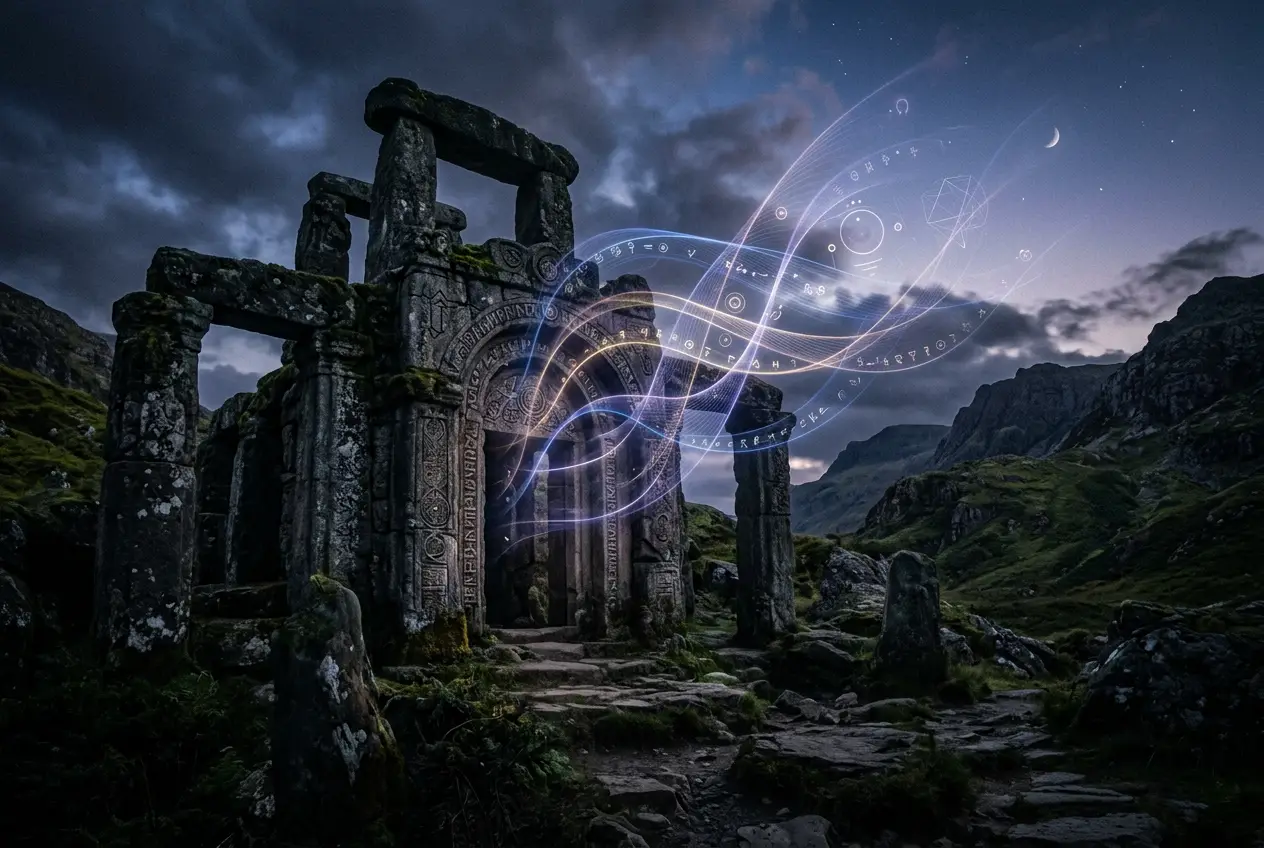
I often find myself marveling at the sheer volume of data we generate and store today. From digital photos of our breakfast to complex scientific simulations, every byte finds a home on a server, a hard drive, or in the cloud. But what about ancient civilizations? Before silicon chips and fiber optics, how did they preserve crucial knowledge, beyond mere scrolls or stone tablets? Recently, I’ve been exploring a fascinating concept: could ancient soundscapes have served as sophisticated, albeit unconventional, data archives?
It’s a thought that truly sparks my curiosity. We instinctively think of history as something written, carved, or painted. But what if the very air, shaped by human activity and architectural design, also held secrets? What if the echoes in a megalithic chamber, the rhythm of a ritual chant, or the specific acoustic properties of a sacred cave were not just ceremonial, but part of a complex system for storing and retrieving information?
Beyond the Written Word: The Power of Sound
We know, of course, that oral tradition was the primary means of knowledge transfer for millennia. Epic poems, mythological narratives, tribal histories, and practical wisdom were passed down through generations, often memorized and recited with incredible accuracy. This itself is a powerful form of data storage, relying on the human mind and vocal cords. However, I’m talking about something potentially deeper – a kind of "acoustic memory" embedded within the environment itself, or within highly structured sonic practices.
Imagine a society where knowledge isn't just spoken, but activated by specific sounds within specific spaces. It’s less about a library of books and more about an interactive, immersive archive where sound acts as the key. This idea isn't entirely new; the field of archaeoacoustics explores the acoustic properties of archaeological sites and their potential role in ancient cultures. Researchers like Iegor Reznikoff have documented astonishing resonant frequencies in caves with prehistoric art, suggesting these spaces were chosen or modified for their sonic qualities. To me, this hints at a deliberate interaction with sound that goes beyond mere aesthetics.
Architectures of Sound: When Buildings Became Instruments
Many ancient structures around the world exhibit remarkable acoustic properties. It’s almost as if the builders were not just engineers of stone, but also maestros of sound.
Consider the Megalithic Temples of Malta, such as Hal Saflieni Hypogeum. These underground chambers, dating back over 5,000 years, are known for their profound reverberations. Some researchers have found that certain frequencies, particularly around 110 Hz, resonate powerfully throughout the Hypogeum. When chanted, these frequencies have been linked to changes in brain activity, potentially inducing states of heightened awareness or meditation. But could these specific resonant frequencies also have been cues for accessing certain types of information? Perhaps a specific tone or rhythmic pattern, when produced in a particular chamber, would "unlock" a memory, a story, or a set of instructions associated with that precise acoustic signature.
Another prime example is Chichen Itza's El Castillo pyramid in Mexico. Clap your hands at the base, and the echo that returns from the grand staircase astonishingly mimics the chirp of a quetzal bird, sacred to the Maya. This is widely considered an intentional acoustic design. Why would ancient architects go to such lengths? Was it purely symbolic, or did this unique sonic "playback" serve a function? I wonder if these acoustic phenomena were designed not just to impress, but to embed or recall specific information related to Maya cosmology, astronomy, or rituals. Could the specific "sound" of the quetzal have been a mnemonic trigger for a complex narrative or calculation?
I found myself pondering an article I read a while back, which discussed how ancient cultures, like those who built megaliths, might have used acoustic properties in their structures. This reminds me of how profound their understanding of sound truly might have been, as explored in articles like Unseen Forces: Did Sound Energy Build Ancient Megaliths?.
How Could Sound Store Data? Unpacking the Mechanisms
The idea of sound as a data archive requires a leap beyond simple oral recitation. Here are a few speculative, yet intriguing, mechanisms:
-
Frequency and Rhythm Encoding: Imagine a system where specific frequencies or rhythmic patterns were associated with different categories of information. A particular drum beat might signify "astronomical knowledge," while a certain pitch sequence could indicate "healing remedies." Over time, through repeated exposure and cultural conditioning, these sonic cues would become deeply integrated into the collective memory, allowing individuals to navigate a vast "sound-based database." This is a more complex form of mnemonic device, leveraging auditory input directly with spatial context. As noted on Wikipedia, mnemonics are memory aids, and this could be an advanced, communal form of it https://en.wikipedia.org/wiki/Mnemonic (opens in a new tab).
-
Spatial Acoustics as "Chapters": If a site like the Hypogeum has multiple chambers, each with distinct resonant characteristics, perhaps each chamber functioned like a different "chapter" or "data block." Initiates moving through the space, performing specific chants or producing particular sounds, would effectively be "loading" or "accessing" different sets of information. The physical journey through the site would become a navigation path through a sonic data structure. This intertwines architecture with information retrieval, a concept touched upon when discussing how Ancient Alignments: Did Structures Track the Cosmos? – linking physical space to cosmic knowledge.
-
Complex Auditory Mnemonics: Beyond simple songs, ancient oral traditions often involved highly structured narratives. What if the very cadence, specific vocalizations, or embedded sound effects within these narratives carried additional layers of encoded data? These might not be obvious to an outsider, but to trained practitioners, these sonic nuances could unlock deeper meanings, precise measurements, or intricate genealogies. The human brain is incredibly adept at pattern recognition, and such complex auditory cues could have served as powerful triggers for vast amounts of stored knowledge.
-
Bioacoustics and Environmental Data: For societies deeply connected to their natural environment, understanding the calls of animals, the sounds of weather patterns, or the flow of water was crucial for survival. Could this "environmental soundscape" also have been 'archived' in a sophisticated way? Perhaps specific rituals involved mimicking these sounds, not just in reverence, but to evoke and transmit detailed knowledge about animal behavior, plant cycles, or meteorological predictions. The overarching idea of a soundscape itself, as defined by Wikipedia, encompasses the entire acoustic environment, natural and human-made https://en.wikipedia.org/wiki/Soundscape (opens in a new tab).
The 'What' of the Data: What Could They Have Stored?
If ancient soundscapes were indeed data archives, what kind of information would they have contained?
- Astronomical Observations: Many ancient cultures had sophisticated astronomical knowledge. Specific chants performed during solstices or equinoxes in astronomically aligned structures could have been mnemonic devices for tracking celestial movements, predicting eclipses, or timing agricultural cycles.
- Genealogical Records: The lineage of kings, priests, or tribal elders was often crucial. Complex songs or rhythmic recitations could have served as dynamic databases for intricate family trees and historical events.
- Healing Practices: Chants, music, and specific sound frequencies are known to have been used in ancient healing rituals. Could these practices have been carefully encoded with information about medicinal plants, anatomical knowledge, or therapeutic techniques?
- Sacred Narratives and Philosophical Insights: The deepest spiritual and philosophical understandings of a culture might have been embedded in elaborate sonic performances, accessible only through deep learning and immersion in the acoustic environment.
- Technological Know-how: While perhaps not "digital," the mechanics of building complex structures, crafting intricate tools, or performing sophisticated processes could have been conveyed through rhythmic instruction, sonic cues, or acoustic demonstrations. This touches on the broader concept of Lost Acoustic Tech: Did Ancients Control Sound Waves?.
Why No Widespread Recognition (Yet)?
The challenges in proving the existence of such a system are significant. Sound is ephemeral; it leaves no physical trace in the way a carved inscription does. The interpretations are often subjective, and without a definitive "Rosetta Stone" for ancient sound data, much remains in the realm of hypothesis. Furthermore, modern archaeological methods have historically prioritized tangible artifacts, only recently giving significant attention to the invisible aspects of ancient life, such as acoustics.
Another factor could be the sheer complexity and context-dependency of such a system. Imagine trying to decipher a computer program without understanding its underlying language, operating system, or hardware. An ancient sound-based data archive would likely have been equally intricate, requiring deep cultural immersion and specific training to access its information. As I've explored the idea of Impossible Artifacts: Clues to Lost Ancient Tech?, it makes me wonder if some "impossible" knowledge was simply stored in a way we haven't yet learned to decode.
Modern Rediscovery and the Future of Sonic Archaeology
Today, however, new technologies are allowing us to "listen" to the past in unprecedented ways. Digital modeling, acoustic reconstruction, and advanced sound analysis are helping archaeoacousticians recreate and study the soundscapes of ancient sites. By measuring reverberation times, resonant frequencies, and sound decay, they are mapping the invisible acoustic properties that defined these spaces. Efforts to record and analyze oral traditions from surviving indigenous cultures also provide invaluable insights into how complex sonic information can be structured and preserved. The potential to understand ancient cultures more deeply by listening to their environments, rather than just looking at their ruins, is a thrilling prospect. The study of oral tradition itself is a rich field, documented extensively on Wikipedia https://en.wikipedia.org/wiki/Oral_tradition (opens in a new tab).
Conclusion: A Call to Listen to the Past
The notion that ancient soundscapes might have functioned as hidden data archives is a profound and captivating one. It challenges our modern, visually-centric understanding of information storage and retrieval. It encourages us to consider the ingenious, multi-sensory ways our ancestors understood and interacted with their world. While definitive proof remains elusive, the evidence of intentional acoustic design in ancient sites, combined with the known power of human memory and oral tradition, paints a compelling picture. As we continue to delve into these fascinating "Tech Mysteries", perhaps all we need to do is listen a little more closely to the echoes of the past.





Conversation0
No comments yet. Be the first to share a thought — the best questions often become new stories.