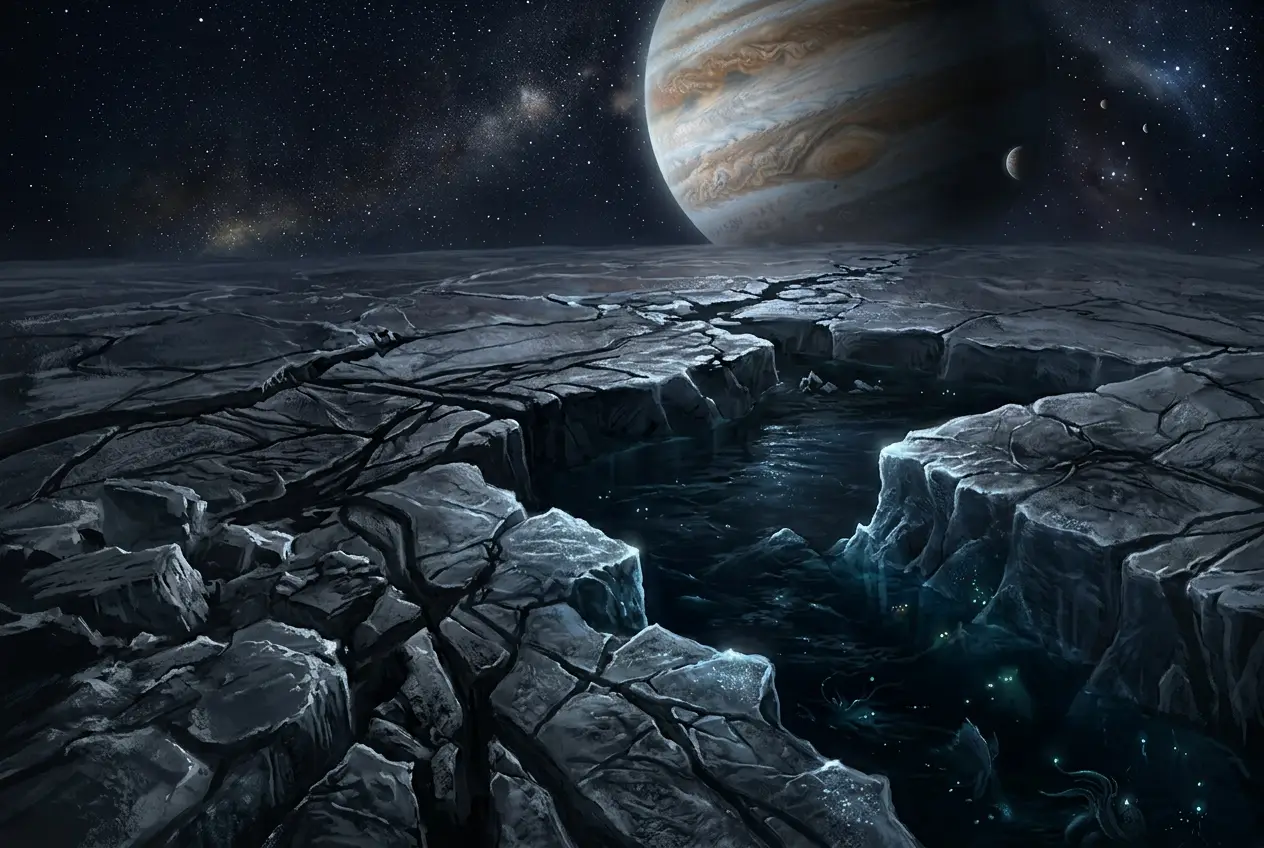
I remember staring at images of Jupiter's moon Europa for the first time, years ago. The intricate network of cracks across its icy shell, gleaming under the distant sun, always felt like a cosmic secret waiting to be unveiled. It looked less like a barren rock and more like a celestial puzzle, hinting at something profound beneath its frozen exterior. What if, I wondered, those cracks weren't just geological scars, but windows into a realm teeming with life?
For decades, the idea of life beyond Earth has captivated scientists and dreamers alike. While Mars often grabs the headlines with its ancient riverbeds and tantalizing traces of water, another contender in our solar system quietly promises even more. Europa, one of Jupiter’s four largest moons, has emerged as a prime candidate in the search for extraterrestrial life, not on its surface, but within a vast, global ocean hidden beneath miles of ice.
### The Allure of Europa: A Subsurface Sea
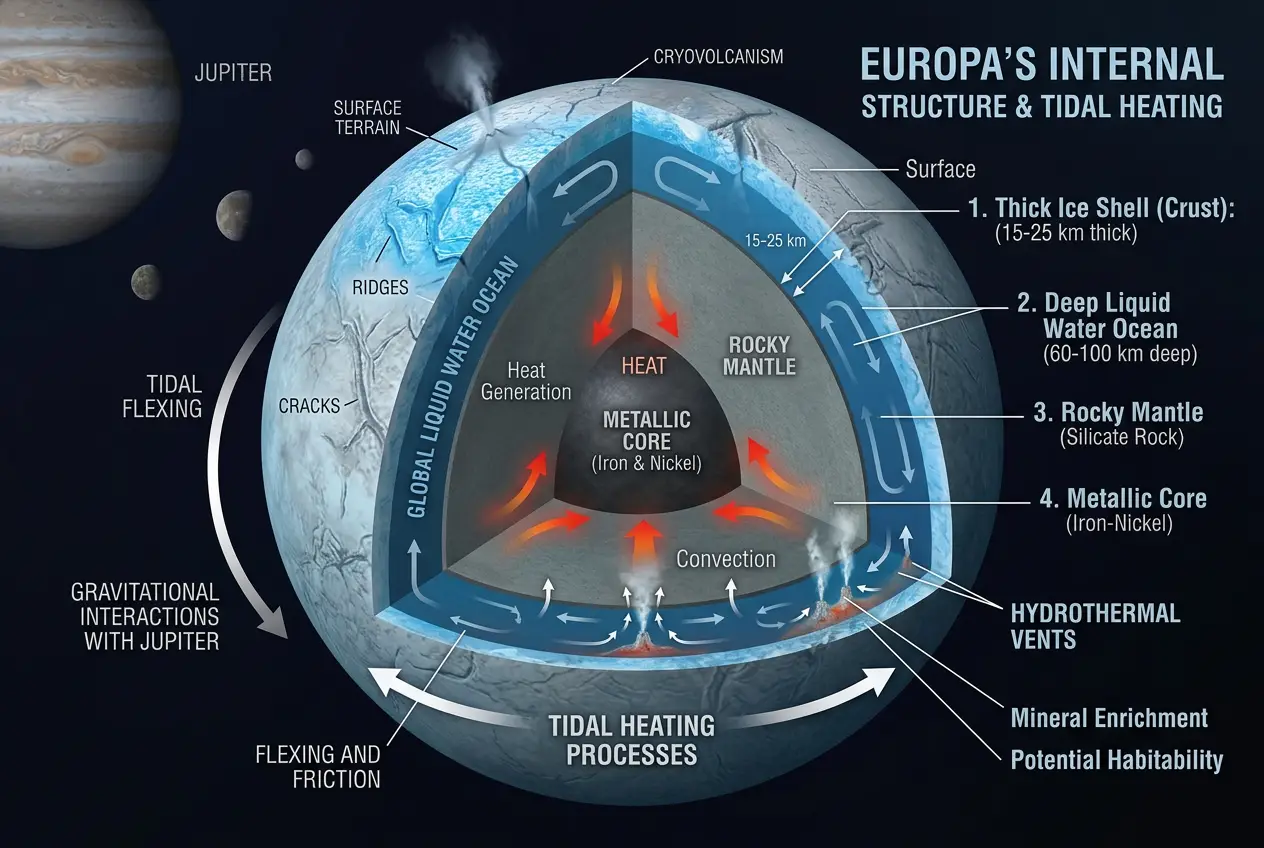
Imagine a world where the surface is an impenetrable shield of ice, possibly tens of kilometers thick, yet beneath it lies an ocean containing more water than all of Earth’s oceans combined. That’s Europa. This incredible discovery isn't just speculation; it's supported by compelling evidence gathered from decades of observations by NASA’s Voyager and Galileo missions. These missions revealed a moon with very few impact craters, suggesting a geologically active surface that resurfaces itself, possibly through ice tectonics or cryovolcanism – processes driven by the dynamic ocean below.
The gravitational dance between Europa and its massive parent planet, Jupiter, is the key to this potential habitability. Jupiter's immense tidal forces constantly stretch and squeeze Europa, generating internal friction that heats the moon's interior. This "tidal heating" is believed to be strong enough to maintain a liquid water ocean under the ice shell, and perhaps even drive hydrothermal activity on its seafloor, similar to the life-supporting vents found deep in Earth's oceans. This makes Europa an anomaly, a potentially warm, wet world in the cold expanse of the outer solar system.
### The Pillars of Life: What Europa Might Offer
For life as we know it, three primary ingredients are generally considered essential: **liquid water**, **essential chemical elements**, and an **energy source**. Europa appears to tick all these boxes:
* **Liquid Water:** As discussed, Europa's subsurface ocean is considered a near certainty. This vast reservoir of water provides the solvent necessary for chemical reactions that underpin life.
* **Essential Chemical Elements:** Scientists believe that Europa's rocky core, in contact with its ocean, could leach out vital elements like carbon, hydrogen, nitrogen, oxygen, phosphorus, and sulfur (CHNOPS), which are the building blocks of organic molecules. Early research even suggests that Europa's ice shell may contain oxygen, possibly produced by radiation from Jupiter, which could then mix into the ocean. You can delve deeper into the fascinating chemistry of celestial bodies on Wikipedia's page about [Astrobiology](https://en.wikipedia.org/wiki/Astrobiology).
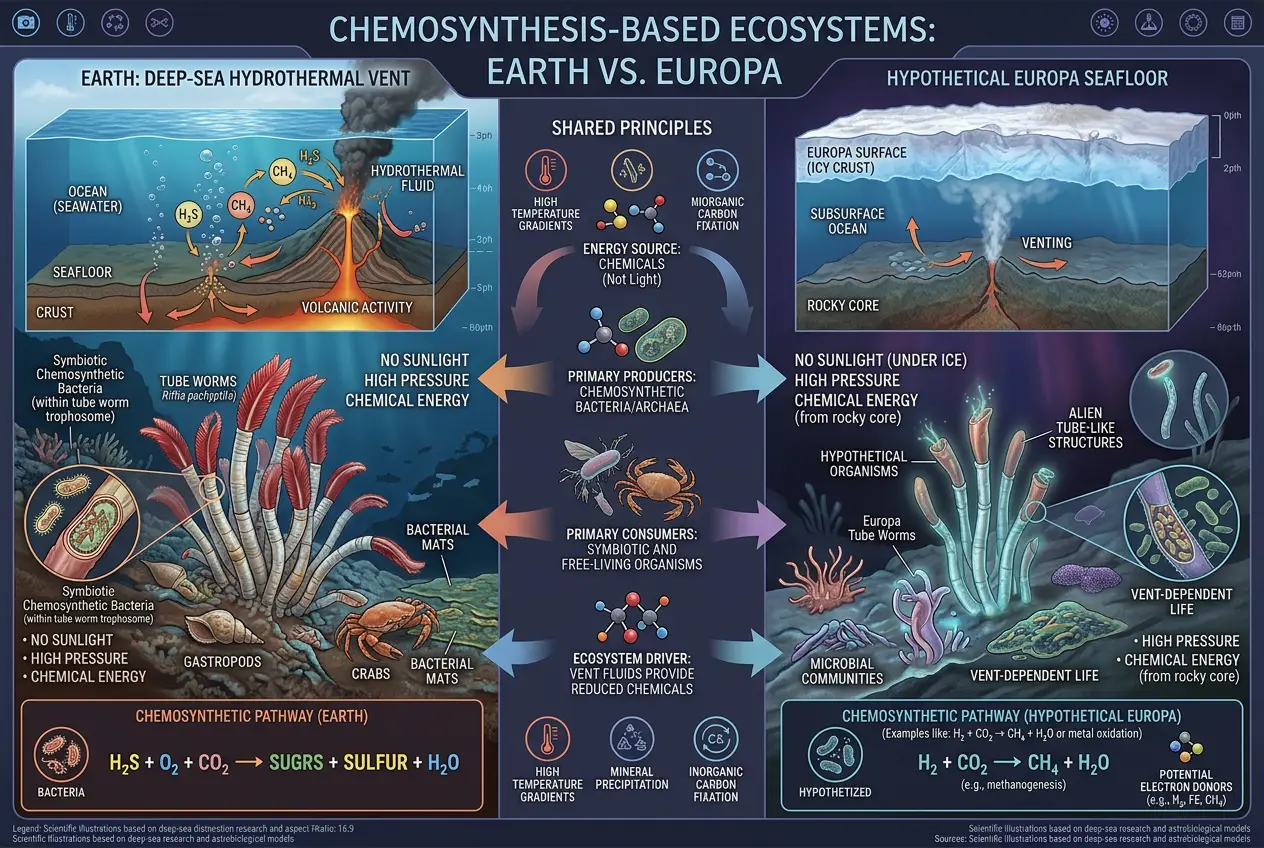
* **Energy Source:** This is where Europa gets truly exciting. On Earth, life often depends on sunlight for energy (photosynthesis). But in the lightless depths of Europa's ocean, life would need to rely on chemosynthesis – harnessing chemical energy. Hydrothermal vents on Europa's seafloor, if they exist, would provide a powerful energy source, releasing heat and minerals that could fuel unique ecosystems, much like those found around deep-sea vents on Earth. This concept is explored further in discussions about our own planet's deep ocean discoveries, like those mentioned on [Wikipedia's Hydrothermal Vent page](https://en.wikipedia.org/wiki/Hydrothermal_vent).
### The Search for Biosignatures: What Are We Looking For?
Finding life on Europa isn't about spotting little green men. It's about detecting "biosignatures" – any substance or structure that provides scientific evidence of past or present life. These could include:
* **Organic Molecules:** Complex carbon-based molecules that are indicative of biological processes.
* **Cellular Structures:** Microscopic fossils or actual living cells, though these would be incredibly challenging to detect.
* **Isotopic Anomalies:** Living organisms often prefer specific isotopes of elements. An unusual ratio could be a biosignature.
* **Gases:** Certain gases in the atmosphere or ocean that are not easily explained by geological processes, such as methane or oxygen in concentrations suggesting biological production.
Recent observations from the Hubble Space Telescope have provided intriguing clues. In 2016, Hubble detected what appeared to be plumes of water vapor erupting from Europa’s surface, potentially offering a direct pathway to sample the ocean without drilling through miles of ice. These plumes, if confirmed and consistent, could be a game-changer for future missions, providing a golden opportunity to "taste" Europa’s ocean.
### NASA's Europa Clipper: Our Eye on the Icy World
To unravel Europa's secrets, NASA is sending the Europa Clipper mission, set to launch in 2024. This ambitious spacecraft won't land on Europa but will perform nearly 50 close flybys of the moon, orbiting Jupiter and swooping past Europa to gather high-resolution images and crucial data. Its sophisticated instruments are designed to:
* **Map the Ice Shell:** Determine the thickness and structure of the ice.
* **Analyze Ocean Composition:** Use radar to probe beneath the ice and magnetometers to study the ocean's properties.
* **Search for Plumes:** Look for and analyze any active water plumes erupting from the surface.
* **Identify Potential Landing Sites:** Pave the way for future lander missions.
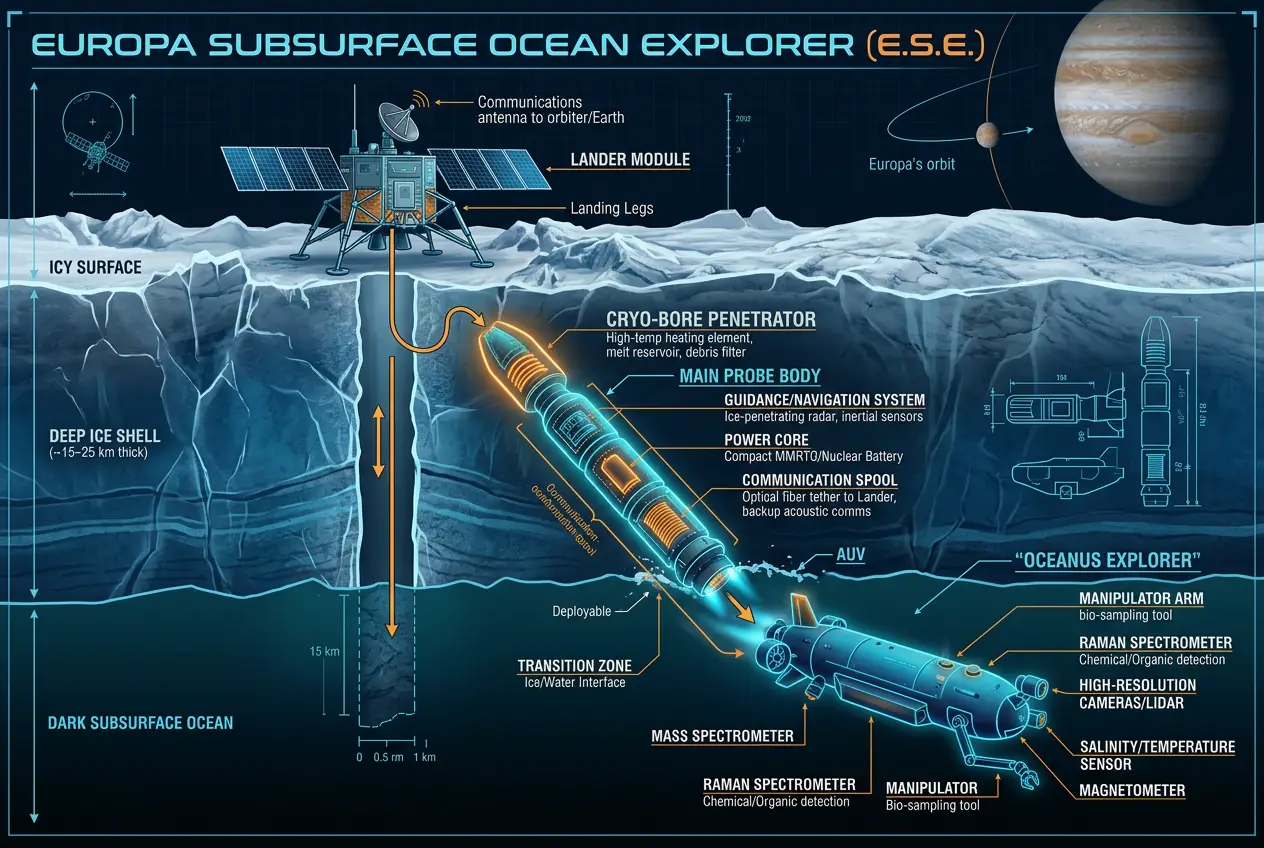
The data from Europa Clipper will be instrumental in understanding the moon's potential for life and guiding future missions, perhaps even a lander that could melt its way through the ice to directly explore the ocean. The journey to unlock these cosmic mysteries is truly one of humanity’s greatest endeavors, reminding us of our continuous quest to explore new frontiers, much like the broader search for extraterrestrial intelligence as explored in discussions around the [Fermi Paradox](https://en.wikipedia.org/wiki/Fermi_paradox) and why the universe seems so quiet, which you can read more about at /blogs/why-is-the-universe-so-quiet-decoding-the-fermi-paradox-5418.
### Beyond Europa: Other Icy Worlds
Europa isn’t alone in its potential. Other icy moons in our solar system, particularly Saturn's moon Enceladus, also boast subsurface oceans and active plumes, confirming that liquid water worlds are not as rare as once thought. Enceladus, with its "tiger stripe" geysers, actively spews ocean material into space, offering another accessible target for astrobiological investigation. The discovery of these active icy worlds truly reshapes our understanding of where life might originate and thrive. To understand more about other such incredible moons, you might want to read our blog on /blogs/do-cryovolcanoes-hide-alien-oceans-1773.
The implications of finding life on Europa, even microbial life, would be monumental. It would fundamentally change our perception of humanity’s place in the universe, suggesting that life might be a common occurrence rather than a unique terrestrial phenomenon. It would fuel further exploration, inspiring generations to come to look up and wonder what other incredible forms of life might exist within the cosmic tapestry. This ongoing exploration mirrors our broader quest to understand life's fundamental building blocks, even considering exotic ideas like /blogs/could-meteors-seed-life-the-panspermia-puzzle-3345.
### The Human Element in Cosmic Exploration
While the scientific instruments do the heavy lifting, it's the insatiable curiosity of humanity that drives these missions. I think about the engineers, scientists, and technicians who dedicate their lives to designing, building, and operating these complex spacecraft. Their passion ensures that we continue to push the boundaries of knowledge, seeking answers to the biggest questions about life, the universe, and everything. Whether it's planning for a future Earth or exploring distant worlds, the human spirit of discovery remains our greatest asset. You can explore our future projections in the blog /blogs/earth-2099-will-humanity-live-in-utopia-or-tech-dystopia-5078.
The potential for life on Europa is more than just a scientific hypothesis; it’s a beacon of hope and a profound challenge to our understanding of biology and planetary science. As we stand on the precipice of these discoveries, I find myself filled with immense excitement, knowing that the next few years could bring answers that redefine our place in the cosmos. The universe, it seems, always has more surprises in store.
The journey to Europa is a testament to human ingenuity and our endless thirst for discovery. Whether we find microbial life or simply further evidence of its potential, Europa will undoubtedly continue to be a star in our quest to answer the age-old question: Are we alone?
Frequently Asked Questions
Europa is considered a prime candidate because it is believed to harbor a vast liquid water ocean beneath its icy shell, maintained by tidal heating from Jupiter. This ocean, in contact with a rocky core, could provide the essential ingredients for life: liquid water, chemical elements, and an energy source from potential hydrothermal vents.
Tidal heating occurs due to the gravitational pull of Jupiter. As Europa orbits, Jupiter's immense gravity stretches and squeezes the moon, creating friction within its interior. This friction generates heat, which is thought to be sufficient to keep Europa's subsurface ocean liquid and potentially drive geological activity, including hydrothermal vents.
NASA's Europa Clipper is a mission set to launch in 2024. It will perform numerous close flybys of Europa to gather high-resolution images and data. Its primary goals include mapping the ice shell, analyzing the ocean's composition using radar and magnetometers, searching for active water plumes, and identifying potential landing sites for future missions. It will help determine if Europa has the necessary conditions for life.
Biosignatures are any substances, patterns, or structures that provide scientific evidence of past or present life. On Europa, scientists would look for organic molecules, unusual isotopic ratios, certain gases (like methane or oxygen) that aren't easily explained by geology, or even microscopic cellular structures, although the latter would be very challenging to detect directly.
Yes, besides Europa, Saturn's moon Enceladus is another significant candidate. It also has a subsurface ocean and actively spews water vapor and organic molecules into space through its 'tiger stripe' geysers. These discoveries suggest that icy moons with hidden oceans might be common, expanding the potential habitats for extraterrestrial life within our own solar system.
Verified Expert
Alex Rivers
A professional researcher since age twelve, I delve into mysteries and ignite curiosity by presenting an array of compelling possibilities. I will heighten your curiosity, but by the end, you will possess profound knowledge.
Leave a Reply
Comments (0)
No approved comments yet. Be the first to share your thoughts!
 Join Us


 Alex Rivers



























Leave a Reply
Comments (0)