


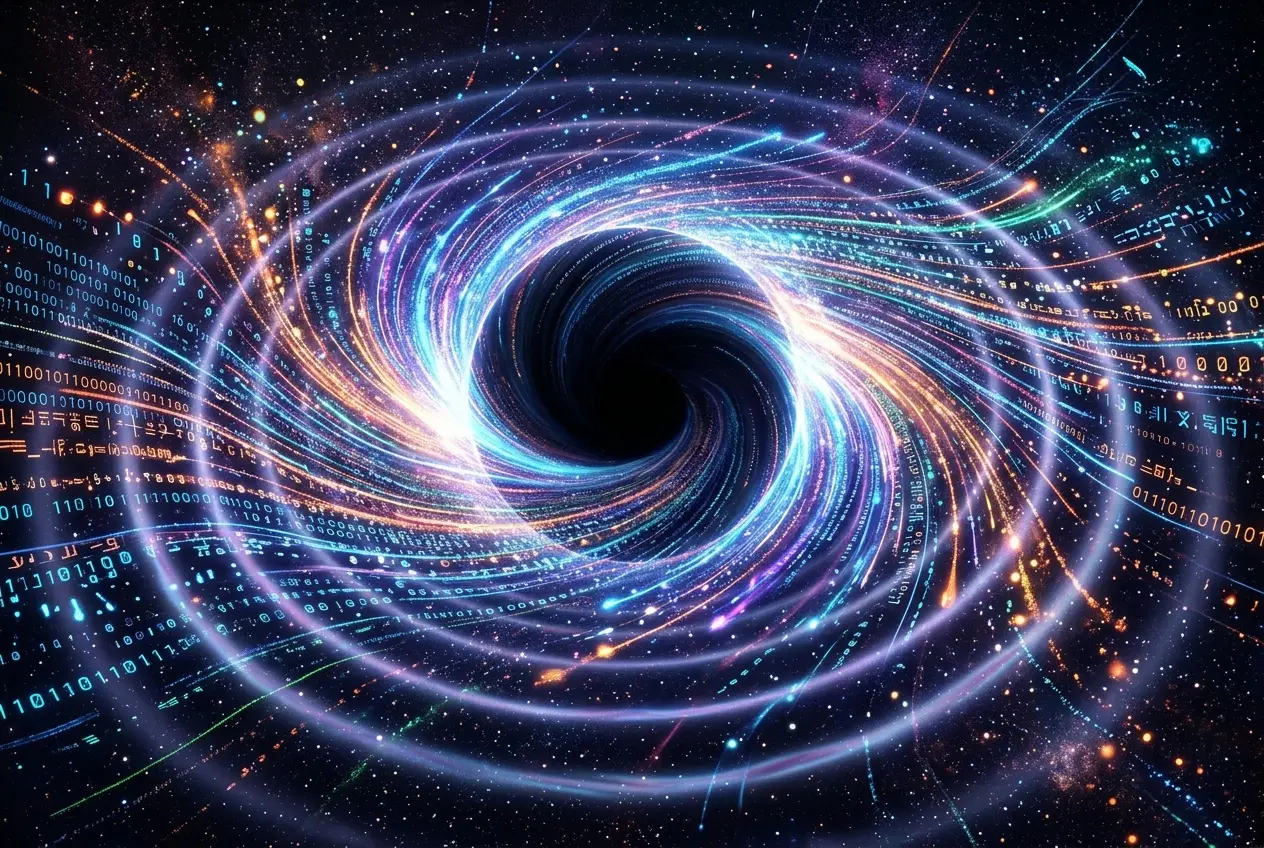
The universe, for all its vastness and mystery, seems to operate on fundamental principles that occasionally reveal themselves in the most unexpected ways. I often find myself pondering the deepest connections between disparate fields of science. One such connection, which consistently piques my curiosity, is the peculiar relationship between information and the physical world – particularly, could information itself possess mass, or at least influence gravity? It sounds like something out of a science fiction novel, yet modern physics offers tantalizing clues that suggest this isn't just a philosophical musing, but a question with profound implications for how we understand reality.
The Bit and the Bang: Is Information Fundamental?
For centuries, physicists grappled with matter, energy, space, and time as the bedrock of reality. However, in the 20th and 21st centuries, a new contender has emerged: information. From the DNA in our cells to the bits flowing through our internet, information seems to be an irreducible component of the cosmos. But is it just an abstract concept, or does it have a tangible physical presence?
This isn't an idle query. If information is fundamental, then perhaps it obeys the same laws as everything else in the universe, including the laws of thermodynamics and even gravity. The idea that information might have a physical cost, or even a physical manifestation, leads us down a fascinating rabbit hole where the digital intertwines with the gravitational.
Landauer's Principle: The Cost of Erasing a Bit
Our journey into digital gravity often begins with a fundamental insight from IBM physicist Rolf Landauer in 1961. Landauer proposed that erasing a single bit of information always dissipates a minimum amount of energy as heat into the environment. Think about it: when you delete a file from your computer, or flip a transistor from a '1' to a '0', that act of "forgetting" or resetting the physical state requires a tiny, but measurable, amount of energy to be expended. This is known as Landauer's Principle (opens in a new tab).
Why is this significant? Because Einstein taught us that energy and mass are interchangeable through his famous equation, E=mc². If erasing a bit requires energy, then by extension, information itself (or at least the change in its state) is intrinsically linked to energy. Does this mean storing a bit also implies a tiny energy cost, and therefore, a minute amount of mass?
"Information is not something that you can abstract from its physical embodiment. It is always embodied in some physical system." — Rolf Landauer
This principle sets a thermodynamic lower bound for computation. It tells us that processing information isn't a free lunch; it's a physical process governed by the laws of physics. Experiments have confirmed Landauer's principle in various systems, from colloidal particles to quantum dots, validating the physical reality of information's thermodynamic cost. This connection is the first whisper of information's tangible nature, hinting that perhaps it's not just an abstract concept, but a physical property of the universe.
The Bekenstein Bound: Information and Black Holes
If Landauer's principle gives us the energy cost of information, then the work of Jacob Bekenstein and Stephen Hawking takes it to the extreme: black holes. Black holes are the ultimate cosmic data shredders, or so we thought. But Bekenstein, pondering what happens to information when it falls into a black hole, realized that if information truly vanishes, it would violate the second law of thermodynamics (which states that entropy, or disorder, never decreases in a closed system).
Bekenstein proposed that a black hole's event horizon, its point of no return, has an entropy proportional to its surface area, not its volume. More astounding, he theorized that there's a maximum amount of information that can be contained within a given region of space, proportional to the area of its boundary. This is the Bekenstein Bound (opens in a new tab).
This implies that the information content of any physical system, including a black hole, is directly tied to a geometric property (area) rather than its internal complexity. When information falls into a black hole, it doesn't vanish; it's encoded on the surface of the event horizon. This is a profound shift: information isn't just about what's inside but about the boundary of the space. It means the universe is a finite storage device, and every bit of information takes up physical space on this cosmic "hard drive."
Furthermore, if black holes have entropy, they must have a temperature and radiate energy (Hawking radiation). This radiation carries away information, albeit in a scrambled form. The mass-energy equivalent of this information loss is significant for black holes. Could the same be true, to a much smaller degree, for information outside black holes?
Digital Gravity: A Universe Built on Bits?
Now, let's connect these threads. If information has an energy equivalent (Landauer's Principle) and takes up fundamental physical "space" (Bekenstein Bound), then could it also exert a gravitational pull? Could digital gravity be a subtle, yet pervasive, force woven into the fabric of reality?
The concept of "it from bit," popularized by physicist John Archibald Wheeler, suggests that information is not just a descriptor of reality but its fundamental constituent. In this view, particles, fields, and even spacetime itself arise from binary choices, from "yes/no" questions. If reality is fundamentally informational, then the properties of information – including its thermodynamic and gravitational implications – become paramount.
Imagine the sheer volume of information generated daily by humanity: countless terabytes of data, streaming across networks, stored in vast data centers. If each bit contributes a minuscule amount of mass, then our digital footprint could collectively exert a measurable, albeit tiny, gravitational effect. This is not about the mass of the electrons or the silicon chips storing the data, but the information encoded within them.
This idea leads to intriguing questions:
- Could the information density of early universe, packed into a tiny volume, have contributed to its initial gravitational landscape?
- Could information entropy play a role in the mysterious nature of dark energy, which seems to be accelerating the expansion of the universe?
- Are there observable cosmological effects of information accumulation?
While these are largely speculative, the underlying physics grounding Landauer's principle and the Bekenstein bound provides a framework for such considerations. The theoretical physicist Erik Verlinde, for instance, has proposed an entropic theory of gravity (opens in a new tab), where gravity is not a fundamental force, but an emergent phenomenon arising from changes in information and entropy. In his model, gravity is a consequence of systems moving towards higher entropy, much like a gas expanding to fill a vacuum. This is a radical departure from Einstein's view of gravity as spacetime curvature but fundamentally places information at the heart of gravity itself.
The Mass of a Byte: A Practical Calculation?
Let's attempt a thought experiment. Landauer's principle states that the minimum energy dissipated when erasing one bit is kT ln 2, where k is the Boltzmann constant, T is the temperature, and ln 2 is the natural logarithm of 2. At room temperature (around 300 Kelvin), this energy is approximately 2.87 x 10^-21 Joules.
Using E=mc², we can calculate the equivalent mass: m = E/c²
Given c (speed of light) ≈ 3 x 10^8 m/s, c² ≈ 9 x 10^16 m²/s². So, m ≈ (2.87 x 10^-21 J) / (9 x 10^16 m²/s²) ≈ 3.19 x 10^-38 kg per bit.
This is an incredibly tiny amount – far smaller than the mass of a single proton (approx. 1.67 x 10^-27 kg). To put it in perspective, you would need to erase roughly 500 million billion bits (5 x 10^17 bits) to generate the equivalent mass of a single electron. This is why we don't feel a gravitational pull from our smartphones when they delete data!
However, the universe is vast, and information is abundant. Over cosmic scales and extreme conditions (like near black holes), these tiny contributions could accumulate. The question then shifts from "Can a bit have mass?" to "Could the cumulative mass-equivalent of information influence cosmological dynamics or local gravitational fields?"
Implications for Future Tech and Beyond
If information truly has a physical footprint beyond its material substrate, what does this mean for our future?
- Ultimate Storage Limits: The Bekenstein bound already suggests limits to how much information can be crammed into a given volume. If information also contributes mass, this could imply even more nuanced limits to hyper-dense storage or computation, as concentrating too much information might create miniature black holes.
- Energy Efficiency: Understanding the deep link between information and energy reinforces the need for ultra-efficient computing. Our current digital infrastructure is a massive energy consumer. Future "reversible computing" aims to circumvent Landauer's limit by performing operations without erasing information, theoretically reducing heat dissipation to near zero.
- Fundamental Physics: The quest to unify quantum mechanics and general relativity (gravity) is one of physics' greatest challenges. If information is a bridge between the two, perhaps it holds the key to a theory of everything. Exploring digital gravity might unlock new ways to understand the universe's fundamental architecture.
- Consciousness and Reality: Some speculative theories even propose that consciousness itself is an informational process, and if information influences reality, then our minds might have a more profound, albeit subtle, connection to the physical world than previously imagined. Could the complex informational processing in our brains have some minute, localized gravitational effect? This is far-fetched, but it sparks curiosity.
The journey into digital gravity is just beginning. While the direct observation of a single bit's mass equivalent remains beyond our current technological capabilities, the theoretical underpinnings are robust. As we continue to generate, store, and process ever-increasing amounts of data, the universe might be subtly responding to our informational output in ways we are only just beginning to comprehend. The line between the abstract and the physical, the digital and the gravitational, seems to blur more with every new discovery, inviting us to look at the universe through a profoundly different lens. For more on how the universe might be a giant computer, you can explore our previous article, Is the Universe a Giant Neural Network? or delve into the mysteries of how quantum mechanics impacts even biological systems by checking out Could Quantum Biology Unlock Life's Deepest Secrets?.




Conversation0
No comments yet. Be the first to share a thought — the best questions often become new stories.