



I remember staring at the image of a stone wall, its blocks interlocked with a precision that seemed to defy the very concept of ancient tools. It wasn't just impressive; it was impossible. Every edge was so perfectly cut, every angle so exact, that my mind struggled to reconcile it with the chisels and hammers we typically associate with civilizations thousands of years ago. It felt like I was looking at something fashioned by laser cutters, not human hands. This encounter sparked a deep dive into what archaeologists call "Out-of-Place Artifacts," or OOPArts – objects that simply shouldn't exist in their historical context.
For centuries, the narrative of human technological progress has largely been viewed as a linear ascent. From primitive tools to the digital age, each innovation built upon the last. But what if this neatly ordered timeline is flawed? What if scattered across our planet are forgotten whispers of sophisticated knowledge, preserved in objects that challenge everything we thought we knew about ancient civilizations? These "impossible artifacts" aren't just curiosities; they are potential keys to unlocking a lost chapter of human history, hinting at advanced engineering, forgotten sciences, or even civilizations far more complex than we currently imagine.
The term "Out-of-Place Artifact" itself is a lightning rod for debate. Skeptics often attribute such anomalies to misinterpretation, natural geological formations, or outright hoaxes. Yet, the persistent existence of certain objects, backed by archaeological evidence and rigorous analysis, continues to baffle conventional explanations. I find myself drawn to these enigmas, not to endorse wild theories, but to explore the genuine scientific questions they provoke. Could our ancestors have harnessed technologies we're only now rediscovering?
Masterful Stonework Beyond Simple Tools
One of the most compelling categories of impossible artifacts lies in the realm of ancient stonework. Across the globe, from the Andean peaks to the Egyptian deserts, we encounter structures and objects that suggest a mastery of stonemasonry far beyond the capabilities typically attributed to the cultures that created them. It’s not just about moving massive stones, but about cutting, shaping, and fitting them with an almost unbelievable precision.
The Enigma of Puma Punku
Perhaps nowhere is this more evident than at Puma Punku, part of the Tiahuanaco complex in modern-day Bolivia. The ruins here feature colossal blocks of diorite and andesite, some weighing over 100 tons, cut with such accuracy that they interlock like giant LEGO bricks. What truly sets Puma Punku apart are the intricate, repetitive "H-blocks" and incredibly precise, almost geometric cuts and polished surfaces. I've often wondered how such perfect right angles, flat surfaces, and drilling-like holes could be achieved with the primitive copper or stone tools believed to be available to the Tiwanaku people. Some cuts are so fine, they appear to have been made by machinery with tolerances comparable to modern industrial manufacturing.
"The precision of the cuts and the complexity of the interlocking elements at Puma Punku suggest a level of engineering sophistication that remains unexplained by conventional archaeological interpretations," notes Dr. Andrew Collins, an author and researcher who has explored ancient mysteries. The sheer effort, let alone the specialized techniques required, to craft these stones is mind-boggling. You can delve deeper into the mystery of this ancient site on its Wikipedia page (opens in a new tab).
Echoes of Precision in Egypt and Beyond
While not as overtly "impossible" in form, the precision seen in ancient Egyptian monuments also raises questions. The sarcophagi within the Serapeum at Saqqara, for instance, are massive granite boxes with perfectly flat internal surfaces and razor-sharp angles, often achieved within fractions of a millimeter. Similarly, the astounding polygonal walls of Inca fortresses like Sacsayhuamán, where enormous, irregularly shaped stones fit together without mortar so tightly that a knife blade cannot be inserted between them, speak to an understanding of engineering and masonry that continues to baffle architects and engineers today. These examples challenge us to reconsider the tools and methods available to ancient builders. Our previous blog, Ancient Alignments: Did Structures Track the Cosmos?, touches on the incredible knowledge embedded in ancient structures.
Whispers of Flight: Anomalous Aerodynamic Designs
Beyond static structures, some artifacts suggest an understanding of principles like aerodynamics, centuries, if not millennia, before powered flight was conceived.
The Saqqara Bird
One such intriguing object is the Saqqara Bird, discovered in an Egyptian tomb in 1898. This small wooden artifact, dating back to around 200 BCE, resembles a bird with outstretched wings but has a vertical tailpiece unlike that of any known bird. When tested by aerodynamicists, some have suggested it exhibits characteristics of a glider. Its inverted dihedral wings (tilted slightly downwards) could have provided stability, while the vertical tail, if appropriately weighted, could have acted as a rudder or elevator. Was it simply a ceremonial toy, or did it represent a model of an ancient attempt at flight, perhaps a lost concept of an early glider? The debate continues to this day, making it a truly fascinating OOPArt. Learn more about the Saqqara Bird on Wikipedia (opens in a new tab).
Pre-Columbian Gold "Airplanes"
Even more astonishing are a collection of small gold artifacts found in South and Central America, dating from 500-800 CE. These objects, initially categorized as zoomorphic depictions of insects or fish, bear striking resemblances to modern aircraft when viewed from a different perspective. They possess triangular delta wings, stabilizers, and even what appear to be fuselages. When models based on these artifacts have been tested in wind tunnels, some have exhibited remarkable aerodynamic stability and lift. While their original purpose remains unknown – perhaps ornamental, perhaps ritualistic – their aerodynamic efficiency invites speculation about a forgotten understanding of flight principles by ancient cultures.
Lost Sciences: Glimpses into Forgotten Metallurgy and Composites?
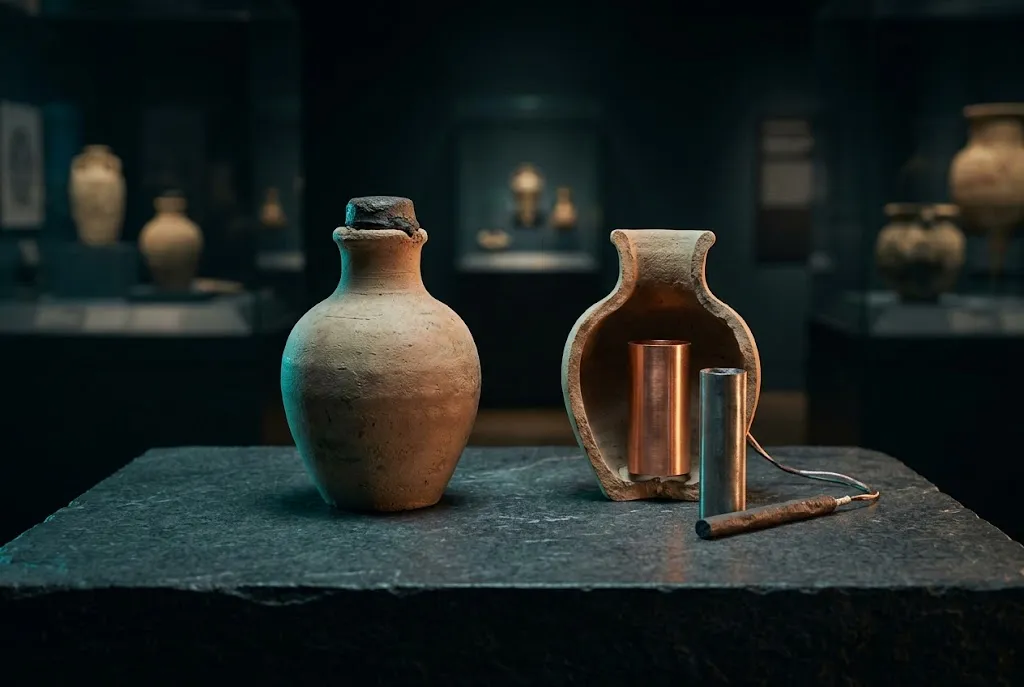
While specific well-known examples like the Baghdad Battery or Ulfberht swords have been discussed (and covered in previous posts like The Baghdad Battery: Did Ancient Iraqis Power a Lost Civilization? and Ulfberht Swords: Did Vikings Forge Impossible Steel?), the broader question remains: did ancient societies possess metallurgical or material science knowledge that has been lost to time?
Evidence often emerges in the form of incredibly durable alloys, unique composite materials, or objects requiring extremely high temperatures or complex chemical processes to create. For instance, some ancient Roman concrete structures, though not strictly an "OOPArt" now, have been found to exhibit self-healing properties that modern concrete struggles to replicate, suggesting a deep understanding of materials science that surpassed our own for centuries. (You can explore this further in our blog, Immortal Concrete: Did Romans Master Lost Tech?). This points to a broader pattern where the capabilities of ancient craftspeople, when truly scrutinized, often exceed our initial assumptions, hinting at lost techniques rather than alien intervention. The existence of these 'impossible' objects compels us to investigate the processes behind them, rather than dismiss them outright.
The Debate: Lost Tech, Alien Influence, or Misinterpretation?
The existence of OOPArts invariably leads to passionate debate and diverse theories:
- Lost Advanced Civilizations: One compelling theory posits that highly advanced ancient cultures, perhaps predating known historical timelines, possessed sophisticated technologies that were subsequently lost due to catastrophic events or societal collapse. Their remnants, like the artifacts we discuss, are mere fragments of a forgotten golden age. This theory often suggests a cyclical view of history rather than a purely linear one.
- Extraterrestrial Contact: A more speculative, yet popular, explanation in certain circles is that these artifacts are evidence of ancient extraterrestrial visitors who shared knowledge or left behind advanced tools. While captivating, this theory generally lacks verifiable scientific proof and tends to be a default explanation for anything that doesn't fit neatly into the archaeological record.
- Misinterpretation & Underestimation of Ancient Capabilities: Mainstream archaeology often argues that OOPArts are either natural formations mistaken for artifacts, misidentified, or simply demonstrate that ancient peoples were far more ingenious and resourceful than we give them credit for. They emphasize that complex problems can be solved with seemingly simple tools through immense labor, patience, and clever methods that are difficult to reconstruct today. Our modern bias often underestimates their ingenuity due to our reliance on machine-based solutions.
I believe the truth likely lies in a nuanced understanding, combining aspects of several theories. While some objects may indeed be misinterpretations, others, like the precision stonework of Puma Punku, demand a re-evaluation of ancient capabilities. These artifacts serve as a powerful reminder that history is not a static text, but a dynamic story constantly being rewritten by new discoveries.
Conclusion: Questioning the Timeline of Innovation
The existence of impossible artifacts forces us to confront uncomfortable questions about our understanding of human technological evolution. Were there periods of advanced knowledge that were lost to time, only to resurface as perplexing anomalies? Or do these objects simply highlight the profound ingenuity of our ancestors, challenging us to look beyond our modern biases and appreciate the full scope of their intellectual and technical achievements?
As I continue to explore these mysteries, I find that the most valuable lesson isn't necessarily about finding proof of aliens or lost super-civilizations, but about cultivating a deeper sense of curiosity and intellectual humility. These objects are not just relics; they are invitations to rethink, re-examine, and perhaps, rediscover the incredible story of human innovation. The journey of unraveling these ancient tech mysteries is far from over, and I encourage you to join the conversation.



Conversation0
No comments yet. Be the first to share a thought — the best questions often become new stories.