


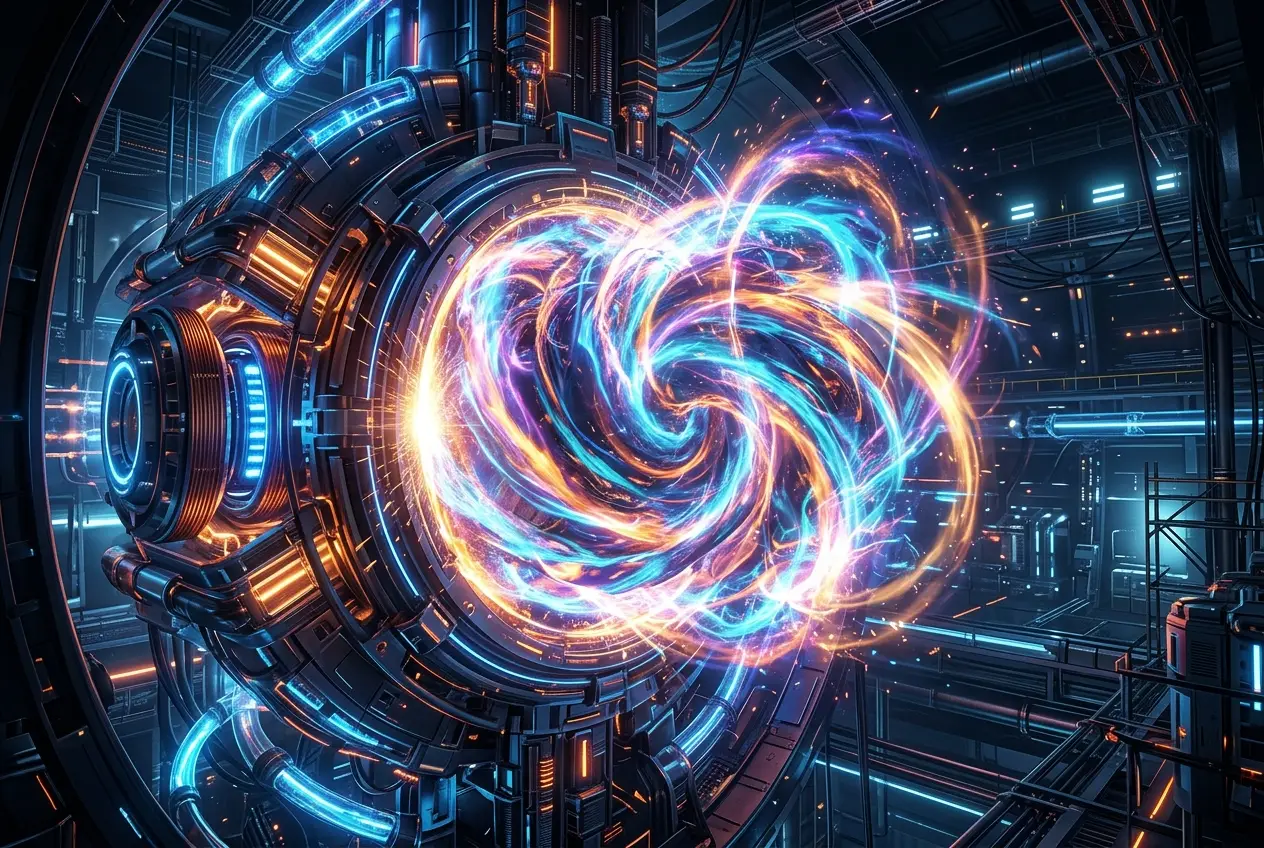
I often find myself looking up at the night sky, captivated by the distant glow of stars. Each one, a cosmic furnace, tirelessly churning out unimaginable amounts of energy. It’s a spectacular thought: what if we could replicate that stellar power here on Earth? For decades, scientists and engineers have chased this dream, pushing the boundaries of physics and engineering. The key to unlocking this monumental energy source lies in something called plasma – often referred to as the fourth state of matter.
It might sound like something out of a science fiction novel, but the pursuit of limitless, clean energy from plasma isn't just a fantasy; it's a relentless scientific quest with profound implications for our future. Imagine a world where power outages are a distant memory, where fossil fuels are obsolete, and our energy needs are met with an abundance that doesn't harm our planet. That's the promise of plasma power, a promise I believe is worth exploring deeply.
What Exactly is Plasma? The Universe's Most Common State
We typically learn about three states of matter: solid, liquid, and gas. But there’s a fourth, far more prevalent state: plasma. Think of it as an ionized gas, where atoms have been stripped of some or all of their electrons, creating a soup of positively charged ions and free-moving electrons. This electrically charged mixture behaves very differently from neutral gases.
From the superheated core of our Sun to the flickering flames of a candle, from neon signs to the dazzling auroras in the sky, plasma is everywhere. In fact, over 99% of the visible universe is composed of plasma. It's the stuff of stars, the interstellar medium, and even lightning bolts. Harnessing this fundamental state of matter is akin to tapping into the very fabric of the cosmos. Understanding its unique properties is the first step on our journey to potential limitless energy.
The Stellar Dream: Fusion Power on Earth
The ultimate goal of plasma research for energy generation is nuclear fusion. This is the process that powers the Sun and all other stars. In essence, it involves forcing light atomic nuclei (like isotopes of hydrogen) to combine under extreme pressure and temperature, forming heavier nuclei and releasing an immense amount of energy in the process. It's the opposite of nuclear fission, which powers existing nuclear reactors and involves splitting heavy atoms. Fusion promises several key advantages over fission:
- Abundant Fuel: Deuterium, an isotope of hydrogen, can be extracted from ordinary water. Tritium, another isotope, can be bred from lithium, which is also plentiful.
- Minimal Long-Lived Waste: Fusion reactions produce helium, an inert gas, and very little radioactive waste compared to fission.
- Inherently Safe: Fusion reactions are not a chain reaction like fission. If containment fails, the plasma cools, and the reaction stops, eliminating the risk of a meltdown.
Sounds perfect, right? The challenge lies in recreating the conditions of a star on Earth. To make fusion happen, you need temperatures exceeding 100 million degrees Celsius – hotter than the Sun's core! At such temperatures, all matter turns into plasma. The main hurdle is how to contain and control this superheated, volatile plasma long enough for a self-sustaining reaction to occur.
Magnetohydrodynamics: Sculpting Plasma with Fields
This is where magnetohydrodynamics (MHD) comes into play. MHD is the study of the dynamics of electrically conducting fluids, like plasma, in the presence of magnetic fields. Because plasma is electrically charged, it interacts strongly with magnetic fields. This interaction allows scientists to "sculpt" and contain the superheated plasma, preventing it from touching the walls of its containment vessel (which would instantly vaporize, cooling the plasma and stopping the reaction).
One of the most promising approaches to magnetic confinement is the tokamak, a toroidal (doughnut-shaped) device. Invented in the Soviet Union, tokamaks use powerful magnetic coils to create a magnetic "cage" that traps the plasma. The magnetic field lines spiral around the torus, keeping the plasma away from the walls. Another, more complex design is the stellarator, which uses external magnets to twist the plasma into a more stable, complex shape.
The theoretical foundations of MHD date back to the early 20th century, with significant contributions from scientists like Hannes Alfvén, who was awarded the Nobel Prize for his work in the field. I've often thought about how fundamental discoveries in physics, like those concerning electromagnetic forces, lay the groundwork for technologies that might power entire civilizations. For a deeper dive into the physics of plasma, the Wikipedia article on Plasma (physics) (opens in a new tab) is an excellent resource.
The Grand Challenge: Keeping it Hot and Contained
The road to viable fusion power has been long and fraught with challenges. The primary hurdles include:
- Achieving Ignition: Getting more energy out of the fusion reaction than what is put in to heat and contain the plasma. This is known as Q > 1.
- Plasma Stability: Hot plasma is notoriously turbulent. Maintaining its stability and preventing disruptions that could damage the reactor is crucial.
- Material Science: The materials used for the reactor walls must withstand intense heat, neutron bombardment, and other extreme conditions.
Despite these immense challenges, significant progress is being made. The International Thermonuclear Experimental Reactor (ITER), currently under construction in France, is a global collaboration aiming to demonstrate the scientific and technological feasibility of fusion power on a large scale. ITER is designed to produce 500 MW of fusion power from 50 MW of input heating power, achieving a Q of 10. You can learn more about this monumental project on its Wikipedia page (opens in a new tab).
"The sun has been burning for five billion years, and it's nothing but a controlled hydrogen bomb. We are trying to do the same thing on Earth." — Carl Sagan, Cosmos: A Personal Voyage
This quote perfectly encapsulates the ambition behind fusion research. We are attempting to miniaturize and control a process that defines the very essence of stellar existence.
Beyond Energy: Plasma's Diverse Applications
While fusion energy is the holy grail, plasma technology already has numerous applications, and many more are being explored.
- Space Propulsion: Plasma thrusters offer a more efficient means of propulsion for spacecraft, potentially enabling faster and longer-duration missions. Unlike chemical rockets, which rely on burning fuel, plasma thrusters accelerate ions to extremely high velocities, creating thrust with much less propellant. This could one day make interstellar travel more feasible, a topic we touched upon in our blog about /blogs/dark-energy-can-it-fuel-future-space-travel-3737.
- Industrial Processes: Plasma torches are used for cutting and welding metals at extremely high temperatures. Plasma treatment is used to modify surfaces of materials, improving properties like hardness or corrosion resistance.
- Environmental Applications: Plasma can be used to treat hazardous waste, breaking down pollutants into less harmful substances.
- Medicine: Cold plasma technology is an emerging field with applications in sterilization, wound healing, and even cancer treatment.
The Pursuit of Limitless: A Vision for Tomorrow
The dream of "limitless energy" might still be some decades away, but the progress in plasma physics and engineering is undeniable. Researchers are exploring not just tokamaks and stellarators, but also inertial confinement fusion (using lasers to implode fuel pellets) and alternative magnetic confinement concepts. Every breakthrough, every increment in plasma containment time or temperature, brings us closer to a future powered by the stars.
I believe this pursuit represents one of humanity's most ambitious scientific endeavors. It's a testament to our ingenuity and our desire to secure a sustainable future. The challenges are formidable, but the potential rewards – a world free from energy scarcity and environmental degradation – are immeasurable. As we continue to unlock the secrets of plasma, we might just find that the power of the stars is not so far out of our reach after all. The journey reminds me of other quests for hidden power, like the theoretical potential of /blogs/zero-point-energy-is-space-a-hidden-powerhouse-3639.



Conversation0
No comments yet. Be the first to share a thought — the best questions often become new stories.