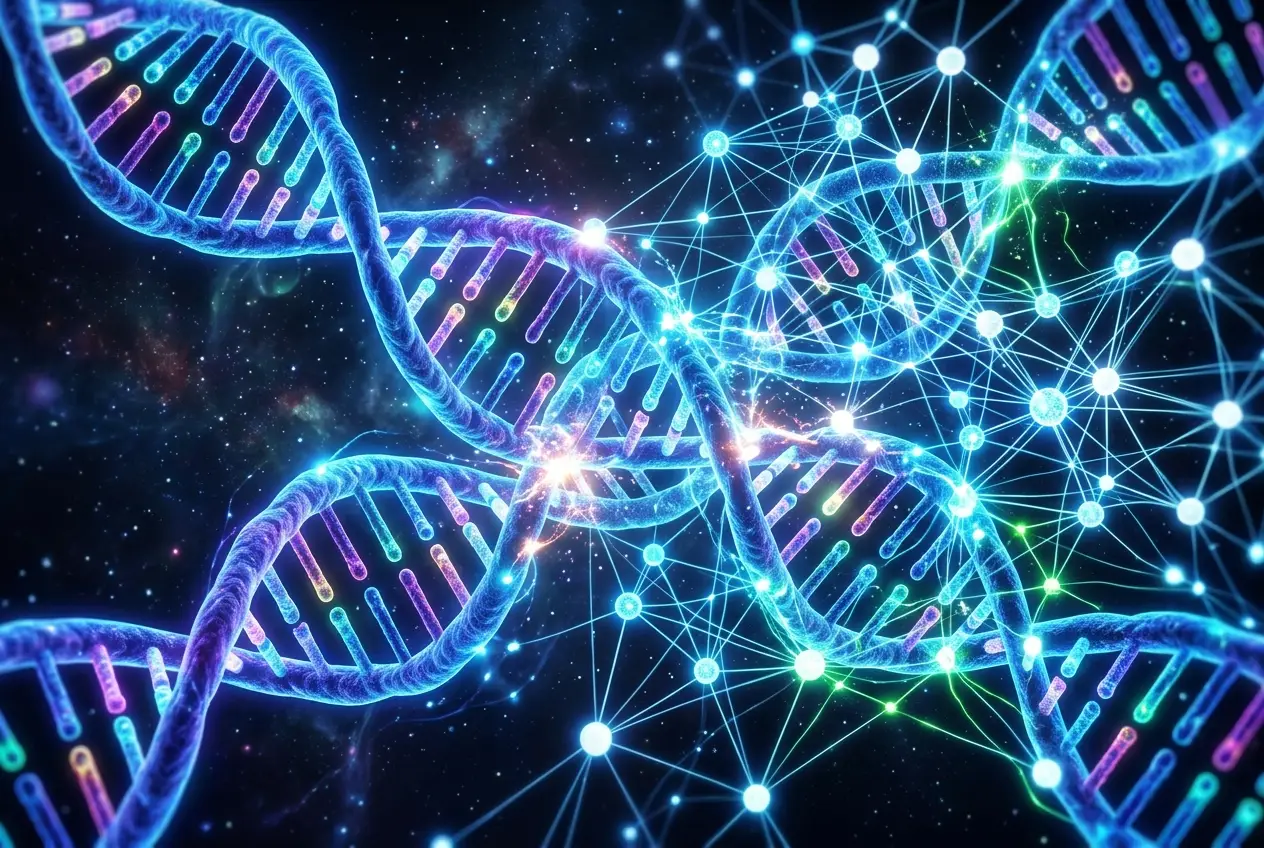
I often find myself gazing at the vastness of human innovation, yet sometimes, the most profound advancements aren't found in silicon valleys or quantum labs, but in the intricate dance of life itself. What if the very building blocks of biology, the elegant double helix of DNA, held the key to unlocking the next generation of artificial intelligence? It sounds like science fiction, a futuristic merger of biology and computation, but the truth is, scientists are already exploring this mind-bending possibility: **DNA computing**.
Imagine a computer that doesn't rely on the binary zeros and ones of electronic circuits, but on the four-letter alphabet of genetic code: A, T, C, G. This isn't just about storing data in DNA, which itself is a monumental feat we’ve discussed before, like in our post on [Can DNA store the world's digital data?](/blogs/can-dna-store-the-worlds-digital-data-5328). No, this is about DNA actively *computing*, processing information in a way that could radically redefine AI.
### The Biological Blueprint: How DNA Stores Information
Before we dive into DNA computing, it’s essential to appreciate the sheer information density of DNA. A single gram of DNA can theoretically store all the digital data on Earth. It's an incredibly compact and stable storage medium, designed by billions of years of evolution. Each nucleotide base (adenine, thymine, cytosine, guanine) acts like a tiny bit of information. The sequence of these bases forms instructions for life, just as a sequence of binary digits forms instructions for a silicon chip.
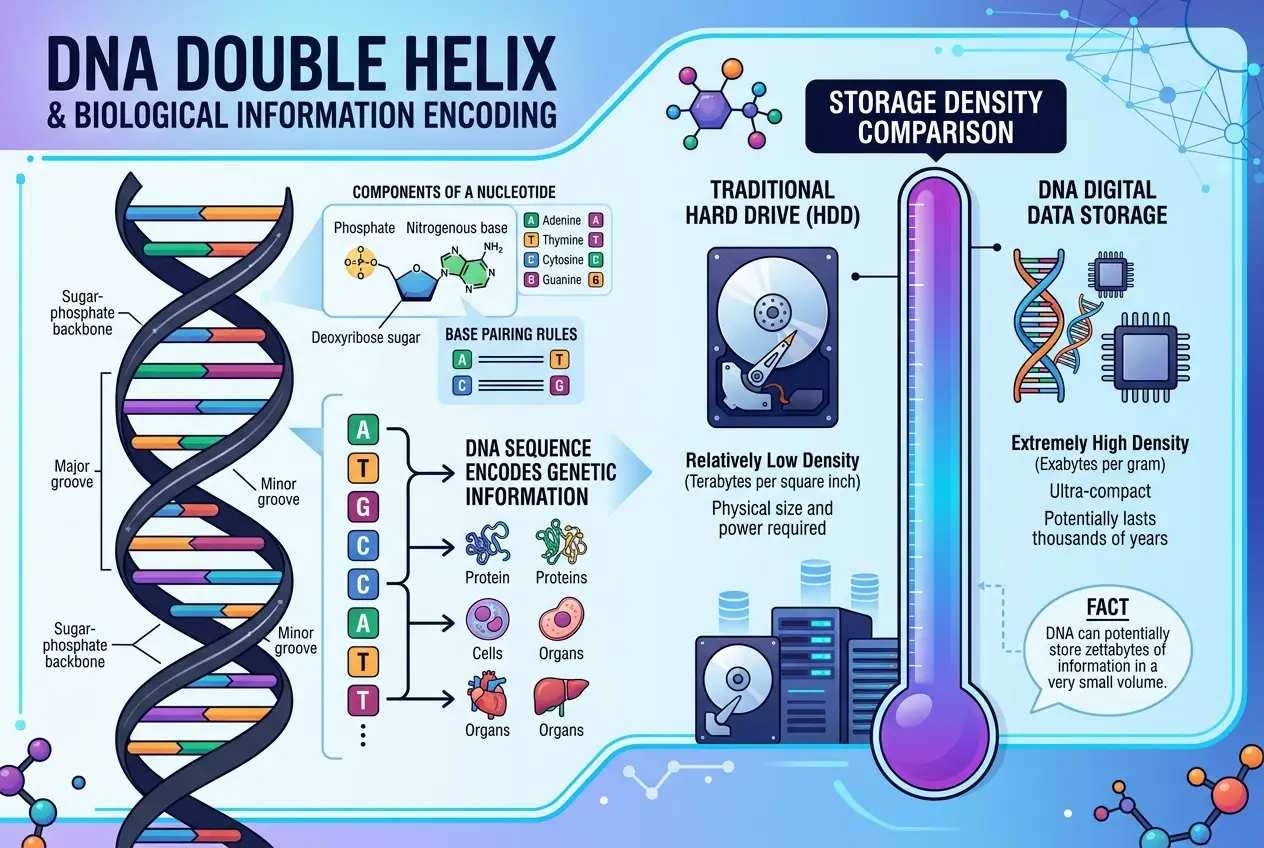
Traditional computers process information serially, one step after another, albeit very quickly. DNA, however, offers a paradigm shift: **massive parallelism**. Think of it like this: if you wanted to solve a complex mathematical problem, a traditional computer would tackle each potential solution one by one. A DNA computer, in theory, could explore millions, even billions, of potential solutions *simultaneously*. This intrinsic parallelism is where its power truly lies, and why it holds such allure for fields like AI.
### Adleman's Breakthrough: The First DNA Computer
The concept of using DNA for computation isn't entirely new. The pioneering work by Leonard Adleman in 1994, which I find absolutely fascinating, demonstrated the first successful DNA computer. He used synthetic DNA strands to solve a classic computational problem: the **Hamiltonian path problem**, often visualized as the "traveling salesman problem" on a tiny scale. Adleman encoded cities and paths as DNA strands, then allowed these strands to mix and bind together in a test tube. Through a series of biological manipulations—such as separating strands by length, amplifying specific sequences, and filtering out incorrect paths—he was able to find the correct solution.
This wasn't a computer in the sense we recognize today, sitting on a desk and running software. It was a molecular reaction in a beaker. But it proved a fundamental point: DNA molecules could perform logical operations. Each molecule acted as a tiny, independent processor, working in concert with countless others. This biological parallelism is what caught the attention of computer scientists and AI researchers alike. You can read more about Adleman's experiment on [Wikipedia's DNA computing page](https://en.wikipedia.org/wiki/DNA_computing).
### How Does DNA Computing Actually Work?
At its core, DNA computing leverages the natural properties of DNA:
* **Specificity of Base Pairing:** Adenine (A) always pairs with Thymine (T), and Cytosine (C) always pairs with Guanine (G). This predictable pairing is crucial for creating specific reactions.
* **Enzymatic Reactions:** Various enzymes (like ligases, restriction enzymes, and polymerases) can cut, join, copy, or modify DNA strands, acting as the "software" or "operations" for the computation.
* **Self-Assembly:** DNA strands with complementary sequences will naturally find and bind to each other, forming larger structures or initiating reactions.
A typical DNA computing process might involve:
1. **Encoding Data:** Information (e.g., numbers, variables, logical states) is translated into specific DNA sequences.
2. **Creating Operations:** Operations are designed as short DNA strands or enzymes that interact with the data strands in a specific way, leading to a desired outcome.
3. **Mixing and Reaction:** The encoded data and operation strands are mixed in a solution. Due to self-assembly and enzymatic reactions, billions of parallel computations occur.
4. **Reading the Result:** Techniques like gel electrophoresis or DNA sequencing are used to extract and decode the final DNA strands that represent the solution.
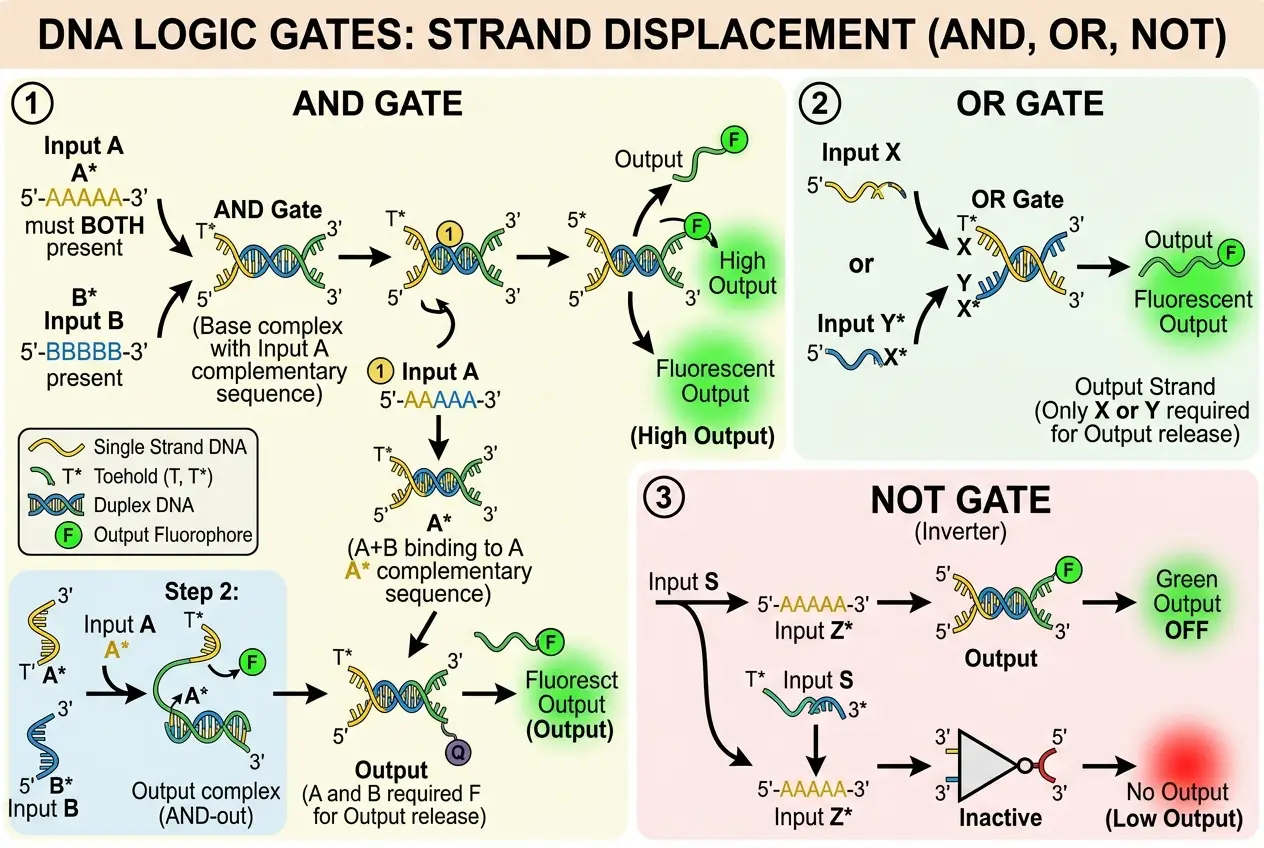
One of the most promising approaches is **DNA strand displacement**, where a new strand enters a complex and "displaces" a weaker-bound strand. This mechanism can be used to perform logical operations like AND, OR, and NOT, forming the building blocks of any digital computation.
### The Promise for AI: Tackling Unsolvable Problems
The implications for artificial intelligence are profound. Modern AI, especially deep learning, relies heavily on massive computational power. Training complex neural networks can take days or weeks on supercomputers. DNA computing's massive parallelism could offer a way to accelerate these processes exponentially.
Consider problems like:
* **Optimization Problems:** Finding the best solution among an astronomical number of possibilities (e.g., protein folding, drug discovery, complex logistics).
* **Machine Learning:** Training AI models faster and more efficiently, especially for tasks requiring vast pattern recognition.
* **Cryptography:** Breaking or creating highly complex codes.
* **Robotics:** Potentially leading to "wet robots" or smart materials that can perform computations directly within their structure.
Imagine an AI system that, instead of running on massive GPU clusters, operates through a network of molecular reactions, perhaps even *within* a living system. This could lead to a new era of **bio-inspired AI** where the boundary between hardware and wetware blurs. For more on how AI is pushing boundaries, check out our piece on [Can AI discover new laws of physics?](/blogs/can-ai-really-discover-new-laws-of-physics-9784).
### Challenges on the Path to a DNA-Powered AI Future
Despite its immense promise, DNA computing faces significant hurdles:
* **Speed:** While massively parallel, the individual reactions are much slower than electronic gates. It's like having a billion incredibly slow calculators working at once.
* **Scalability & Error Rates:** Designing complex DNA systems that can perform reliably without errors as the complexity increases is a huge challenge. Misbindings or incomplete reactions can lead to incorrect results.
* **Input/Output:** Getting data *into* and *out of* a DNA computer in a usable format remains cumbersome. Sequencing and synthesis are powerful but not yet instant.
* **Programming Complexity:** "Programming" a DNA computer involves synthesizing precise DNA strands and carefully orchestrating biochemical reactions, which is far more complex than writing code for a silicon chip.
* **Environmental Factors:** DNA computation is sensitive to temperature, pH, and the presence of various chemicals, requiring carefully controlled laboratory conditions.
Researchers are actively working on these challenges. Innovations in **DNA nanotechnology** are creating more robust and predictable molecular circuits. Concepts like **DNA origami** allow scientists to fold DNA into complex 3D structures, opening avenues for more intricate molecular machines and computational architectures. The field of **synthetic biology** is also advancing rapidly, making it easier to design and manipulate biological systems for novel purposes, which can contribute to the progress of DNA computing. You can delve deeper into synthetic biology on its [Wikipedia page](https://en.wikipedia.org/wiki/Synthetic_biology).
### Beyond Traditional Computing: A New Form of Intelligence?
The true revolution of DNA computing for AI might not be in simply replacing silicon, but in enabling entirely new forms of intelligence. We might see:
* **In-vivo computing:** Imagine tiny biological computers operating inside cells or organisms, performing diagnostic tasks, delivering targeted therapies, or even augmenting biological processes. This moves beyond traditional medical tech into bio-computation.
* **Smart Materials:** Materials embedded with DNA computers that can react intelligently to their environment, repairing themselves, changing properties, or performing complex sensing tasks.
* **Decentralized Intelligence:** Instead of a single, monolithic AI, we could have distributed, molecular-level intelligence woven into the fabric of systems.
This isn't just about faster AI; it's about a different *kind* of AI, one that could mimic the distributed, parallel, and self-organizing nature of biological intelligence itself. It pushes the boundaries of what we understand as computation and intelligence, blurring the lines between the living and the artificial. The question of whether our brains are quantum field generators, as explored in [Are our brains quantum field generators?](/blogs/are-our-brains-quantum-field-generators-7406), touches upon similar ideas of complex, non-traditional computation.
### The Future of Biological AI
The journey to a fully functional, DNA-powered AI system is long and complex, but the steps taken so far are nothing short of extraordinary. From Adleman's initial experiment to the development of sophisticated DNA nanobots capable of performing logical operations, the field is rapidly evolving.
As researchers continue to refine the precision of molecular programming and develop more efficient input/output mechanisms, the dream of an AI powered by the very code of life moves closer to reality. It's a future where intelligence is not just confined to electronic circuits but can exist in a test tube, in a living cell, or even woven into the very materials around us. This blend of biology and computation promises not just faster algorithms, but a fundamental reimagining of what AI can be, unlocking a new frontier in the quest to understand and create intelligence.
Frequently Asked Questions
Traditional computing uses electronic transistors for binary operations (0s and 1s) processed serially, while DNA computing uses molecular reactions and the four-letter genetic code (A, T, C, G) to perform massively parallel computations simultaneously.
While individual DNA reactions are much slower than electronic gates, the strength of DNA computing lies in its massive parallelism. Theoretically, it can perform billions of operations at once, which could lead to overall faster solutions for specific complex problems, especially those requiring many parallel explorations.
DNA computing is particularly well-suited for problems requiring massive parallelism and exhaustive searches, such as complex optimization problems (e.g., drug discovery, logistics), machine learning model training, and pattern recognition tasks where many possibilities need to be explored simultaneously.
DNA nanotechnology is crucial for building precise, reliable molecular circuits. Techniques like DNA origami allow scientists to construct complex 3D nanostructures that can act as molecular machines or sophisticated computational architectures, addressing challenges like scalability and error rates.
It's unlikely DNA computers will fully replace traditional silicon-based computers, as they excel at different types of tasks. DNA computing is more suited for specific, complex, parallel problems, while electronic computers remain superior for general-purpose, high-speed, sequential operations. Instead, they will likely complement each other, opening up new computational paradigms.
Verified Expert
Alex Rivers
A professional researcher since age twelve, I delve into mysteries and ignite curiosity by presenting an array of compelling possibilities. I will heighten your curiosity, but by the end, you will possess profound knowledge.
Leave a Reply
Comments (0)
No approved comments yet. Be the first to share your thoughts!
 Join Us

 Unknown Author













Leave a Reply
Comments (0)