


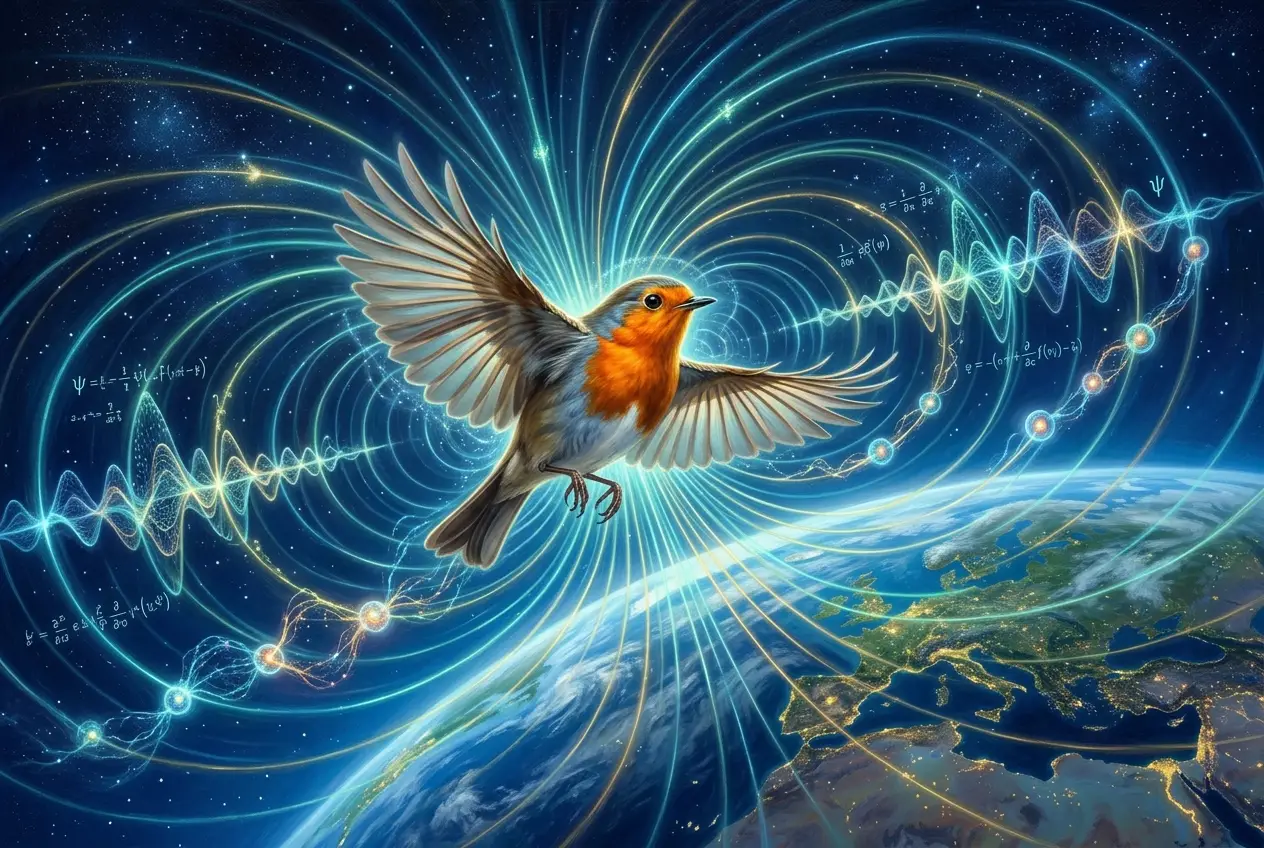
I remember the first time I truly appreciated bird migration. It was a crisp autumn evening, and I watched flocks of geese carve perfect V-formations across a twilight sky, heading south with an unwavering sense of purpose. How do they do it? For centuries, this has been one of nature's most enduring mysteries. We've known about their incredible ability to sense Earth's magnetic field, acting like living compasses. But what if their navigational prowess isn't just a simple magnetic sensor, but something far more extraordinary, something that delves into the bizarre world of quantum mechanics?
It sounds like science fiction, doesn't it? The idea that tiny, feathered creatures might be leveraging principles that baffle even our brightest physicists. Yet, a growing field called quantum biology is proposing exactly this: that birds, and possibly many other organisms, exploit the subtle, counter-intuitive rules of the quantum realm to perceive the world around them. This isn't just about magnetism; it’s about a direct interaction with the fundamental fabric of reality, allowing them to literally see the Earth's magnetic field.
The Enigma of Avian Migration: A Magnetic Sense
The journey of migratory birds is nothing short of epic. Arctic Terns, for example, undertake an annual round trip of over 49,000 miles, flying from the Arctic to the Antarctic and back. This phenomenal endurance and precision navigation have long fascinated scientists. We’ve established that birds don't just use visual landmarks or the sun's position; they possess a magnetoreception system, an innate ability to detect Earth's geomagnetic field.
Early experiments in the 1960s and 70s demonstrated that birds could orient themselves even in completely artificial, featureless environments, as long as they had access to a magnetic field. But here’s the kicker: their magnetoreception isn't like a mechanical compass needle pointing north. Instead, it seems to be an inclination compass, meaning they sense the angle at which the magnetic field lines cross the Earth's surface. This allows them to distinguish between north and south without needing to know magnetic polarity. This distinction is crucial because it hinted at a sensing mechanism far more sophisticated than previously imagined. For a deeper dive into how living organisms might compute, check out our piece on whether living organisms can compute.
Enter Quantum Biology: A Radical New Field
Quantum biology explores how quantum mechanical phenomena might play a significant role in biological processes. For a long time, it was thought that the warm, wet, noisy environment of living cells was too chaotic for delicate quantum effects like superposition or entanglement to persist long enough to be useful. These phenomena usually require extremely cold temperatures and isolated conditions, like those found in labs working on quantum computers. Yet, nature, it seems, might be a master of harnessing these very effects. If you're curious about how quantum effects influence our daily lives, you might enjoy reading about how quantum effects influence our consciousness.
One of the most compelling theories in quantum biology involves a protein called cryptochrome, found in the retina of birds and many other animals, including humans. Cryptochromes are sensitive to blue light and play a role in regulating circadian rhythms. But their involvement in magnetoreception is what truly captures the imagination.
The Cryptochrome Mechanism: A Quantum Compass
The proposed mechanism works something like this:
- Light Absorption: When a bird's cryptochrome protein absorbs a photon of blue light, an electron is excited, leading to the formation of a radical pair. A radical pair consists of two electrons that are separated but still quantumly entangled.
- Entangled Spins: These two electrons have an intrinsic property called "spin," which can be thought of as a tiny magnetic moment. Because they are entangled, their spins are correlated.
- Magnetic Field Interaction: The orientation of the Earth's weak magnetic field influences the rate at which these entangled electron spins interconvert between different states (singlet and triplet states). This interconversion rate affects the chemical reactivity of the cryptochrome protein.
- Chemical Signal: The difference in chemical reactivity, driven by the magnetic field's influence on the quantum spins, is then translated into a biochemical signal. Essentially, the bird's eye could be "seeing" the magnetic field as variations in light intensity or patterns, acting as a visual overlay that correlates with magnetic field lines.
The beauty of this system is that it’s incredibly sensitive. Even the weak geomagnetic field (about 0.5 Gauss, compared to a refrigerator magnet's 50 Gauss) is enough to influence these delicate quantum spins. This makes it an incredibly precise compass. You can learn more about the fascinating science of magnetoreception on Wikipedia's page on Magnetoreception (opens in a new tab).
The Role of Entanglement and Coherence
For this quantum compass to work, the entangled spin states of the radical pair must maintain their coherence – their quantum-ness – for a relatively long time, given the cellular environment. This is where the challenge lies and why quantum biology is so groundbreaking. How do biological systems protect these delicate quantum states from decoherence?
Researchers suggest that the very noise and vibrations within the protein structure might, counter-intuitively, help protect the coherence. This idea, known as "coherence-assisted transport" or "noise-assisted transport," proposes that the interaction with the environment isn't always destructive but can sometimes help guide quantum processes more efficiently. It’s like a biological "quantum computer" running at ambient temperatures, a feat we struggle to achieve in our labs. To delve deeper into the concept of entanglement and its potential, our blog on can quantum entanglement connect minds offers another fascinating perspective.
Experimental Evidence and Ongoing Research
The hypothesis isn't just theoretical; it's backed by a growing body of experimental evidence.
- Cryptochrome knockout experiments: Studies on fruit flies (Drosophila) where the cryptochrome gene was silenced showed impaired magnetoreception, supporting its crucial role.
- Magnetic field manipulation: Birds exposed to very specific radiofrequency fields, designed to disrupt the quantum coherence of radical pairs, showed disorientation during migration.
- Isotope effects: Replacing common isotopes of hydrogen with deuterium (a heavier isotope) in a bird's diet has been shown to affect their magnetic compass sense. This is because nuclear spins of isotopes can influence electron spins, a subtle effect that only makes sense within a quantum framework. This connection is further detailed on Wikipedia's Quantum Biology page (opens in a new tab).
While the evidence is strong, direct observation of quantum entanglement in vivo within a bird's eye remains a significant challenge. However, the indirect evidence is compelling enough to convince many in the scientific community that birds are indeed leveraging quantum physics.
Implications Beyond Birds
If birds can use quantum mechanics for navigation, what else might nature be doing with it? The implications of quantum biology extend far beyond avian migration:
- Photosynthesis: The incredible efficiency of light harvesting in plants and bacteria is another area where quantum coherence is suspected to play a role. Excitons (quanta of energy) might explore multiple pathways simultaneously to find the most efficient route to the reaction center, a classic quantum phenomenon.
- Enzyme catalysis: Some theories suggest that enzymes might use quantum tunneling, where particles pass through energy barriers without sufficient energy, to speed up chemical reactions.
- Olfaction: There's a hypothesis that our sense of smell might involve quantum vibrational effects, where receptors detect the vibrational frequency of molecules rather than just their shape.
The idea that living systems, evolved over billions of years, have found elegant ways to exploit quantum mechanics is both humbling and awe-inspiring. It suggests that our understanding of biology is still incomplete and that the line between the quantum world and the macroscopic world of life is far blurrier than we once thought. This could even open new avenues for understanding life's deepest secrets through quantum biology.
Conclusion: Nature's Quantum Engineers
The thought that a tiny songbird, fluttering across continents, is employing quantum mechanics to find its way is mind-boggling. It reshapes our perception of what life is capable of and how deeply intertwined it is with the fundamental laws of the universe. We often think of technology as our domain, but birds, in their own way, are sophisticated quantum engineers.
This journey into the quantum world of bird navigation is a testament to nature's ingenuity and a reminder that the most profound insights often come from observing the simplest creatures. As we continue to unravel these mysteries, who knows what other "impossible" feats we'll discover happening all around us, powered by the strange and wonderful rules of quantum physics? It makes me wonder what other secrets the natural world holds, silently utilizing principles we're only just beginning to comprehend. Perhaps the next big technological leap will come not from a lab, but from understanding a bird's eye.





Conversation0
No comments yet. Be the first to share a thought — the best questions often become new stories.