I often find myself looking up at the night sky, mesmerized not just by the stars, but by the invisible forces that protect our planet. One such force, the Earth's magnetic field, is a silent guardian, deflecting harmful solar radiation and allowing life as we know it to thrive. But what if this shield faltered? What if the magnetic poles decided to take a grand, leisurely stroll, or even flip positions entirely? It sounds like the stuff of science fiction, a cinematic disaster unfolding in slow motion, yet it's a very real phenomenon that has happened numerous times throughout Earth's history. And honestly, it’s a scenario that keeps me thinking about our increasingly interconnected, tech-dependent world.
Imagine a world where your GPS starts telling you to drive into the ocean, where power grids flicker offline without warning, and where the aurora borealis is a common sight in the tropics. This isn't a doomsday prediction, but rather a speculative glimpse into a future where humanity grapples with a dramatic shift in one of Earth's most fundamental protective mechanisms. I’ve been researching what the science tells us about these geomagnetic reversals, and more importantly, how our modern technology might endure – or crumble – in the face of such a profound cosmic event.
Earth's Shifting Shield: A Cosmic Dance
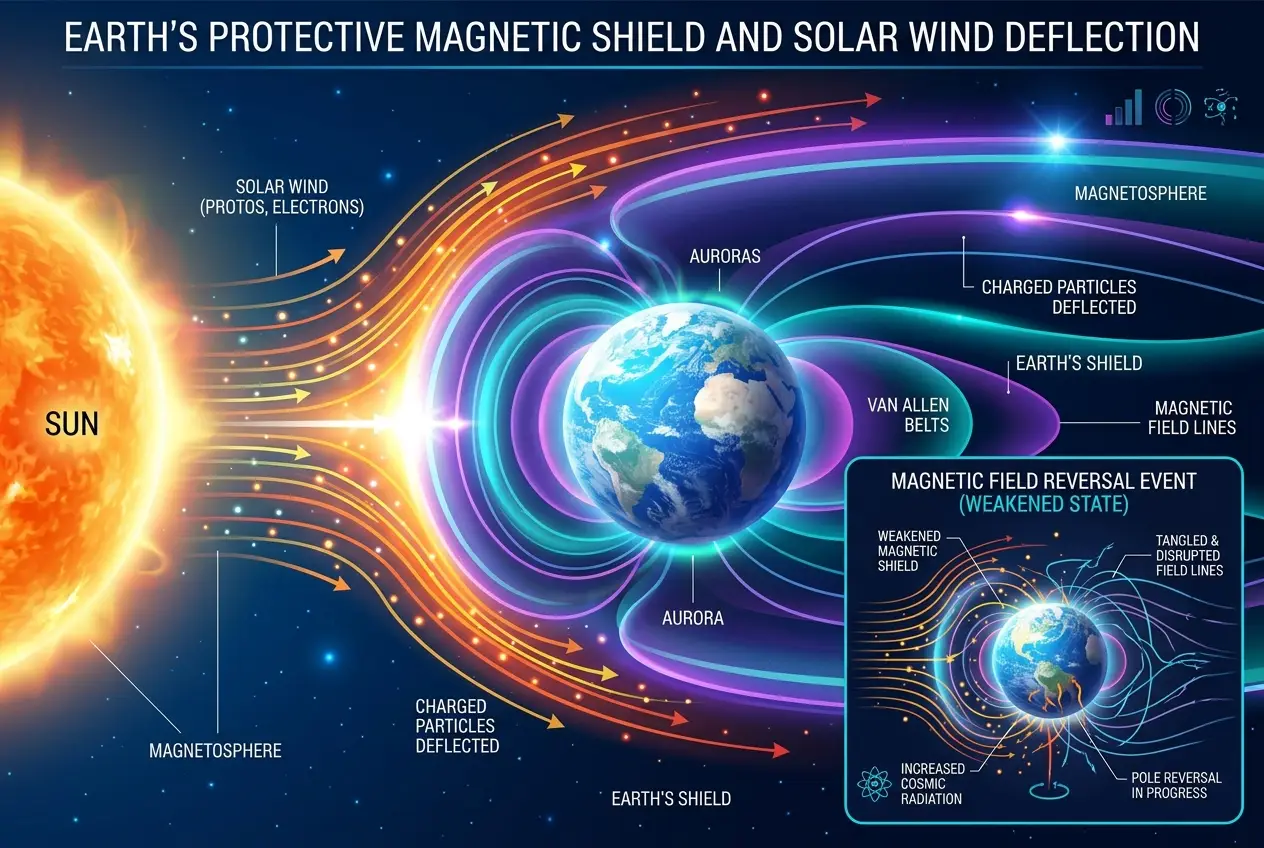
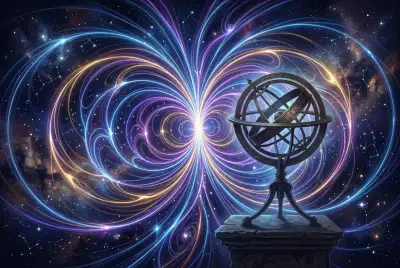
The Earth's magnetic field is generated by the churning, molten iron in our planet's outer core, creating a vast geodynamo. This invisible force field extends thousands of kilometers into space, forming the magnetosphere, which acts as our primary defense against the solar wind – a constant stream of charged particles from the Sun. Without it, our atmosphere would be stripped away, much like Mars', rendering Earth uninhabitable.
For millennia, this field has protected us, but it's not static. Over geological timescales, the poles have reversed hundreds of times. The last full reversal, known as the Brunhes-Matuyama reversal, occurred approximately 780,000 years ago. These events aren't instantaneous; they typically unfold over hundreds to thousands of years. During a reversal, the field doesn't just switch directions; it weakens significantly, becoming unstable and prone to multiple, temporary poles wandering across the globe. This period of instability, characterized by a much weaker magnetic field, is what scientists call an "excursion" or a "reversal event."
We are currently in a period of decreasing magnetic field strength, with the North Magnetic Pole steadily moving towards Siberia at an accelerating rate. This movement isn't a reversal yet, but it's a stark reminder that our planet's magnetic personality is dynamic. According to some studies, the magnetic field has weakened by about 15% over the last 150 years, prompting scientists to debate if we're entering another reversal. You can read more about the Earth's magnetic field on
Wikipedia's entry for Earth's Magnetic Field.
The Vulnerability of Our Digital Age
Our modern civilization is inextricably linked to technology. From the satellites orbiting our planet to the smartphones in our pockets, virtually every aspect of our daily lives relies on electronics and data. A weakening or flipping magnetic field introduces a cascade of vulnerabilities that could push our technological infrastructure to its limits.
Satellite Systems and GPS
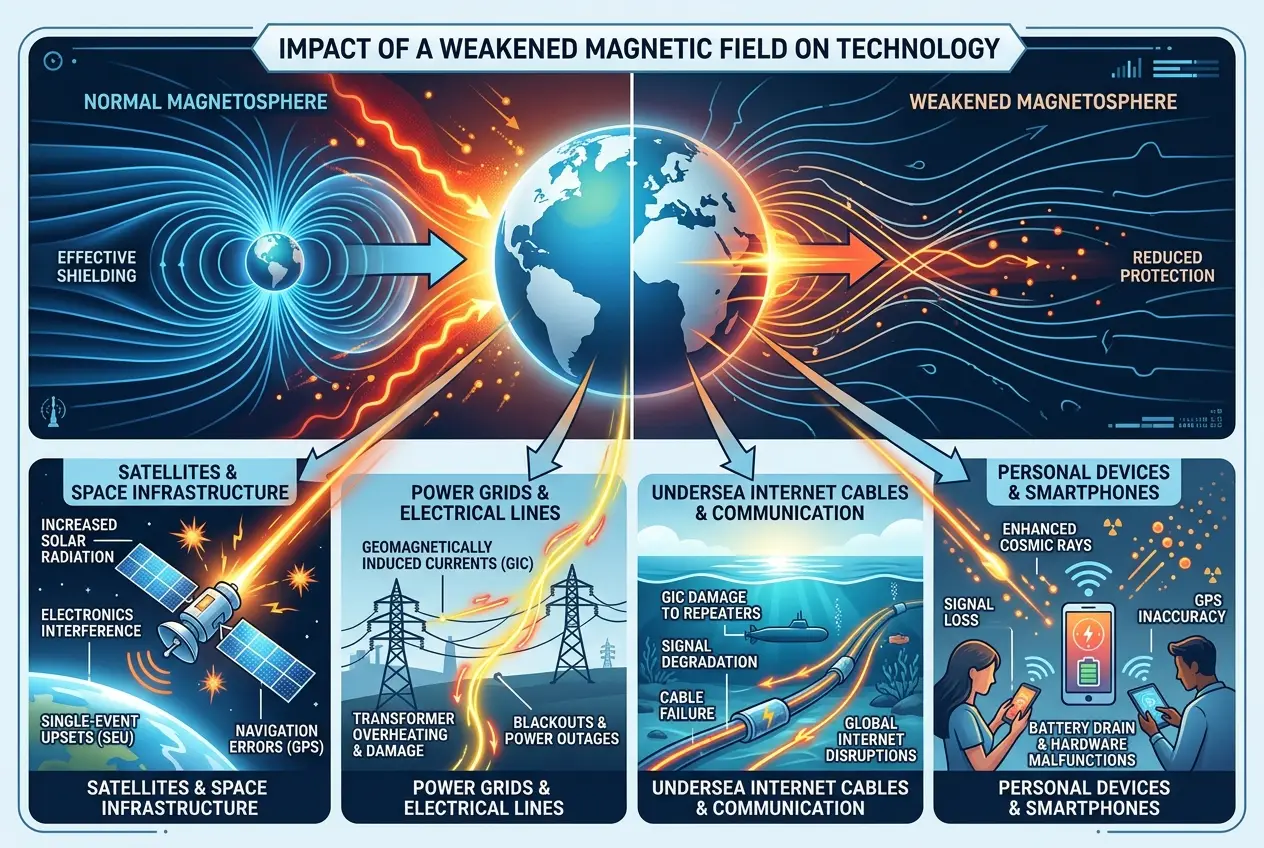
Satellites are the first line of defense, and the first to be affected. With a weakened magnetosphere, satellites in Low Earth Orbit (LEO) and Geosynchronous Orbit (GEO) would be exposed to significantly higher levels of solar radiation. This radiation can cause "single-event upsets" (SEUs) – temporary glitches in electronics – or even permanent damage, known as "single-event latch-ups" (SELs), leading to satellite failure. Imagine a world without accurate GPS, impacting everything from navigation and precision agriculture to air traffic control and financial transactions. Commercial flights could face disruptions, having to rely on more traditional, less efficient methods of navigation.
Power Grids and Infrastructure
On Earth's surface, the primary concern would be geomagnetically induced currents (GICs) in long conductors like power lines and pipelines. When a weakened magnetic field allows more charged particles to hit the upper atmosphere, it can create intense electrical currents. These GICs can overload transformers, potentially causing widespread blackouts and severe damage to power grids. The Carrington Event of 1859, a powerful solar storm, caused telegraph systems to fail and even spark fires. While we weren't as technologically dependent then, a similar event today, amplified by a weaker magnetic field, would be catastrophic. Understanding the impact of geomagnetic storms is crucial, as explored in our blog on
Could Solar Storms Ignite Digital Chaos?
Communications and Internet
Beyond power grids, communications infrastructure could also suffer. Radio blackouts, especially at high latitudes, would become more common. Submarine communication cables, though buried, might still be susceptible to GICs, disrupting the global internet backbone. Data centers, while often hardened, could experience increased errors due to heightened radiation levels, leading to data corruption or loss.
Increased Radiation Exposure
For those on Earth, the direct health risk from increased radiation at ground level is generally considered low, as the atmosphere still provides a significant shield. However, increased background radiation could lead to a slight uptick in certain cancers over long periods. Astronauts and frequent flyers, especially those on polar routes, would face significantly higher radiation doses, potentially requiring changes in flight paths or missions. This echoes concerns about cosmic rays altering DNA, a topic we touched on in
Could Cosmic Rays Alter Our DNA?
Adapting to a Flickering Shield: Tech's Resilience
While the prospect of a geomagnetic reversal is daunting, it's not a sudden, cataclysmic event. Humanity would have centuries, if not millennia, to adapt. Scientists are actively monitoring the field, and engineers are already designing systems with resilience in mind.
Hardening Our Infrastructure
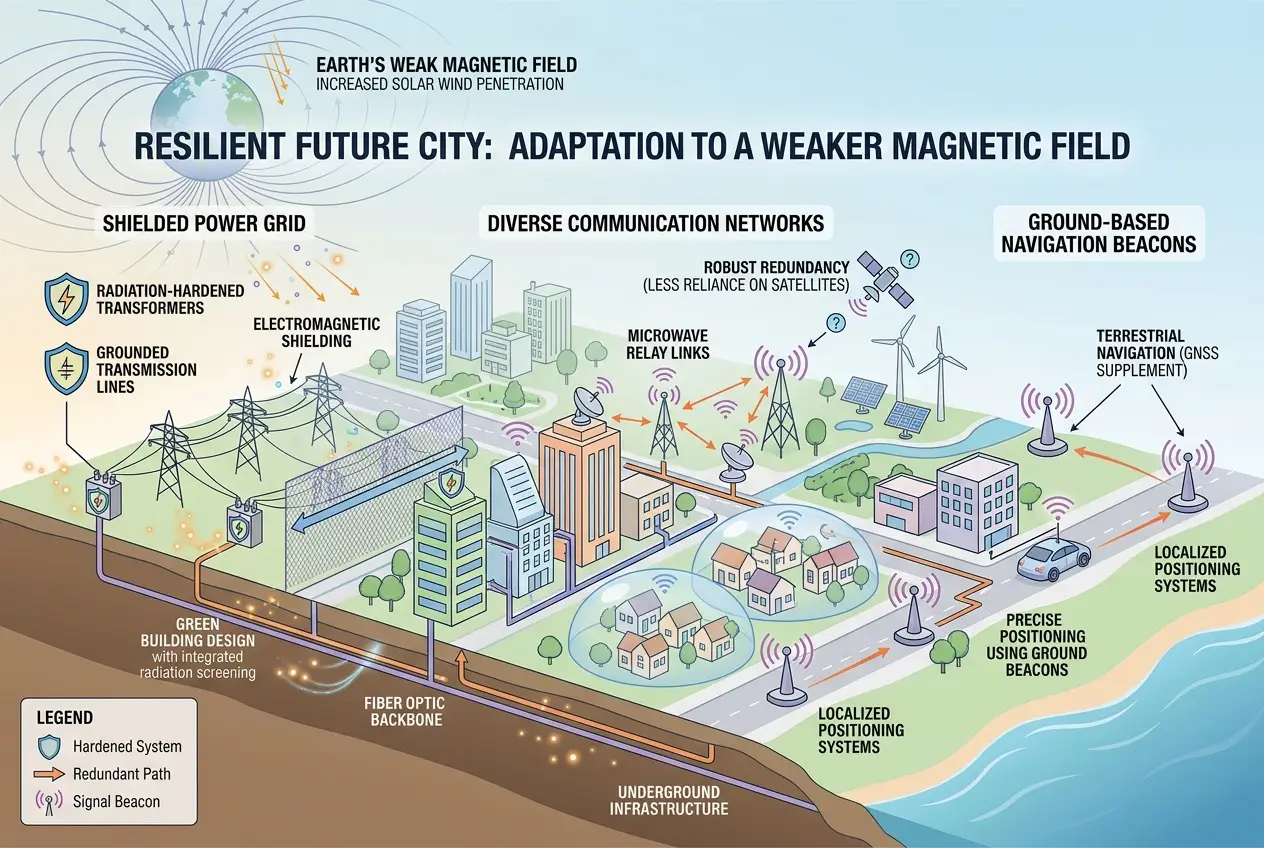
One key approach is to **harden** existing infrastructure. For satellites, this means developing more radiation-tolerant electronics and implementing robust error-correction codes. For power grids, strategies include installing more GIC-blocking devices on transformers, better monitoring systems, and creating modular, resilient grid architectures that can isolate damaged sections. Governments and utilities are increasingly aware of this threat and are working on mitigation plans. The European Space Agency's (ESA) Swarm mission, for example, is providing unprecedented data on the magnetic field's changes. More details about such missions can be found on
Wikipedia's Swarm Mission page.
Next-Generation Navigation
Beyond GPS, alternative navigation systems are being explored. Terrestrial-based systems, inertial navigation systems, and even pulsars as cosmic clocks (as discussed in
Pulsars: Can These Cosmic Clocks Guide Future Explorers?) could provide robust alternatives, reducing our reliance on vulnerable satellites.
Developing Future-Proof Materials and Designs
The challenge also presents an opportunity for innovation. Could we develop new materials or technologies that are inherently more resistant to electromagnetic interference and radiation? Research into advanced shielding materials, quantum-resistant computing, and even bio-inspired electronics that can self-repair could offer long-term solutions. Imagine microchips designed with redundant pathways or self-healing properties that could shrug off radiation damage.
Living with a Wandering Compass
A geomagnetic reversal isn't just a technical challenge; it's also a societal one. Our sense of direction, both literally and metaphorically, is tied to the Earth's magnetic field. Many animal species, from birds to sea turtles, use the magnetic field for navigation. A significant shift could disrupt ecosystems and migratory patterns, adding another layer of complexity to an already challenging scenario.
For humans, our compasses would become unreliable, and mapping services would need constant recalibration. But these are solvable problems with enough foresight and technological development. The most critical aspect is not succumbing to panic but focusing on scientific understanding, preparedness, and collaborative international efforts. The slow pace of a reversal gives us a unique window to adapt, innovate, and ultimately ensure that our technological civilization can continue to thrive, even when our planetary shield takes a temporary dip.
In the grand scheme of cosmic events, a magnetic pole reversal is a natural planetary rhythm. It’s a reminder that we live on a dynamic world, subject to powerful forces far beyond our control. But it's also a testament to human ingenuity that we can understand these processes, anticipate their effects, and devise strategies to safeguard our progress. The future of our tech in a world of flipping poles isn't about mere survival; it's about intelligent adaptation and building a more resilient, space-weather-proof civilization. It makes me wonder what other hidden cosmic data the Earth might be silently recording, waiting for us to decode.
 Join Us



 Unknown Author






















Leave a Reply
Comments (0)