


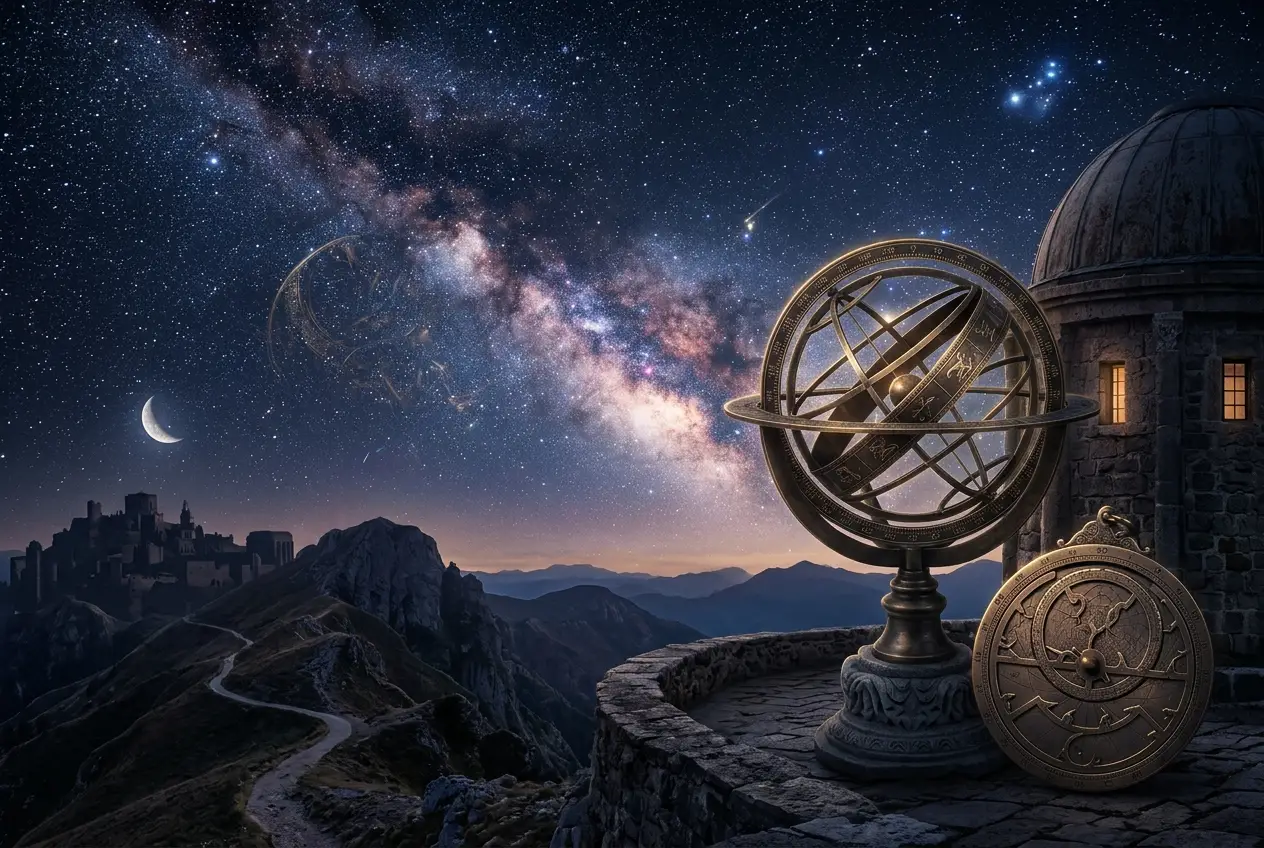
I’ve always been fascinated by the human quest to understand the universe. From the earliest campfires, our ancestors gazed at the stars, not just with wonder, but with a profound desire to find meaning, order, and perhaps, even predict the future. We often think of "algorithms" as a modern invention, a series of precise steps a computer follows to solve a problem or make a prediction. But what if ancient civilizations, without silicon chips or digital displays, were engaged in a similar, albeit organic, form of cosmic computation? What if the "seers" of antiquity weren’t just diviners, but sophisticated observers who had decoded the universe's own celestial algorithms?
Recently, I delved into the incredible astronomical prowess of cultures like the Maya, Babylonians, and ancient Greeks. Their ability to predict eclipses, track planetary movements, and even anticipate solstices and equinoxes with remarkable accuracy always left me pondering: How did they do it without telescopes or advanced mathematics as we know it today? Was there a hidden "code" they were reading, a set of cosmic algorithms that governed the celestial dance?
The Sky as a Predictable Ledger
Imagine living in a world where the changing seasons, the ebb and flow of tides, and the very rhythms of life were dictated by the sun, moon, and stars. For ancient agricultural societies, knowing when to plant, when to harvest, or when significant floods might occur was a matter of survival. The sky wasn't just a beautiful backdrop; it was a cosmic clock, a calendar, and crucially, a predictive engine.
One of the earliest and most profound examples comes from Babylonian astronomy. Dating back thousands of years, their clay tablets reveal intricate tables of astronomical observations and mathematical calculations. They meticulously recorded the positions of planets, the cycles of the moon, and the occurrences of eclipses. These weren’t just casual observations; they were systematic data collection over centuries. The Babylonians developed sophisticated arithmetical methods to predict celestial phenomena, almost like running a program. Their understanding of periodicity was astonishing, allowing them to foresee events that would only repeat after long cycles. For instance, they developed methods to predict lunar eclipses with impressive precision, understanding the 18-year Saros cycle. You can learn more about their remarkable achievements on Wikipedia's article on Babylonian astronomy (opens in a new tab).
Decoding Planetary Paths: Babylonian Precision
The Babylonians didn't just observe; they systematized. They created what we might call **ephemerides**—tables of astronomical data that allowed them to track and predict the positions of celestial bodies. These tables often accounted for irregularities in planetary motion, indicating a deep empirical understanding, even if they didn't have a heliocentric model. Their "algorithms" were embedded in these tables, a series of steps: observe, record, calculate, predict. This was a form of data processing that arguably set the foundation for later astronomical developments.The Maya and Their Calendar of Ages
Across the globe, the ancient Maya developed one of the most complex and accurate calendrical systems known to humanity. Their Long Count calendar, often mistakenly associated with apocalyptic prophecies, was in fact an incredibly precise tool for tracking vast stretches of time and correlating celestial events. They tracked the cycles of Venus, calculated lunar phases, and understood the periodicity of eclipses, all without metal tools or the wheel for large-scale construction.
Their "cosmic algorithms" weren't just about prediction; they were about understanding the grand cycles of creation and destruction, influencing their societal and religious practices. The Dresden Codex, one of the few surviving Mayan books, contains detailed astronomical tables, including eclipse warnings and tables for Venus's synodic period. This wasn't merely religious mysticism; it was observational science of the highest order, combined with a profound philosophical framework. Their ability to track celestial movements for millennia speaks to a complex system of observation, calculation, and recording. In a way, they were building predictive models for the cosmos, ensuring they were in harmony with its grand design. You can explore the fascinating details of their calendrical system and astronomy on Wikipedia's Maya astronomy page (opens in a new tab).
The Mayan "Cosmic Clock"
The Maya understood that the universe operated on vast, interconnected cycles. Their calendars, like the Tzolk'in (260 days) and Haab' (365 days), intermeshed to create larger cycles, capable of tracking time over millions of years. This wasn't just a basic calendar; it was a multi-layered predictive system that integrated various cosmic rhythms. Their priests, or "seers," were effectively the data scientists of their time, interpreting these cycles to guide agricultural, social, and ceremonial life.- "The Maya were masters of cycles. Their astronomers observed the heavens for centuries, meticulously tracking the movements of the sun, moon, and planets. They didn't just see patterns; they understood the underlying mechanics enough to predict future events with astounding precision." - Dr. David Stuart, Mayanist.
This systematic approach to understanding celestial mechanics suggests a deep understanding of what we now call pattern recognition and extrapolation, core components of any algorithm. If you're curious about how other ancient cultures made similar predictions, check out our blog on how ancient star maps might have predicted cosmic events.
Greek Mechanical Genius: The Antikythera Mechanism
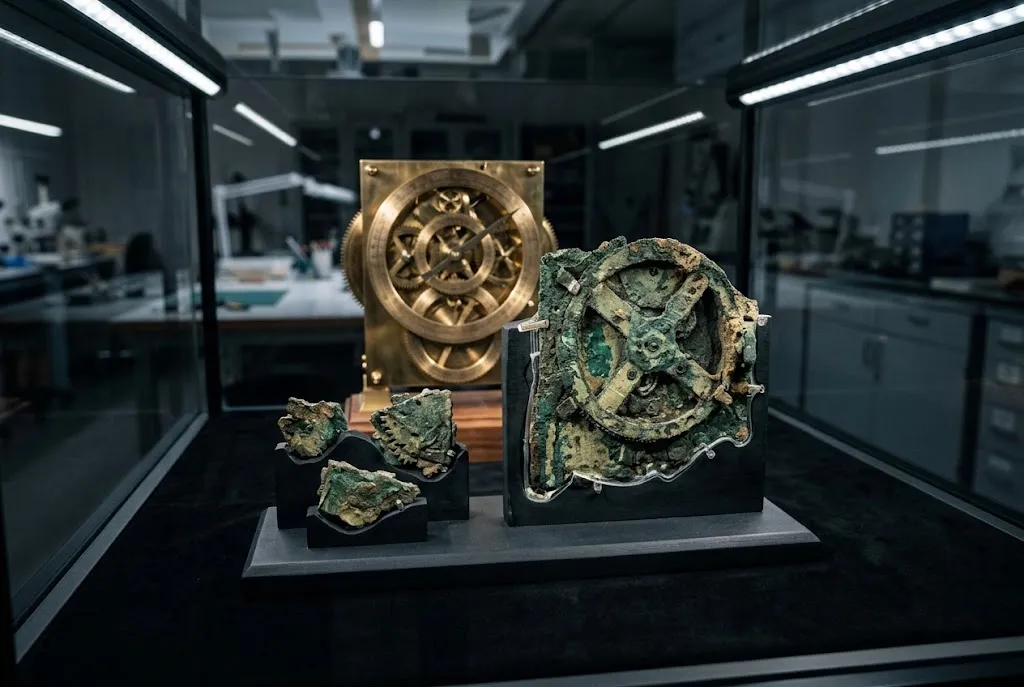
While not directly a "cosmic algorithm" in the purely observational sense, no discussion of ancient computational thinking and the cosmos would be complete without mentioning the Antikythera Mechanism. Discovered in a shipwreck off the coast of Greece, this astonishing device, dating back to the 2nd century BCE, is often hailed as the world's first analog computer.
It was an intricate clockwork mechanism, composed of dozens of bronze gears, designed to calculate and display astronomical positions and predict eclipses. It modeled the movements of the moon and possibly the planets, incorporating complex cycles like the Saros and Metonic cycles. This wasn't just an observation tool; it was a physical manifestation of ancient Greeks' understanding of celestial mechanics, a machine built to process cosmic data and generate predictions. It’s a testament to their engineering and mathematical genius, turning abstract algorithms into tangible, functional hardware. Dive deeper into its complexities on Wikipedia's Antikythera Mechanism page (opens in a new tab).
Antikythera: The Analog Processor
The Antikythera Mechanism effectively embodied the "cosmic algorithms" that Greek astronomers like Hipparchus and Archimedes had deduced. It was a mechanical representation of a complex mathematical model, allowing users to "run" celestial simulations. By turning a crank, one could see the positions of celestial bodies on specific dates, foretelling eclipses and moon phases. It’s a powerful reminder that "computation" doesn't always require electronics; it requires a systematic approach to processing information to achieve a desired output.The sophistication of this device makes you wonder about other lost technologies or knowledge. Perhaps ancient minds were encoding cosmic data in other forms, too. We've even explored if ancient observatories were also cosmic clocks in a previous blog.
Modern Algorithms: A Cosmic Echo?
Today, our cosmic algorithms are encoded in lines of Python, C++, or specialized simulation software. We use massive supercomputers to model the birth of stars, the dynamics of galaxies, and the intricate dance of exoplanets. Yet, the fundamental principle remains the same: observe, collect data, identify patterns, formulate rules (algorithms), and use those rules to predict future states.
The ancient seers, with their painstaking observations, clay tablets, stone structures, and mechanical gears, were doing essentially the same thing. They sought to find order in the apparent chaos of the cosmos, to extract the underlying rules – the algorithms – that governed its behavior. Their methods were empirical and often geometrical, rather than algebraic, but the intent was identical. They created systems to process cosmic information and derive actionable insights, whether for ritual, agriculture, or navigation.
The accuracy of these ancient predictions, often achieved through centuries of observational data and ingenious mathematical models, highlights that the "future" was not just a matter of divine revelation but a calculable outcome for those who understood the cosmic code. They saw the sky as a vast, open book, waiting to be read, its secrets revealed through diligent observation and the application of what we can retroactively call cosmic algorithms.
This journey into ancient astronomy reminds me that the human drive to decode the universe is timeless. It spans millennia, bridging the gap between ancient seers gazing at constellations and modern astrophysicists simulating black holes. The tools change, but the fundamental curiosity, the desire to find patterns, and the quest to predict what lies ahead in the cosmic dance remains profoundly the same. Perhaps in a sense, the ancients had indeed decoded fragments of the cosmic algorithms that continue to shape our universe.





Conversation0
No comments yet. Be the first to share a thought — the best questions often become new stories.