


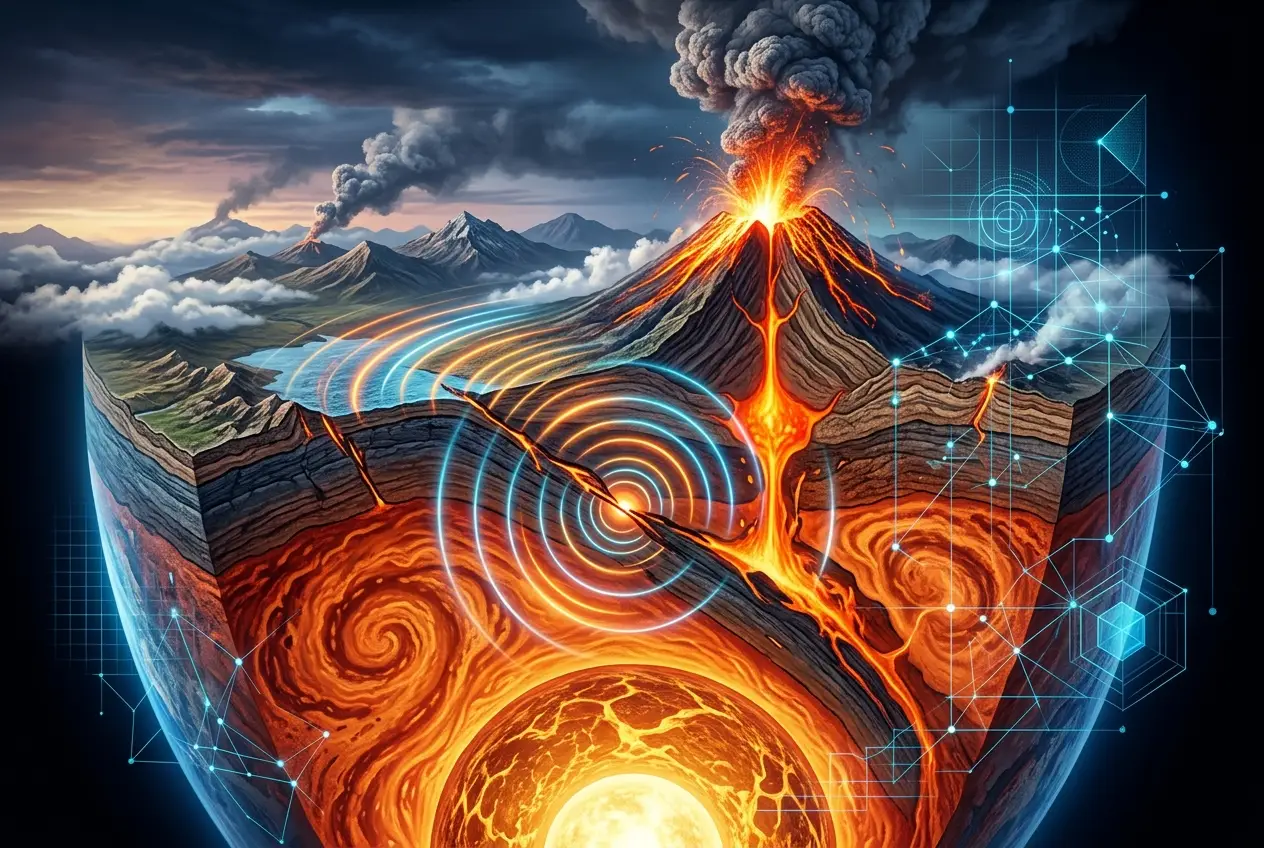
I remember vividly the news reports after a major earthquake. The sheer devastation, the suddenness, the terrifying unpredictability. For all our technological marvels, the Earth still holds some of its most destructive forces close to its chest, doling them out with little to no warning. Earthquakes remain one of nature’s most formidable and enigmatic phenomena, their timing and magnitude largely beyond our predictive grasp. But what if the Earth itself offered clues, whispered through its most volatile features: volcanoes? Could these fiery mountains, often seen as harbingers of their own destruction, also serve as unlikely prophets for seismic tremors?
The Unpredictable Fury: Why Earthquakes Remain a Mystery
Earthquakes are primarily a consequence of plate tectonics, the slow, relentless movement of Earth's massive crustal plates. These plates constantly grind, collide, and slide past one another along fault lines. When the stress along these faults exceeds the strength of the rock, it ruptures, releasing immense energy in seismic waves that shake the ground. We understand the "how" of earthquakes quite well, but the "when" and "where" with enough precision for public safety remain elusive.
Scientists have spent decades trying to develop reliable earthquake prediction methods. Everything from animal behavior to changes in groundwater levels, even variations in Earth's magnetic field, has been studied. Yet, truly accurate, short-term predictions—those that could save countless lives—have largely evaded us. This isn't for lack of effort; it's due to the immense complexity of the Earth's crust and the chaotic, non-linear nature of stress accumulation and release. For a deeper dive into seismic phenomena, you can explore the fascinating topic of Earthquake Light on Wikipedia (opens in a new tab).
Volcanoes: Earth's Restless Giants
Volcanoes, on the other hand, are often viewed through a different lens. While also destructive, their activity often exhibits clearer precursors. Ground deformation, increased gas emissions, changes in heat flow, and seismic swarms (many small earthquakes) typically precede an eruption. These signals allow volcanologists to often forecast eruptions with reasonable accuracy, providing crucial time for evacuations.
But what if the relationship isn't just one-way? What if the intense geological activity associated with volcanoes—the movement of magma, the buildup of pressure, the fracturing of rock—could also influence, or even signal, broader tectonic stresses that lead to major earthquakes further afield? This is where the idea of volcanic foresight for earthquakes sparks intense scientific curiosity.
The Unseen Connection: How Volcanoes & Earthquakes Interact
The Earth's crust is not a series of isolated systems. Volcanoes and earthquakes, though distinct in their immediate cause, are often products of the same fundamental forces at play beneath our feet. They are both energetic expressions of our planet's internal heat and dynamic plate movements.
- Magma Movement and Stress Transfer: The ascent of magma within a volcano can exert significant pressure on surrounding rock, potentially altering the stress fields on nearby fault lines. This "magmatic push" can sometimes trigger seismic events, either small volcano-tectonic earthquakes directly beneath the edifice or, in rarer cases, influence larger regional faults.
- Hydrothermal Systems: Hot, pressurized fluids circulating within volcanic and seismic zones can act as lubricants or pressurizing agents, affecting the frictional properties of faults. Changes in these systems, often linked to volcanic activity, could modulate earthquake occurrence.
- Regional Tectonic Settings: Many volcanic arcs are located directly above subduction zones—areas where one tectonic plate is forced beneath another. These are also prime locations for some of the world's most powerful earthquakes. The forces driving volcanism and megathrust earthquakes in these regions are intrinsically linked, making it challenging to disentangle their individual signals.
Scientists are particularly interested in the concept of stress transfer, where the seismic energy released by one event (like a volcanic earthquake swarm) can remotely "load" or "unload" stress on adjacent faults, making them either more or less likely to rupture. Understanding this intricate dance is key to potentially using volcanic signals as a form of seismic foresight.
A Symphony of Signals: Seismic Precursors and Volcanic Activity
The quest to use volcanoes to forecast earthquakes involves deciphering a complex "symphony" of Earth signals. Researchers are meticulously studying patterns where volcanic unrest precedes or correlates with significant seismic events. For instance, an increase in gas emissions, subtle ground uplift measured by GPS (Global Positioning System), or a flurry of small, shallow earthquakes around a volcano might be more than just signs of an impending eruption. They could be indicators of deeper tectonic shifts.
One area of active investigation involves slow-slip events (SSEs), which are seismic events that release energy over days or weeks rather than seconds, often occurring near subduction zones. While not volcanic themselves, SSEs are linked to the same plate movements that drive both volcanism and large earthquakes. Some studies suggest that volcanic activity might sometimes be a surface expression or a trigger related to these deeper, slower seismic processes. Discover more about the Earth's intricate geophysics, including its deep core, by reading our blog, "Is Earth's Core Slowing? A Cosmic Time Shift?".
Decoding the Earth's Whispers: Technologies for Seismic Foresight
Modern technology plays an indispensable role in listening to the Earth's whispers.
- Seismometer Networks: Dense arrays of seismometers around volcanoes and fault zones can detect subtle changes in seismic activity, including shifts in earthquake locations, depths, and frequency.
- Satellite Geodesy (InSAR & GPS): Satellites equipped with Interferometric Synthetic Aperture Radar (InSAR) can measure ground deformation over vast areas with millimeter precision. GPS stations provide continuous, real-time measurements of ground movement, revealing inflation or deflation around volcanoes and strain accumulation on faults.
- Gas Sensors: Monitoring the composition and flux of volcanic gases (like CO2, SO2, and H2S) can indicate changes in magma depth or interaction with hydrothermal systems.
- Thermal Imaging: Infrared cameras and satellite-based thermal sensors detect changes in surface temperature, which can signal magma nearing the surface.
Integrating data from these diverse sources using advanced computational models, including AI and machine learning, is crucial. These models can sift through vast datasets to identify subtle patterns and correlations that might escape human observation. The goal is to build comprehensive Early Warning Systems that can fuse volcanic and seismic data. You can read more about the principles of Earthquake Prediction on Wikipedia (opens in a new tab).
The Promise and Peril: What Volcanic Foresight Could Mean
The potential benefits of even short-term earthquake forecasts linked to volcanic activity are immense. Imagine having a few hours, or even days, of warning before a major seismic event. This could allow for:
- Evacuation of high-risk areas.
- Securing critical infrastructure.
- Shutting down sensitive facilities.
- Dispatching emergency services more effectively.
Such foresight wouldn't just save lives; it would also significantly reduce economic losses. For regions prone to both volcanism and seismicity, like the Pacific Ring of Fire, understanding these deep Earth connections could revolutionize disaster preparedness. The scientific community is tirelessly working towards this future, constantly refining models and gathering more data.
Challenges on the Horizon: The Path to Reliable Prediction
Despite the promising avenues of research, using volcanoes for reliable earthquake prediction faces significant hurdles:
- Complexity and Variability: Every volcano and every fault system is unique. The specific ways they interact can vary widely, making a "one-size-fits-all" predictive model highly unlikely.
- False Positives: Volcanic activity can escalate and then subside without leading to a major earthquake. Over-alerting the public with false alarms can lead to public complacency and distrust, undermining future warnings.
- Deep Earth Processes: Many large earthquakes originate at depths beyond direct observation. Inferring these deep processes from surface volcanic signals is extremely challenging.
- Data Gaps: Even with modern technology, many remote or oceanic volcanoes lack sufficient monitoring, creating gaps in our understanding.
The path to truly reliable volcanic-seismic foresight is not straightforward. It requires continued, long-term investment in monitoring infrastructure, interdisciplinary research, and sophisticated data analysis. However, the tantalizing prospect of unlocking one of Earth's greatest mysteries makes the effort undeniably worthwhile.
Beyond Prediction: Building Resilient Futures
While the dream of precise earthquake prediction remains a scientific "holy grail," the insights gained from studying volcano-seismic interactions are invaluable. They enhance our understanding of Earth's dynamic systems, improving long-term hazard assessments and informing resilient urban planning. The journey to understand how Earth's restless giants might offer warnings for its sudden tremors is a testament to human curiosity and our relentless pursuit of knowledge in the face of nature's awesome power. We may not achieve perfect prediction, but every piece of understanding helps us live more safely on our dynamic planet.




Conversation0
No comments yet. Be the first to share a thought — the best questions often become new stories.