I recently found myself staring at a map of Earth's interior, a diagram showing layers of rock and metal extending thousands of kilometers beneath our feet. It got me thinking: what exactly is going on down there? We live on this planet, relying on its fundamental processes for everything from breathable air to stable ground, yet the very heart of it remains shrouded in mystery. The Earth’s core, a region we can never directly access, is a powerhouse—a dynamic engine that defines our world and protects life as we know it. But what truly fuels this colossal, subterranean reactor?
For centuries, the mysteries of Earth’s deep interior have captivated scientists and curious minds alike. From ancient myths envisioning an underworld to modern seismic explorations, our understanding has slowly evolved. Today, with advanced seismology and sophisticated simulations, we're piecing together the intricate puzzle of our planet's fiery heart. I've always been fascinated by how something so distant and hidden can have such a profound impact on our daily lives and our technological landscape.
### The Invisible Shield: Earth's Crucial Magnetic Field
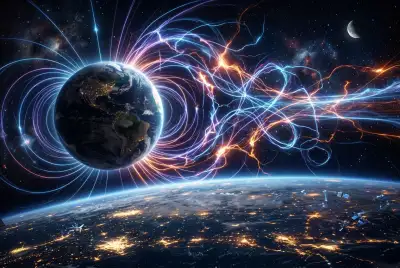
Before diving into the core itself, it's crucial to understand one of its most vital outputs: Earth's magnetic field. This isn't just a quirky planetary feature; it's a colossal, invisible shield that deflects harmful solar winds and cosmic radiation, making our planet habitable. Without it, our atmosphere would likely be stripped away, and life on the surface would be exposed to deadly radiation. This geomagnetic field is generated by what scientists call the **geodynamo**, a self-sustaining mechanism operating within the Earth’s core.
Consider its importance: have you ever thought about how our planet’s magnetic field might even influence our biological rhythms or affect the behavior of animals? You can explore more about this fascinating connection in our blog, [Can Magnetic Fields Reshape Our Biological Clocks?](https://curiositydiaries.com/blogs/can-magnetic-fields-reshape-our-biological-clocks-9345). The very existence of GPS, long-distance communication, and even our power grids depend on the stability and presence of this protective field.
### Journey to the Center: What We Know
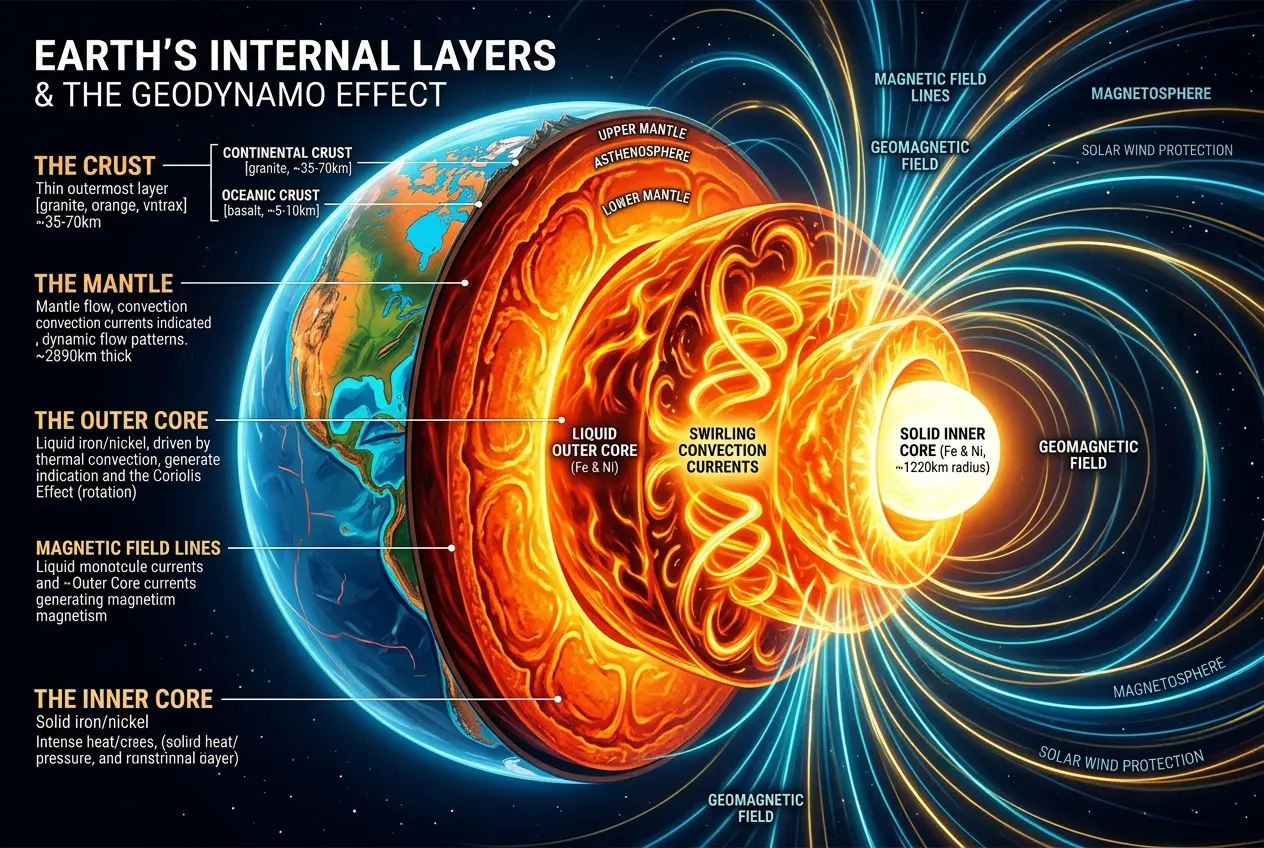
While we can't send a probe to the center of the Earth, we've developed ingenious ways to infer its structure and composition. The primary tool for this is **seismology**, the study of seismic waves generated by earthquakes. Just as doctors use X-rays to see inside the human body, seismologists use seismic waves to "scan" Earth’s interior. Different types of waves travel at varying speeds through different materials and densities, allowing scientists to map out the planet's layered structure.
What we've discovered is truly awe-inspiring:
* **Crust:** The thin, rocky outer layer we live on.
* **Mantle:** A thick, semi-solid layer of silicate rock, slowly churning over geological timescales.
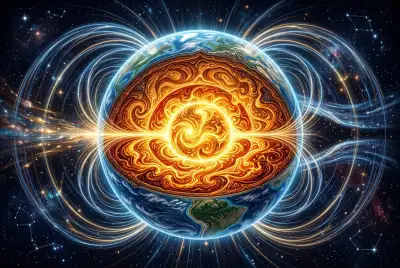
* **Outer Core:** A scorching, liquid ocean of primarily iron and nickel, extending about 2,200 kilometers thick. This is where the magic of the geodynamo happens.
* **Inner Core:** A solid ball of iron and nickel, roughly the size of the Moon, with temperatures comparable to the surface of the Sun (around 5,200 °C or 9,392 °F). Despite the immense heat, the overwhelming pressure keeps it solid.
"The Earth's core is like a living entity, constantly in motion, generating the magnetic field that protects us from the harshness of space. It's a reminder of the dynamic nature of our planet." — Dr. Stephen Sparks, Geophysics Professor.
### The Core's Engine: Sources of Heat
So, what generates and sustains the extreme temperatures required to keep the outer core molten and drive this planetary engine? Scientists point to several key heat sources:
1. **Primordial Heat:** When Earth first formed 4.5 billion years ago, it was a fiery ball. The immense gravitational compression and collisions of planetesimals generated colossal amounts of heat, much of which remains trapped within the core. This residual heat is still slowly radiating outwards. Think of it like a giant, perfectly insulated oven that’s been cooling for billions of years, but still incredibly hot inside.
2. **Radioactive Decay:** Deep within Earth's mantle and potentially also in the core (though less certain for the core itself), radioactive isotopes like Uranium-238, Thorium-232, and Potassium-40 undergo decay. This process releases energy in the form of heat, contributing significantly to Earth's internal thermal budget. While a major heat source for the mantle, its direct contribution to the *core's* energy is a subject of ongoing research and debate. Many scientists believe most of the heat driving core convection comes from heat escaping the core into the mantle, rather than heat generated *within* the core from decay.
3. **Latent Heat of Crystallization:** This is a crucial, often overlooked, heat source. As the Earth slowly cools over billions of years, the liquid iron in the outer core gradually solidifies onto the surface of the solid inner core. This phase transition releases a tremendous amount of **latent heat**. It's similar to how water releases heat when it freezes into ice. This continuous growth of the inner core provides a steady, powerful source of energy that helps sustain the convection in the outer core, acting as a "freeze-out" powered engine.
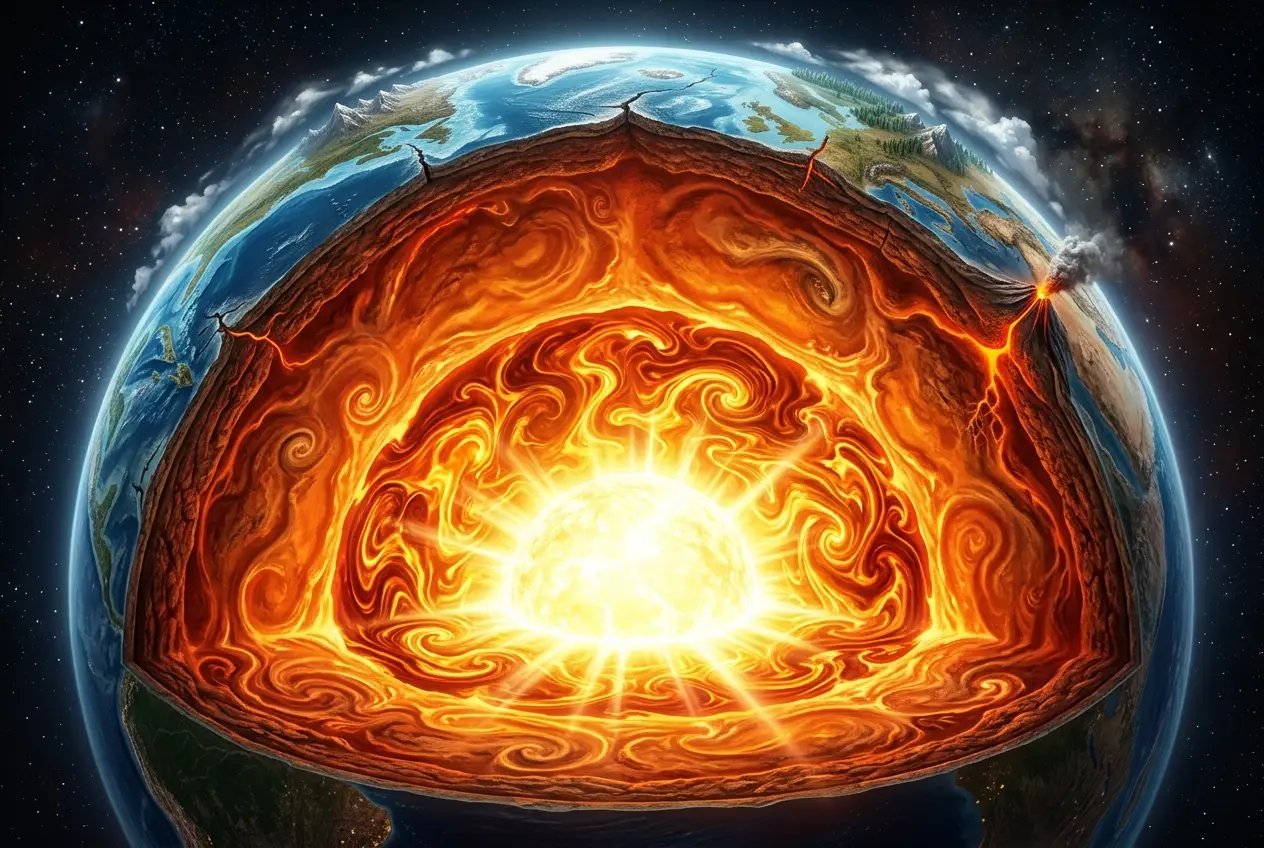
These heat sources together create powerful convection currents within the molten outer core. Hotter, less dense fluid rises, while cooler, denser fluid sinks, setting up a continuous circulation.
### The Geodynamo: A Planetary Reactor
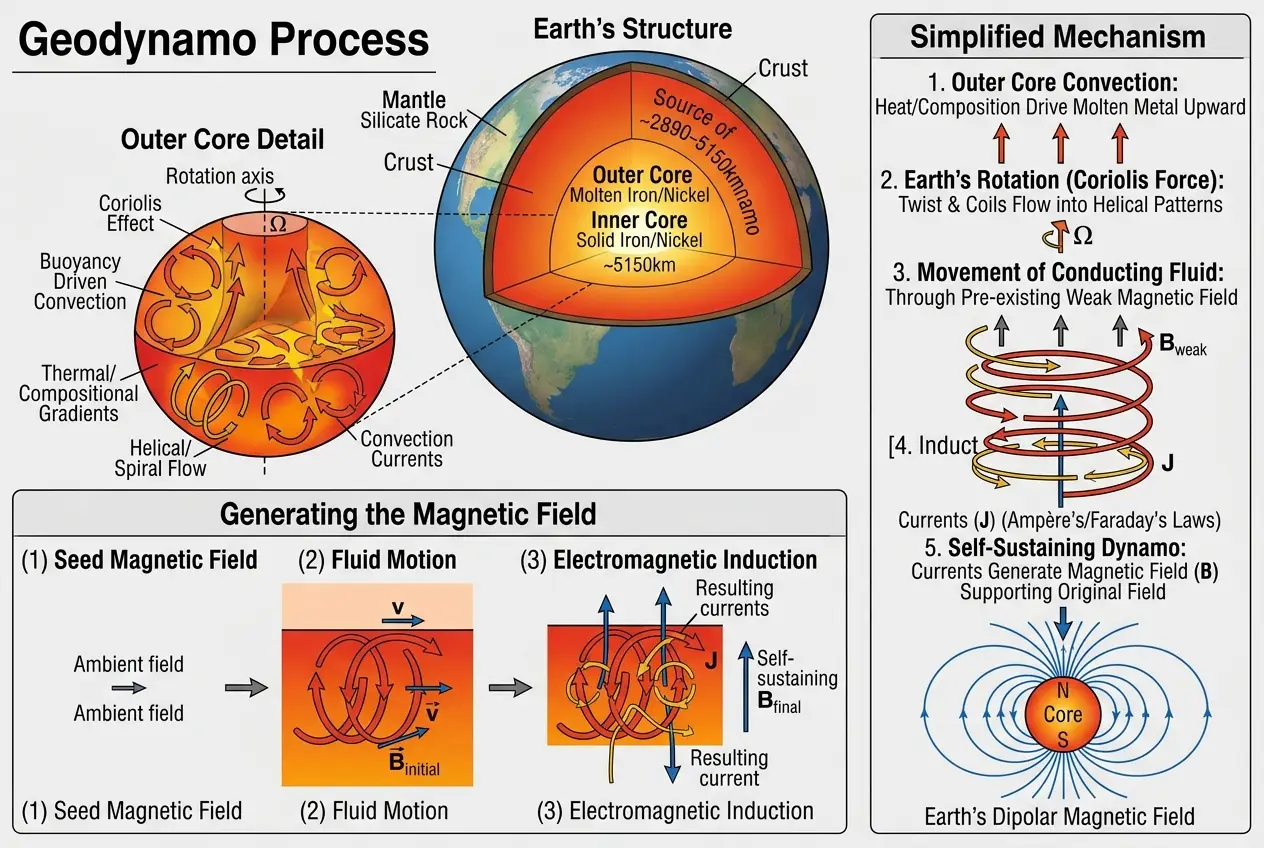
The actual generation of the magnetic field is a complex dance between heat, fluid motion, and planetary rotation—a process known as the **geodynamo**. Here's a simplified breakdown:
1. **Convection:** The heat from the inner core and residual primordial heat drive thermal and compositional convection in the liquid outer core. Lighter elements within the iron alloy also contribute to compositional buoyancy, causing movement.
2. **Coriolis Effect:** As this molten iron fluid moves, Earth's rotation (the Coriolis effect) deflects its path, causing it to swirl into helical currents.
3. **Electric Currents:** Because molten iron is an excellent electrical conductor, these swirling, helical motions generate powerful electric currents.
4. **Magnetic Fields:** According to fundamental principles of electromagnetism (specifically, Faraday's law of induction), these electric currents, in turn, generate magnetic fields.
5. **Self-Sustaining Cycle:** Crucially, these newly generated magnetic fields interact with the existing fluid motion, reinforcing and sustaining the electric currents, thus creating a self-perpetuating feedback loop. This cycle is what makes the geodynamo so powerful and long-lasting. For a deeper understanding of this incredible mechanism, I recommend consulting the Wikipedia article on the [Geodynamo](https://en.wikipedia.org/wiki/Geodynamo).
This dynamic system is not always stable. The Earth's magnetic field periodically undergoes **geomagnetic reversals**, where the magnetic north and south poles swap places over thousands of years. While the exact implications for life are debated, such events could leave our planet vulnerable to cosmic radiation during the transition. You can learn more about these fascinating reversals on [Wikipedia's Geomagnetic Reversal page](https://en.wikipedia.org/wiki/Geomagnetic_reversal).
### Unpacking the Anomalies & Future Research
Despite our advances, many mysteries about Earth's core persist. For instance, the exact composition of the inner core is still under debate; while predominantly iron and nickel, trace amounts of lighter elements are thought to be present. The behavior of materials under such extreme pressures and temperatures is incredibly difficult to replicate in a lab, pushing the boundaries of materials science.
Scientists use supercomputer simulations to model the complex fluid dynamics of the geodynamo, but even the most powerful computers struggle to fully capture its chaotic nature. These simulations help us understand phenomena like the Earth's magnetic field strength fluctuations and even the slow, observed "slowing" of the inner core's rotation relative to the mantle. If you’re curious about how planetary rotation affects our perception of time, check out our blog, [Is Earth's Core Slowing? A Cosmic Time Shift](https://curiositydiaries.com/blogs/is-earths-core-slowing-a-cosmic-time-shift-5994).
Future research involves developing even more sensitive seismic instruments, leveraging neutrino detectors to potentially "see" into the core (though this is extremely challenging), and refining our understanding of high-pressure physics.
### The Impact on Life & Technology
The geodynamo isn't just an abstract scientific concept; it's fundamental to planetary habitability. Without the magnetic shield, Earth would be a very different, likely barren, world. The presence of a strong, stable magnetic field is often considered a prerequisite for complex life on any exoplanet we discover. It's a key factor in our ongoing search for Earth 2.0.
In our technological age, understanding the core's dynamics is also crucial. Fluctuations in the magnetic field can affect satellite communications, power grids, and navigation systems. Events like geomagnetic storms, driven by solar activity, interact with our planet's magnetic field, sometimes causing significant disruptions.
The deep Earth, far from being a static, dead interior, is a vibrant, dynamic, and essential part of our living planet. Its continuous internal processes remind me of the hidden complexity that underlies so much of our existence—a powerful, unseen engine that has shaped our world for billions of years and continues to protect us every single day. The more we learn about what fuels Earth’s core, the more profound our appreciation becomes for the incredible, intricate mechanisms that allow life to flourish here.

Frequently Asked Questions
No, Earth's core has two main parts: a solid inner core and a liquid outer core. The liquid outer core is crucial for generating Earth's magnetic field.
Scientists primarily use seismology, the study of how seismic waves (from earthquakes) travel through and reflect off different layers of the Earth. The way these waves change speed and direction provides clues about the composition and state (solid or liquid) of the deep interior.
The Earth's core is slowly cooling over billions of years, but it's not expected to cool down completely or stop its dynamic processes within any human-relevant timescale. Its movement is driven by immense heat and Earth's rotation.
The Coriolis effect is a force that acts on moving objects (like fluid currents) within a rotating frame of reference, such as Earth. In the liquid outer core, it deflects the paths of the molten iron currents, creating the helical flows essential for generating the magnetic field through the geodynamo process.
While the core generates heat that drives mantle convection, which in turn influences plate tectonics and volcanism, the direct link is complex. The core's heat is transferred to the mantle, creating plumes and currents that contribute to the movement of tectonic plates, leading to earthquakes and volcanic activity.
Verified Expert
Alex Rivers
A professional researcher since age twelve, I delve into mysteries and ignite curiosity by presenting an array of compelling possibilities. I will heighten your curiosity, but by the end, you will possess profound knowledge.
Leave a Reply
Comments (0)
No approved comments yet. Be the first to share your thoughts!
 Join Us



 Unknown Author































Leave a Reply
Comments (0)