



I remember first encountering the name Richard Feynman not in a stuffy physics textbook, but through a collection of his lectures. It wasn't the complex equations or the mind-bending concepts that captivated me initially, but the sheer joy and irreverence with which he approached the universe. He spoke of quantum mechanics as if it were a grand, intricate dance, inviting everyone to join in, even if they stumbled over their feet a few times. This wasn't just a scientist; this was a storyteller, a performer, a genius who saw the world through a lens of perpetual wonder and playful defiance.
In the annals of scientific history, few figures shine as brightly and uniquely as Richard Phillips Feynman. He wasn't just a Nobel laureate who revolutionized quantum electrodynamics; he was a safecracker, a bongo player, an artist, and an unparalleled educator who made the most esoteric corners of physics accessible, even beautiful. His life story, an odyssey of intellectual adventure and vibrant human experience, offers far more than just scientific breakthroughs. It’s a testament to the power of curiosity, the beauty of independent thought, and the profound impact one individual can have on our understanding of reality.
This is going to be a very long blog, delving deep into the remarkable life, groundbreaking work, and enduring legacy of Richard Feynman, exploring how this maverick physicist truly danced with the quantum reality and left an indelible mark on science, education, and culture.
Early Life and Awakening Genius (1918-1939)
Richard Feynman was born on May 11, 1918, in Far Rockaway, Queens, New York, to Melville Arthur Feynman and Lucille Feynman. His upbringing was instrumental in shaping his distinctive worldview. His father, a sales manager, encouraged him from a young age to question everything, to observe the world with keen interest, and to think independently, rather than simply accepting conventional wisdom. I often think about how crucial this early mentorship was; it instilled in Feynman a deep-seated curiosity that would define his entire career.
His mother, Lucille, nurtured his sense of humor and love for storytelling. Together, his parents created an environment where intellectual exploration was celebrated, mistakes were learning opportunities, and laughter was a constant companion. This combination of rigorous intellectual stimulation and emotional support was a potent brew for a budding genius.
Feynman showed an early aptitude for mechanics and mathematics. He set up a home laboratory, experimenting with radios and other electrical devices, often fixing radios in his neighborhood. This hands-on approach to understanding how things work would remain a hallmark of his scientific method. He devoured books on mathematics and science, often teaching himself advanced concepts beyond his school curriculum. This self-driven learning was a powerful force, allowing him to explore subjects without the constraints of formal instruction.
His high school years at Far Rockaway High School were marked by an impressive academic record and a burgeoning reputation for unconventional thinking. He excelled in mathematics and science competitions, consistently outperforming his peers. Yet, he was not just a bookworm; he was charismatic and already displaying the playful, mischievous personality that would become legendary.
College Days: MIT and Princeton (1939-1942)
Feynman's exceptional talents earned him admission to the Massachusetts Institute of Technology (MIT), where he enrolled in 1935. At MIT, he initially majored in mathematics but quickly switched to electrical engineering before settling on physics, recognizing it as the field that truly allowed him to explore the fundamental workings of the universe. This shift wasn't just about a change of major; it was about finding his intellectual home.
His time at MIT was marked by both academic brilliance and a continued rebellious streak. He challenged professors, questioned established theories, and developed his own unique methods for solving problems. It was here that he began to cultivate his legendary problem-solving approach, which often involved simplifying complex problems to their core components and building solutions from the ground up, rather than relying solely on established formalisms. His undergraduate thesis, "Forces and Stresses in Molecules," showcased his early interest in fundamental interactions.
After graduating from MIT in 1939, Feynman continued his academic journey at Princeton University for his Ph.D. This was a period of intense intellectual growth, where he delved deeply into quantum mechanics, under the mentorship of prominent physicists like John Archibald Wheeler. I can only imagine the intellectual ferment of Princeton at that time, a crucible of scientific brilliance.
It was at Princeton that Feynman began to develop his radical "sum over histories" (or path integral) formulation of quantum mechanics. This approach fundamentally reimagined how particles move, suggesting they take all possible paths between two points, with each path contributing to the final probability. This was a profoundly intuitive yet mathematically rigorous way to understand quantum phenomena, differing significantly from the then-dominant Schrödinger and Heisenberg formulations. It wasn't immediately embraced, but its elegance and power would later prove indispensable. You can read more about the path integral formulation on Wikipedia (opens in a new tab).
The Manhattan Project: A Secret Chapter (1942-1945)
The outbreak of World War II dramatically altered the trajectory of many scientists' lives, and Feynman was no exception. In 1942, as he was finishing his Ph.D. at Princeton, he was recruited for the top-secret Manhattan Project, the Allied effort to develop the atomic bomb. Initially, he worked at Princeton on a project related to isotope separation for uranium enrichment.
His intellect quickly made him indispensable, and he was soon transferred to the project's main laboratory in Los Alamos, New Mexico. There, under the leadership of J. Robert Oppenheimer, Feynman became the youngest group leader in the theoretical division. His role was crucial, focusing on calculations for the implosion method of the plutonium bomb and, perhaps more famously, setting up and managing the "human computers"—groups of women who performed complex calculations by hand, using mechanical calculators.
Feynman's unconventional personality shone even in the intensely secretive and high-stakes environment of Los Alamos. He taught himself how to crack safes, often leaving humorous notes for his colleagues as he "stole" classified documents, demonstrating that security protocols were not as robust as they should be. This wasn't mere mischief; it was a practical demonstration of security vulnerabilities, wrapped in his signature humor.
The project, for all its scientific intensity, also brought immense personal tragedy. While at Los Alamos, his beloved first wife, Arline Greenbaum, whom he married shortly before joining the project despite her tuberculosis diagnosis, succumbed to her illness in 1945. Her death deeply affected him, but he channeled his grief into his work, driven by a commitment to the project's ultimate goal.
The successful detonation of the first atomic bomb, the Trinity test, on July 16, 1945, was a moment of profound mixed emotions for Feynman, as it was for many scientists involved. The scientific triumph was undeniable, but the ethical implications of unleashing such destructive power weighed heavily.
Post-War: Cornell and Caltech (1945-1950s)
After the war, Feynman sought to move away from the military applications of science. He accepted a professorship at Cornell University in 1945. The immediate post-war period was a challenging one for him. He experienced a profound sense of burnout and a crisis of purpose, questioning whether he still possessed the intellectual spark for fundamental physics.
However, a chance observation of a student spinning a plate in the cafeteria reignited his passion. He began idly analyzing the physics of the spinning plate, and soon, the joy of discovery returned. This anecdote, often recounted, highlights his unique ability to find profound physics in everyday phenomena. This period at Cornell was crucial for the development of his most celebrated work: Quantum Electrodynamics (QED).
The Birth of Quantum Electrodynamics (QED)
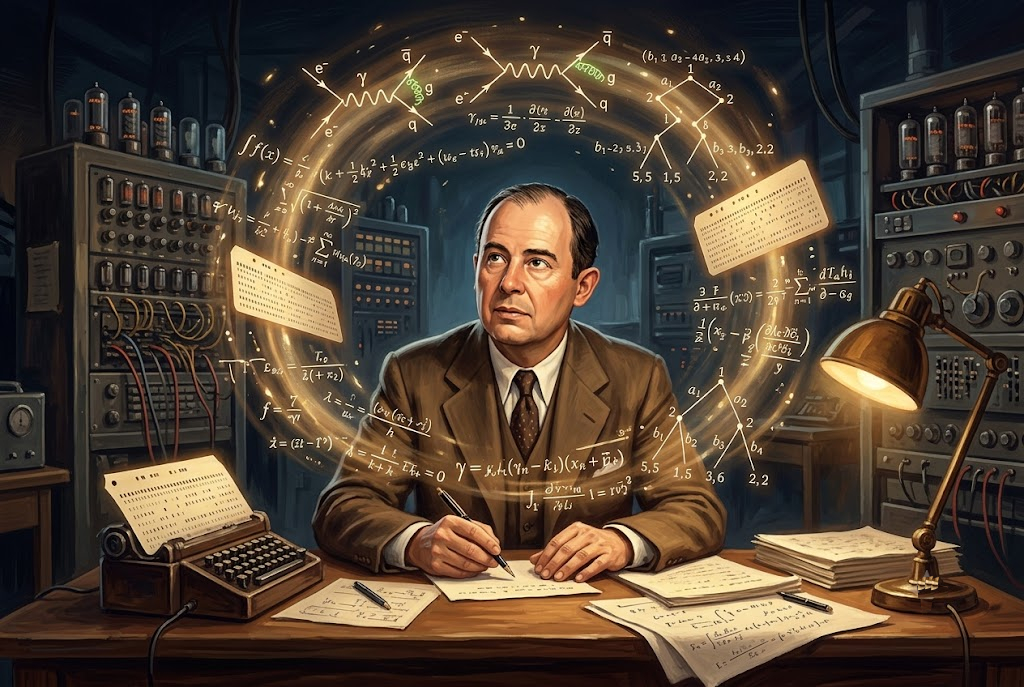
Between 1947 and 1949, Feynman, working independently but parallel to Julian Schwinger and Shin'ichirō Tomonaga, developed a relativistic quantum theory of electrodynamics. His approach was groundbreaking, employing visual "Feynman diagrams" to describe the interactions of subatomic particles. These diagrams provided an intuitive and powerful way to visualize and calculate complex quantum processes, greatly simplifying calculations that were previously cumbersome and error-prone.
The development of QED was not just a technical achievement; it was a conceptual leap. It accurately described how light (photons) and matter (electrons) interact, merging special relativity with quantum mechanics. For his foundational work in QED, Feynman shared the Nobel Prize in Physics in 1965 with Schwinger and Tomonaga. I consider this one of the most significant achievements in 20th-century physics, paving the way for the Standard Model of particle physics.
In 1950, Feynman moved to the California Institute of Technology (Caltech), where he would remain for the rest of his career. Caltech provided him with the freedom to pursue his diverse interests, teach in his unique style, and collaborate with brilliant minds. This environment allowed his maverick personality to truly flourish.
The Great Explainer: Educator and Author (1960s-1970s)
Feynman's impact extended far beyond theoretical physics. He was an extraordinary educator, known for his clarity, humor, and ability to strip away jargon to reveal the core beauty of physics. His lectures were legendary, often delivered with an infectious enthusiasm that inspired generations of students.
In the early 1960s, he undertook the monumental task of revamping the undergraduate physics curriculum at Caltech. The result was The Feynman Lectures on Physics, a three-volume masterpiece that remains one of the most influential physics textbooks ever written. These lectures captured his unique teaching style, emphasizing intuition, problem-solving, and a deep conceptual understanding rather than rote memorization. They were not just textbooks; they were a window into the mind of a genius. You can find more details about these influential lectures on Wikipedia (opens in a new tab).
A Table of Feynman's Contributions to Physics
To appreciate the breadth of Feynman's contributions, let's look at some key areas:
| Area of Physics | Key Contributions | Impact |
|---|---|---|
| Quantum Mechanics | Path Integral Formulation ("Sum Over Histories") | Alternative, intuitive, and powerful formulation; used in quantum field theory and statistical mechanics. |
| Quantum Electrodynamics (QED) | Feynman Diagrams, Renormalization Techniques | Unified quantum mechanics and special relativity for electromagnetic interactions; Nobel Prize-winning. |
| Superfluidity | Microscopic theory of superfluid helium-4 | Explained anomalous behavior of liquid helium at low temperatures; crucial for condensed matter physics. |
| Particle Physics | Parton model for deep inelastic scattering | Insight into the internal structure of protons and neutrons, paving way for quantum chromodynamics. |
| Nanotechnology | "There's Plenty of Room at the Bottom" lecture | Visionary ideas on manipulating matter at atomic scale; inspired the field of nanotechnology. |
Feynman’s gift for explanation wasn't limited to academic settings. His books, such as "Surely You're Joking, Mr. Feynman!" and "What Do You Care What Other People Think?", are rich with anecdotes, philosophical musings, and insights into his problem-solving process. These autobiographical works, which I found immensely entertaining, reveal his irreverent humor, his love for adventure, and his deep disdain for pretension. They made him a cultural icon, demonstrating that a brilliant scientist could also be a fascinating, accessible human being.
Philosopher, Innovator, and Public Figure (1980s)
Beyond his pure scientific and educational endeavors, Feynman was a profound thinker about the nature of science itself, the importance of doubt, and the pursuit of knowledge. His famous 1959 lecture, "There's Plenty of Room at the Bottom," delivered at an American Physical Society meeting at Caltech, is widely regarded as the foundational talk for the field of nanotechnology. In it, he speculated about the possibilities of manipulating individual atoms and molecules to build incredibly small structures and machines. His vision was decades ahead of its time, but it ignited the imaginations of engineers and scientists, setting the stage for future technological revolutions. This visionary talk is a must-read for anyone interested in the origins of nanotechnology. You can access the full transcript and audio on Wikipedia (opens in a new tab).
In 1986, Feynman was thrust into the public spotlight again when he was appointed to the Rogers Commission, tasked with investigating the Space Shuttle Challenger disaster. Despite his failing health due to cancer, he brought his characteristic rigor, skepticism, and hands-on approach to the investigation. Famously, during a televised hearing, he demonstrated how the O-ring seals, which failed in cold temperatures, lost their resilience by simply dropping a piece of the O-ring material into a glass of ice water. This simple, elegant experiment immediately clarified the core technical issue for a global audience, bypassing bureaucratic obfuscation. His directness and insistence on scientific integrity were instrumental in uncovering the truth behind the tragedy.
His involvement in the Challenger investigation cemented his image as a scientist who was not afraid to challenge authority and speak truth to power. He insisted on including his personal dissenting views in the commission's final report, ensuring that the full extent of NASA's organizational flaws was publicly documented. I personally found his unwavering commitment to scientific honesty, even in the face of political pressure, incredibly inspiring.
Personal Life and Passions
Feynman's life was as rich and varied as his intellectual pursuits. After Arline's death, he married twice more. His second marriage to Mary Louise Bell was brief. His third marriage to Gweneth Howarth in 1960 was a lasting and happy one, producing two children, Carl and Michelle. Gweneth, an adventurous woman, was a perfect match for his spirited nature.
He had a wide array of hobbies and interests that sometimes seemed contradictory to his image as a Nobel-winning physicist. He was an accomplished bongo player, performing at parties and even in local ensembles. He learned to draw and paint, becoming surprisingly proficient. He was also a passionate safecracker, a pursuit that he approached with the same methodical curiosity he applied to physics. He traveled extensively, exploring different cultures and languages. His fascination with the small island nation of Tuva led him on a long quest to visit it, which unfortunately he couldn't complete before his death.
Feynman's relentless pursuit of knowledge wasn't confined to the academic realm; it permeated every aspect of his existence. He saw the universe as a playground of puzzles, and he approached each one, whether a fundamental problem in physics or the mechanism of a lock, with the same infectious enthusiasm and ingenuity.
The Legacy of a Maverick (Beyond 1988)
Richard Feynman passed away on February 15, 1988, after a long battle with cancer. His death marked the end of an era, but his influence continues to reverberate across science, technology, and popular culture.
His scientific contributions, particularly QED, remain fundamental to our understanding of particle physics and quantum field theory. Feynman diagrams are now a universal language for physicists, simplifying complex interactions into elegant visual representations. His early insights into nanotechnology continue to drive research in materials science and engineering.
As an educator, his "Lectures on Physics" continue to educate and inspire students worldwide. He demystified physics, showing that it wasn't just for the intellectually elite but for anyone with curiosity and a willingness to think. His approach to learning—questioning authority, embracing doubt, and always seeking an intuitive understanding—is perhaps his most enduring pedagogical legacy.
Culturally, Feynman remains an icon. His autobiographical books are perennial bestsellers, offering a glimpse into the mind of a genius who was profoundly human. He showed that intellect could be coupled with irreverence, that scientific rigor didn't preclude playfulness, and that the greatest discoveries often emerge from the most unexpected places. He proved that a scientist could be a public intellectual, engaging with the world with honesty, humor, and a deep commitment to truth.
In an age where information is abundant but true understanding can be elusive, Feynman’s emphasis on critical thinking and the joy of discovery is more relevant than ever. He reminds us that the greatest adventure lies not in simply accumulating facts, but in constantly questioning, exploring, and dancing with the mysteries of the universe.
For those interested in exploring his life further, I highly recommend watching his "Fun to Imagine" series or reading any of his published lectures and books. You can start by learning more about his life and works on Wikipedia's main article on Richard Feynman (opens in a new tab).
The world may never see another Richard Feynman – a Nobel laureate who played bongos, cracked safes, and explained the universe with such captivating clarity. His legacy is not just a collection of scientific papers or lecture notes, but an enduring spirit of intellectual adventure, a reminder that the greatest truths are often found by those brave enough to challenge convention and embrace the sheer joy of discovery.
Conversation0
No comments yet. Be the first to share a thought — the best questions often become new stories.