


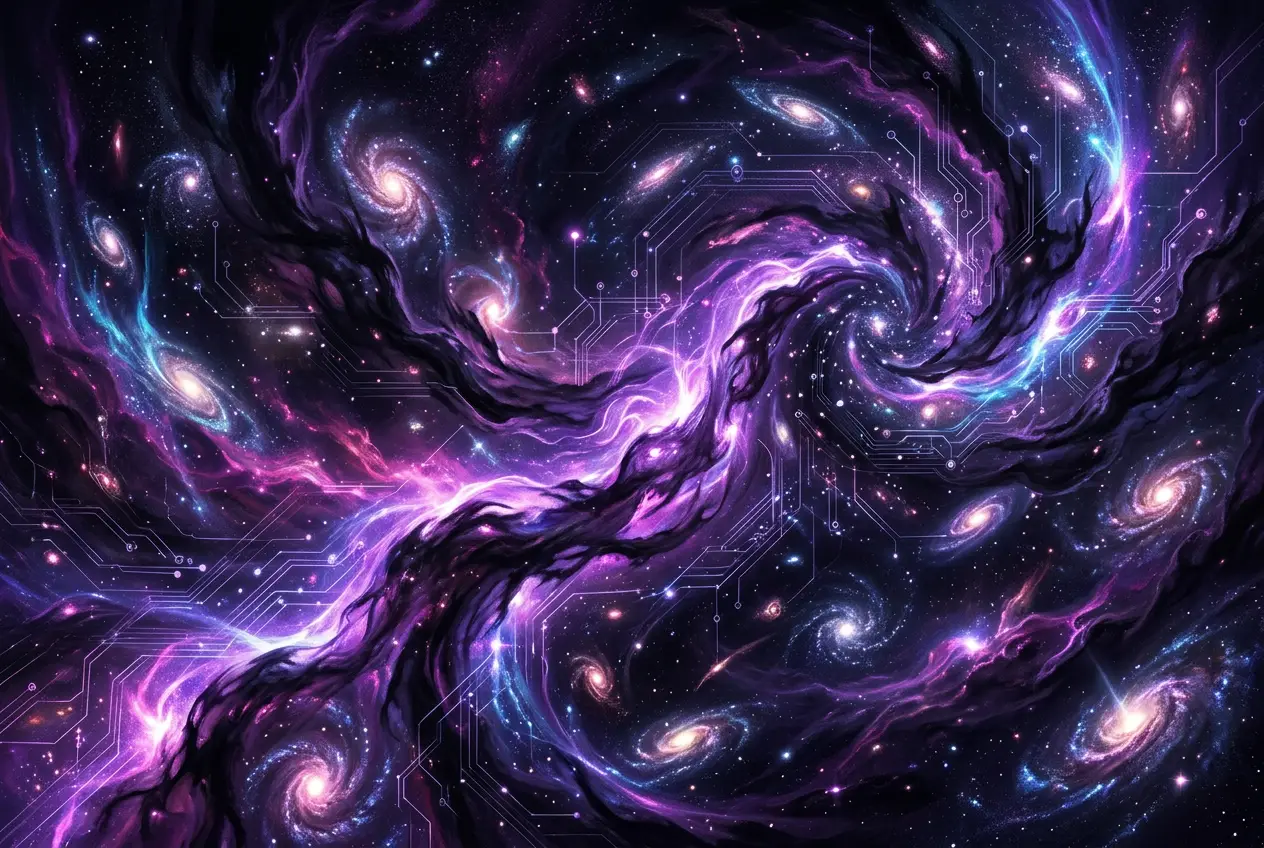
I often find myself looking up at the night sky, not just in awe of the twinkling stars, but pondering the sheer, unimaginable scale of the universe. It's a vast canvas, mostly dark, yet brimming with secrets. For decades, our civilization has been grappling with an increasingly urgent question: where will our future energy come from? We've harnessed fossil fuels, split atoms, and captured sunlight, but each method comes with its own set of limitations and consequences. What if, I wondered recently, the ultimate answer wasn't buried deep within Earth, nor burning brightly in our sun, but hidden within the very fabric of space itself? What if the universe's most enigmatic force, Dark Energy, held the key to an inexhaustible, clean power source that could propel humanity into a future far beyond our current dreams?
It sounds like pure science fiction, I know. But the idea of tapping into the cosmos's most mysterious component is a thrilling thought experiment, one that pushes the boundaries of our understanding of physics and engineering. Join me as we dive into the heart of this cosmic enigma and explore whether this invisible force could truly be the ultimate fuel of tomorrow.
The Unseen Architect: What is Dark Energy?
Imagine our universe, not as a static entity, but as a colossal, ever-expanding balloon. For a long time, scientists believed that gravity, the universe's inherent "pull," would eventually slow this expansion, perhaps even reversing it into a "Big Crunch." Then, in the late 1990s, a startling discovery turned cosmology on its head. Observations of distant supernovae revealed that the universe wasn't just expanding; its expansion was accelerating. It was as if something was actively pushing galaxies apart, overcoming gravity's embrace. This mysterious, repulsive force was dubbed Dark Energy.
The implications were profound. Dark Energy now constitutes roughly 68% of the total energy density of the universe, dwarfing ordinary matter (about 5%) and even the equally mysterious Dark Matter (about 27%). It's the dominant component of our cosmos, yet we can't see it, touch it, or directly detect it. It interacts only through gravity, and its precise nature remains one of the greatest unsolved puzzles in science. As a result, its existence fundamentally reshapes our understanding of cosmic evolution and our place within it. For a deeper dive into its origins, check out the Wikipedia article on Dark Energy (opens in a new tab).
The Elusive Power: Why is it So Hard to Pin Down?
The challenge with Dark Energy is its sheer elusiveness. Unlike a star's fusion or a wind turbine's rotation, Dark Energy isn't concentrated in discrete pockets; it's thought to be smoothly distributed throughout space, permeating everything. Its density is incredibly low – so low, in fact, that its effects are only noticeable on cosmic scales, over billions of light-years. On Earth, or even within our solar system, its influence is negligible compared to gravity and other fundamental forces.
Consider the concept of vacuum energy. In quantum mechanics, even "empty" space isn't truly empty. It's a bubbling cauldron of virtual particles constantly popping into and out of existence. This inherent energy of the vacuum is a strong candidate for Dark Energy, often referred to as the cosmological constant (opens in a new tab). However, theoretical calculations for vacuum energy predict a value astronomically larger than what astronomical observations suggest for Dark Energy – by a factor of 10^120! This monumental discrepancy, known as the "cosmological constant problem," is one of physics' most embarrassing puzzles.
This brings us to the core dilemma: if Dark Energy is so diffuse and its nature so poorly understood, how could we possibly hope to harness it? It's like trying to collect sunlight with a sieve; the energy is there, but it's spread too thin for conventional collection methods.
From Theory to "How": Tapping the Untappable?
This is where science fiction often steps in, fueling our imagination with concepts that, for now, remain firmly in the realm of theory. However, the pursuit of understanding Dark Energy could lead to breakthroughs in fundamental physics that open unforeseen avenues. If Dark Energy is indeed a form of vacuum energy, then the challenge becomes about manipulating the vacuum itself.
One highly speculative idea involves a deeper understanding and control over zero-point energy – the residual energy that remains even at absolute zero temperature. While the concept of extracting usable energy from the quantum vacuum faces immense theoretical and practical hurdles, it's a field of ongoing, albeit controversial, research. We explored related ideas in our post on whether space is a hidden powerhouse. If we could develop technology that could "tap" into this underlying energy field, even locally, the implications would be revolutionary.
Another theoretical possibility hinges on the nature of spacetime. If Dark Energy is tied to the expansion of spacetime, perhaps future technologies could locally "warp" or "manipulate" spacetime to extract energy from the expansive force. Imagine devices that could create microscopic regions where the repulsive force of Dark Energy is intensified and channeled. This sounds eerily similar to concepts like the Alcubierre drive, which hypothesizes warp bubbles for faster-than-light travel by distorting space. While this is far beyond current capabilities, it illustrates the kind of radical thinking required.
A Glimpse into Tomorrow: Potential Applications
Should humanity ever achieve the impossible feat of harnessing Dark Energy, the impact would be nothing short of civilization-altering.
Interstellar & Intergalactic Travel
The dream of traversing vast cosmic distances would become a reality. If Dark Energy could be used to propel spacecraft, perhaps by creating localized "warp bubbles" that surf on the expanding fabric of space, then the speed limits imposed by conventional physics might be bypassed. We could reach distant stars in decades, not millennia, and perhaps even glimpse other galaxies. Imagine not needing rocket fuel, but simply drawing power from the very vacuum of space.
Infinite, Clean Energy
On Earth, and across any colonized planets, an inexhaustible, pollution-free energy source would transform society. Energy scarcity would become a relic of the past. Entire cities could run on power drawn from the vacuum, enabling advanced technological development and improving quality of life for billions. This could fuel megastructures, terraform barren planets, and support populations far beyond what current energy models allow.
Matter Manipulation and Cosmic Engineering
With mastery over Dark Energy, even the manipulation of matter and spacetime itself could become theoretically possible. Imagine constructing materials with properties previously unimaginable, or even localized control over gravitational fields. It could even be a key component in understanding and utilizing other cosmic mysteries, perhaps shedding light on what Dark Matter hides or if the universe is a cosmic neural network. The possibilities would be limitless, allowing for cosmic engineering on a scale that beggars belief.
The Road Ahead: Challenges and Ethical Questions
The path to harnessing Dark Energy is, frankly, fraught with colossal challenges. We currently lack a unified theory of quantum gravity, a comprehensive understanding of what Dark Energy truly is, and any technology remotely capable of interacting with it in a meaningful way. The first step is purely scientific: to unravel the fundamental nature of this cosmic force. Major observatories like the upcoming Vera C. Rubin Observatory and the Nancy Grace Roman Space Telescope are designed to probe Dark Energy's characteristics with unprecedented precision, offering vital clues.
Even if the scientific hurdles are overcome, a host of ethical questions would arise. What are the potential unforeseen consequences of manipulating such a fundamental cosmic force? Could we accidentally destabilize spacetime? What would be the implications for resource distribution and power dynamics if one entity gained control over such an infinite energy source? These are questions that humanity would need to address with immense wisdom and foresight.
Conclusion: A Dream Worth Chasing
While harnessing Dark Energy remains firmly in the realm of theoretical physics and speculative engineering, it represents one of humanity's grandest dreams: to tap into the fundamental forces that shape the cosmos. The journey to understand Dark Energy is itself a powerful driver of scientific discovery, pushing the boundaries of our knowledge of the universe's expansion (opens in a new tab) and the very laws of physics.
Perhaps one day, many millennia from now, our descendants will gaze up at the night sky, not with just wonder, but with the knowledge that the immense, invisible force pushing the universe apart also fuels their civilization, allowing them to explore and thrive across the stars. For now, I continue to look up, content in the knowledge that the biggest mysteries often hold the biggest promises, and Dark Energy is undoubtedly the biggest of them all.




Conversation0
No comments yet. Be the first to share a thought — the best questions often become new stories.