


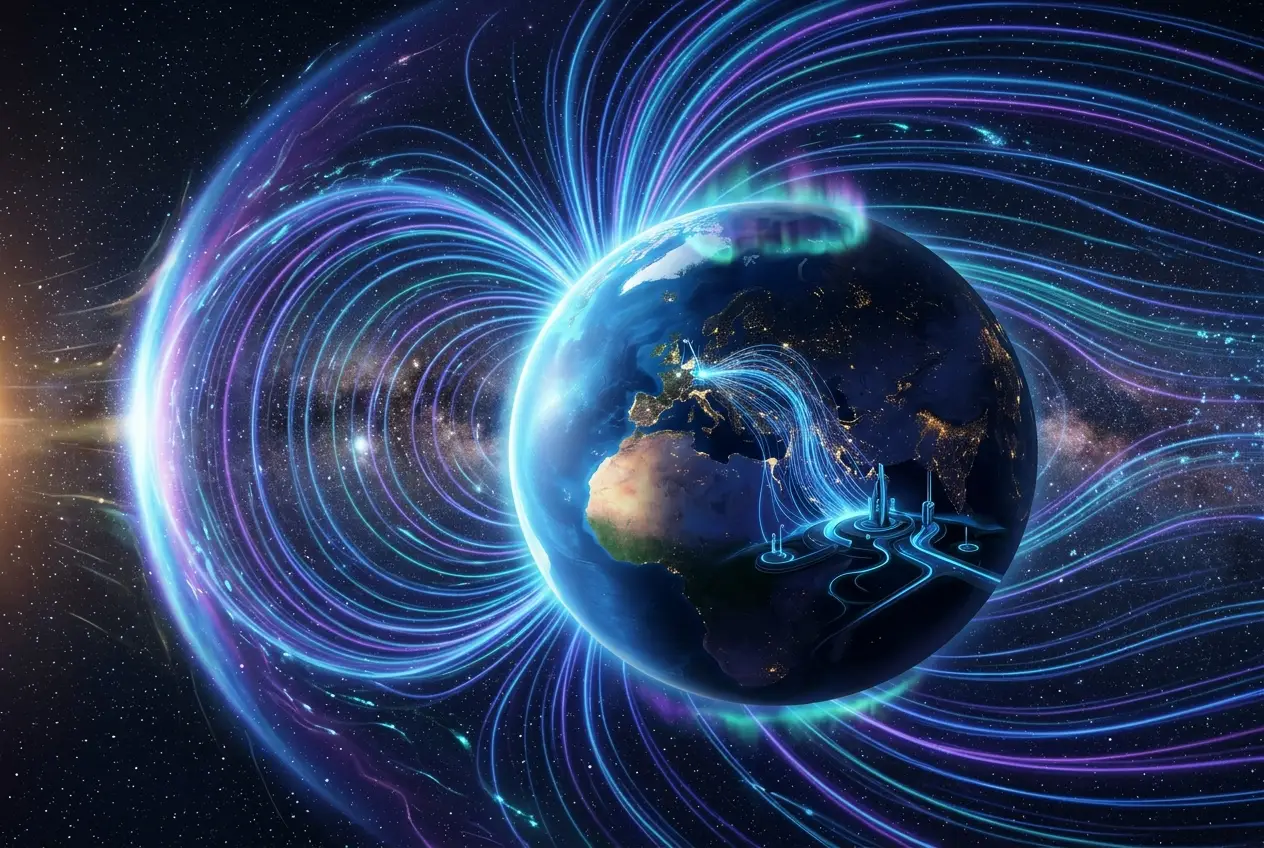
Imagine a world where power isn't drawn from a grid, but from the very pulse of our planet. Not the geothermal heat bubbling beneath, nor the winds sweeping across landscapes, but something far more subtle, omnipresent, and deeply intertwined with Earth's electrical symphony. It's a concept that sounds like science fiction, yet the fundamental phenomenon has been a subject of scientific fascination for decades: Schumann Resonance, often called Earth's natural heartbeat.
For years, I’ve been intrigued by the idea of tapping into ambient energy. We talk about solar, wind, and even nuclear, but what about the less obvious, almost mystical sources? The planet we inhabit is a giant, living electrical system, buzzing with frequencies that have profoundly shaped life. Could this constant, global hum be harnessed to power our future? It’s a question that pushes the boundaries of our understanding of energy and challenges us to look at our home planet in an entirely new light.
The Earth's Hidden Hum: What is Schumann Resonance?
At its core, Schumann Resonance describes a set of global electromagnetic resonances, generated and excited by lightning discharges in the cavity formed by the Earth's surface and the ionosphere. Think of the Earth and the lower ionosphere as two concentric spheres, creating a giant natural waveguide. When lightning strikes, it acts like a giant transmitter, sending out electromagnetic waves that travel around the Earth. These waves bounce back and forth, and at certain frequencies, they reinforce each other, creating standing waves. The fundamental frequency of this resonance is approximately 7.83 Hz, often referred to as Earth's "master frequency" or "brainwave" frequency.
It's a phenomenon that's been consistently observed since its theoretical prediction by Winfried Otto Schumann in 1952. The stability of this frequency is remarkable, varying only slightly due to daily and seasonal changes in the ionosphere and global lightning activity. It's truly a constant, subtle reminder of our planet's vibrant electromagnetic activity. For a deeper dive into the science, you can explore the Schumann Resonance on Wikipedia (opens in a new tab).
The Symphony of Lightning and Ionosphere
To truly grasp the potential, we must understand its origin. Lightning, in its raw, electrifying power, isn't just a dramatic atmospheric event; it's the primary engine of the Schumann Resonance. Every second, somewhere on Earth, approximately 50-100 lightning flashes occur. Each flash generates electromagnetic pulses that propagate through the Earth-ionosphere cavity.
The ionosphere, a layer of the Earth's upper atmosphere that is ionized by solar and cosmic radiation, acts as a reflective ceiling for these electromagnetic waves. This layer is crucial because it creates the closed cavity necessary for the waves to resonate. Without the ionosphere, the pulses would simply dissipate into space. The thickness and conductivity of the ionosphere change throughout the day and night, affecting the exact frequencies and strengths of the Schumann Resonance modes. This interaction forms a global electric circuit, constantly recharging itself.
From Theory to Tangible Power: The Harvesting Challenge
The idea of harvesting energy from the Schumann Resonance is tantalizing. Imagine devices that could draw power from the very air around them, without wires, solar panels, or wind turbines. The challenge, however, lies in the exceedingly low power density of these waves. While omnipresent, the energy available from Schumann Resonance is minuscule, typically in the femtowatt range per square meter.
Consider the ambient electromagnetic noise around us – radio signals, Wi-Fi, cell phone transmissions. These are orders of magnitude stronger than the Schumann Resonance. Extracting usable power from such a weak signal is akin to trying to hear a whisper in a rock concert.
So, how might we even begin to approach this? One promising area could be resonant energy harvesting. This involves designing antennas or transducers that are precisely tuned to the Schumann frequencies. Just as a radio antenna resonates with specific broadcast frequencies, a specialized resonator could theoretically amplify these incredibly weak natural signals.
- Piezoelectric Materials: These materials generate an electric charge when subjected to mechanical stress, or vice-versa. If we could design materials that vibrate in resonance with Earth's subtle electromagnetic fluctuations, they might convert this kinetic energy into electrical energy. Research into piezoelectricity (opens in a new tab) has shown incredible advancements in harvesting ambient vibrations, which could potentially be adapted.
- Nano-antennas and Metamaterials: The future of energy harvesting often lies at the nanoscale. Scientists are developing highly efficient nano-antennas and metamaterials that can capture and convert electromagnetic waves with unprecedented efficiency. Could these technologies one day be refined to resonate with the extremely low frequencies and power levels of Schumann Resonance?
- Ultra-low Power Devices: The most realistic early application wouldn't be powering homes, but rather tiny, autonomous sensors or medical implants that require only micro- or nanowatts of power. For such devices, a constant, albeit minute, power source could be revolutionary, eliminating the need for batteries or frequent recharging.
"The greatest challenge in harnessing ambient energy isn't merely capturing it, but doing so efficiently enough to make it practical," says Dr. Elena Petrova, a leading researcher in electromagnetic energy harvesting. "With Schumann Resonance, we're talking about pushing the absolute limits of detector sensitivity and energy conversion."
Historical Whispers and Modern Resonance
It's fascinating to consider if ancient cultures, perhaps intuitively, sensed or even tried to interact with Earth's frequencies. While lacking scientific instruments, many ancient structures, like megaliths, have been theorized to possess resonant properties. Some wonder if these were early attempts to attune to planetary energies. Though highly speculative, the human connection to Earth's rhythms is undeniable. We've explored the idea of whether ancient structures resonated with Earth's frequencies in a previous post: Did Ancient Structures Resonate with Earth's Frequencies?.
In modern times, the Schumann Resonance has also piqued interest beyond just energy. It's been linked to potential effects on human consciousness and biological processes, given that brainwave frequencies often overlap with these natural Earth rhythms. While still a subject of ongoing research, this connection hints at a deeper interaction between life and our planet's electromagnetic environment. Could quantum biology, which we discussed in Could Quantum Biology Unlock Life's Deepest Secrets?, offer some answers here?
The Road Ahead: A Sustainable Dream?
If we could unlock the secrets of harnessing Earth's resonant field, the implications for sustainable technology would be profound. Imagine a world where:
- Off-grid Sensors: Environmental monitoring devices in remote locations could operate indefinitely without battery changes.
- Personal Wearables: Low-power health monitors could be truly 'always on,' drawing power directly from the environment.
- Distributed Networks: A network of tiny, self-powered devices could form vast intelligent systems without any centralized power infrastructure.
However, the path is fraught with immense scientific and engineering hurdles. We are dealing with signals orders of magnitude weaker than what current energy harvesting technologies typically target. It's not about inventing a new type of energy, but about refining our ability to detect, capture, and convert incredibly subtle, omnipresent energy. The pursuit itself pushes the boundaries of electromagnetism, materials science, and quantum physics. It aligns with the spirit of seeking "free energy" from the environment, a concept that has long fascinated researchers, as seen in topics like Unseen Forces: Did Tesla Discover Free Energy?.
Conclusion: A Whisper of Potential
The Schumann Resonance remains one of the Earth's most intriguing geophysical phenomena. While the dream of powering entire cities with Earth's heartbeat is far-fetched for now, the continuous quest to understand and potentially harness this subtle energy is a testament to human ingenuity. It forces us to look beyond conventional energy sources and consider the vast, unseen energetic landscape of our planet. As technology advances, especially in areas like metamaterials and ultra-low power electronics, the whisper of Earth's hum might one day become a quiet, but powerful, hum of sustainable energy. The journey to unlock this potential is a long one, but it is paved with curiosity and the enduring belief that the Earth holds more secrets than we can imagine.





Conversation0
No comments yet. Be the first to share a thought — the best questions often become new stories.