


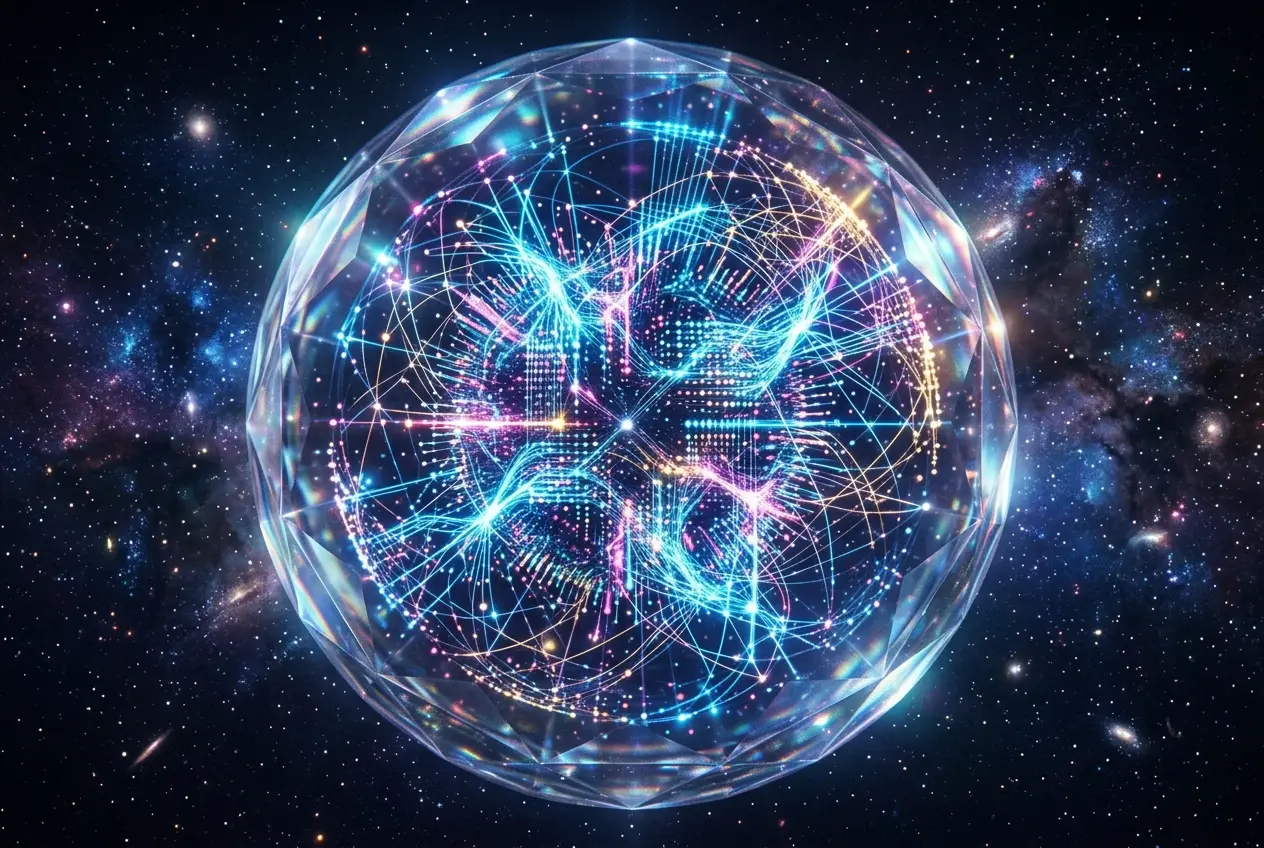
I often find myself marveling at the sheer volume of data we generate every single second. From streaming high-definition videos and sharing countless photos to powering complex AI models and scientific simulations, our digital footprint is expanding at an exponential rate. It’s a staggering thought: every two days, humanity creates as much data as we did from the dawn of civilization up until 2003. This explosion brings a crucial question to the forefront: how do we store it all? Our current storage technologies, largely reliant on silicon-based hard drives and flash memory, are rapidly approaching their physical limits. We're facing a looming data storage crisis, demanding solutions that are not just incrementally better, but fundamentally revolutionary.
This challenge has scientists and engineers looking beyond conventional materials, peering into the very fabric of the universe for inspiration. And one of the most enigmatic, yet ubiquitous, entities in existence might hold the key: light itself. Can the humble photon, the elementary particle of light, become the ultimate storage medium, capable of holding unthinkable amounts of data, perhaps even "worlds" of information, in incredibly small spaces? I believe the truth is more fascinating than fiction.
The Data Deluge: A Looming Crisis
Today’s digital infrastructure is a marvel, yet it’s built on principles that are beginning to creak under the strain. Hard disk drives store data magnetically, requiring physical space for platters and read/write heads. Solid-state drives (SSDs) use flash memory, storing data as electrical charges in tiny silicon transistors. Both methods, while incredibly efficient, are bounded by the laws of classical physics and material science. We can only shrink transistors so much, and magnetic domains can only be made so small before quantum effects cause instability. The energy consumption of these massive data centers is also a growing concern, demanding sustainable alternatives.
The global data sphere is projected to reach over 175 zettabytes by 2025. To put that in perspective, one zettabyte is a trillion gigabytes. Imagine trying to store that on current devices! We need a paradigm shift, a leap into a storage technology that can offer orders of magnitude greater density, speed, and energy efficiency. This is where light, with its remarkable quantum properties, steps onto the stage.
Beyond Bits: How Light Can Encode Information
We're already familiar with light-based storage in a classical sense. CDs, DVDs, and Blu-ray discs use lasers to read pits and lands on a reflective surface, representing binary 0s and 1s. This is essentially two-dimensional storage. However, the true potential of light lies in exploiting its more complex characteristics: its wavelength, polarization, phase, and even its quantum states like superposition and entanglement.
Holographic Data Storage: The 3D Frontier
One of the most promising avenues for super-dense light-based storage is holographic data storage (opens in a new tab). Unlike traditional methods that store data on a surface, holographic storage records information throughout the volume of a material, often a photosensitive crystal or polymer. Here’s how it works:
- Reference Beam: A laser beam, known as the reference beam, is directed at the recording medium.
- Signal Beam: Another laser beam, the signal beam, carries the data. This data is encoded as an interference pattern by passing the laser through a spatial light modulator (SLM) – essentially a tiny screen that displays pages of binary data as bright and dark pixels.
- Interference: When the reference and signal beams intersect within the recording medium, they create a complex three-dimensional interference pattern. This pattern, much like a tiny hologram, alters the optical properties of the material, "recording" the data.
- Reading Data: To retrieve the data, only the reference beam is shined through the recorded area. The recorded interference pattern then diffracts the light, reconstructing the original signal beam, which is then captured by a camera and decoded back into data.
The beauty of holographic storage is its ability to overlap multiple data "pages" in the same volume, each recorded at a slightly different angle or wavelength. This dramatically increases data density, moving from two-dimensional surfaces to three-dimensional volumes. Imagine storing hundreds of gigabytes, or even terabytes, within a cube of sugar-sized crystal!
Quantum Memory and Photons: The Ultimate Qubit Carriers
Taking an even more radical leap, quantum mechanics suggests that individual photons, or even their fundamental properties, could act as carriers for quantum bits, or qubits (opens in a new tab). Unlike classical bits that are either 0 or 1, qubits can exist in a superposition of both states simultaneously. This means a single qubit can hold exponentially more information than a classical bit. Furthermore, multiple entangled photons can form a quantum state where the state of one instantly influences the others, regardless of distance.
In quantum memory research, scientists are exploring ways to store these fragile quantum states carried by photons. This involves trapping photons in specialized materials, such as ultracold atomic gases or rare-earth-ion-doped crystals. These materials temporarily "absorb" the photon's quantum state, holding it for a short period before it can be retrieved. While still in its early stages, quantum memory is a cornerstone for quantum computing and the development of a quantum internet, allowing for ultra-secure communication and processing of vast datasets.
I've learned a lot about the potential of these mind-bending concepts by diving into other articles. For instance, the idea of how can-light-trapped-in-crystals-build-quantum-internet-9359 delves into similar aspects of harnessing light for advanced data solutions.
The Theoretical Limits: How Much is "Worlds"?
When we talk about storing "worlds" in a photon, we're venturing into the theoretical limits of information density. The fundamental laws of physics dictate how much information can be stored in a given amount of energy or space.
One key principle is Landauer's Principle (opens in a new tab), which states that erasing a single bit of information always dissipates a minimum amount of energy as heat. This principle sets a fundamental thermodynamic cost for computation and data processing. For storing data, the Bekenstein bound suggests a maximum amount of information that can be contained within a finite region of space, which relates to its surface area (or entropy).
However, by leveraging the quantum properties of light, we can push these boundaries far beyond classical limits. A single photon, by encoding information not just in its presence or absence (like a classical bit), but in its spin, polarization, frequency, or entangled state with other photons, can carry significantly more information.
Consider a photon that can exist in multiple frequency states, each state encoding a unique piece of information. Or a photon whose polarization can be manipulated to carry several bits. The quantum world offers a multidimensional canvas for information encoding. The dream is that by manipulating a photon's numerous quantum degrees of freedom, we could compress vast amounts of data into a single quantum of light. We're talking about densities that make current technologies look like ancient scrolls compared to a digital library.
Challenges and the Road Ahead
Despite its immense promise, light-based and quantum storage face significant hurdles:
- Stability: Quantum states are incredibly fragile and easily disrupted by environmental interference (decoherence). Maintaining them for useful periods is a major challenge.
- Read/Write Speed: While light travels at incredible speeds, the process of encoding and decoding complex quantum information can be slow and error-prone with current technologies.
- Integration: Developing robust, scalable, and room-temperature systems that can seamlessly integrate with existing digital infrastructure is a monumental task.
- Cost: The advanced materials and intricate laser systems required for some of these technologies are currently very expensive.
However, research is advancing at a rapid pace. Scientists are experimenting with new materials like metamaterials and photonic crystals, designing novel optical circuits, and pushing the boundaries of laser precision. Breakthroughs in room-temperature quantum memory and more efficient holographic recording materials are bringing us closer to practical applications.
The implications of successfully harnessing light for super-dense data storage are profound. Imagine:
- Pocket-Sized Libraries: Carrying the entire knowledge of humanity in a device no larger than a coin.
- Instantaneous Data Transfer: Light-speed data access within quantum networks.
- Revolutionary AI: AI models with access to unprecedented amounts of data, processed at incredible speeds.
- Long-Term Archival: Storing critical historical or scientific data in ultra-stable, light-based media for millennia.
This quest to unlock light's data secret reminds me of how fundamentally information itself operates at the deepest levels, as explored in articles like does-information-have-mass-unpacking-digital-gravity-5714. The more we understand the universe, the more we find its principles reflected in our technological ambitions.
Conclusion
The notion of storing "worlds" in a single photon might sound like science fiction, but the underlying science of holographic and quantum data storage is very real and actively being pursued. As our digital universe expands, the need for radically new storage solutions becomes ever more urgent. Light, the very medium that illuminates our world, offers a path to an future where data is not just stored, but intricately woven into the fabric of matter itself. It’s a journey that promises to redefine our relationship with information, unlocking capabilities we can only begin to imagine today. The age of light-based data is not just coming; it's already beginning to glow on the horizon.



Conversation0
No comments yet. Be the first to share a thought — the best questions often become new stories.