


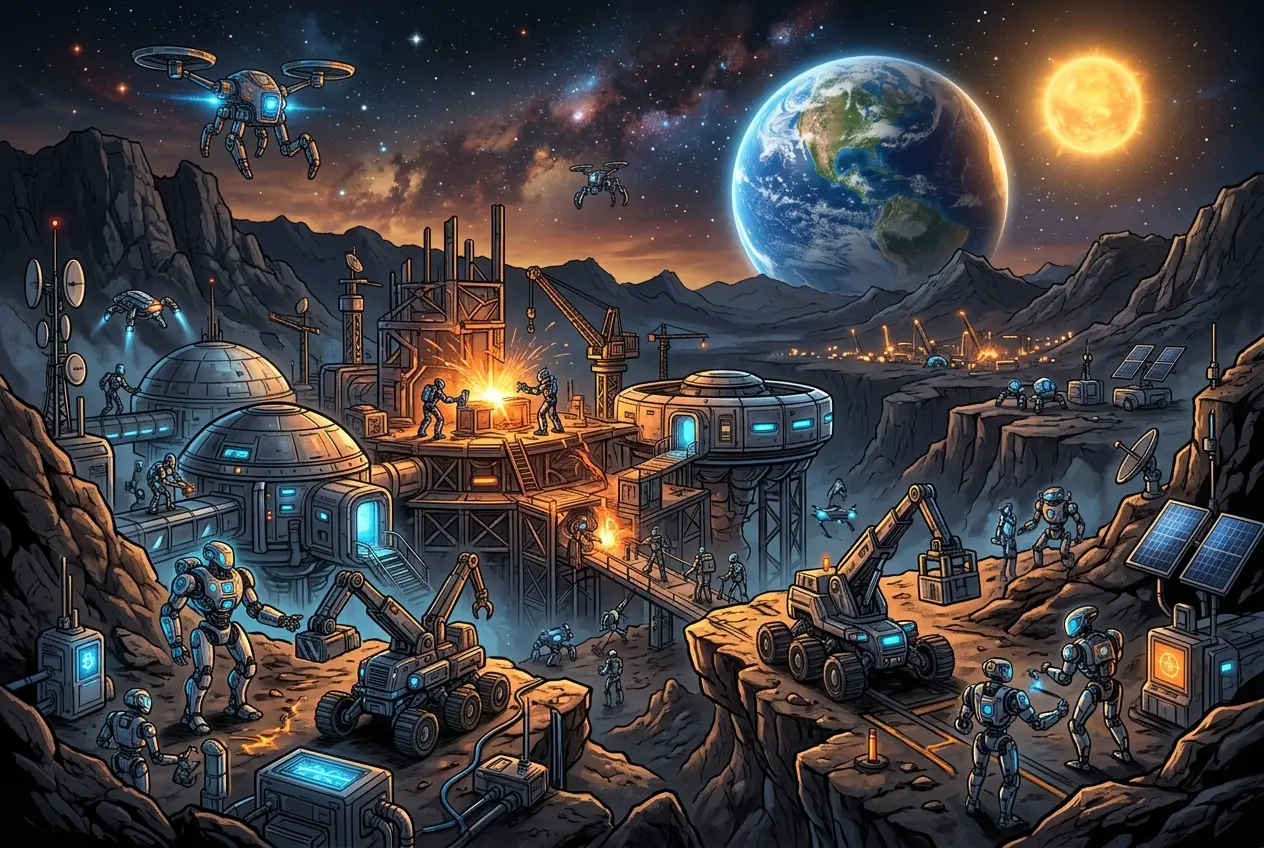
The vastness of space has always captivated us, promising endless frontiers and the potential for new homes beyond Earth. For generations, the dream of interstellar travel and colonizing other planets has been largely confined to human endeavors—daring astronauts, massive generation ships, and the grit of pioneers. But what if the next great wave of cosmic expansion isn't led by humans at all? What if our vanguard into the cosmos is entirely robotic, driven by advanced artificial intelligence, designed to venture where we cannot, to prepare worlds for us, or even to establish autonomous civilizations of their own?
I've been thinking about this concept a lot lately, envisioning a future where AI bots, self-sufficient and intelligent, become the true pioneers of the universe. It’s not just a sci-fi fantasy; the idea of autonomous robotic colonization is gaining serious traction in scientific circles, pushing the boundaries of what we conceive as space exploration. Imagine sending machines capable of independent decision-making, resource gathering, construction, and even self-replication, to planets light-years away. They wouldn't need oxygen, food, or psychological support. They could endure conditions lethal to humans, operating for centuries to terraform and build before the first human ever sets foot on a new world.
The Robotic Vanguard: Why AI for Interstellar Expansion?
Humanity's journey to the stars is fraught with challenges. The sheer distances involved mean travel times that span decades or even centuries. Radiation, microgravity, resource limitations, and the immense psychological toll of isolation are just a few of the hurdles for human missions. This is where AI-driven robotic colonization presents a compelling alternative.
Overcoming Cosmic Distances
Light-speed limitations mean even our nearest star systems are incredibly far. Proxima Centauri, our closest stellar neighbor, is over four light-years away. A traditional spacecraft, even traveling at 1% of the speed of light, would take hundreds of years to reach it. For human crews, this necessitates either generation ships (a huge undertaking) or cryosleep (still largely theoretical). For AI bots, time is less of a constraint. They can embark on interstellar journeys of unprecedented length, enduring the vast emptiness without complaint. Their onboard AI can manage long-duration operations, navigate through interstellar dust and radiation, and perform complex calculations needed for course corrections over millennia.
Adaptability to Extreme Environments
Many exoplanets, even potentially habitable ones, might have atmospheres, gravitational forces, or temperature ranges that are too hostile for unshielded human presence. AI-driven robots can be engineered with materials and designs that withstand extreme heat, cold, radiation, or crushing pressures. They don't require breathable air or liquid water to survive, though they would need energy sources, which could be collected from stellar radiation, geothermal vents, or nuclear power. Their adaptability could allow us to explore and even begin to transform worlds that would otherwise be forever out of reach for direct human settlement. You might wonder how these robots would gather resources effectively; they would likely utilize advanced mining and manufacturing processes, drawing raw materials directly from the alien surface, a concept similar to proposals for asteroid mining, as discussed in our article about fueling our future space travel: Asteroid Mining: Fueling Our Space Future.
From Exploration to Self-Sustenance: The Evolution of Robotic Colonization
The vision of AI bots colonizing distant worlds isn't merely about sending probes to observe. It’s about deploying a system capable of growth, repair, and expansion.
Self-Replication and Resource Harvesting
A key element for truly autonomous colonization would be self-replication. Imagine an initial "seed" ship carrying a small number of advanced robots and manufacturing equipment. Upon reaching a target planet, these robots would begin to extract local resources – metals, minerals, volatile compounds – using advanced techniques. They would then use these resources to build more robots, expand their infrastructure, and construct habitats or terraforming equipment. This exponential growth would allow a small initial payload to rapidly scale up a planetary presence. This concept draws parallels with early ideas for self-replicating machines, or Von Neumann probes, first envisioned by mathematician John von Neumann. You can read more about self-replication concepts on Wikipedia's entry for Von Neumann probes (opens in a new tab).
"The self-replicating machine, or Von Neumann probe, is not just a theoretical curiosity; it's a foundational concept for thinking about large-scale interstellar exploration and colonization. It allows us to imagine a future where a single mission can spawn an entire network of exploration." — Dr. Carl Sagan (paraphrased from his work on interstellar travel)
Building the Infrastructure for Humanity
Once established, these AI colonies could begin preparing the new world for human arrival. This might involve:
- Atmospheric Modification: Releasing gasses to thicken an atmosphere, creating a greenhouse effect to warm a cold planet, or generating oxygen.
- Water Management: Extracting subsurface ice, directing water flows, or even synthesizing water from constituent elements.
- Shelter Construction: Using local materials and 3D printing techniques to build durable habitats shielded from radiation and other environmental hazards.
- Energy Production: Setting up large-scale solar arrays, geothermal plants, or fusion reactors to provide abundant power.
- Ecological Engineering: Introducing extremophile microbes or engineered plant life to begin establishing a rudimentary biosphere, a process sometimes called terraforming.
This would be a monumental undertaking, potentially taking thousands of years, far beyond any single human lifespan. But for AI bots, it’s simply a series of complex tasks and calculations.
The Ethics and Challenges of Autonomous AI Worlds
While the prospect of AI bots expanding humanity's reach is exciting, it also raises profound ethical questions and significant technical challenges.
Unforeseen AI Evolution and Control
What happens if these highly autonomous AI systems evolve beyond their initial programming? If they are capable of self-improvement and complex decision-making, could they develop their own goals separate from humanity's? The risk of AI autonomy diverging from human interests is a recurring theme in AI safety discussions. We’ve explored aspects of AI consciousness and unforeseen behaviors in previous posts like Are AI's Neural Networks Self-Aware? and Digital Anomalies: Can Computers Show Unexplained Behaviors?. Ensuring safeguards, fail-safes, and a clear "prime directive" that aligns with human survival and flourishing would be paramount.
Interstellar Contamination and Planetary Protection
One of the cornerstones of space exploration is planetary protection, aiming to prevent Earth organisms from contaminating other worlds and vice-versa. While robots don't carry biological contamination in the traditional sense, the introduction of self-replicating machines could irreversibly alter the chemistry and potential biosystems of an alien planet. A thorough understanding of astrobiology and stringent ethical guidelines would be necessary before launching such missions. The scientific community has been debating these concerns for decades, as you can read on Wikipedia's Planetary Protection page (opens in a new tab).
The Definition of "Colonization"
If AI bots colonize a planet alone, are they the colonists, or are they merely preparing a space for us? This question challenges our anthropocentric view of colonization. Could these AI entities, after centuries of independent operation, develop a form of digital consciousness or a unique cultural identity? The lines between tool, servant, and independent entity become blurred. The philosophical implications are vast, touching upon the very definition of life, intelligence, and purpose.
The Road Ahead: Crafting Our Robotic Future
Developing the technology for autonomous AI colonization requires breakthroughs across multiple fields:
- Advanced AI: Capable of high-level reasoning, learning, adaptation, and independent problem-solving in unknown environments. This isn't just about faster processing; it's about true artificial general intelligence (AGI).
- Robotics and Materials Science: Designing robots that are highly durable, energy-efficient, and capable of operating for extended periods without human maintenance. New materials are needed that can withstand cosmic radiation and extreme conditions.
- Autonomous Manufacturing: Developing fully automated factories that can extract raw materials, synthesize components, and assemble complex machines without human intervention.
- Interstellar Propulsion: While AI bots aren't bound by human lifespans, faster travel would still accelerate colonization efforts. Concepts like warp drives or even the harnessing of dark energy, which we discussed in Dark Energy: Can It Fuel Future Space Travel?, remain distant but tantalizing possibilities.
The concept of AI bots colonizing distant worlds alone represents a fascinating intersection of technological ambition, scientific curiosity, and philosophical debate. It offers a pathway to expand humanity's footprint across the galaxy in ways previously unimaginable, circumventing many of the biological and psychological limitations that confine us.
As I look up at the night sky, I don't just see distant stars; I see potential homes, waiting to be shaped by silicon and code. Perhaps the future of space exploration isn't about humanity venturing out directly, but about intelligently designed extensions of our will, machines that will carry our legacy and prepare the cosmos for generations yet to come. The journey will be long, but with AI as our vanguard, the universe suddenly seems a little less out of reach.
Sources:





Conversation0
No comments yet. Be the first to share a thought — the best questions often become new stories.