


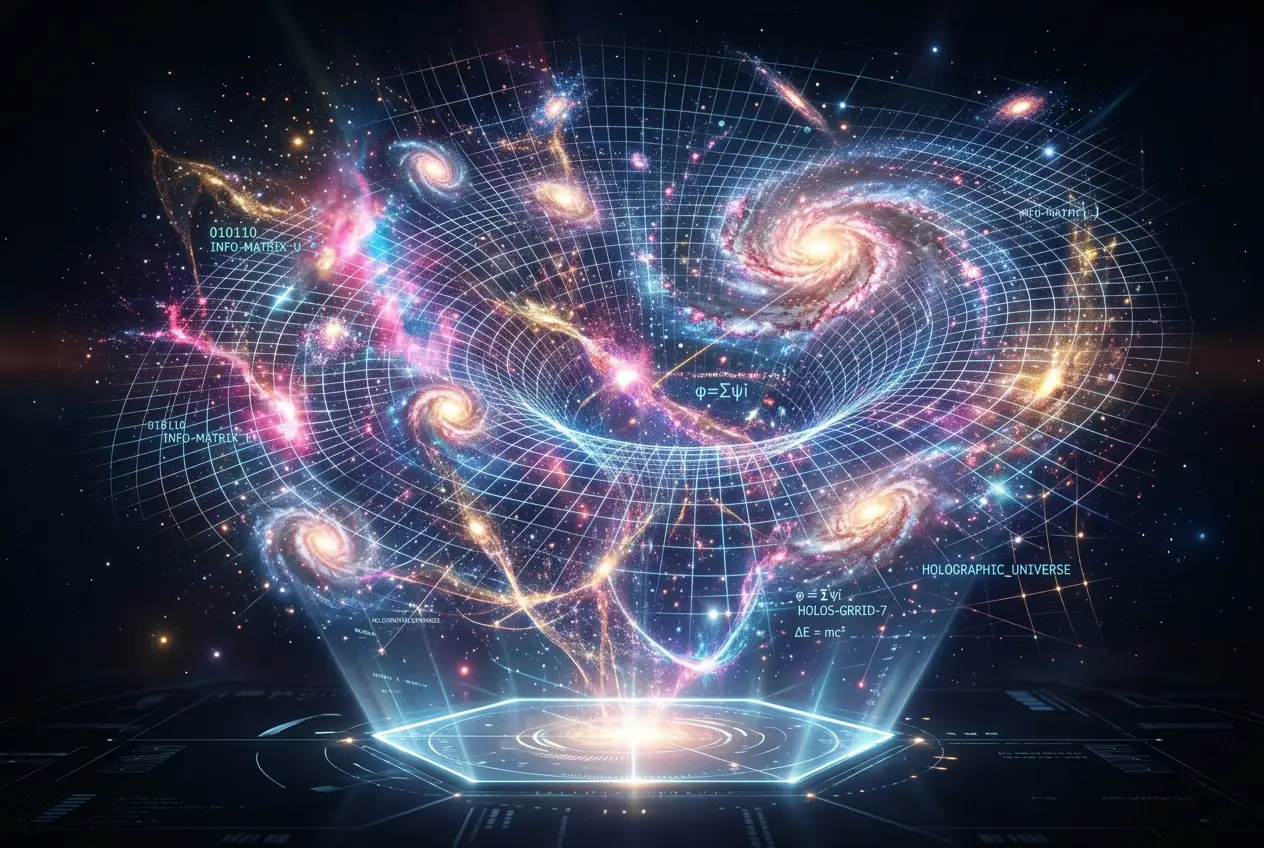
I remember staring up at the night sky once, feeling an overwhelming sense of wonder, but also a strange disconnect. The stars, the planets, the vast emptiness – it all felt so real, so tangible. Yet, in the back of my mind, a persistent question echoed: what if this reality, this seemingly solid universe, isn't what it appears to be? What if it's not a three-dimensional space in the way we've always understood it? This isn't the stuff of science fiction anymore; it’s a mind-bending concept being seriously explored by some of the brightest minds in theoretical physics: the holographic principle.
For decades, we’ve taken for granted that our universe exists in three spatial dimensions (length, width, depth) plus time. But imagine if everything we perceive – every atom, every galaxy, every memory – is merely a projection, an incredibly detailed illusion generated from information encoded on a distant, two-dimensional surface. This idea, once relegated to philosophical musings, has gained significant traction, especially from insights gleaned from black holes and the very fabric of spacetime. It challenges our fundamental understanding of existence, suggesting that the "real" reality might be far simpler, yet infinitely more profound, than we ever dared to imagine.
The Enigma of Black Holes: A Seed of the Holographic Idea
The story of the holographic principle truly begins with black holes. These cosmic behemoths, with their gravitational pull so immense that not even light can escape, are some of the most mysterious objects in the universe. What started as a thought experiment led to a profound realization about them. In the 1970s, physicist Jacob Bekenstein proposed that black holes have entropy, a measure of disorder, and that this entropy is proportional to the surface area of their event horizon, not their volume.
This was a radical departure from conventional physics. For any normal object, entropy scales with volume. If you pack more stuff into a bigger box, you get more disorder. But Bekenstein's work, later supported by Stephen Hawking’s discovery of Hawking radiation, suggested that for a black hole, all the information about what fell into it – every star, every particle, every quantum fluctuation – seemed to be encoded not within its three-dimensional interior, but on its two-dimensional boundary, the event horizon.
I find this simply astonishing. It's like realizing that all the data of a complex 3D video game isn't stored in a massive 3D chunk of memory, but on a flat disc, and the "game" we experience is just the playback. This anomaly of black hole thermodynamics gave birth to the holographic principle.
Juan Maldacena and the AdS/CFT Correspondence
While Bekenstein and Hawking laid the groundwork, it was Argentine theoretical physicist Juan Maldacena who truly brought the holographic principle into the mainstream of theoretical physics. In 1997, Maldacena proposed a groundbreaking conjecture known as the AdS/CFT correspondence (Anti-de Sitter/Conformal Field Theory).
Simply put, Maldacena suggested that a specific type of gravitational theory in a certain kind of curved, anti-de Sitter space (a universe with negative curvature, unlike our own, which seems to have positive or zero curvature) is mathematically equivalent to a quantum field theory without gravity existing on the boundary of that space. Think of it like this: everything happening in the 3D (or higher) gravitational "bulk" can be perfectly described by a quantum theory living on its lower-dimensional boundary. It’s a bit like a 3D object casting a 2D shadow that contains all the information of the 3D object.
This correspondence is a powerful tool because it connects two vastly different areas of physics: quantum gravity (the incredibly complex realm of unifying gravity with quantum mechanics) and quantum field theory (which describes particles and forces). It allows physicists to translate problems from one domain to the other, potentially solving issues that are intractable in their original form. For instance, some of the most perplexing challenges in quantum gravity, like understanding how black holes process information, become more manageable when viewed through the lens of a lower-dimensional quantum field theory.
I can't overstate the significance of this. It provides a concrete, mathematical example of a holographic universe, even if it's not our universe directly. It’s a proof-of-concept that such a reality is possible and internally consistent.
Is Our Universe a Cosmic Projection?
Maldacena’s work primarily applies to anti-de Sitter spaces, which are not exactly like our universe. Our universe is believed to be expanding at an accelerating rate, leading to a de Sitter space (positive curvature) or a flat spacetime. However, the success of the AdS/CFT correspondence has led physicists to wonder if a similar principle might apply to our own cosmos. Could the entire visible universe, with all its stars, galaxies, and black holes, be a projection of information encoded on a distant, two-dimensional surface?
One of the most compelling arguments for this comes from the idea of the cosmological horizon. Just as a black hole has an event horizon, our expanding universe has a cosmological horizon beyond which we cannot observe anything, even in principle, because light from those regions hasn't had time to reach us. Some theories suggest that information about our entire universe might be encoded on this boundary, much like the black hole scenario.
This theory offers potential solutions to some of physics' biggest puzzles. For instance, the infamous "information paradox" of black holes, which questions whether information is truly lost when it falls into a black hole (violating quantum mechanics), finds a natural resolution in a holographic framework: the information is never lost, merely encoded on the boundary. You can read more about how physicists are grappling with the simulation hypothesis, a concept somewhat related to the holographic principle, in our previous blog post: Could Our Reality Be a Simulation? Decoding the Matrix Hypothesis.
The Search for Evidence: Cosmic Microwave Background and Information
So, if our universe is a hologram, how would we ever know? Physicists are actively looking for subtle clues. One promising area involves studying the cosmic microwave background (CMB) radiation – the afterglow of the Big Bang. The CMB is an incredibly uniform bath of radiation permeating the universe, but it contains tiny temperature fluctuations that correspond to the seeds of all structures we see today.
Some theoretical models predict that if our universe is holographic, these fluctuations might exhibit specific patterns or characteristics that would be different from what a purely 3D universe would produce. For example, researchers have looked for signs of "holographic noise" – a kind of quantum fuzziness that would arise from the fundamental resolution limit of a holographic projection. Early studies, such as those by physicists like Craig Hogan at Fermilab, explored whether there's a limit to how precisely we can resolve distances in the universe, suggesting that spacetime itself might not be infinitely smooth but granular, much like pixels on a screen. While conclusive evidence remains elusive, the pursuit is ongoing.
Another intriguing line of inquiry relates to the concept of information. In a holographic universe, the amount of information the universe can contain would be finite and limited by its surface area, not its volume. This has deep implications for everything from quantum gravity to the nature of reality itself. In fact, the way black holes might store and process information has led to theories suggesting they could even function as ultimate quantum computers, a fascinating concept explored in our article, Black Holes: Nature's Ultimate Quantum Computers.
“The holographic principle is probably the most revolutionary development in theoretical physics in the last 20 years. It states that the physics of a region can be completely described by the physics of its boundary.” — Leonard Susskind, Theoretical Physicist, Stanford University
Challenges and Counterarguments
Despite its elegance and the profound insights it offers, the holographic principle in the context of our own universe faces significant challenges. The main hurdle is that the AdS/CFT correspondence is a specific mathematical duality that doesn't directly map to our universe's observed properties (like its expansion). Applying it to our universe requires further theoretical development and, crucially, experimental verification.
Moreover, while the concept of a "holographic noise" or pixelation of spacetime is theoretically intriguing, current experimental sensitivities haven't been able to detect it conclusively. Some physicists argue that the holographic principle might apply at extremely high energies or in very specific cosmological settings, but not necessarily to the macroscopic reality we experience every day.
It's also worth noting that the holographic principle is one of several competing theories in the quest for quantum gravity. Other approaches, such as string theory (which heavily influenced Maldacena's work) or loop quantum gravity, offer different perspectives on the fundamental nature of spacetime. However, the holographic principle's unique ability to bridge gravity and quantum mechanics makes it an incredibly powerful and exciting avenue for exploration. For a broader look at how theories attempt to describe realities beyond our own, you might be interested in Beyond Our Universe: What Types of Multiverses Exist?.
The Future of Reality: Why This Matters
Whether our universe is truly a hologram or not, the holographic principle has already revolutionized our understanding of spacetime, gravity, and quantum mechanics. It has shown us that reality can be far more intricate and counterintuitive than our everyday experience suggests. It forces us to question our deepest assumptions about the nature of space, time, and information.
If we were to definitively prove that our universe operates on holographic principles, the implications would be staggering. It could reshape cosmology, lead to a unified theory of quantum gravity, and fundamentally alter our perception of ourselves within the cosmos. It would mean that information, not matter or energy, might be the most fundamental building block of reality.
I believe this ongoing quest to understand the universe's true nature is one of humanity's most profound endeavors. The holographic principle is not just a quirky idea; it's a testament to the power of scientific inquiry to push the boundaries of knowledge, even when those boundaries challenge our most cherished notions of what is real. Perhaps the universe's biggest secret is not hidden in a distant galaxy, but encoded on a surface we can barely conceive, subtly projecting the vibrant, three-dimensional world we call home.






Conversation0
No comments yet. Be the first to share a thought — the best questions often become new stories.