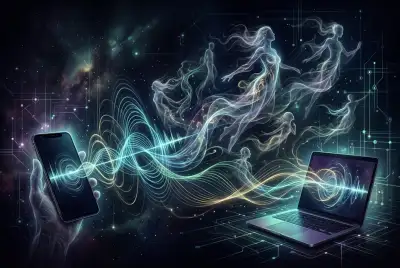
I remember watching a documentary about deep space probes, marveling at how we engineer intricate machines to transmit vast amounts of data across unimaginable distances. We compress, encrypt, and broadcast, all in the hope of sending a message or receiving one. But what if nature has been doing something far more sophisticated, for eons, using the most unlikely of couriers: **cosmic dust?** This isn't just about microbes hitching a ride on meteorites; it's about the very essence of life, its informational blueprint, being broadcast across the universe on tiny, silent specks.
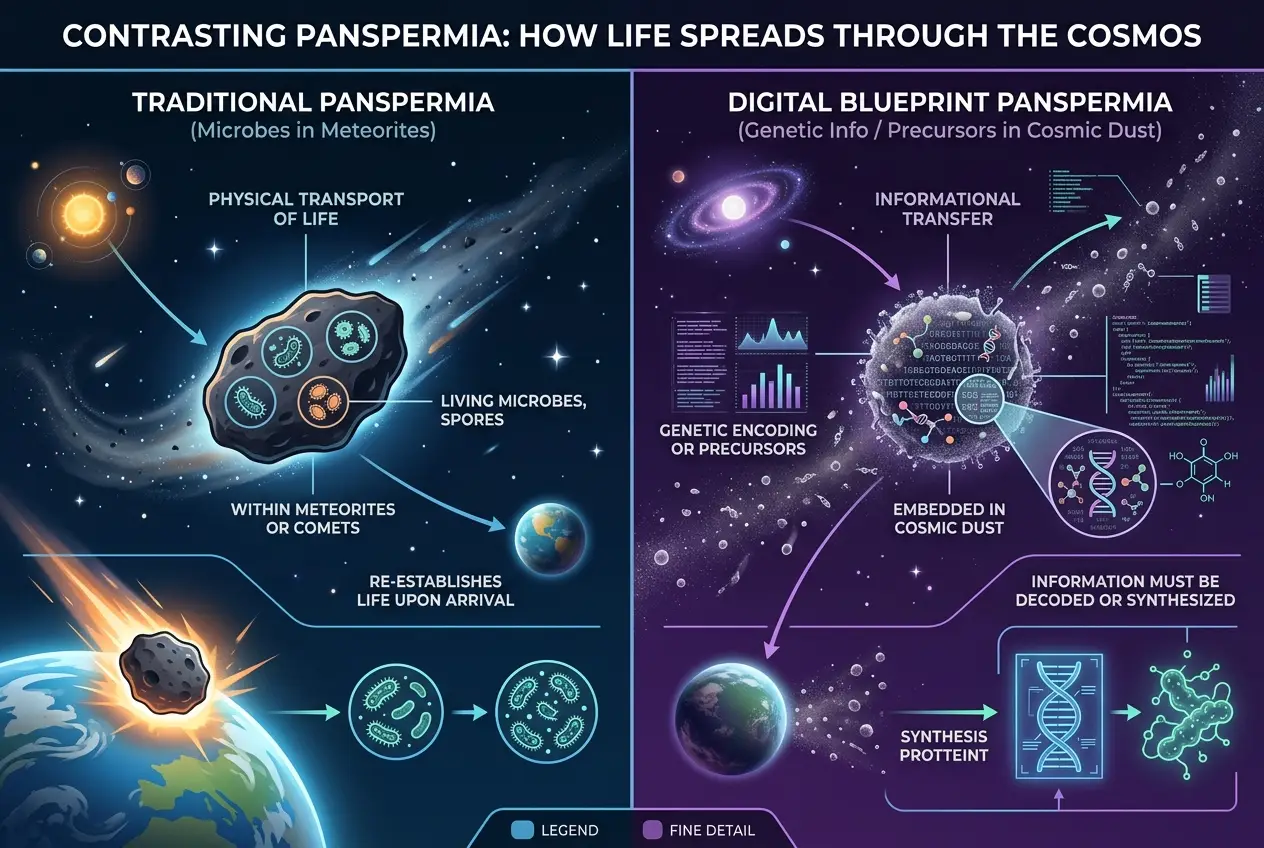
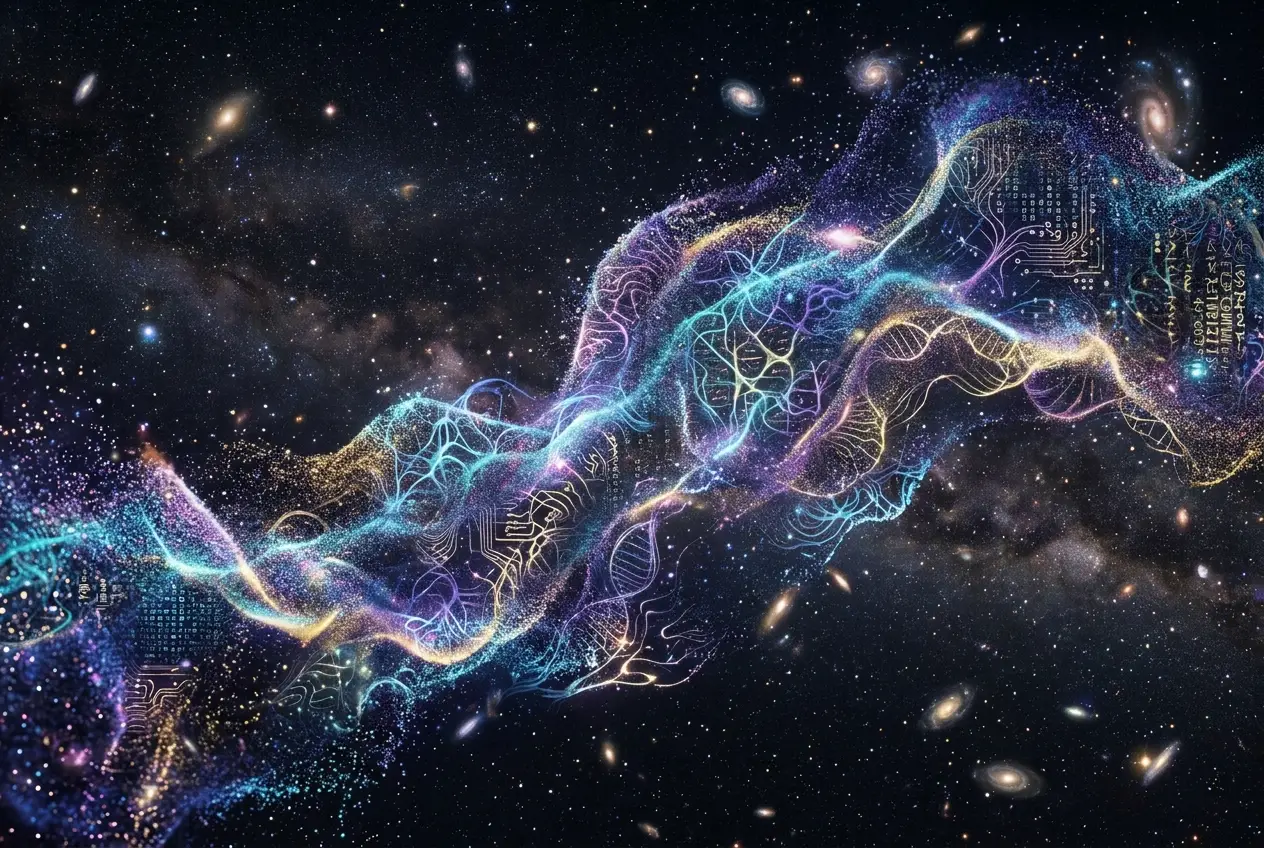
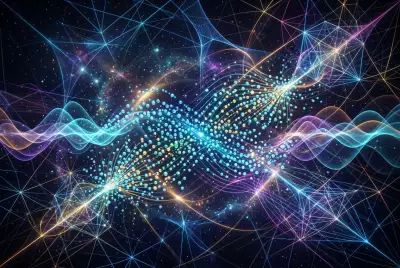
The idea that life might travel between planets or even star systems isn't new. It’s a concept known as **panspermia**, often conjuring images of resilient bacteria surviving the vacuum of space, dormant within a meteorite, only to awaken and colonize a new world. But I’ve been pondering a more advanced, almost sci-fi version of this theory: what if the cosmic dust that constantly drifts through galaxies isn't just carrying dormant cells, but the *instructions* for life itself? What if it's a cosmic "digital blueprint" – the equivalent of a biological data packet, waiting to be decoded by the right environment?
### The Ultimate Cosmic Data Transfer: More Than Just Seeds
For decades, panspermia has been a compelling, if controversial, explanation for how life might spread. The argument is simple: certain hardy microorganisms, or extremophiles, could endure the harsh conditions of space—radiation, extreme cold, vacuum—if shielded within larger debris, like an asteroid ejected from one planetary system and eventually crashing into another. This idea gained traction with the discovery of organic molecules in meteorites and the incredible resilience of terrestrial extremophiles found in places like deep-sea vents or frozen Antarctic lakes.
However, the "digital blueprint" concept takes this a step further. Instead of intact, albeit dormant, life forms, imagine the fundamental information that *defines* a life form—its genetic code, its molecular architecture—existing in a highly stable, compact form. This isn't necessarily a functioning organism but rather the recipe, the algorithm, for building one. It's like the difference between sending a complete, pre-assembled computer and sending a detailed schematic and parts list for a computer, knowing that the receiving environment has the raw materials and energy to put it together. Could cosmic dust be carrying these universal "source codes"?
### The Cosmic Dust Highway: Tiny Couriers of Life
Cosmic dust, composed of tiny particles ranging from a few molecules to 0.1 mm in size, is ubiquitous. It's the stardust from which planets form, the remnants of ancient supernovae, and the debris from colliding asteroids and comets. These microscopic travelers are not just passive observers; they are constantly interacting with radiation, magnetic fields, and other matter.
What makes cosmic dust an intriguing candidate for carrying a "digital blueprint" is its sheer abundance and its ability to traverse vast interstellar distances. Unlike larger, less frequent meteorites, cosmic dust is everywhere, constantly moving. While individual dust grains are small, they can offer surprising levels of protection. Agglomerations of dust, or even individual grains with specific compositions, could shield complex molecules from destructive ultraviolet radiation and cosmic rays. For more on interstellar dust, you can read this Wikipedia article on [Interstellar Dust](https://en.wikipedia.org/wiki/Interstellar_dust).
The journey isn't easy, of course. Surviving the journey means resisting intense radiation, extreme temperature fluctuations, and the vacuum of space. Yet, the same physics that allows the formation of complex molecules in nebulae might also protect them during their voyage. These particles might not arrive as perfect packages, but perhaps just enough core information could endure.
### Encoding Life: Is DNA the Universe's Hard Drive?
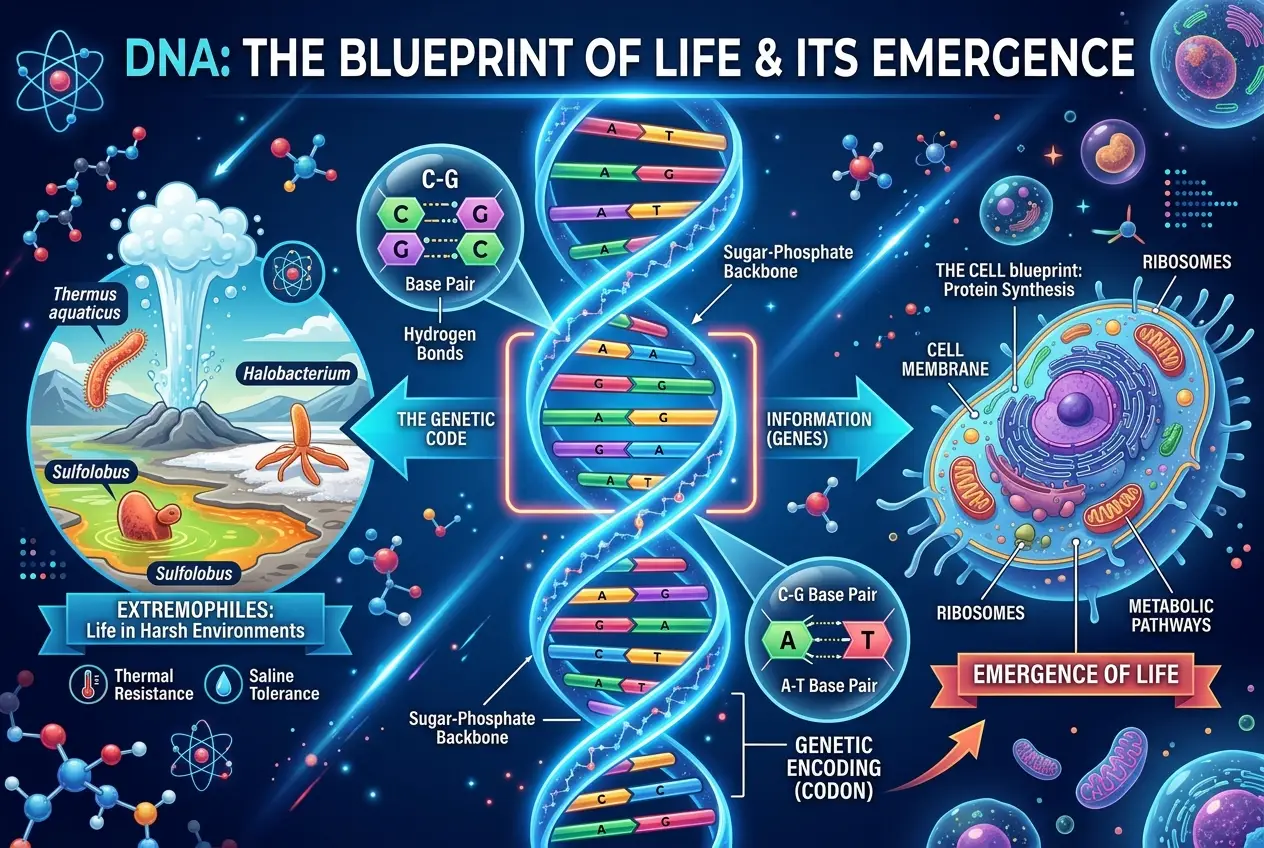
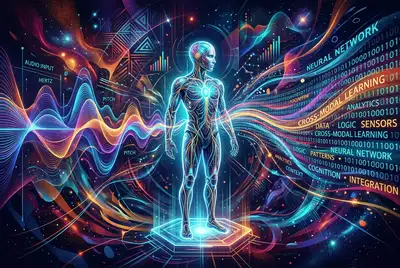
When we talk about life's "digital blueprint," we're inherently talking about **information storage**. On Earth, this role is spectacularly filled by **DNA** (and RNA). DNA is an incredibly dense, robust, and complex information storage system. It can carry instructions for building an entire organism in a microscopic package. The stability of DNA, even outside a living cell under certain conditions, is remarkable. We've retrieved viable DNA from ancient bones and frozen specimens, demonstrating its endurance.
But what if the "blueprint" isn't exactly Earth-like DNA? It could be a different form of nucleic acid, or a self-assembling complex of amino acids that, upon encountering the right chemical soup, could catalyze further organization into more complex structures. The core idea is that the "seed" isn't a fully formed organism, but a highly structured informational packet that carries the potential for life, waiting for the right conditions to "boot up."
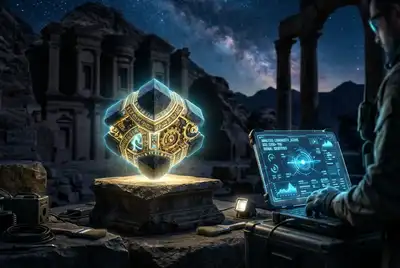
Imagine the possibility of an alien civilization embedding genetic information within a highly stable synthetic polymer or even in quantum-entangled particles, then launching these "seeds" into space. This is a leap, but it highlights the conceptual breadth of what a "digital blueprint" might entail. For more on how biological information is stored and processed, you might find our previous blog on [Could DNA Computing Revolutionize AI?](https://www.curiositydiaries.com/blogs/could-dna-computing-revolutionize-ai-3887) fascinating.
### The Challenges of a Cosmic USB Stick
While the concept sparks immense curiosity, the challenges are formidable.
* **Survival:** Even shielded within dust, molecules would face constant bombardment from cosmic rays and solar flares, potentially degrading the "code." The cold vacuum of space, while preserving some structures, could also lead to molecular breakdown over astronomical timescales.
* **Detection:** How would we recognize such a blueprint? It wouldn't necessarily emit signals. We'd have to find it, analyze it at a molecular level, and then *understand* its coded message. This is akin to finding an ancient, alien hard drive and not just recognizing it as data storage, but knowing how to run the operating system.
* **"Activation":** Assuming a blueprint survives the journey and lands on a habitable planet, how would it "come alive"? It would need the raw materials, energy, and specific environmental conditions to begin self-assembly and replication. It's one thing to have a recipe, another to have a kitchen and ingredients ready.
### Searching for Echoes: Where Do We Look?
The search for extraterrestrial life, or astrobiology, already implicitly looks for these "blueprints." When missions like NASA's Perseverance rover search for organic molecules on Mars, they are, in a sense, looking for evidence of these cosmic data packets, or at least the components that could form them. Scientists analyze meteorites for complex organic compounds, sometimes finding amino acids and nucleobases—the building blocks of DNA and RNA. Read more about the science of searching for life beyond Earth on Wikipedia's page about [Astrobiology](https://en.wikipedia.org/wiki/Astrobiology).
Beyond our solar system, telescopes observing exoplanet atmospheres are looking for biosignatures—chemical imbalances that might hint at active biological processes. But what if the first signs of alien life are not biological processes, but highly ordered, complex molecules indicative of a "digital blueprint," waiting for the right conditions to trigger full biological activity? Furthermore, our previous exploration into [Do Exoplanet Transits Hide Alien Tech?](https://www.curiositydiaries.com/blogs/do-exoplanet-transits-hide-alien-signals-7272) might offer insights into how we could extend our search beyond traditional biosignatures.
The idea transforms our search from looking for existing life to looking for the *potential* for life, or the *instructions* for life. It suggests a universe far more interconnected than we might have imagined, where life isn't just an isolated phenomenon, but a constantly spreading, self-replicating information system.
### Implications for Humanity: Are We Cosmic Downloads?
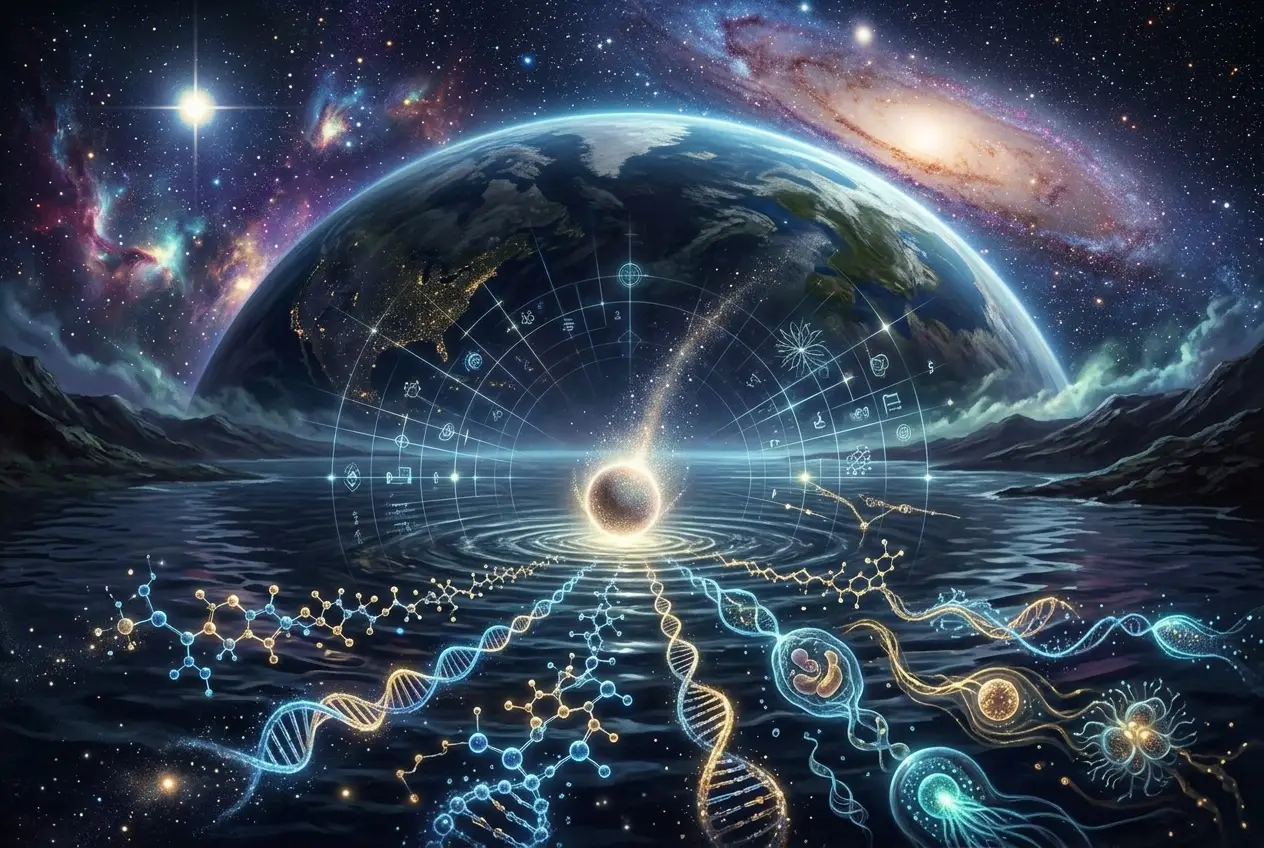
If cosmic dust can indeed carry and disseminate alien life's digital blueprint, the implications for our own origins are profound. It opens the door to the possibility that life on Earth didn't originate here entirely, but was "seeded" from elsewhere. We, and all life around us, could be descendants of a cosmic download—a vast, galactic information transfer event. This changes our perception of our place in the cosmos, turning us from isolated experiments into potential members of a larger, interconnected biological network. This also touches upon the ongoing scientific inquiry into the [Origin of Life](https://en.wikipedia.org/wiki/Origin_of_life) on Earth.
This perspective encourages us to think of life not just as a local phenomenon, but as a universal constant, an emergent property of matter and energy that, once encoded, seeks to proliferate. It’s a compelling thought that our very existence might be an echo of distant, ancient star systems.
### The Future of Astrobiology: Decoding the Universe's Message
The future of astrobiology will likely integrate more sophisticated ways of detecting not just active life, but the dormant or informational precursors to it. We might need advanced spectrometry to detect highly complex, non-random molecular structures in interstellar dust samples. Laboratory experiments could simulate planetary conditions to see if complex organic "blueprints" can indeed self-assemble into rudimentary life forms. Our previous article, [Could AI Discover New Cosmic Life Forms?](https://www.curiositydiaries.com/blogs/could-ai-discover-new-cosmic-life-forms-5803) delves into how advanced computational power might assist in this very quest.
The next generation of space telescopes, like the James Webb Space Telescope, are already analyzing the chemical compositions of exoplanet atmospheres with unprecedented detail. Perhaps among the familiar gases, we'll find an anomaly—a signature that doesn't scream "life" but whispers "information," waiting to be translated.
### Conclusion: A Universe Teeming with Invisible Data
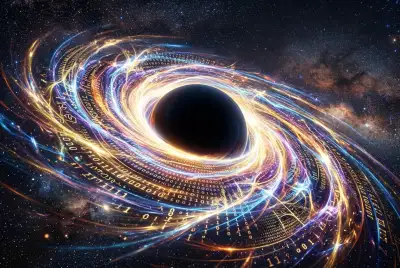
The notion that cosmic dust could carry alien life's digital blueprint is a fascinating blend of panspermia, astrobiology, and information theory. It transforms our understanding of interstellar space from a barren void into a dynamic medium for biological data transfer. It suggests that the universe might be teeming with the potential for life, constantly exchanging information, making every dust motes a potential message in a bottle, waiting for a cosmic shore. This pursuit, driven by curiosity, continues to push the boundaries of science, prompting us to ask not just if we are alone, but how deeply connected we might truly be.
Frequently Asked Questions
Yes, significantly. Traditional panspermia suggests the transfer of intact, dormant microorganisms. The 'digital blueprint' concept posits the transfer of fundamental biological information or complex molecular instructions, rather than a full, albeit inactive, organism.
It could be in the form of highly stable, complex organic molecules, such as specialized nucleic acids or self-assembling protein structures. These molecules would carry the necessary information to kickstart life processes under suitable environmental conditions, acting as a 'recipe' rather than a live 'seed'.
Detecting it would require advanced spectroscopic analysis, molecular forensics, and high-resolution imaging to identify highly ordered, non-random molecular structures. 'Reading' it would likely involve sophisticated AI and biochemistry techniques to understand how these structures encode genetic or developmental information.
Potentially, yes. If life's blueprints are constantly being exchanged across star systems via cosmic dust, it implies a shared genetic heritage for life throughout the cosmos, suggesting a universal origin or continuous dissemination from common ancestral sources.
The primary hurdles include the extreme survival challenges for complex molecules (radiation, vacuum, temperature extremes) during interstellar travel, the mechanism by which such a blueprint would 'activate' on a new planet, and our current technological limitations in detecting and interpreting such subtle, encoded information.
Verified Expert
Alex Rivers
A professional researcher since age twelve, I delve into mysteries and ignite curiosity by presenting an array of compelling possibilities. I will heighten your curiosity, but by the end, you will possess profound knowledge.
Leave a Reply
Comments (0)
No approved comments yet. Be the first to share your thoughts!
 Join Us
 Unknown Author








Leave a Reply
Comments (0)