


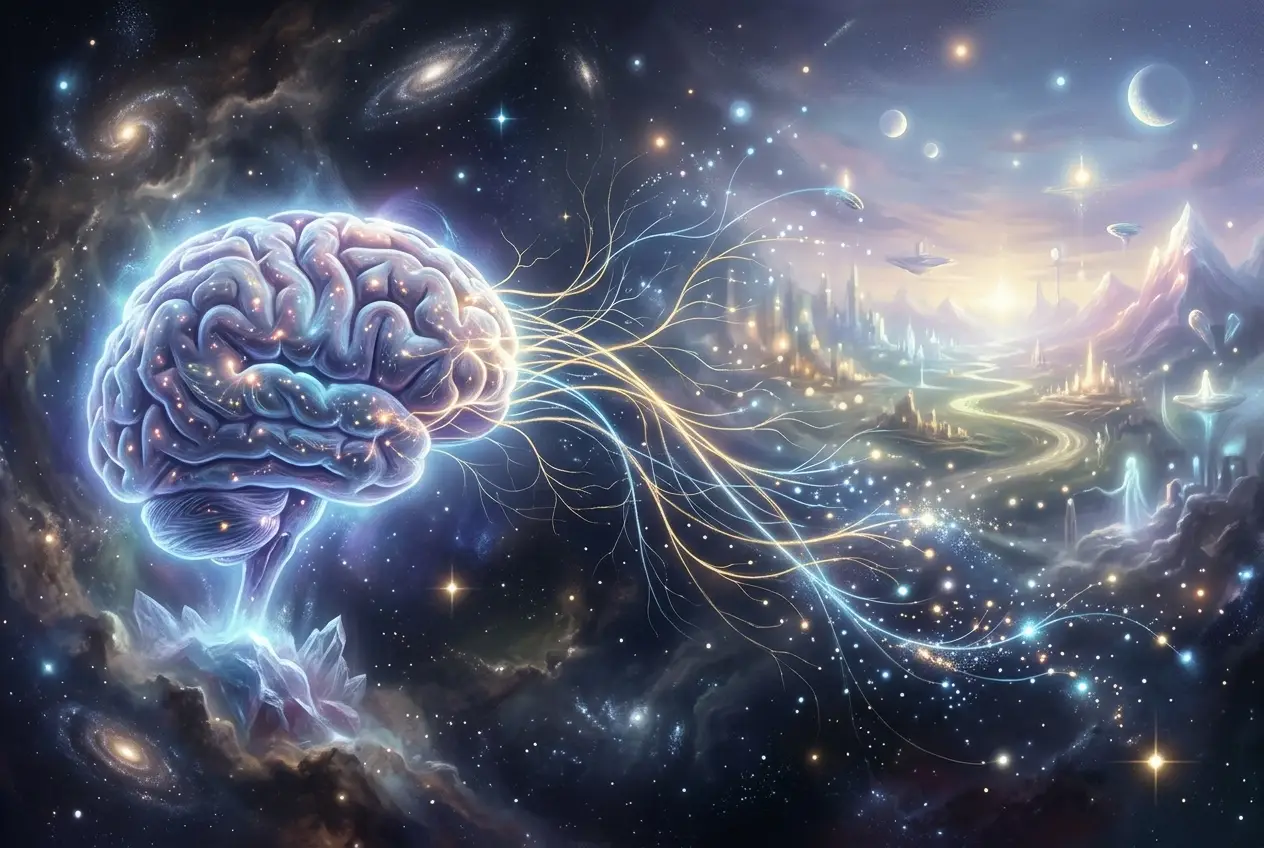
I remember a distinct moment when I was a child, standing on the edge of a diving board, feeling an inexplicable pull to wait just a second longer. A split second later, another child unexpectedly belly-flopped into the water directly below where I would have landed. Was it luck? A coincidence? Or did my brain, in some imperceptible way, know? This phenomenon, often dismissed as mere anecdotal happenstance, taps into one of humanity's most enduring fascinations: precognition. Can our brains truly catch glimpses of events yet to unfold?
The very idea challenges our understanding of time, causality, and the linear progression of existence. For centuries, philosophers, scientists, and mystics have grappled with the concept of foreknowledge. While mainstream science largely remains skeptical, a small, persistent body of research and countless personal experiences continue to fuel the curiosity surrounding this enigmatic human faculty. I find myself constantly drawn to these edges of human perception and what they might imply for the future of technology and our understanding of consciousness.
What Exactly Is Precognition?
At its core, precognition is defined as the acquisition of future information through means other than inference. This isn't about making an educated guess based on current data, like a meteorologist predicting tomorrow's weather or an AI forecasting stock market trends. Instead, it refers to a direct, non-inferential "knowing" of a future event. It often manifests as dreams, sudden intuitions, gut feelings, or vivid waking visions that later correspond to actual occurrences.
The scientific community, understandably, views claims of precognition with a healthy dose of skepticism. The concept fundamentally conflicts with the established laws of physics, particularly the arrow of time, which dictates that cause must precede effect. If precognition were a verifiable reality, it would necessitate a radical re-evaluation of spacetime, quantum mechanics, and even the nature of consciousness itself.
The Anecdotal Evidence: Whispers of Tomorrow
Talk to enough people, and you’ll inevitably hear stories of uncanny premonitions. I’ve heard countless tales from friends and colleagues: a dream about a distant relative’s passing, only to receive news of their death the next morning; a sudden, strong feeling to take a different route to work, narrowly avoiding an accident; or an inexplicable certainty about a lottery number combination. While compelling on a personal level, these anecdotes face a significant hurdle in scientific validation: confirmation bias.
Confirmation bias is our brain's tendency to seek out, interpret, and remember information in a way that confirms our existing beliefs or hypotheses. If you have a thousand dreams, it’s statistically probable that one or two might coincidentally align with future events. We remember the 'hits' and forget the 'misses,' creating an illusion of precognitive ability. This cognitive shortcut makes it incredibly difficult to distinguish genuine anomaly from mere chance.
However, the sheer persistence and widespread nature of these experiences have compelled some researchers to delve deeper. Could there be something more than just bias at play?
The Scientific Pursuit: Challenging Conventional Wisdom
For decades, a small subset of researchers, often within the field of parapsychology, has attempted to study precognition under controlled laboratory conditions. One of the most prominent figures in this controversial area was Daryl Bem, a social psychologist from Cornell University. In 2010, Bem published a paper titled "Feeling the Future" in the Journal of Personality and Social Psychology, claiming evidence for "anomalous retroactive influence" – essentially, that future events could subtly influence a person's present responses. You can read more about his research and the subsequent scientific debate on Wikipedia's article on Daryl Bem's experiments (opens in a new tab).
Bem's experiments involved tasks where participants were asked to predict the location of a stimulus that would only be randomly selected after their prediction was made. For instance, in one experiment, participants were shown two curtains and asked to guess which one hid an erotic image. The image was randomly assigned after their choice. Bem reported statistically significant results suggesting participants chose the correct curtain more often than chance.
The findings sparked intense debate and attempted replications. Many independent research teams failed to reproduce Bem's results, leading to questions about methodology, statistical analysis, and the 'file drawer problem' (where only successful experiments get published). Despite the controversy, Bem's work highlighted the challenges and complexities of studying phenomena that seem to defy established scientific paradigms.
Micro-Precognition: A Subtle Edge?
While full-blown visions of the future remain firmly in the realm of science fiction, some researchers propose a more subtle form of precognition, sometimes called "micro-precognition" or "presentiment." This isn't about knowing what will happen, but rather experiencing a physiological response before a future event.
Imagine your heart rate increasing, your skin conductance rising, or your brain activity subtly shifting moments before a truly shocking or emotional image flashes on a screen. Studies in this area, often using tools like fMRI or EEG, have explored if the body or brain exhibits a pre-stimulus response. Some meta-analyses of these studies have reported small, but statistically significant, effects.
However, these findings are also met with strong criticism. Explanations often point to methodological flaws, researcher bias, or even subtle, non-conscious cues influencing participants. It’s incredibly difficult to design experiments that are truly 'future-proof' – where every possible conventional explanation for a pre-response has been eliminated.
For a deeper dive into how our brains process and potentially misinterpret information, I recommend checking out our blog on /blogs/how-does-vr-trick-your-brain-unpacking-realitys-illusion-3236, which explores the fascinating ways our minds construct reality.
The Physics of Time: A Stumbling Block
The greatest challenge to precognition comes from the very fabric of our universe. Modern physics, particularly the theory of relativity, describes time as a fourth dimension woven with space into spacetime. Events unfold linearly, and information cannot travel faster than light, let alone backward in time.
However, some theoretical physicists explore concepts that, at the extreme edges, might offer tantalizing, albeit highly speculative, avenues. Retrocausality, for instance, is a theoretical concept where a future event can influence a past event. This idea often appears in interpretations of quantum mechanics, where the act of measurement can appear to influence a particle's past state. While fascinating, applying these quantum phenomena to macroscopic brain functions or everyday precognition is a massive leap and far from scientifically accepted. You might find our discussion on /blogs/do-time-crystals-break-physics-the-strange-state-of-matter-1285 relevant, as it delves into other instances where our understanding of time's linearity is challenged.
Another theoretical idea involves block universe theory, where all moments in time – past, present, and future – exist simultaneously, like frames in a film reel. If this were true, our perception of linear time would be an illusion, and the 'future' would already exist. This doesn't necessarily imply precognition, but it opens philosophical doors to possibilities that a strictly linear view of time does not. For more on the block universe, see the Wikipedia entry on the block universe (opens in a new tab).
Brain's Predictive Power: The Neuroscience Angle
While true precognition remains scientifically elusive, our brains are, in fact, incredibly sophisticated prediction machines. I find this aspect particularly fascinating because it shows how our natural cognitive abilities can mimic the feeling of foresight.
From the moment we wake up, our brains are constantly anticipating. When you catch a ball, your brain predicts its trajectory. When you have a conversation, your brain predicts the next word or phrase. This is called predictive coding, where the brain constantly generates hypotheses about incoming sensory information and updates its models based on errors between its predictions and actual inputs. This process allows us to navigate the world efficiently, react quickly, and even anticipate social cues.
The brain uses vast amounts of sensory data, memory, and learned patterns to construct these predictions. A strong "gut feeling" about a situation might not be a future event influencing your present, but rather your subconscious brain rapidly processing subtle cues that your conscious mind hasn't registered yet. For example, a veteran firefighter might "sense" a building is about to collapse moments before it does, not through precognition, but through years of accumulated, rapid pattern recognition of structural stress.
Could AI, with its advanced predictive algorithms and pattern recognition capabilities, eventually replicate or even surpass this "predictive intuition"? We explore this in more detail in our blog: /blogs/can-ai-predict-humanitys-next-big-leap-2672.
The Future of Precognition Research
Where do we go from here? The scientific method demands rigorous, repeatable experiments. For precognition to gain mainstream acceptance, researchers would need to:
- Develop unambiguous, replicable experimental protocols: These must eliminate all conventional explanations, including sensory leakage, experimenter effects, and statistical anomalies.
- Identify underlying mechanisms: A plausible theoretical framework, consistent with known physics, would be necessary.
- Demonstrate practical utility: Can precognition be harnessed or controlled?
Until these criteria are met, precognition will likely remain on the fringes of scientific inquiry, a fascinating mystery that continues to capture the imagination. As a tech writer, I believe understanding the limitations of current science helps us appreciate the true breakthroughs when they occur.
I’m convinced that even if literal precognition remains unproven, the exploration of our brain's predictive capacities and how consciousness interacts with time will continue to be a fertile ground for discovery. Perhaps the "future-sensing" capabilities we seek are not about breaking the laws of physics, but about unlocking deeper levels of perception and predictive intelligence within our own minds – abilities we are only just beginning to understand and, perhaps, augment with technology. The more we learn about the brain, the more we realize its profound complexity, and the more questions arise about its full potential. You can learn about how our perception of reality might be influenced by subtle forces in our post on /blogs/does-earths-magnetic-field-affect-our-minds-6923.
Conclusion: A Riddle Yet Unsolved
So, can brains truly 'see' the future? The scientific consensus, grounded in current understanding of physics and biology, says no. The evidence for genuine precognition, while intriguing to some, falls short of the rigorous standards required for scientific acceptance. Most reported instances can be attributed to cognitive biases, chance, or highly sophisticated, non-conscious pattern recognition.
However, the enduring human desire to peek beyond the veil of the present isn't going anywhere. It speaks to a deep-seated curiosity about our place in the universe and the limits of our perception. As technology advances, particularly in neuroscience and artificial intelligence, we might find new ways to model, predict, and perhaps even simulate aspects of "foreknowledge." Whether these advancements will ever confirm true precognition or simply refine our understanding of extraordinary human intuition remains one of the most exciting and perplexing questions of our time. I believe that remaining open to such possibilities, while maintaining a critical scientific lens, is essential for true discovery.



Conversation0
No comments yet. Be the first to share a thought — the best questions often become new stories.