I often find myself lost in thought, pondering the very fabric of reality – especially when it comes to time. It’s a concept we take for granted: a relentless, unidirectional arrow constantly pushing us from past to future. But what if the most cutting-edge technology we’re developing, quantum computing, isn't just about faster calculations but about bending or even *breaking* time’s ironclad rules? It sounds like science fiction, a plot straight out of a blockbuster movie, but the deeper I delve into the quantum realm, the more I realize that our understanding of reality, including time, might be far more flexible than we ever imagined.
**The Quantum Realm: Where Reality Gets Weird**
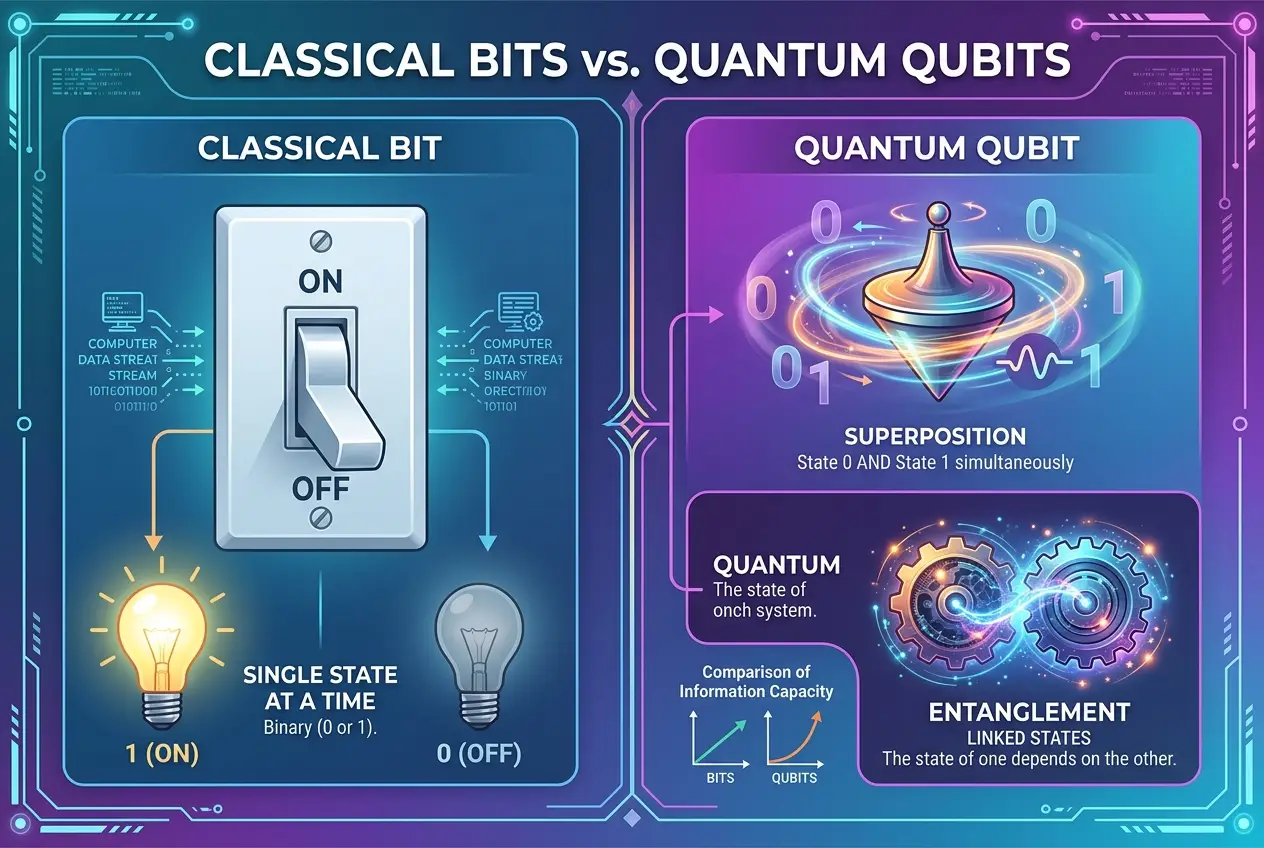
Before we dive into the fascinating possibility of quantum computers tinkering with time, let's quickly recap what makes these machines so revolutionary. Unlike classical computers that use bits representing either a 0 or a 1, quantum computers use **qubits**. These qubits can be 0, 1, or — thanks to a phenomenon called **superposition** — both 0 and 1 simultaneously. Imagine a coin spinning in the air; it's neither heads nor tails until it lands. A qubit in superposition is like that spinning coin, holding multiple possibilities at once.
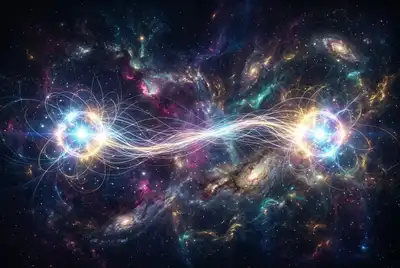
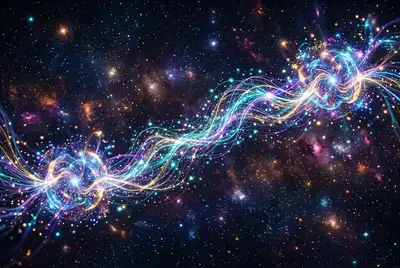
Then there's **entanglement**. This is where things get truly bizarre. Two or more qubits can become linked in such a way that they share the same fate, no matter how far apart they are. If you measure one entangled qubit, instantly determining its state, the state of its entangled partner is also instantly known, even if it's light-years away. Albert Einstein famously called this "spooky action at a distance." It’s a cornerstone of quantum mechanics and defies classical intuition about locality and information transfer. For a deeper dive into how this phenomenon challenges our perceptions of space, you might find our article on [how quantum entanglement defies space-time](https://www.curiositydiaries.com/blogs/how-does-quantum-entanglement-defy-space-time-5424) particularly illuminating.
These quantum phenomena – superposition and entanglement – allow quantum computers to process vast amounts of information simultaneously and solve problems that would take classical supercomputers billions of years. But could their unique relationship with probability and instantaneous connections extend to manipulating time itself?
**Time: Not As Simple As It Seems**
Our everyday experience of time is linear, a steady march forward. However, physicists have long understood that time is far more complex. Einstein's theory of relativity introduced **time dilation**, demonstrating that time isn't absolute; it can slow down or speed up depending on an observer's relative speed or proximity to a massive gravitational field. For instance, astronauts on the International Space Station experience time slightly slower than people on Earth, a tiny but measurable effect. You can read more about time dilation on [Wikipedia](https://en.wikipedia.org/wiki/Time_dilation).
At the quantum level, the concept of time becomes even murkier. Some theories suggest that time might not even exist as a fundamental dimension, but rather emerges from the interactions of quantum particles. The laws of quantum mechanics are, in many ways, time-symmetric, meaning they work just as well backward as forward. Yet, we only ever observe time moving forward, a puzzle often referred to as the "arrow of time."
**The Quantum Computer and the Arrow of Time**
So, how could a quantum computer potentially "break" time's rules? It’s not about building a time machine to visit the dinosaurs – at least, not yet! Instead, the focus is on manipulating the *flow* and *causality* of information at a fundamental level.
One fascinating area of theoretical exploration involves **retrocausality**. This concept suggests that future events could, in some specific quantum scenarios, influence past ones. While highly speculative and still a subject of intense debate, some quantum experiments hint at connections that seem to defy a strict forward-moving causal chain. If information could, in some form, travel backward in time, even infinitesimally, it would fundamentally challenge our understanding of cause and effect.
Quantum computers, with their ability to explore vast computational spaces and handle probabilities in ways classical machines cannot, might offer a unique lens to probe these temporal anomalies. Imagine a quantum algorithm designed not just to simulate future outcomes but to find paths that *reverse* or *reorder* causal events within a contained quantum system.
"The idea that quantum mechanics might allow for influences to propagate backward in time is one of the most counter-intuitive but potentially profound implications of the theory," noted Dr. Huw Price, a philosopher of physics, in a discussion on causality. "It pushes the boundaries of what we understand about the universe."
**Simulating Retrocausality and Temporal Puzzles**
While direct time travel remains firmly in the realm of fiction, quantum computers *can* simulate extremely complex quantum phenomena that touch upon these ideas. Researchers are already using quantum systems to explore:
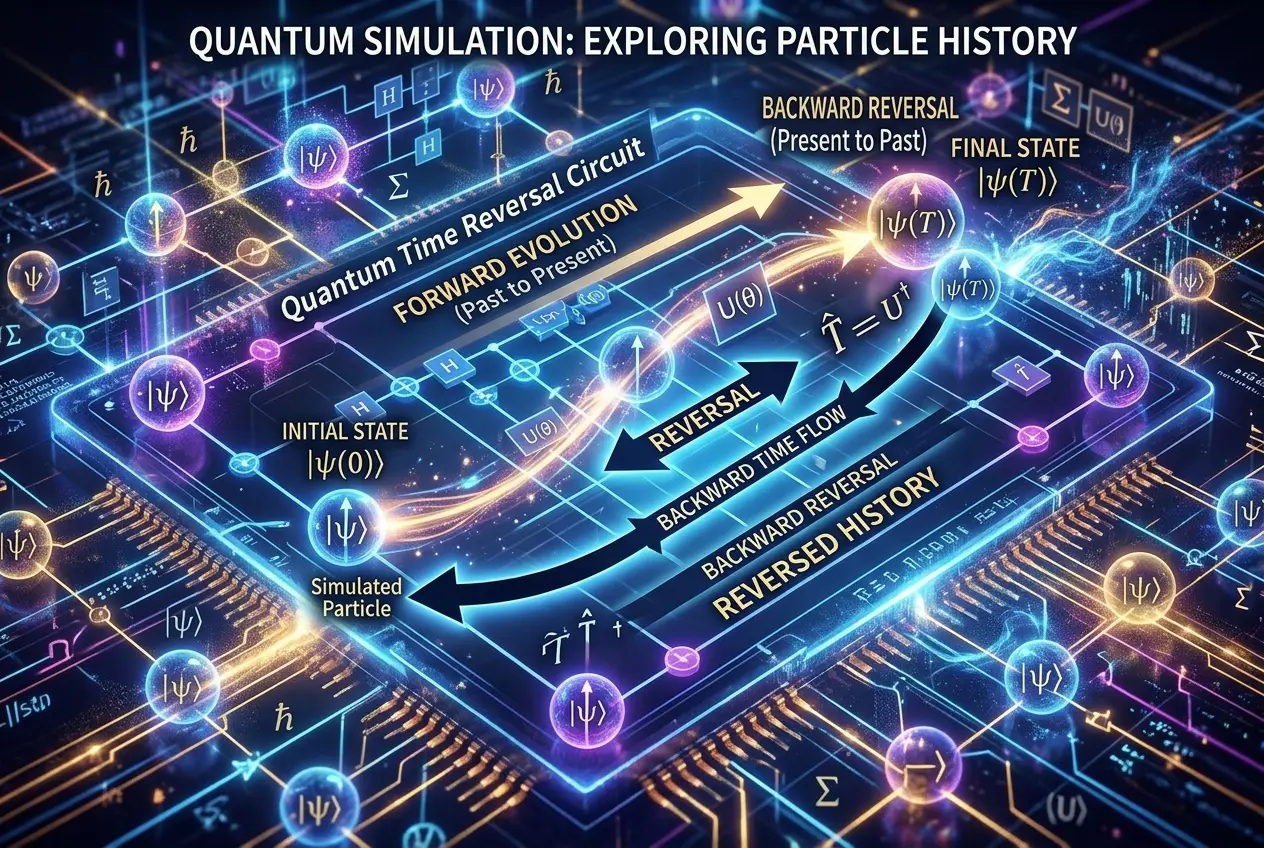
1. **Quantum Time Loops:** In 2020, scientists at Los Alamos National Laboratory used a quantum computer to simulate a particle traveling backward in time. They didn't actually send a particle back in time, but they observed how a quantum state could return to its initial condition after evolving forward, essentially "un-doing" its past. This isn't breaking causality but rather demonstrating the reversible nature of quantum mechanics under certain conditions. It provides a computational playground for exploring what *would* happen if causality were more flexible.
2. **Violating the 'No-Cloning Theorem':** The quantum no-cloning theorem states that it's impossible to create an identical copy of an unknown quantum state. However, some theoretical models propose scenarios involving closed timelike curves (a theoretical possibility in general relativity) where such cloning *might* be possible, even if only effectively. Quantum computers could help simulate such extreme gravitational environments, providing insights into the interplay of quantum mechanics and spacetime.
3. **Quantum Causality:** Researchers are developing "quantum causal models" to understand how cause and effect work in the quantum world, where superposition and entanglement can make relationships ambiguous. A quantum computer could run complex simulations to test these models, potentially revealing new rules for causality that differ from our classical understanding. For more on how quantum technology challenges fundamental rules, consider reading about [can quantum computing break gravity's rules](https://www.curiositydiaries.com/blogs/can-quantum-computing-break-gravitys-rules-9323).
**The Limits and Ethical Considerations**
It’s crucial to emphasize that these are largely theoretical explorations and simulations. We are not on the verge of building a quantum device that sends messages to the past or predicts the future with certainty. The challenges are immense:
* **Decoherence:** Qubits are incredibly fragile and easily lose their quantum properties when interacting with their environment. Maintaining superposition and entanglement for complex, temporally challenging computations is extraordinarily difficult.
* **Measurement Problem:** The act of measuring a qubit forces it out of superposition and into a definite state, inherently limiting our ability to observe certain quantum phenomena over extended periods.
* **The Paradoxes of Time Travel:** If true retrocausality were possible, it would open up a Pandora's Box of paradoxes, like the famous "grandfather paradox." Most physicists believe that nature finds a way to prevent such paradoxes.
However, even if quantum computers don't allow for literal time travel, their ability to model and explore the fundamental nature of time, causality, and information flow could have profound implications. If we can better understand the underlying mechanisms that give rise to our perception of a linear, forward-moving time, we might unlock new forms of information processing or even a deeper understanding of the universe itself. The potential to "break" time's rules might simply mean understanding them better, finding loopholes, or discovering that some rules aren't as rigid as we thought. Just as quantum computing promises to break traditional encryption methods (explored in [can quantum computers break every encryption](https://www.curiositydiaries.com/blogs/can-quantum-computers-break-every-encryption-1438)), it may also break our conventional understanding of time.
**Conclusion: A Journey, Not a Destination**
The journey into quantum computing is a journey into the heart of reality itself. While the idea of these machines literally breaking time's rules remains speculative and theoretical, their capacity to simulate and explore the most profound mysteries of physics—including the nature of time and causality—is undeniable. I believe that as quantum technology advances, we will continue to challenge our preconceived notions of what is possible, pushing the boundaries of science and perhaps even revealing that time, like so many other aspects of the quantum world, holds secrets we are only just beginning to decipher. It’s a captivating thought, isn't it? That the future of computing might hold keys to unlocking the past, or at least, rewriting our understanding of it.
Frequently Asked Questions
Classical computing follows a linear, predictable time sequence for operations. Quantum computing, due to superposition and entanglement, can theoretically explore multiple computational paths simultaneously, hinting at more complex interactions with information flow that might challenge classical causality.
No, currently, it does not imply actual physical time travel. Instead, it refers to the theoretical possibility of manipulating or understanding the *flow of information* and *causality* within quantum systems in ways that deviate from our classical, linear perception of time.
Retrocausality is a theoretical concept suggesting that future events could, under specific quantum conditions, influence past ones. Quantum computers might be used to simulate or explore these complex causal relationships at a fundamental level, helping physicists test such theories.
While no experiments have proven actual time manipulation, some quantum simulations have demonstrated phenomena like quantum states returning to their initial conditions, effectively 'undoing' their past evolution within a contained system. These experiments provide insights into the time-reversible nature of quantum mechanics.
Major limitations include decoherence (qubits losing quantum properties quickly), the measurement problem (measurement collapsing a qubit's superposition), and the inherent paradoxes associated with true retrocausality, which most physicists believe nature prevents.
Verified Expert
Alex Rivers
A professional researcher since age twelve, I delve into mysteries and ignite curiosity by presenting an array of compelling possibilities. I will heighten your curiosity, but by the end, you will possess profound knowledge.
Leave a Reply
Comments (0)
No approved comments yet. Be the first to share your thoughts!
 Join Us


 Unknown Author
















Leave a Reply
Comments (0)