I recently found myself lost in thought, staring up at the night sky. Not at the familiar constellations, but at the untold riches lurking beyond our atmosphere. Imagine a future where your smartphone is powered by materials sourced not from Earth, but from millions of miles away. Or where space travel is as common as air travel, fueled by cosmic ice. Sounds like pure science fiction, doesn't it? But as I've delved into the burgeoning field of **asteroid mining**, I've come to believe this isn't just a distant dream; it's an economic inevitability that could reshape humanity's future in space.
The concept itself is audacious: dispatch robots and spacecraft to asteroids, extract valuable resources, and bring them back to Earth or process them in space. It sounds like something out of a blockbuster movie, yet the science and engineering behind it are rapidly advancing, pushing us towards an era where space isn't just a place for exploration, but a vast reservoir of wealth and opportunity.
### Why Asteroids? The Cosmic Treasure Chest
Earth’s resources are finite, and the demand for critical materials—especially those used in electronics, renewable energy, and advanced manufacturing—is constantly growing. Asteroids, however, are essentially giant, floating ore deposits. They are remnants from the early solar system, containing a diverse array of materials, many of which are scarce on Earth.
**What exactly are we looking for?** Primarily, three types of resources pique the interest of would-be space miners:
1. **Water Ice:** This is arguably the most valuable resource in space. Water can be used for drinking, life support, and crucially, it can be broken down into hydrogen and oxygen—components of rocket fuel. Imagine refueling depots in Earth orbit or beyond, powered by asteroid-derived water. This would dramatically reduce the cost and logistical challenges of deep space missions, making everything from lunar bases to Martian colonies more feasible. As we explored in "From Earth to Orbit: How Satellites Reach Space" (read more at: /blogs/from-earth-to-orbit-how-satellites-reach-space-2649), getting anything into space is incredibly expensive; locally sourced fuel would be a game-changer.
2. **Precious Metals:** Asteroids, particularly M-type (metallic) asteroids, are thought to be rich in platinum-group metals (PGMs) like platinum, palladium, rhodium, and iridium, as well as gold, silver, and nickel. These metals are vital for catalysts, electronics, and various industrial applications. On Earth, these are exceedingly rare and expensive to extract, often found deep within the planet's crust. In space, they are freely floating, waiting to be collected. According to an article on Wikipedia about Platinum-group metals, "The total world production of platinum in 2019 was 180 tonnes (5.8 million troy ounces), while for palladium it was 220 tonnes (7.1 million troy ounces)." Imagine if a single asteroid could yield a thousand times that amount!
3. **Rare Earth Elements:** Essential for modern electronics, electric vehicles, and defense technologies, rare earth elements are another key target. While not strictly "rare" in the Earth's crust, they are difficult and environmentally costly to mine and process in concentrations high enough to be economically viable. Asteroids could offer a cleaner, more abundant source.
### The Science and Engineering Challenge
Extracting these treasures isn't a simple smash-and-grab operation. It requires innovative technologies and a deep understanding of astrodynamics and materials science.
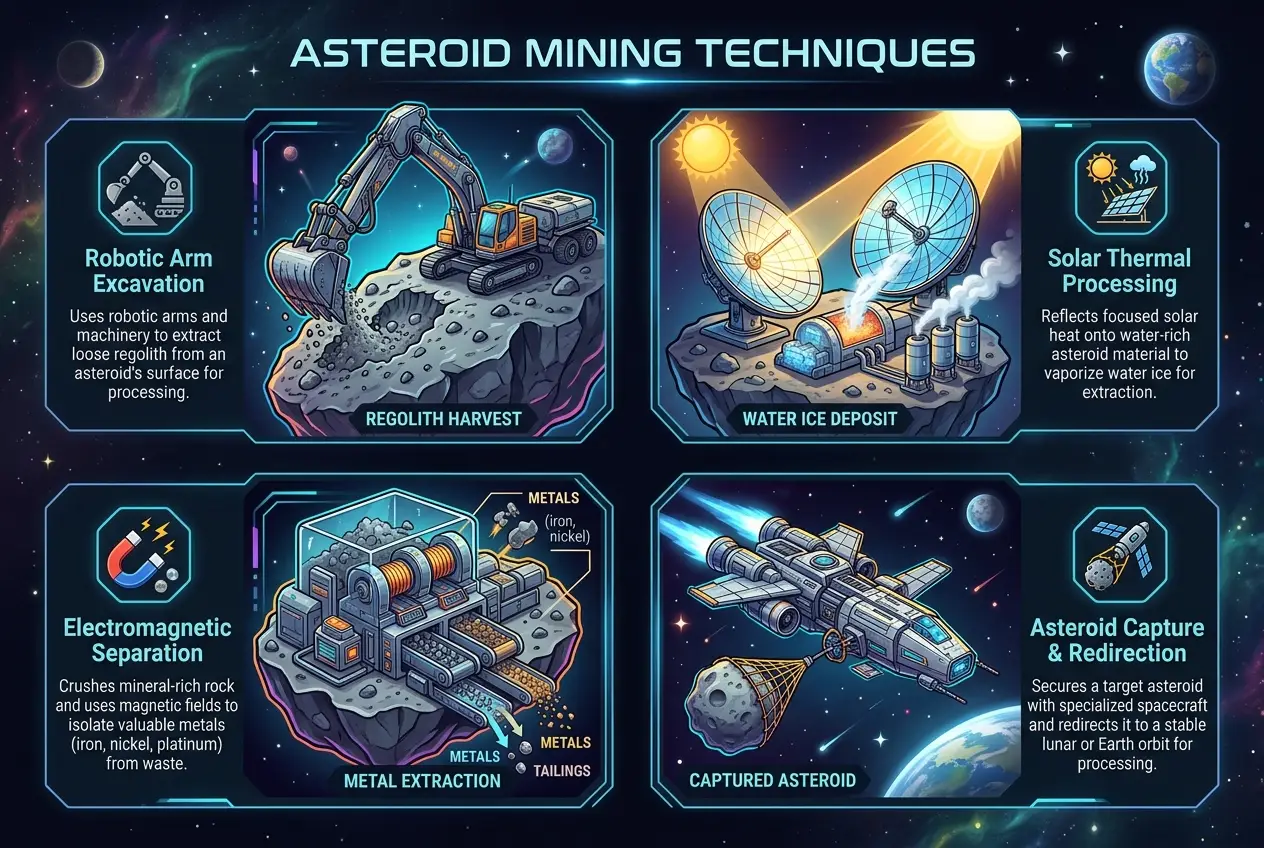
**Key Technologies Under Development:**
* **Robotic Prospectors:** Missions like NASA’s OSIRIS-REx and Japan’s Hayabusa2 have already demonstrated the ability to rendezvous with asteroids, map their surfaces, and even collect samples. The next step is scaling these capabilities for industrial-level operations. These probes act as scouts, identifying the most promising candidates for extraction.
* **Asteroid Capture and Redirection:** Some concepts involve capturing smaller asteroids and bringing them into a stable orbit around Earth or the Moon, making them easier to mine. This idea, while still largely theoretical for large objects, holds immense promise for creating in-space manufacturing hubs.
* **Automated Extraction and Processing:** Once at the asteroid, various methods could be employed:
* **Volatiles Extraction:** Heating the asteroid material using concentrated sunlight or microwave energy to vaporize water ice and other volatiles, which are then collected and condensed.
* **Mechanical Excavation:** Robotic drills and shovels for scraping loose regolith or breaking apart rock.
* **Electromagnetic Separation:** For metallic asteroids, breaking down the rock and using magnetic fields to separate valuable metals.
* **In-Situ Resource Utilization (ISRU):** This is the holy grail – processing materials directly on or near the asteroid to produce finished products or propellants, reducing the need to transport raw materials over vast distances. This mirrors the dream of "Can we build a Dyson Sphere, taming a star for power?" (explore more at: /blogs/can-we-build-a-dyson-sphere-taming-a-star-for-power-3135), where resources are utilized on a grand, cosmic scale.
### Near-Earth Objects (NEOs): The Low-Hanging Fruit
The primary targets for initial asteroid mining efforts will likely be **Near-Earth Objects (NEOs)**. These are asteroids whose orbits bring them relatively close to Earth, making them more accessible than those in the asteroid belt between Mars and Jupiter. NEOs vary greatly in size, composition, and orbital characteristics. Choosing the right asteroid is crucial, balancing the richness of its resources with the energy required to reach it and return. You can learn more about these fascinating objects on Wikipedia's Near-Earth object page.
One of the greatest challenges isn't just the journey, but understanding the diverse nature of these space rocks. As we've seen with topics like "Could Meteors Seed Life: The Panspermia Puzzle" (/blogs/could-meteors-seed-life-the-panspermia-puzzle-3345), asteroids and meteors are incredibly varied, and understanding their composition is key to effective mining.
### The Vision: A Thriving Space Economy
Asteroid mining isn't just about enriching a few companies; it’s about enabling a fundamental shift in humanity's relationship with space. The ultimate goal is to create a self-sustaining **space economy**.
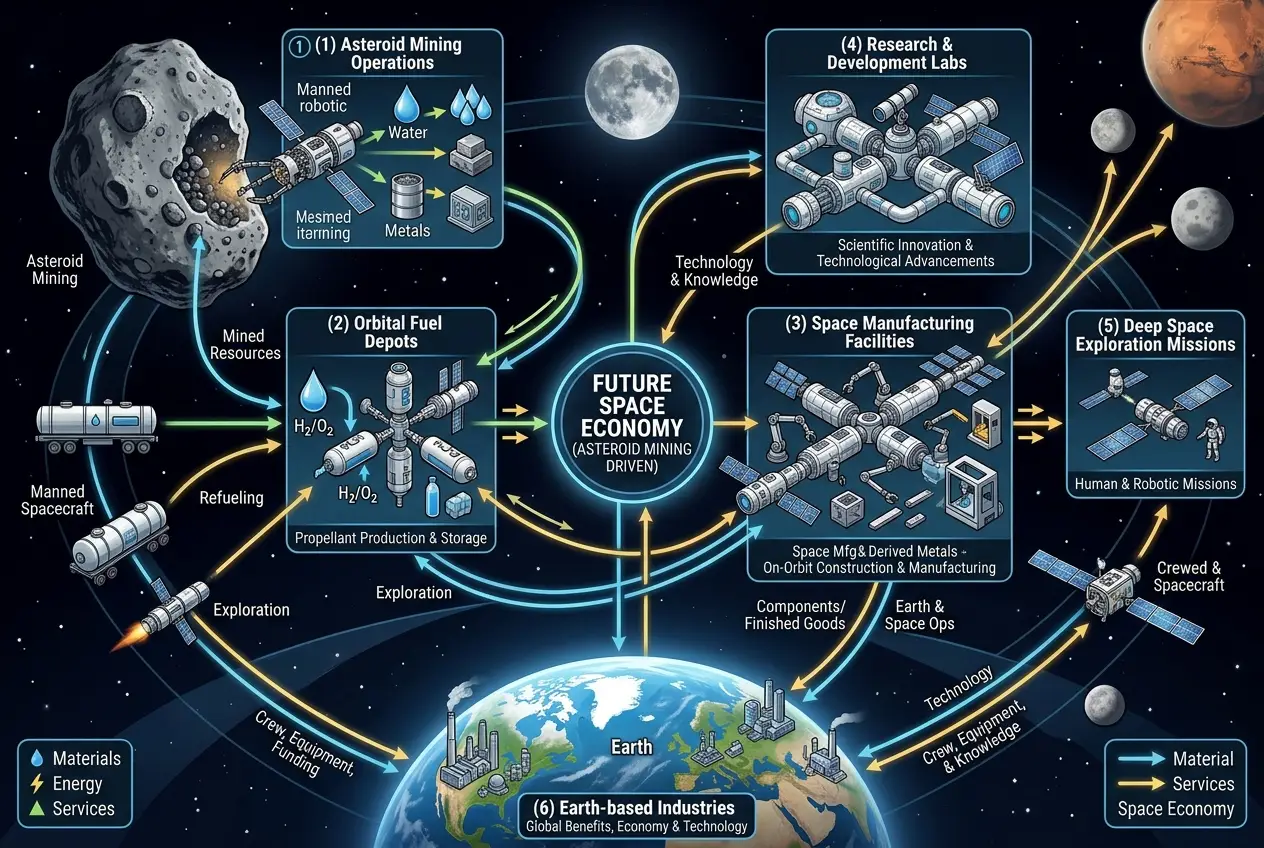
**The implications are profound:**
* **Reduced Costs for Space Travel:** Locally sourced fuel means rockets no longer need to haul all their propellant from Earth's deep gravity well. This slashes launch costs, making space travel and exploration far more affordable and frequent.
* **In-Space Manufacturing:** Imagine factories operating in zero-gravity, using asteroid metals to build satellites, space stations, and even new spacecraft. This allows for the construction of larger, more specialized structures that would be impossible to launch from Earth. This could even lead to "Alien Megastructures: Are We Missing Cosmic Architects?" (/blogs/alien-megastructures-are-we-missing-cosmic-architects-6667) of our own making!
* **Space Colonization:** With abundant water, fuel, and construction materials available in space, establishing permanent human outposts on the Moon, Mars, or even free-floating space habitats becomes much more viable.
* **New Industries and Jobs:** An entirely new sector of the economy would emerge, encompassing asteroid prospecting, mining, processing, manufacturing, transport, and commercialization.
* **Environmental Benefits on Earth:** Access to extraterrestrial resources could reduce the intense pressure on Earth’s finite resources and mitigate the environmental impact of terrestrial mining. While not a complete solution, it offers a crucial alternative.
### The Road Ahead: Challenges and Opportunities
Despite the incredible promise, asteroid mining faces significant hurdles. The upfront investment is enormous, the technological challenges are immense, and the regulatory framework for resource ownership in space is still largely undefined. The Outer Space Treaty of 1967, for instance, prevents any nation from claiming sovereignty over celestial bodies, but it doesn't explicitly address the private ownership of extracted resources.
However, the opportunities far outweigh the challenges. Several private companies, backed by significant investment, are already making strides in developing the necessary technologies. Governments and international organizations are also exploring legal frameworks to facilitate safe and equitable space resource utilization. The global space industry is already a multi-trillion-dollar market, and asteroid mining could propel it to unprecedented heights, as detailed on Wikipedia’s Space Industry page.
### Conclusion: A New Frontier of Prosperity
The dream of asteroid mining is no longer confined to the pages of science fiction. It’s a testament to human ingenuity and our insatiable drive to explore and innovate. I believe that within decades, we will see the first commercial ventures successfully extract resources from asteroids, igniting a new era of prosperity and expansion into the cosmos. The implications for our technological advancement, economic growth, and even our survival as a species are simply staggering. We are standing at the precipice of a cosmic gold rush, and the future of humanity might just depend on whether we dare to reach for those distant, glittering rocks.
Frequently Asked Questions
The main resources sought in asteroid mining are water ice (for rocket fuel and life support), precious metals like platinum, palladium, and gold (for electronics and industry), and rare earth elements (for advanced technologies).
Asteroid mining takes place in a zero-gravity, vacuum environment, requiring specialized robotic systems and in-situ resource utilization (ISRU) techniques. It avoids many environmental impacts associated with Earth-based mining but presents unique challenges related to distance, radiation, and microgravity.
Near-Earth Objects (NEOs) are generally considered the most suitable initial targets due to their closer proximity to Earth. Within NEOs, C-type (carbonaceous) asteroids are rich in water and organic compounds, while M-type (metallic) asteroids are abundant in precious metals.
Significant challenges include the immense upfront capital investment, developing reliable autonomous mining and processing technologies for harsh space environments, establishing a clear international legal framework for space resource ownership, and ensuring the safety of long-duration space missions.
Asteroid mining could provide a new source for scarce critical materials, potentially reducing the environmental impact of terrestrial mining and lowering the cost of advanced technologies. It also stimulates innovation and creates new industries, contributing to global economic growth.
Verified Expert
Alex Rivers
A professional researcher since age twelve, I delve into mysteries and ignite curiosity by presenting an array of compelling possibilities. I will heighten your curiosity, but by the end, you will possess profound knowledge.
Leave a Reply
Comments (0)
No approved comments yet. Be the first to share your thoughts!
 Join Us


 Unknown Author























Leave a Reply
Comments (0)