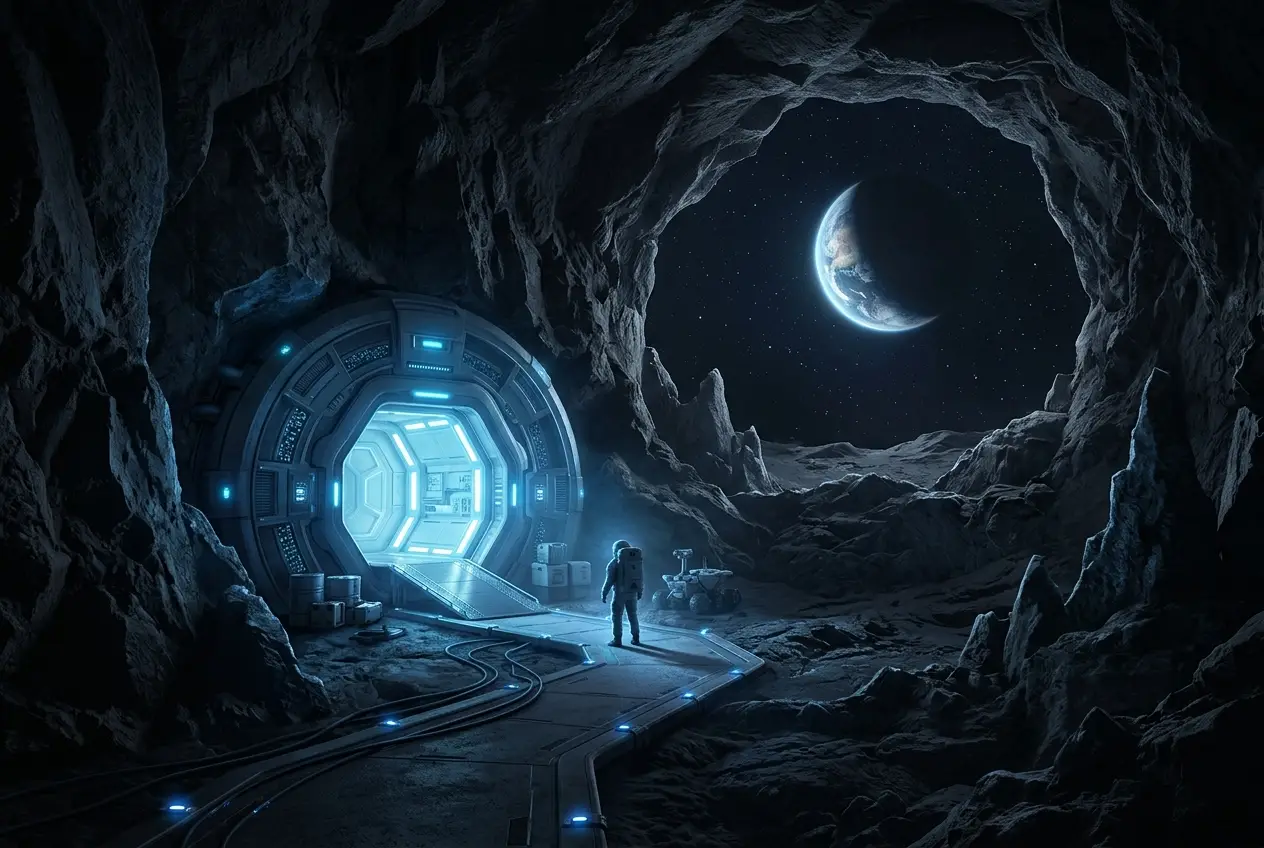
I vividly recall staring up at the full moon as a child, imagining civilizations hidden beneath its pockmarked surface. The idea felt like pure fantasy then, something confined to science fiction novels and vivid dreams. Yet, as an adult, I've come to realize that those childhood fantasies might not be so far-fetched after all. The Moon, our closest celestial neighbor, may indeed be hiding vast, ancient tunnels — remnants of its tumultuous volcanic past — that could serve as humanity’s ultimate future real estate: shielded, stable, and surprisingly spacious lunar bases.
This isn't just wishful thinking; it’s a compelling hypothesis supported by growing scientific evidence. Over the past few decades, high-resolution imagery and advanced geological studies have revealed tell-tale signs of what scientists call "lunar lava tubes." Imagine a subterranean network of natural caves, stretching for miles, formed billions of years ago when molten rock flowed beneath the Moon's surface. These aren't just pretty geological features; they represent a potential game-changer for lunar colonization, offering unprecedented protection from the harsh lunar environment.
The Moon's Fiery Past: Forging Subterranean Sanctuaries
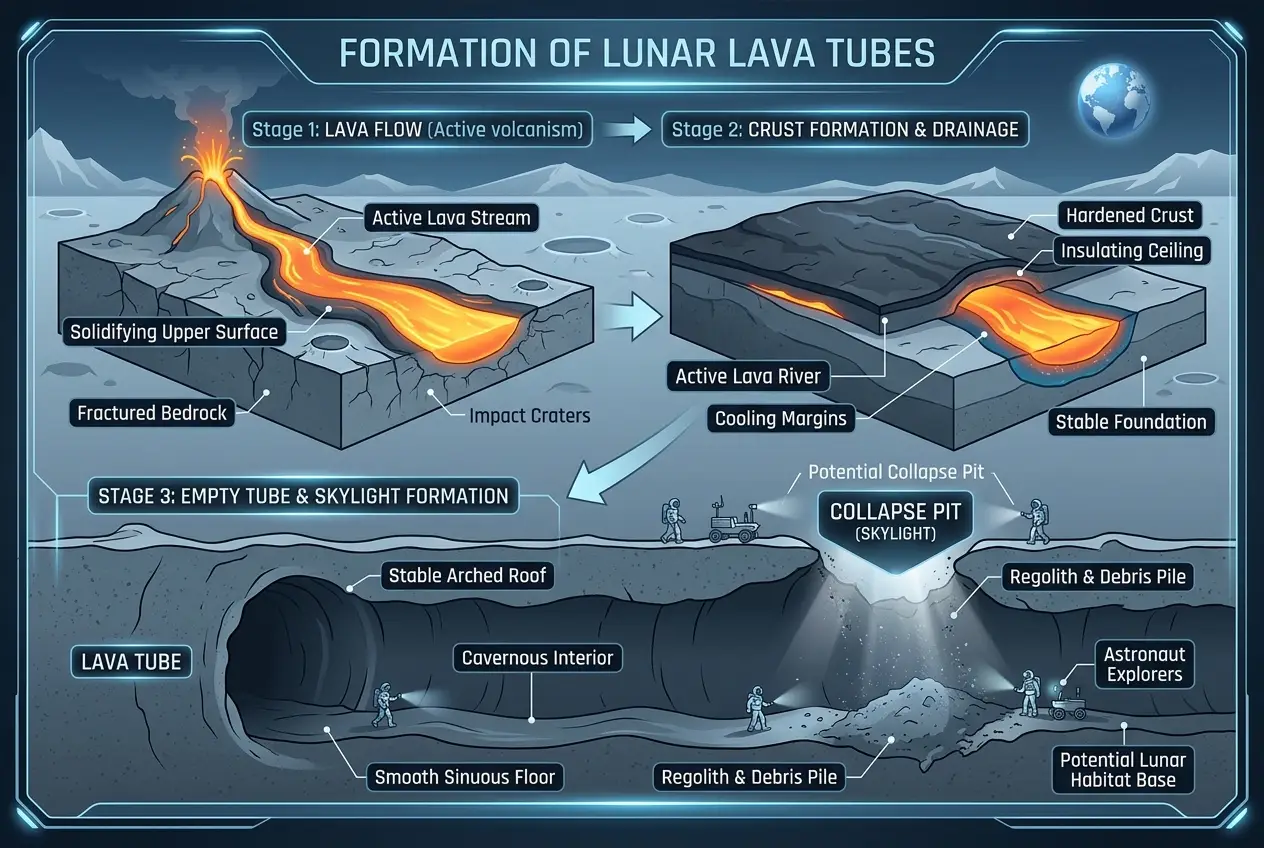
To understand lunar lava tubes, we first need to look back at the Moon's violent adolescence. Billions of years ago, the Moon was a volcanic powerhouse. Massive eruptions spewed rivers of basaltic lava across its surface, forming the dark plains we now call maria. During these intense volcanic periods, lava often flowed through existing channels or carved new ones. As the outer layers of these lava flows cooled and solidified, they formed an insulating crust. Beneath this crust, molten lava continued to flow, draining away after the eruption ceased, leaving behind an empty, hollow tunnel.
These formations are not unique to the Moon. On Earth, we have terrestrial lava tubes, like those found in Hawaii or the Canary Islands. I’ve had the privilege of exploring some of these on Earth, and the sheer scale and natural insulation are remarkable. However, lunar lava tubes are expected to be significantly larger due to the Moon's lower gravity and the extended periods of volcanic activity. Some estimates suggest they could be hundreds of meters wide and stretch for tens or even hundreds of kilometers.
Hunting for Hidden Havens: How We Find Them
So, how do we find these hidden subterranean marvels? We can’t simply walk around the Moon with a flashlight. Scientists primarily use two methods:
-
Skylights: Windows to the Underworld
The most direct evidence comes from what are known as "skylights." These are collapsed sections of the lava tube roof, forming circular or irregular holes on the lunar surface. Imagine a sinkhole on Earth, but on the Moon, leading into a vast cavern. Missions like NASA's Lunar Reconnaissance Orbiter (LRO) have photographed hundreds of these potential skylights, particularly in regions like Mare Tranquillitatis and the Marius Hills. These skylights are incredibly exciting because they offer direct access points to the hypothesized tubes below. One such prominent feature is "Marius Hills Hole," a skylight estimated to be about 65 meters wide and extending at least 80 meters deep, hinting at an even larger cavity beneath. You can learn more about these discoveries on Wikipedia's page on Lunar Lava Tubes.
-
Gravity Anomalies and Radar
Another method involves looking for subtle variations in the Moon's gravitational field. A large, empty void beneath the surface would create a slight dip in the gravitational pull detectable by orbiting spacecraft. Additionally, subsurface radar can be used to probe beneath the Moon's surface, potentially identifying the characteristic signatures of hollow tubes. Japanese Kaguya spacecraft's radar sounder detected a massive underground structure in the Marius Hills, consistent with a lava tube. This discovery, published in *Geophysical Research Letters*, provided strong corroborating evidence for the existence of these extensive tunnels.
Why Lava Tubes Are the Ultimate Lunar Real Estate
The appeal of lunar lava tubes for future human settlements is multifaceted and compelling. On the lunar surface, conditions are brutal:
* **Extreme Temperatures:** Swings from scorching +120°C during the day to freezing -170°C at night.
* **Deadly Radiation:** Constant bombardment from cosmic rays and solar flares, which can be lethal to unprotected humans and damaging to electronics.
* **Micrometeorite Impacts:** A continuous shower of tiny, high-velocity space rocks.
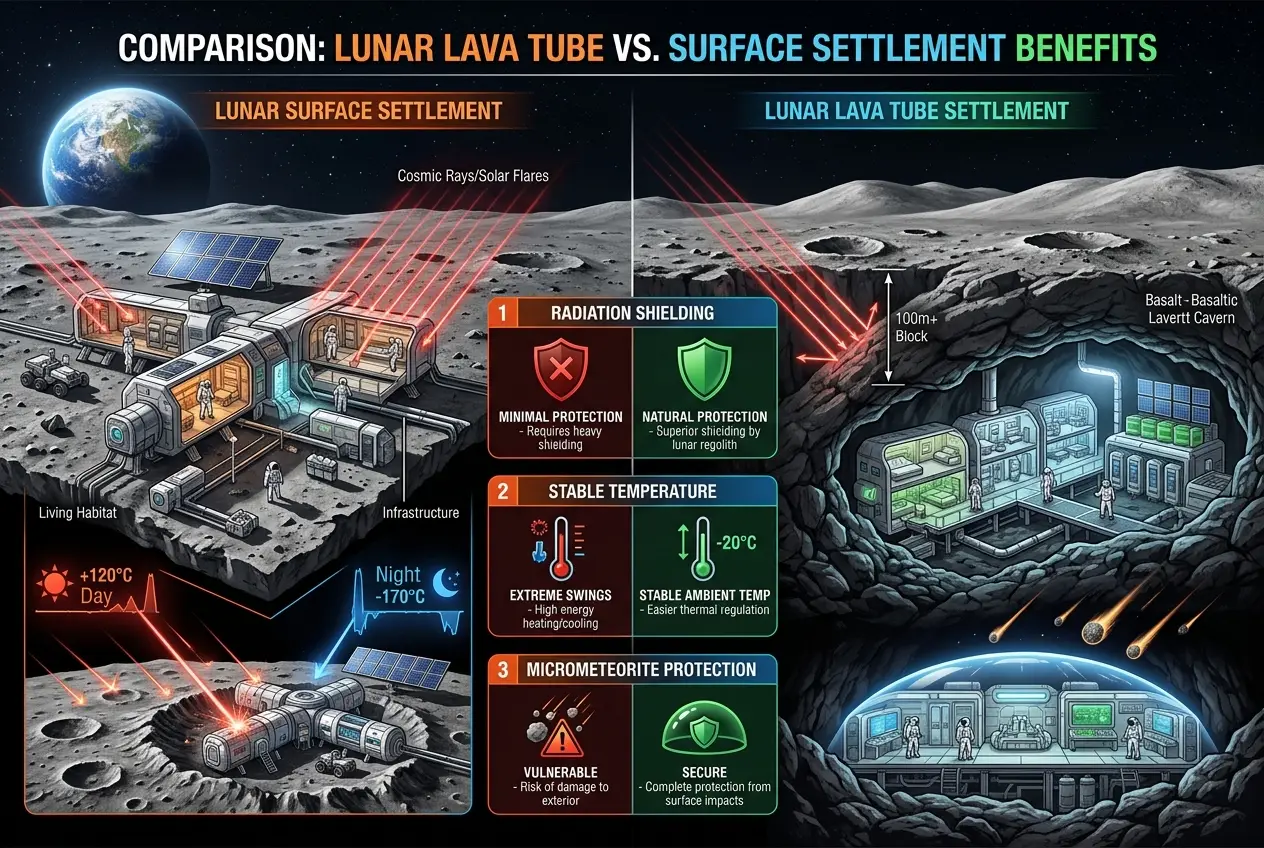
Within a lava tube, however, these dangers are dramatically mitigated:
* **Natural Radiation Shielding:** The overhead rock and regolith (lunar soil) provide a natural barrier against harmful radiation. Scientists estimate that just a few meters of rock could reduce radiation exposure to safe levels, potentially hundreds of times less than on the surface. This is a critical factor for long-term human presence.
* **Stable Temperatures:** Underground, temperatures remain remarkably constant, likely hovering around a manageable -20°C to -25°C. This significantly reduces the energy required for heating and cooling, making habitat design and power demands much more feasible.
* **Micrometeorite Protection:** The solid rock roof offers an impenetrable shield against the constant barrage of micrometeorites, protecting structures and inhabitants.
* **Shelter from Dust:** Lunar dust, abrasive and electrically charged, is a notorious problem for surface operations. Inside a sealed lava tube, it would be far less of an issue.
* **Vast, Habitable Volume:** The sheer size of these tubes could allow for expansive, interconnected habitats, agricultural areas, and industrial zones, all under a single, protective roof. This offers psychological benefits, too, providing a sense of openness rather than claustrophobic confinement.
From Hypothesis to Habitation: The Road Ahead
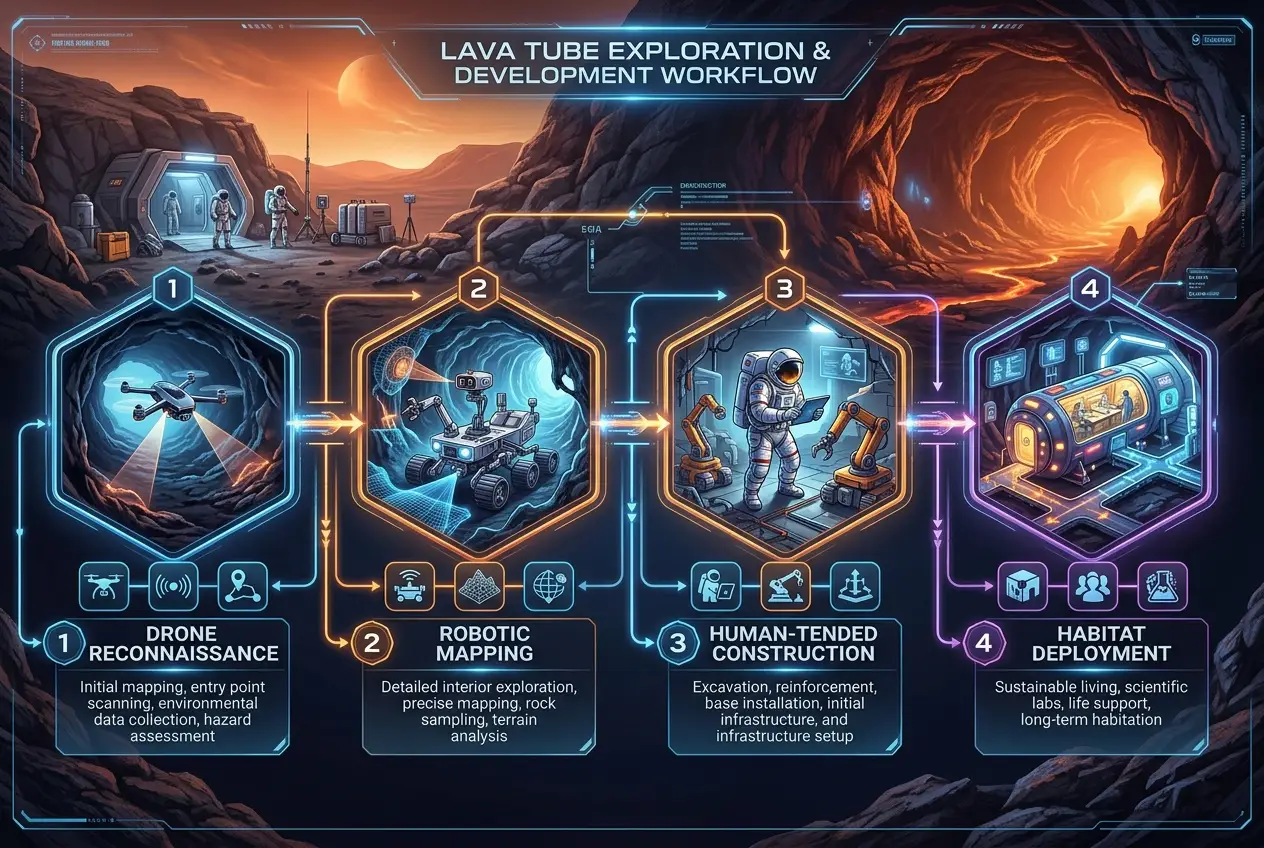
The idea of establishing bases within lava tubes is rapidly moving from science fiction to serious engineering consideration. I believe the next steps involve a multi-pronged approach:
Reconnaissance and Detailed Mapping
Before humans can descend into these depths, we need to send in robotic scouts. Small, autonomous rovers or even flying drones (potentially propelled by cold gas thrusters or propellers in the low lunar gravity, as discussed in /blogs/could-ai-bots-colonize-distant-worlds-alone) could explore skylights and initial sections of the tubes. These robots would map the internal structure, assess stability, and characterize environmental conditions. Imagine a swarm of robotic explorers meticulously charting every crevice, creating 3D models of potential base locations.
Infrastructure and Construction
Once a suitable tube is identified, the challenge shifts to construction. Inflatable habitats, like those proposed for surface bases, could be deployed and expanded within the tubes. Robotic construction equipment would be essential for preparing the floor, installing power systems, and sealing off sections for pressurization. The Moon's abundant resources, such as regolith, could be used for 3D printing additional structures or as further shielding. Some of our previous discussions on using lunar resources, like in /blogs/asteroid-mining-fueling-our-space-future, highlight the importance of *in-situ* resource utilization.
Life Support and Self-Sufficiency
Long-term habitation requires robust life support systems. Within the tubes, challenges remain, such as recycling water, generating oxygen, and managing waste. However, the stable environment makes these tasks easier than on the surface. Hydroponic farms could be established, growing food and recycling air. The potential for vast, protected spaces means these agricultural systems could be scaled up.
Challenges and Unknowns
While the vision is exciting, there are significant hurdles to overcome:
* **Accessibility:** Not all skylights may lead to stable, traversable tubes. Some might be too deep, too narrow, or prone to further collapse.
* **Internal Environment:** While temperatures are more stable, the internal atmosphere (vacuum) and potential for unique hazards (e.g., trapped gases, complex geological formations) need thorough investigation.
* **Logistics:** Transporting equipment and personnel into and out of these underground environments will require specialized engineering solutions.
* **Psychological Impact:** Living underground for extended periods could have psychological effects on astronauts, requiring careful consideration in habitat design and crew selection.
* **Ownership and Governance:** As humanity eyes lunar colonization, the question of who owns what, especially unique features like lava tubes, will become increasingly important.
The Outer Space Treaty currently governs space, but specific regulations for lunar resources are still evolving.
A New Frontier Underfoot
I find the prospect of building a future within the Moon's ancient arteries absolutely captivating. It’s a testament to human ingenuity that we can look at a celestial body’s violent past and see the blueprints for our future. The Moon, often viewed as a barren rock, might actually be a treasure trove of perfectly pre-built shelters, waiting for us to inhabit them. As we push the boundaries of space exploration, these hidden tunnels offer a pathway to sustainable, long-term human presence beyond Earth. The next generation of lunar missions might not just land on the Moon; they might delve deep beneath its surface, uncovering a new frontier underfoot. The age of subsurface colonization, once a realm of pure fiction, is inching closer to reality, and I, for one, can’t wait to see what discoveries await us in the Moon's silent, ancient depths.
For more insights into the challenges and opportunities of lunar exploration, you might be interested in our blog post on
Could AI Build Our First City on the Moon? or exploring the broader topic of space habitats on
Wikipedia's Space Habitat page.
 Join Us


 Unknown Author



























Leave a Reply
Comments (0)