Imagine standing on the precipice of the unknown, not just gazing at distant stars, but *listening* to the universe's most profound, often violent, whispers. For centuries, our exploration of the cosmos has been primarily visual, augmented by radio waves and other electromagnetic spectra. But what if there was another way to "hear" the universe – a secret language woven into the very fabric of space and time? I'm talking about gravitational waves, the ripples caused by the most extreme events in the cosmos. For a long time, these were theoretical, a brilliant prediction of Einstein's general relativity. Now, with advanced observatories, we can detect them, but truly understanding their intricate "language" remains a monumental challenge. This is where Artificial Intelligence steps in, promising to unlock a new era of cosmic discovery.
## The Universe's Echoes: What Are Gravitational Waves?
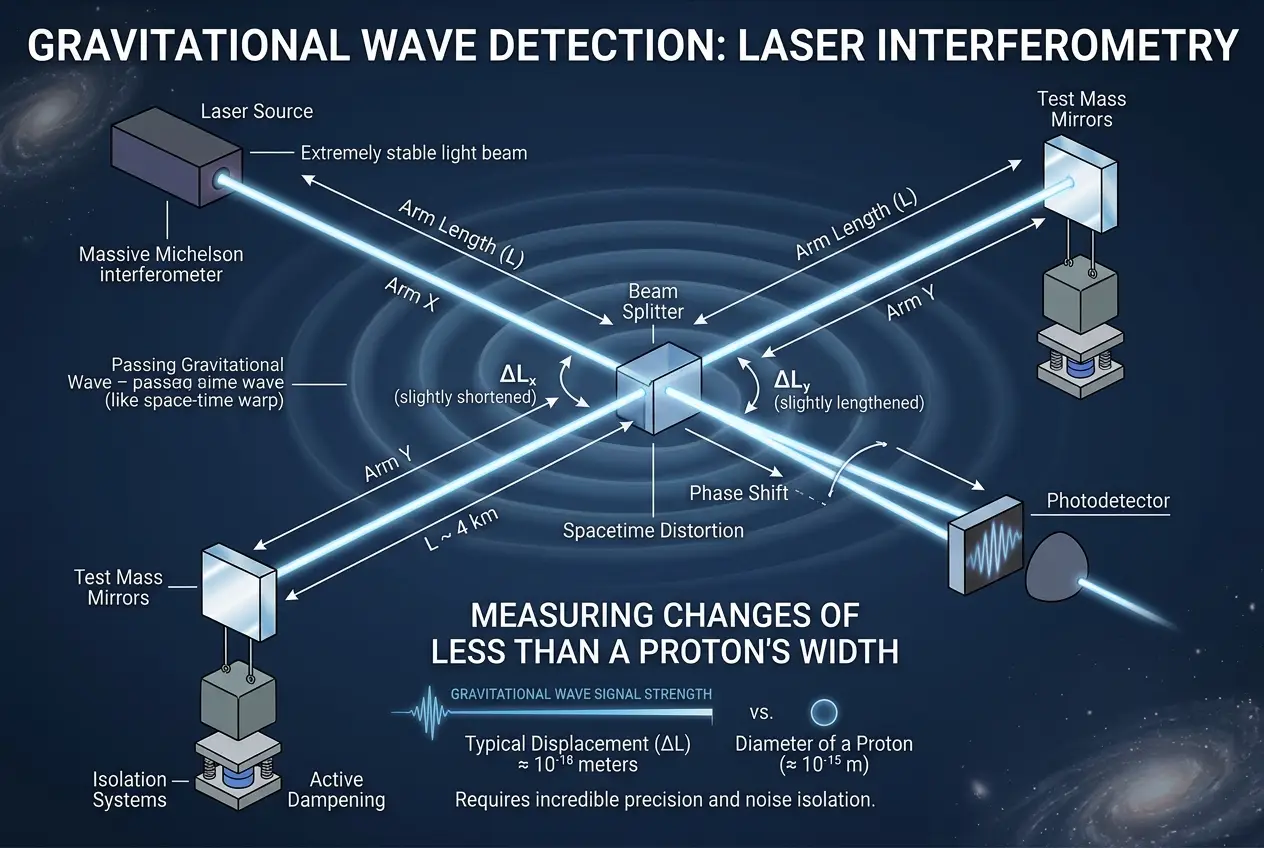
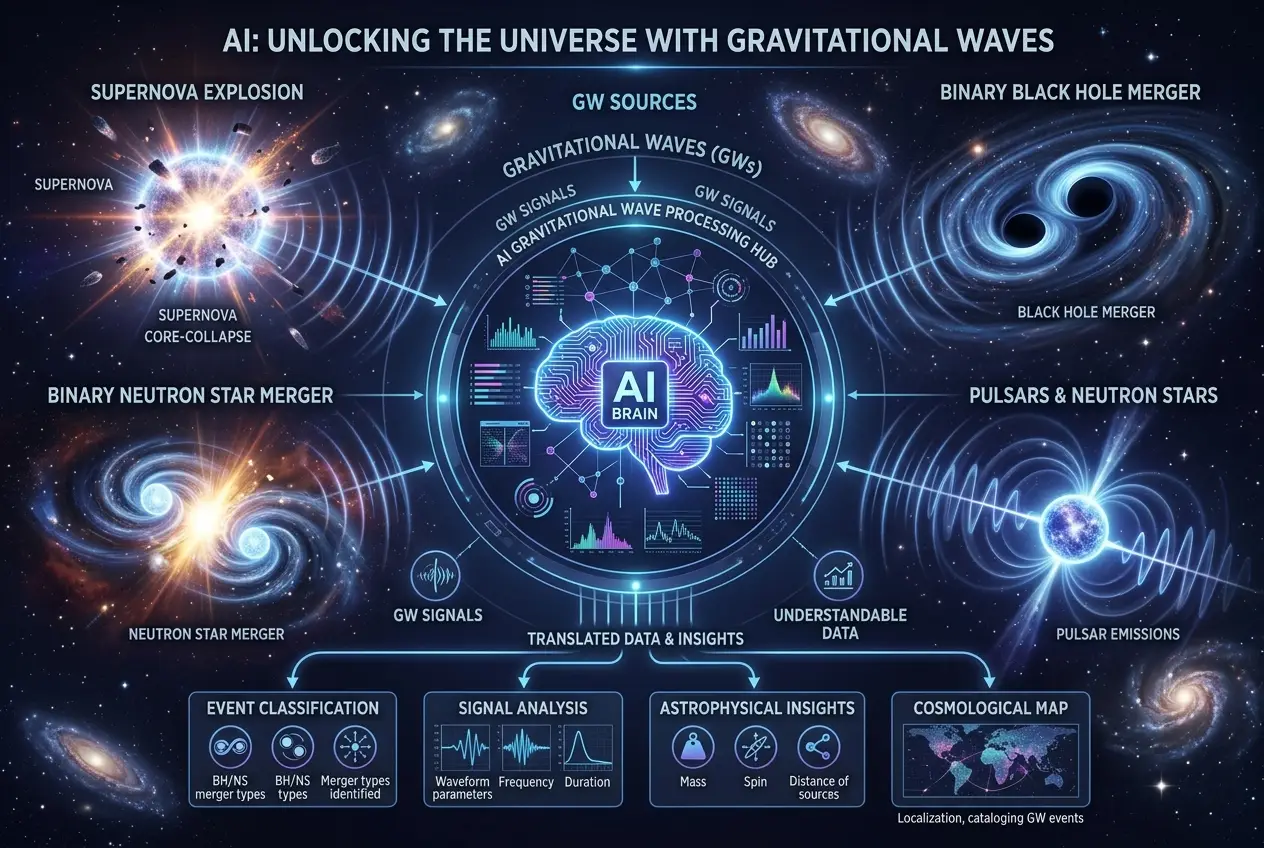
At its core, a gravitational wave is a disturbance in the curvature of spacetime, generated by accelerating masses. Think of dropping a heavy stone into a pond; the ripples that spread out are analogous to gravitational waves. However, instead of water, it's the very structure of our universe that's rippling. These aren't just any masses; we're talking about colossal events like the merger of black holes, the collision of neutron stars, or even the explosive end of massive stars (supernovae). These cataclysms send waves traveling at the speed of light, carrying with them information about their violent origins.
Albert Einstein first predicted the existence of gravitational waves in 1916 as a consequence of his theory of general relativity. Yet, their direct detection proved incredibly elusive due to their extraordinarily weak nature. It wasn't until 2015, a century after Einstein's prediction, that the Laser Interferometer Gravitational-Wave Observatory (LIGO) made history by detecting the gravitational waves produced by two colliding black holes. This monumental achievement, later followed by detections from Virgo and Kagra, opened a brand new window into the universe, allowing us to "hear" events that are otherwise invisible to traditional telescopes. You can learn more about this groundbreaking discovery on [Wikipedia's Gravitational Waves page](https://en.wikipedia.org/wiki/Gravitational_wave).
### Why Are These Cosmic Whispers So Hard to Decipher?
The challenge in deciphering gravitational waves lies in their extreme subtlety. The ripples they create are incredibly tiny, distorting spacetime by far less than the width of an atomic nucleus, even for the most violent cosmic events. Detecting them is like trying to hear a whispered conversation from a billion light-years away while standing next to a jackhammer. The observatories like LIGO are engineering marvels, essentially giant L-shaped vacuum tubes, several kilometers long, equipped with ultra-sensitive lasers and mirrors designed to detect these infinitesimal distortions.
But detection is only the first step. The raw data collected is a cacophony of noise: seismic vibrations, thermal fluctuations, even quantum jitters in the detectors themselves. Extracting the faint gravitational wave signal from this overwhelming noise requires sophisticated data processing techniques. Furthermore, the signals themselves are complex. They vary in frequency and amplitude, creating unique "chirps" that tell us about the masses of the colliding objects, their spin, and their distance from Earth. Manually sifting through petabytes of data for these fleeting, complex patterns is simply not feasible.
## AI: The Universe's New Cosmic Translator
This is where Artificial Intelligence, particularly machine learning and deep learning, has emerged as an indispensable tool. AI's ability to identify subtle patterns in massive datasets, learn from examples, and filter out noise makes it uniquely suited to the task of deciphering gravitational wave signals.
### How AI Learns to Listen
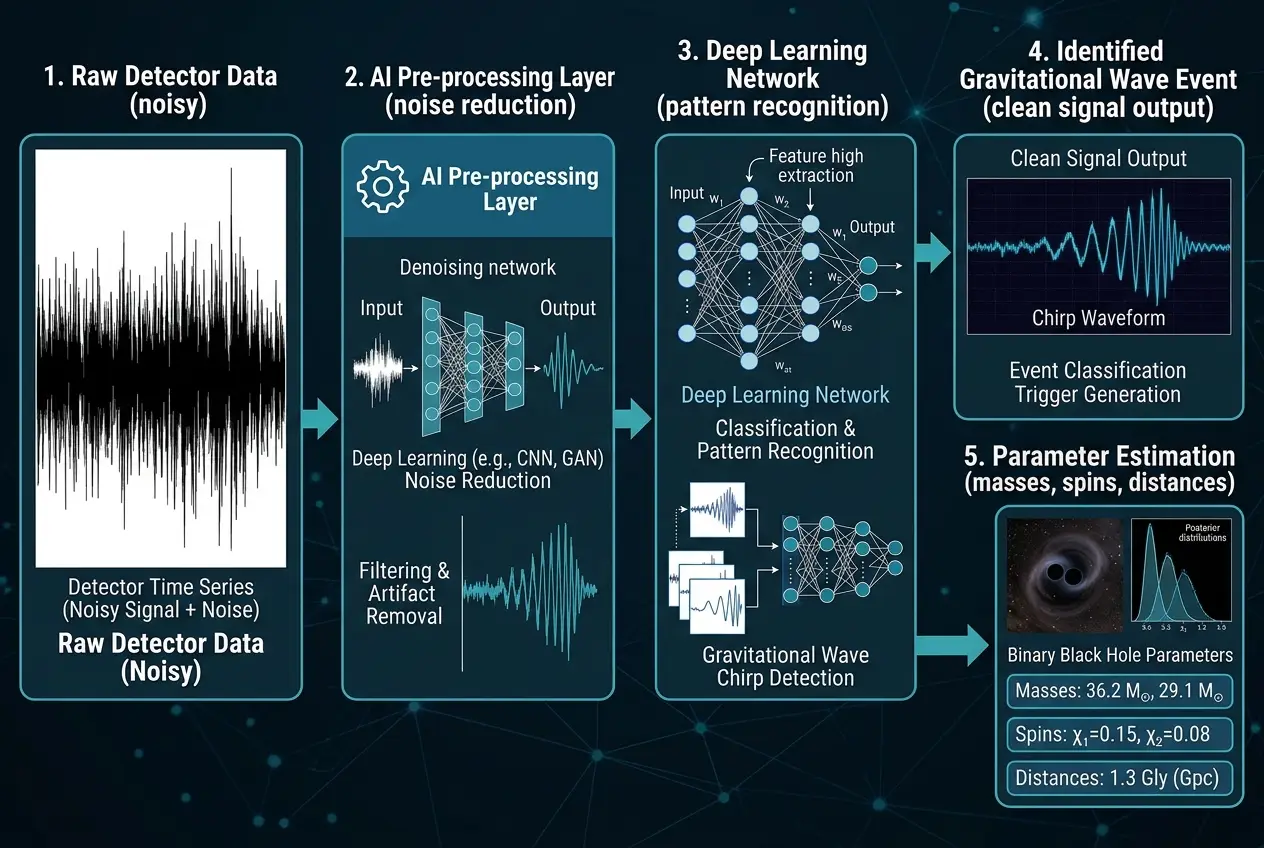
At its core, AI approaches gravitational wave analysis by treating the raw detector data as a complex audio signal. Just as speech recognition software learns to identify words in noisy conversations, deep learning algorithms can be trained to recognize the characteristic "chirps" of gravitational waves amidst the background static.
**Here's a simplified breakdown of the AI process:**
1. **Training Data:** AI models are fed vast amounts of simulated gravitational wave signals, generated from theoretical models of black hole mergers or neutron star collisions, embedded within real detector noise. This teaches the AI what a gravitational wave *should* sound like, and what *noise* sounds like.
2. **Feature Extraction:** Traditional signal processing techniques might manually extract features like frequency changes or amplitude peaks. AI, especially deep learning, can automatically learn and extract the most relevant features directly from the raw data.
3. **Pattern Recognition:** Neural networks, a type of AI inspired by the human brain, are particularly adept at recognizing complex, non-linear patterns. They can identify the characteristic "chirp" signature that signifies a gravitational wave event, even if it's deeply buried in noise.
4. **Noise Reduction:** AI models can learn to differentiate between genuine cosmic signals and various sources of terrestrial and instrumental noise. This allows for more effective filtering, leading to clearer, more confident detections.
Researchers are employing various machine learning techniques, including convolutional neural networks (CNNs) and recurrent neural networks (RNNs), which are particularly effective for time-series data like gravitational wave signals. These models can quickly and accurately analyze incoming data streams, flagging potential events for further human review. This drastically speeds up the detection process and helps uncover signals that might have been missed by traditional matched-filtering algorithms, especially for unexpected or weaker signals. I've often thought about how AI's ability to find these hidden patterns is almost like it's developing its own intuition for the universe's mechanics. To dive deeper into how machine learning works, you can visit [Wikipedia's Machine Learning page](https://en.wikipedia.org/wiki/Machine_learning).
## The "Secret Language" Revealed: What AI is Helping Us Understand
With AI's assistance, we're not just detecting gravitational waves; we're beginning to decode the profound information they carry. Each "chirp" is a unique cosmic fingerprint, revealing details about the events that caused it.
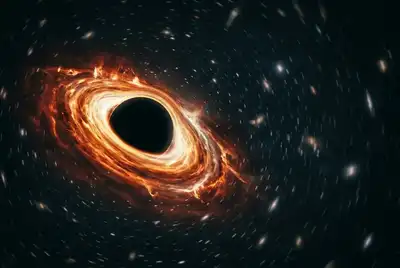
* **Black Hole Mergers:** AI can quickly and precisely determine the masses and spins of the progenitor black holes and the resulting larger black hole. This helps us understand the evolution of these enigmatic objects and their distribution across the universe. For more on black holes, check out [Wikipedia's Black Hole article](https://en.wikipedia.org/wiki/Black_hole).
* **Neutron Star Collisions:** These events are particularly exciting because they are thought to be the primary cosmic factories for heavy elements like gold and platinum. AI's rapid analysis can provide early warnings, allowing traditional telescopes to quickly pinpoint the location and observe the electromagnetic counterparts, providing a multi-messenger view of these incredible phenomena.
* **Early Universe Echoes:** One of the holy grails of gravitational wave astronomy is to detect the faint echoes from the very early universe – remnants of the Big Bang itself. These primordial gravitational waves are incredibly weak, but AI's advanced sensitivity might just be the key to uncovering them, offering unprecedented insights into the universe's genesis.
* **Unusual Sources:** AI is not limited to recognizing known patterns. Its ability to identify anomalies can potentially lead to the discovery of entirely new types of cosmic events or exotic objects that we haven't even theorized yet. Imagine a signal so strange, so unlike anything we expect, that only an AI could flag it as significant.
### Challenges on the Cosmic Listening Post
Despite its incredible promise, AI in gravitational wave astronomy faces its own set of hurdles. One major challenge is **data bias**. AI models are only as good as the data they are trained on. If our simulated signals don't accurately represent all possible cosmic events, the AI might miss truly novel phenomena. Another issue is **interpretability**: sometimes, deep learning models can be black boxes, making it difficult for human scientists to understand *why* a particular signal was flagged or a certain parameter was estimated. Ensuring the reliability and verifiability of AI's conclusions is paramount.
The sheer volume of data is also a constant challenge. Gravitational wave detectors generate continuous streams of data, and processing this in real-time requires immense computational power and efficient algorithms. However, as computational capabilities advance and AI models become more sophisticated, these challenges are steadily being addressed.
## The Future: A Universe Reimagined by AI
I envision a future where AI acts as our primary cosmic translator, continuously sifting through the universe's whispers, turning raw spacetime ripples into a symphony of scientific discovery. AI-powered observatories might one day be so sensitive that they could monitor the entire universe for gravitational wave events, providing alerts that allow other telescopes to instantly turn their gaze towards new, never-before-seen cataclysms.
This synergy between cutting-edge physics and advanced AI promises to fundamentally change our understanding of the cosmos. We might uncover new laws of physics, identify exotic forms of matter, or even detect signals from cosmic phenomena we can barely imagine today. The 'secret language' of gravitational waves, once a theoretical concept, is slowly but surely being translated, and AI is proving to be our most powerful linguistic tool.
Just as we discussed how artificial intelligence might uncover hidden cosmic anomalies in our blog on [Can AI Uncover Hidden Cosmic Anomalies?](https://www.curiositydiaries.com/blogs/can-ai-uncover-hidden-cosmic-anomalies-3679), or how the cosmic web itself could compute the universe's fate in [Can the Cosmic Web Compute Our Universe's Fate?](https://www.curiositydiaries.com/blogs/can-the-cosmic-web-compute-our-universes-fate-1603), this application of AI to gravitational wave astronomy highlights its transformative potential in deciphering the most profound mysteries of the universe. It’s a testament to how technology is constantly expanding our senses, allowing us to perceive dimensions of reality we once only dreamed of.
**Conclusion:**
The journey to understand gravitational waves has been a century-long saga, moving from theoretical prediction to astonishing detection. With Artificial Intelligence now firmly integrated into the fabric of astrophysical research, we are on the cusp of truly deciphering the universe's secret language. This powerful combination of human ingenuity and machine intelligence isn't just about finding more events; it's about unlocking a deeper, richer understanding of the forces that shape our cosmos, revealing a universe far more dynamic and mysterious than we ever thought possible.
&meta_title; AI's Role in Deciphering Gravitational Waves &meta_title;
&meta_description; Uncover how Artificial Intelligence is revolutionizing astrophysics by decoding the complex 'secret language' of gravitational waves, revealing insights into black holes, neutron stars, and the early universe. &meta_description;
&faqs;{"faqs":[{"id":1,"question":"How does AI improve on traditional gravitational wave detection methods?","answer":"AI improves upon traditional matched-filtering methods by being more adaptable to unexpected signal shapes, better at sifting through complex noise, and capable of faster, real-time data processing, potentially uncovering fainter or novel events that might otherwise be missed."},{"id":2,"question":"What types of cosmic events generate detectable gravitational waves?","answer":"The primary events that generate gravitational waves strong enough for current detection are the mergers of black holes, the collisions of neutron stars, and possibly certain types of supernovae. Scientists are also searching for faint, continuous waves from spinning neutron stars and primordial waves from the early universe."},{"id":3,"question":"Can AI actually 'predict' gravitational wave events before they happen?","answer":"Not in the sense of predicting a future event. However, AI can significantly speed up the analysis of incoming data, allowing for near real-time detection and rapid alerts to other observatories. This quick turnaround is crucial for multi-messenger astronomy, where different telescopes observe the same event across various spectra."},{"id":4,"question":"Are there ethical concerns with using AI to interpret cosmic data?","answer":"While not directly related to human ethics, concerns include ensuring the transparency and interpretability of AI models (avoiding 'black box' decisions), preventing algorithmic bias if training data is incomplete, and rigorously validating AI's findings to maintain scientific integrity. The goal is augmentation, not replacement, of human scientific oversight."},{"id":5,"question":"What is the next big goal for AI in gravitational wave astronomy?","answer":"A key goal is to develop AI models capable of detecting weaker, more distant, and potentially unknown types of gravitational wave sources. Another frontier is using AI to automatically extract more precise astrophysical parameters from detected signals and to integrate data from multiple observatories more seamlessly for better localization and characterization of events."}]}&faqs;
Frequently Asked Questions
AI improves upon traditional matched-filtering methods by being more adaptable to unexpected signal shapes, better at sifting through complex noise, and capable of faster, real-time data processing, potentially uncovering fainter or novel events that might otherwise be missed.
The primary events that generate gravitational waves strong enough for current detection are the mergers of black holes, the collisions of neutron stars, and possibly certain types of supernovae. Scientists are also searching for faint, continuous waves from spinning neutron stars and primordial waves from the early universe.
Not in the sense of predicting a future event. However, AI can significantly speed up the analysis of incoming data, allowing for near real-time detection and rapid alerts to other observatories. This quick turnaround is crucial for multi-messenger astronomy, where different telescopes observe the same event across various spectra.
While not directly related to human ethics, concerns include ensuring the transparency and interpretability of AI models (avoiding 'black box' decisions), preventing algorithmic bias if training data is incomplete, and rigorously validating AI's findings to maintain scientific integrity. The goal is augmentation, not replacement, of human scientific oversight.
A key goal is to develop AI models capable of detecting weaker, more distant, and potentially unknown types of gravitational wave sources. Another frontier is using AI to automatically extract more precise astrophysical parameters from detected signals and to integrate data from multiple observatories more seamlessly for better localization and characterization of events.
Verified Expert
Alex Rivers
A professional researcher since age twelve, I delve into mysteries and ignite curiosity by presenting an array of compelling possibilities. I will heighten your curiosity, but by the end, you will possess profound knowledge.
Leave a Reply
Comments (0)
No approved comments yet. Be the first to share your thoughts!
 Join Us
 Unknown Author












Leave a Reply
Comments (0)