I’ve often wondered about the unseen forces that shape our reality. We tend to think of sound as mere vibrations, something we hear, a phenomenon of macroscopic waves moving through a medium. But what if the realm of sound extends far beyond what our ears can perceive, venturing into the quantum world? What if these seemingly simple vibrations possess the ability to precisely manipulate matter at its most fundamental level, rearranging atoms, influencing quantum states, and even forging entirely new materials?
It sounds like something out of science fiction, doesn't it? Yet, the fascinating field of **quantum acoustics** is exploring precisely this — the profound interplay between sound waves and quantum particles. Imagine a future where we don't just hear sound, but use it as a finely tuned instrument to conduct symphony on a molecular stage, altering properties of matter with sonic precision. This isn't just a fantastical idea; it's a rapidly evolving frontier of science that promises to unlock breakthroughs in computing, materials science, and even medicine.
The Unseen Symphony: Sound in the Quantum Realm
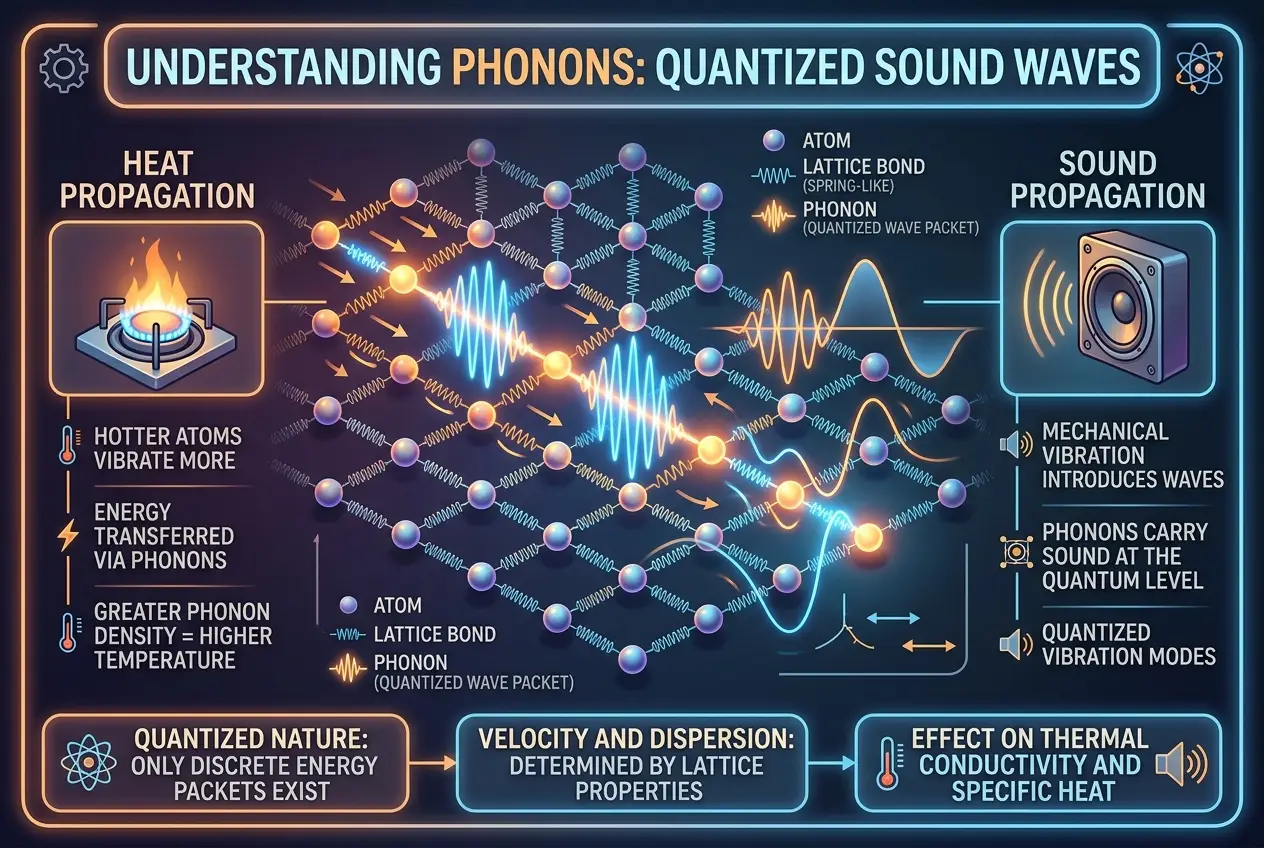
To understand how sound can influence matter at the quantum scale, we first need to shift our perspective on what sound truly is. On a macroscopic level, sound is a pressure wave. But zoom in, deep into the heart of a material, and you'll find that these pressure waves are, in essence, collective excitations of atoms. When atoms vibrate in an organized manner, transmitting energy through a lattice, we call these quantized vibrations **phonons**. Think of phonons as the quantum packets of sound energy, much like photons are the quantum packets of light.
These phonons are not just abstract concepts; they are real quasi-particles that carry energy and momentum. They are responsible for many of the thermal and acoustic properties of materials. For instance, the way heat moves through a solid is largely governed by how phonons propagate and interact. But what's truly intriguing is their potential for manipulation. If we can control phonons, can we control the fundamental properties of matter they influence?
Acoustic Traps and Levitation: Macroscopic Precursors
Before diving too deep into the quantum, it’s worth noting that using sound to manipulate matter isn't entirely new, even at a larger scale. Acoustic levitation, for example, has been around for decades. Using carefully tuned ultrasonic waves, scientists can create pressure nodes in the air, trapping small objects and suspending them against gravity. I recall seeing a demonstration of this where tiny water droplets floated effortlessly, defying the laws of gravity as if by magic. This macroscopic phenomenon serves as a powerful analogy for the precise control we aim to achieve at the quantum level.
The principle is simple: **sound waves** create pressure differentials. If these differentials are stable and strong enough, they can exert a force. Now, extend that concept to the atomic scale. What if these pressure differences, driven by phonons, could gently nudge individual atoms or even entire molecules into specific configurations, or hold them in quantum traps?
Sonochemistry: Sound's Chemical Influence
While not directly quantum manipulation, sonochemistry offers a compelling bridge between sound and matter alteration. Sonochemistry is the study of using sound waves (particularly ultrasound) to accelerate or initiate chemical reactions. When high-intensity ultrasound passes through a liquid, it creates microscopic bubbles that rapidly grow and then violently collapse. This phenomenon, known as **cavitation**, generates extreme local conditions: temperatures reaching thousands of Kelvin and pressures in the hundreds of atmospheres, all within nanoseconds.
These extreme conditions can break chemical bonds, create highly reactive free radicals, and significantly enhance reaction rates. Imagine a cleaner and more efficient way to synthesize complex molecules or nanomaterials, driven not by harsh chemicals or extreme heat, but by controlled sonic pulses. This field is already seeing applications in environmental remediation, material synthesis, and even in drug delivery systems. For more detailed information on sonochemistry, you can refer to its comprehensive Wikipedia page: [Sonochemistry - Wikipedia](https://en.wikipedia.org/wiki/Sonochemistry).
Quantum Acoustics: The New Frontier
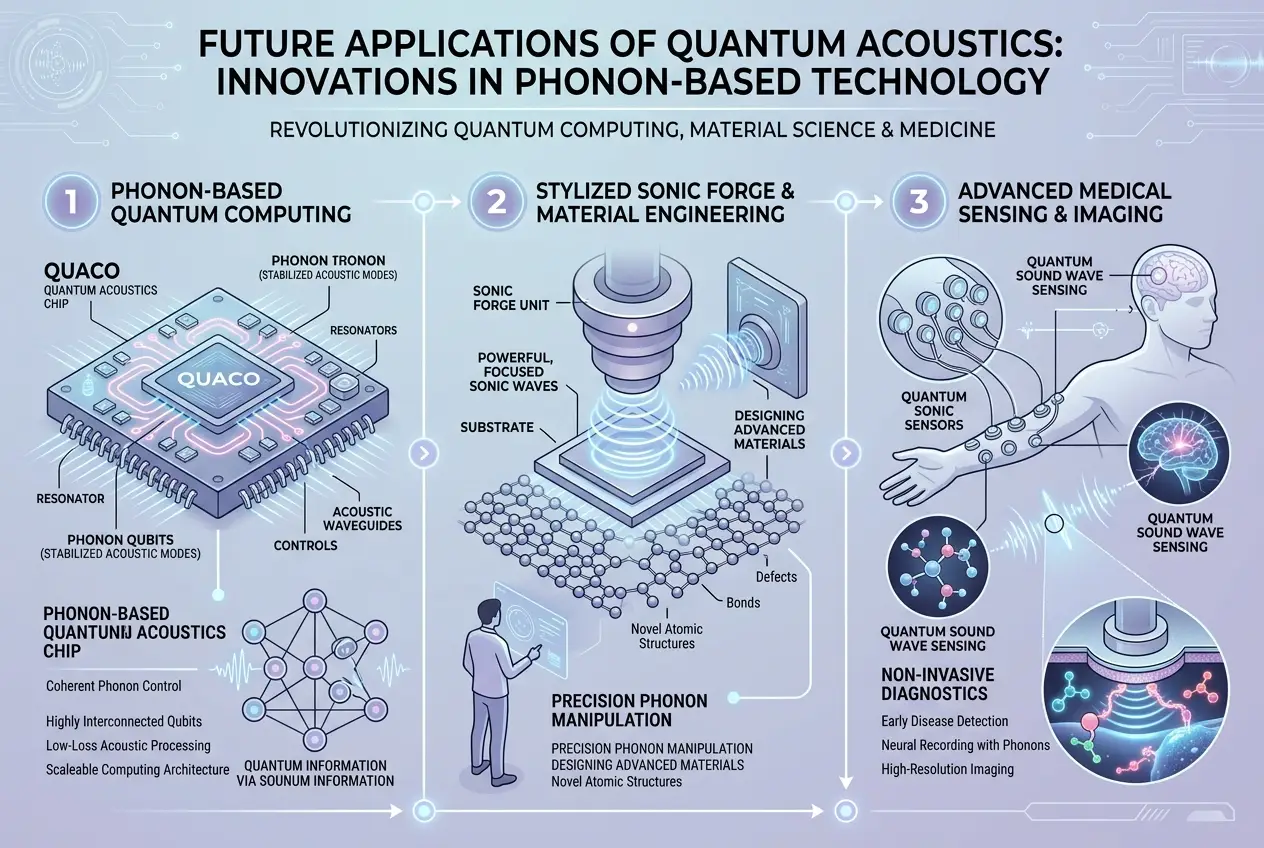
Now, let's return to the truly quantum. Researchers are developing techniques to generate and control phonons with unprecedented precision. By using carefully crafted acoustic resonators and **nanoscale devices**, they can create coherent phonons – essentially, perfectly synchronized sound waves – that interact directly with quantum systems like superconducting qubits or quantum dots.
One exciting application is in **quantum computing**. Just as photons are used to transmit quantum information in optical quantum computers, phonons could potentially serve a similar role in mechanical or solid-state quantum systems. Imagine "phononic qubits" where information is encoded in the vibrational states of a material. The ability to precisely control these phonons means we could build more robust and scalable quantum processors. This is a fascinating area where the future of computing might literally hum with quantum vibrations. You can delve deeper into the concept of quantum computing by checking out our blog on how quantum dots might revolutionize AI: [do-quantum-dots-see-other-dimensions-unpacking-hyper-vision-3853](/blogs/do-quantum-dots-see-other-dimensions-unpacking-hyper-vision-3853).
| Aspect of Interaction |
Macroscopic Sound |
Sonochemistry (Ultrasound) |
Quantum Acoustics (Phonons) |
| Mechanism |
Pressure waves |
Cavitation, extreme local conditions |
Quantized lattice vibrations |
| Scale of Manipulation |
Objects, fluids |
Molecules, chemical bonds |
Atoms, electrons, quantum states |
| Applications |
Hearing, communication, levitation |
Material synthesis, catalysis, drug delivery |
Quantum computing, sensing, new material design |
| Precision |
Low (relative to atomic) |
High (molecular) |
Extremely high (quantum state) |
Shaping Materials with Sonic Waves
Beyond computing, the ability to manipulate matter with sound at the quantum level could revolutionize materials science. Imagine using precise phonon pulses to:
* **Engineer band gaps in semiconductors:** By altering the vibrational modes of a material, we could subtly change its electronic properties, leading to more efficient solar cells or faster transistors.
* **Create novel metamaterials:** These are materials with properties not found in nature, designed at the atomic level. Sound waves could potentially act as a "sonic forge," guiding the self-assembly of atoms into unique structures with exotic acoustic, optical, or electronic characteristics.
* **Enhance superconductivity or superfluidity:** The interaction between electrons and phonons is crucial for phenomena like superconductivity. If we can manipulate these interactions, we might be able to create superconductors that operate at higher temperatures or novel superfluids. This echoes some of the incredible possibilities explored in our post on how [can-superfluidity-revolutionize-future-computing-1604](/blogs/can-superfluidity-revolutionize-future-computing-1604).
* **Fabricate nanostructures:** Using focused sound waves as a non-invasive tool to precisely carve, etch, or deposit materials at the nanoscale, building intricate components for future electronics.
The precision required for this kind of manipulation is immense. It involves creating acoustic waves with wavelengths comparable to atomic distances and controlling their phase and amplitude with exquisite accuracy. Researchers are employing advanced techniques, often leveraging piezoelectric materials and microfabrication, to achieve this level of control. These materials convert electrical signals into mechanical vibrations and vice-versa, making them ideal for generating and detecting these tiny quantum sound waves. For a deeper dive into piezoelectricity and its applications, the Wikipedia article is a great resource: [Piezoelectricity - Wikipedia](https://en.wikipedia.org/wiki/Piezoelectricity).
The Challenges Ahead
While the potential is staggering, significant challenges remain. Generating and detecting phonons at the quantum limit is incredibly difficult. Maintaining the coherence of these quantum sound waves – ensuring they don't lose their quantum properties too quickly due to interactions with the environment – is another major hurdle. Noise and thermal vibrations can easily overwhelm the subtle quantum effects we're trying to harness.
Furthermore, precisely targeting and manipulating individual atoms or quantum states with phonons requires breakthroughs in acoustic microscopy and quantum control. It’s like trying to play a specific note on a tiny, intricate instrument in a very noisy room. However, the progress in this field is rapid, fueled by advancements in nanofabrication and quantum measurement techniques. The dream of harnessing sound to power future innovations, as discussed in our article [can-sound-waves-forge-power-3170](/blogs/can-sound-waves-forge-power-3170), is becoming less of a dream and more of a tangible scientific pursuit.
A Future Shaped by Sound
The idea that something as ubiquitous as sound could be a key to unlocking quantum-level control over matter is truly mind-bending. From crafting ultra-efficient quantum computers to designing materials with unheard-of properties, the implications are vast. We are only just beginning to decode this "unseen symphony" of the universe, learning how to conduct its smallest vibrations to compose a future filled with revolutionary technologies. The next time you hear a sound, perhaps you’ll pause and wonder: what quantum echoes might it be stirring, far beyond the reach of our human ears?
 Join Us




 Unknown Author



































Leave a Reply
Comments (0)