


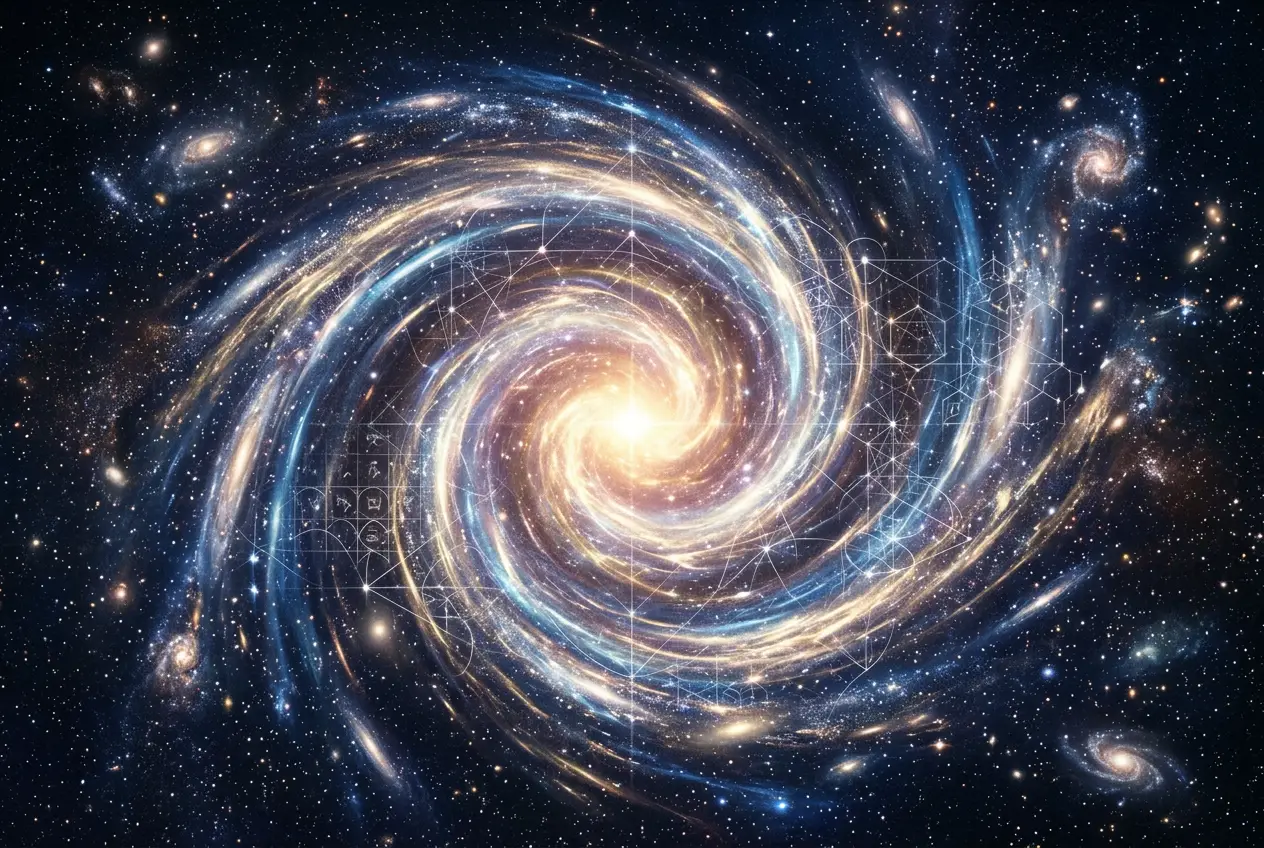
I was recently reading about the vacuum of space, that seemingly empty expanse, and a thought struck me: what if it’s not truly empty? What if the void itself hums with an unquantifiable power, a hidden energy waiting to be tapped? This isn't science fiction, at least not entirely. It’s the intriguing, often controversial, concept of Zero-Point Energy (ZPE) – a phenomenon rooted deep in the bizarre world of quantum mechanics, hinting at a reality far more complex and energetic than our everyday senses perceive.
Imagine a future where your phone never dies, your car runs on nothing but the fabric of space-time, and humanity has an inexhaustible, clean power source. Sounds like a dream, right? For decades, scientists and inventors have chased this elusive dream, fueled by the whispers of quantum physics. I’ve always been fascinated by theories that challenge our understanding of what's possible, and ZPE sits squarely in that realm.
The Quantum Hum: What is Zero-Point Energy?
To understand Zero-Point Energy, we need to dive into the mind-bending principles of quantum mechanics. Unlike classical physics, which predicts a complete absence of energy at absolute zero (-273.15°C or 0 Kelvin), quantum mechanics paints a different picture. It suggests that even at this theoretical coldest possible temperature, particles can never be perfectly still. They retain a minimum amount of vibrational energy, known as zero-point motion. This isn’t just a quirky theoretical idea; it’s a direct consequence of the Heisenberg Uncertainty Principle.
The Uncertainty Principle, formulated by Werner Heisenberg, states that you cannot simultaneously know both the exact position and the exact momentum of a particle. If a particle were perfectly still (zero momentum) and at a fixed location, this principle would be violated. Therefore, quantum mechanics dictates that there must always be a residual, irreducible jitter, an inherent "fuzziness" to the universe even at its lowest energy state. This residual energy, present everywhere, is what we call Zero-Point Energy. It’s the background hum of existence, the cosmic static that fills the vacuum.
Think of it like an ocean. Even when the surface appears calm, there are always tiny ripples, currents, and microscopic movements beneath. The quantum vacuum is not empty; it's a seething foam of virtual particles constantly popping into and out of existence. These fleeting particles contribute to the vacuum's inherent energy. You can delve deeper into the concept of virtual particles and the quantum vacuum on Wikipedia's page for Zero-Point Energy (opens in a new tab).
Evidence for the Unseen: The Casimir Effect
While ZPE might sound like pure theoretical speculation, there's tangible, experimentally verified evidence that hints at its reality: the Casimir Effect. First predicted by Dutch physicist Hendrik Casimir in 1948, this effect demonstrates that even in a vacuum, two uncharged, parallel metal plates placed very close together will experience a small but measurable attractive force.
Why? According to quantum electrodynamics, the vacuum is filled with virtual particles and electromagnetic waves (photons) constantly flickering into existence. Between the plates, only wavelengths that fit perfectly within the gap can exist. Outside the plates, however, all wavelengths are permitted. This restriction creates an imbalance: there are fewer virtual photons pushing out from between the plates than there are pushing in from the outside. The net effect is a slight pressure difference, forcing the plates together.
I find this absolutely mind-boggling. It’s like the "empty" space between the plates is literally being squeezed by the energy of the vacuum itself. The Casimir effect has been repeatedly measured in experiments since the 1990s, providing robust evidence for the physical reality of zero-point fluctuations. It’s a powerful testament to the fact that the quantum vacuum is anything but empty.
The Dream of Harnessing ZPE
The existence of ZPE raises a tantalizing question: if this energy is everywhere, could we tap into it? Could we extract useful work from the vacuum? This is where the scientific community often diverges, separating confirmed physics from speculative engineering and, unfortunately, sometimes outright pseudoscience.
The challenge lies in the nature of ZPE. It’s not like a conventional energy source that can be easily "burned" or "converted." It’s an inherent property of the vacuum itself. Think of it as the foundational "level" of energy; it's hard to extract energy from the lowest possible state. You can read more about the challenges and the history of attempts to harness ZPE on Wikipedia's article on the Casimir Effect (opens in a new tab).
However, some theoretical models propose ways to manipulate the quantum vacuum to create a localized imbalance, similar to how the Casimir effect works, but on a much larger, more useful scale. If successful, such technologies could revolutionize energy production, offering an unlimited, non-polluting power source. This ambition echoes similar quests throughout history, from the pursuit of perpetual motion to the theoretical promise of atomic batteries that could power our future without recharging.
The Roadblocks and the Hope
The biggest roadblock to harnessing ZPE isn't necessarily its existence, but the laws of thermodynamics. Specifically, the Second Law states that entropy (disorder) always increases in a closed system, and energy cannot be created or destroyed, only transformed. Extracting energy from ZPE without putting in more energy than you get out would effectively mean building a perpetual motion machine of the second kind, which is generally considered impossible under current understanding.
However, some physicists argue that our understanding of thermodynamics might need revision in the context of an open system interacting with the quantum vacuum. They propose that if we could create a system that continually "pushes" against the vacuum fluctuations in a specific way, we might be able to extract net energy. This is a highly theoretical and contested area of research.
Research continues in laboratories around the world, exploring exotic materials and quantum phenomena that might offer new avenues. Advances in nanotechnology and quantum computing – which itself leverages quantum mechanics to achieve speeds far beyond classical machines, as explored in why quantum computers are mind-bogglingly faster than supercomputers – could potentially unlock new ways to interact with the quantum vacuum. We might not be talking about Star Trek-style warp drives or boundless energy just yet, but the fundamental research into these areas is crucial.
Beyond Energy: Implications for Space and Reality
The implications of Zero-Point Energy extend far beyond just power generation. If the vacuum truly contains such immense energy, it could potentially explain phenomena like dark energy, the mysterious force driving the accelerating expansion of the universe. Current calculations based on ZPE predict a vacuum energy density vastly greater than what astronomers observe for dark energy – a discrepancy of 120 orders of magnitude, known as the "vacuum catastrophe." This huge difference suggests either a profound misunderstanding of ZPE, or perhaps that there are unknown mechanisms that cancel out most of this energy. Exploring these questions might lead us to a deeper understanding of the cosmos itself, perhaps even to concepts as mind-bending as what types of multiverses exist.
Moreover, the constant "fuzziness" of the quantum vacuum raises philosophical questions about the very nature of reality. If emptiness is never truly empty, if particles pop in and out of existence, then our perception of a solid, stable universe is just one layer of a much more dynamic, effervescent reality.
I believe the journey to understanding and potentially harnessing ZPE is one of humanity’s most ambitious scientific quests. It pushes the boundaries of our knowledge, forcing us to confront the weirdness of the quantum world and reconsider what we thought was impossible. While the practical realization of "free energy" from the vacuum remains firmly in the realm of theoretical physics and engineering challenges, the underlying quantum principles are undeniably real. Who knows, perhaps one day we'll look back at our current energy struggles and marvel at how we overlooked the boundless power hidden in plain sight – the subtle, persistent hum of the quantum vacuum. It's a reminder that the universe, and our place within it, is far more mysterious and magnificent than we often imagine.


Conversation0
No comments yet. Be the first to share a thought — the best questions often become new stories.