


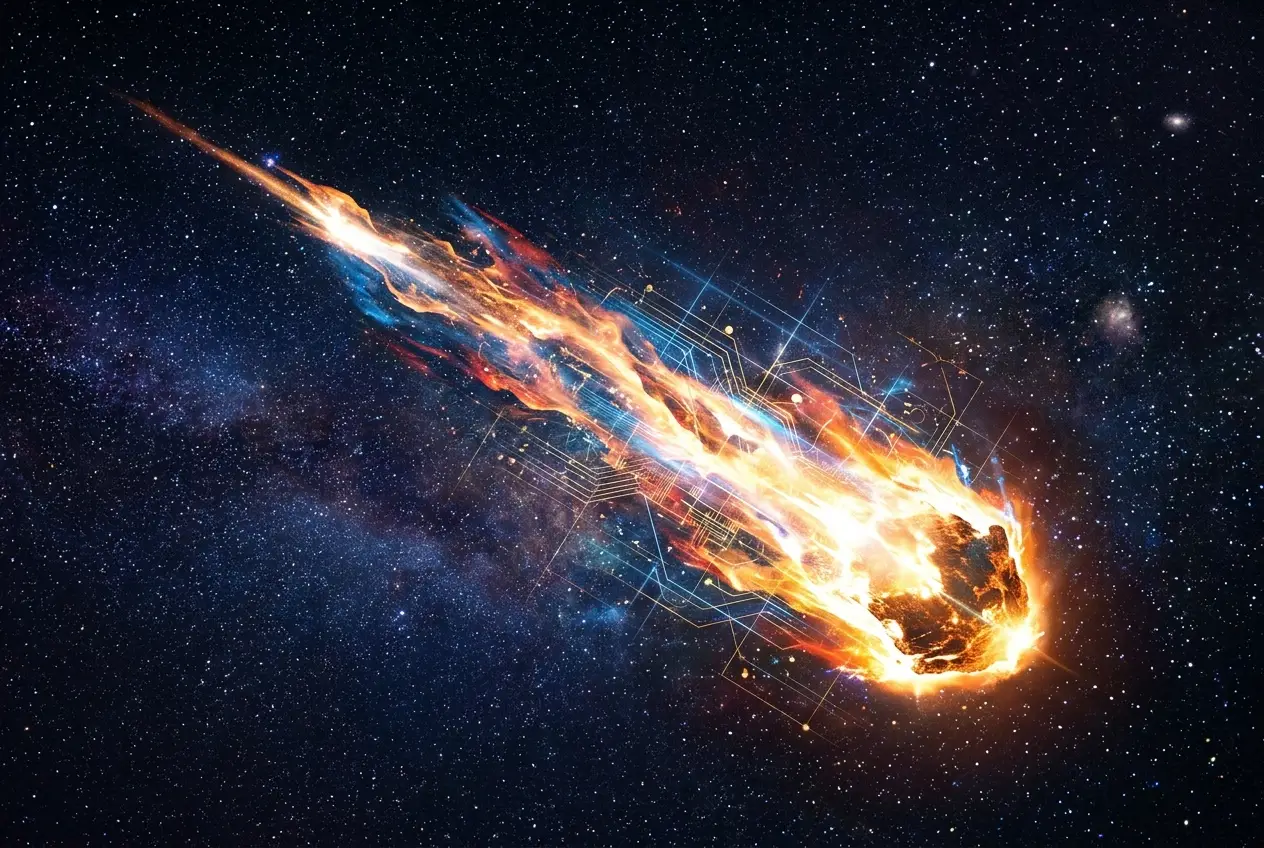
I’ve always found myself drawn to the mysteries that fall from the sky. There’s something profoundly humbling and thrilling about holding a piece of rock that has traveled unimaginable distances, bearing witness to cosmic history. But what if some of these celestial messengers aren't just inert space rocks? What if, occasionally, a fragment of something engineered, something alien, manages to slip through our atmosphere and land on Earth? It’s a tantalizing thought that takes me far beyond the typical geological classification of a meteorite.
For centuries, meteorites have been cataloged as natural phenomena—fragments of asteroids or comets that survive entry through Earth’s atmosphere. Yet, the question lingers: In a universe teeming with possibilities, could some objects we discover be more than just rocks? Could they be remnants of advanced extraterrestrial technology, lost and wandering through the void, only to find a final resting place on our planet? It’s a query that ignites the imagination, pushing the boundaries of what we understand about cosmic debris and the potential for life—and engineering—beyond Earth.
The Usual Suspects: What Defines a Meteorite?
Before we dive into the extraordinary, let’s establish the baseline. A meteorite is, by scientific definition, a solid piece of debris from an object such such as a comet, asteroid, or meteoroid, that originates in outer space and survives its passage through the atmosphere to reach the surface of a planet or moon. Most meteorites are fragments of asteroids that formed in the early solar system, making them invaluable time capsules of planetary formation. They're typically composed of silicates (stony meteorites), iron-nickel alloys (iron meteorites), or a mix of both (stony-iron meteorites).
Scientists use a battery of tests to classify these cosmic visitors: examining their mineralogy, chemical composition, isotopic ratios, and crystalline structures. Each analysis helps piece together its origin story, from the asteroid belt to potentially more distant reaches of our solar system. The vast majority fit neatly into these categories, their natural, albeit ancient, origins clear. You can delve deeper into their classification on Wikipedia's Meteorite page (opens in a new tab).
When the Rocks Tell Strange Tales: Anomalous Findings
However, every so often, an object defies easy classification. These are the anomalies, the outliers that spark scientific debate and public fascination. While no definitively proven "alien artifact" meteorite has ever been found, history is dotted with discoveries that have fueled speculation due to unusual composition, structure, or implied precision.
One of the key challenges in identifying truly anomalous objects is distinguishing them from natural geological processes or even terrestrial contamination. For example, some meteorites exhibit complex carbon compounds, which initially led to questions about life, but these are now largely understood as naturally occurring organic molecules, not necessarily signs of biology. However, the search isn't for biological signs but for technological ones.
Imagine finding a meteorite with a perfectly symmetrical geometric structure that cannot be explained by crystallography or natural forces. Or one composed of alloys unknown in nature, with properties that suggest deliberate engineering. These are the scenarios that fuel the "alien tech" hypothesis. For instance, the infamous Oumuamua, an interstellar object that passed through our solar system, exhibited strange accelerations and properties that led some to speculate it could be an alien probe. While ultimately classified as a natural object, it highlighted the scientific rigor and open-mindedness required when encountering the truly unprecedented. For more on Oumuamua and similar interstellar visitors, I suggest reading our previous blog: Is Oumuamua Alien Tech? Deciphering Interstellar Visitors.
The Space Junk Conundrum: Natural vs. Artificial Re-entry
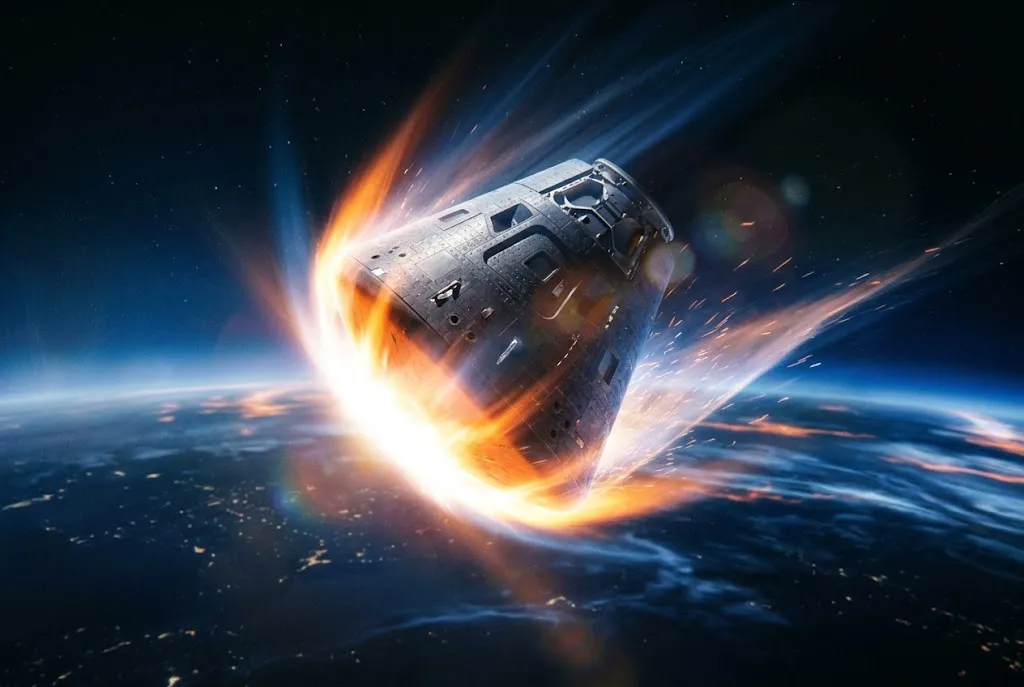
One of the more mundane, yet often confusing, aspects of identifying potential alien tech from space is the sheer volume of human-made space debris. Since the dawn of the space age, humanity has launched thousands of rockets and satellites, many of which eventually fall back to Earth. These re-entering objects, often burning up in the atmosphere, can sometimes be mistaken for meteorites.
Distinguishing between a natural meteorite and a piece of space junk is usually straightforward for experts. Human-made objects typically have identifiable features: welding marks, screws, manufactured alloys, or traces of paint. However, if an advanced alien civilization's technology were to fall to Earth, it might not look like our "nuts and bolts" approach. Their materials might be self-assembling, bio-integrated, or composed of metamaterials that defy our current understanding of engineering. Think about the concept of programmable matter and how it would challenge our definitions of natural vs. artificial if we encountered it from space.
The Black Box Analogy
Consider the analogy of a "black box" flight recorder. If such a device were to fall from space, millennia after its creators were gone, its purpose might be utterly opaque to a less advanced civilization. It might simply appear as an unusually durable, complexly structured piece of material. Our current methods are geared toward identifying *known* natural processes. The real challenge lies in identifying technology that is truly *alien*—meaning it doesn't conform to any known terrestrial or celestial formation process.The Scientific Quest: How We Search for the Unusual
The search for extraterrestrial technology, even in the form of cosmic debris, relies on cutting-edge scientific techniques. When an unusual object is found, scientists employ an arsenal of analytical tools:
- Spectroscopy: Analyzing the light absorbed or emitted by the material to determine its elemental composition. Unusual spectral signatures could hint at exotic elements or isotopes.
- Electron Microscopy: High-magnification imaging to reveal fine-scale structures, grain boundaries, and any micro-machining or assembly that isn't naturally occurring.
- X-ray Diffraction: Mapping the atomic structure to identify crystal lattices. A material with a highly ordered, non-natural atomic arrangement would be a major clue.
- Isotopic Analysis: Measuring the ratios of different isotopes of elements. Terrestrial and solar system materials have characteristic isotopic signatures. Any significant deviation could indicate an extrasolar origin, or even artificial processing.
- Material Strength and Conductivity Tests: Materials with unusually high strength-to-weight ratios, extreme thermal conductivity, or superconducting properties at ambient temperatures would certainly raise eyebrows.
The focus is always on falsifiability: can we rule out all known natural explanations? Only when every terrestrial and natural celestial explanation has been exhausted does the "alien tech" hypothesis even begin to gain a whisper of credibility. It’s a painstaking process driven by skepticism and an unwavering commitment to empirical evidence. This meticulous approach is what we apply when we try to decode other cosmic signals, as explored in Are Our Devices Hiding Alien Echoes? Decoding Cosmic Signals.
The Future of Astromaterials and the Cosmic Harvest
As space exploration advances, our ability to collect and analyze extraterrestrial materials will only improve. Missions like OSIRIS-REx, which returned samples from asteroid Bennu, are providing unprecedented opportunities to study space rocks in pristine laboratory conditions. Future missions to comets or even direct sample returns from interstellar objects (if Oumuamua-like visitors are detected early enough) could offer new avenues for discovery.
Beyond Earth-bound discoveries, humanity's expansion into space means we are increasingly encountering cosmic debris in its natural environment. Understanding the vast ecosystem of space junk, both natural and artificial, is crucial for future space endeavors. The European Space Agency (ESA) provides extensive information on space debris (opens in a new tab) and its monitoring, highlighting the complexity of objects orbiting Earth.
Moreover, the field of astromaterials science is rapidly evolving, integrating data from astronomy, geology, chemistry, and engineering. This interdisciplinary approach is our best bet for discerning the truly extraordinary from the merely unusual. It's about developing a comprehensive "fingerprint" library of natural space materials so that anything that falls outside those parameters can be rigorously examined.
Conclusion: The Thrill of the Unknown, Grounded in Science
The idea that some meteorites could be alien technology is one of those thrilling thoughts that remind us how much we still don't know about the cosmos. While definitive proof remains elusive, the scientific rigor applied to every unusual discovery ensures that if such an artifact were to arrive on our doorstep, we would have the tools and the methodology to investigate it thoroughly.
It's a continuous journey of discovery, where every new meteorite analysis, every anomaly detected, pushes the boundaries of our knowledge. And who knows? Perhaps one day, a piece of cosmic debris will land that undeniably carries the signature of intelligent design, forever changing our understanding of our place in the universe. Until then, the meteorites we study continue to whisper tales of planetary birth, stellar evolution, and the vast, silent stretches of space, waiting for us to decipher their true origins.
&meta_title; Alien Tech Meteorites? Decoding Cosmic Anomalies &meta_title; &meta_description; Dive into the intriguing question: could some meteorites be extraterrestrial technology? Explore the science behind classifying space rocks, identifying anomalous objects, and distinguishing natural debris from potential alien artifacts that crash-land on Earth. &meta_description; &faqs;{"faqs":[{"id":1,"question":"How do scientists differentiate a natural meteorite from man-made space junk?","answer":"Scientists examine material composition, crystalline structure, isotopic ratios, and look for identifiable manufacturing signs like welds or screws. Natural meteorites have distinct mineralogies and isotopic signatures formed in space, while space junk reveals terrestrial engineering methods."},{"id":2,"question":"Have any meteorites ever been definitively identified as alien technology?","answer":"No, as of now, no meteorite has ever been definitively identified and confirmed as being of artificial extraterrestrial origin. All objects studied so far have been classified as natural celestial bodies or human-made space debris."},{"id":3,"question":"What kind of features would make scientists suspect a meteorite is alien tech?","answer":"Features like highly organized, non-natural geometric patterns, alloys or materials unknown in nature, isotopic ratios inconsistent with any known solar system formation, or evidence of machining or assembly at a microscopic level would raise suspicions."},{"id":4,"question":"Could a very old piece of alien technology be mistaken for a natural rock due to decay?","answer":"It's possible that extremely ancient and weathered alien technology could degrade to a point where its artificial origin is obscured. However, advanced analytical techniques can still detect subtle structural, chemical, or isotopic anomalies that might point to a non-natural history, even if the original function is lost."},{"id":5,"question":"Beyond meteorites, what other cosmic objects are being scrutinized for signs of alien tech?","answer":"Scientists also investigate interstellar objects like Oumuamua, unusual astronomical phenomena like unexplained stellar dimming, and listen for anomalous radio signals (SETI projects) as potential signs of extraterrestrial technology or intelligence."}]}&faqs;
Conversation0
No comments yet. Be the first to share a thought — the best questions often become new stories.