


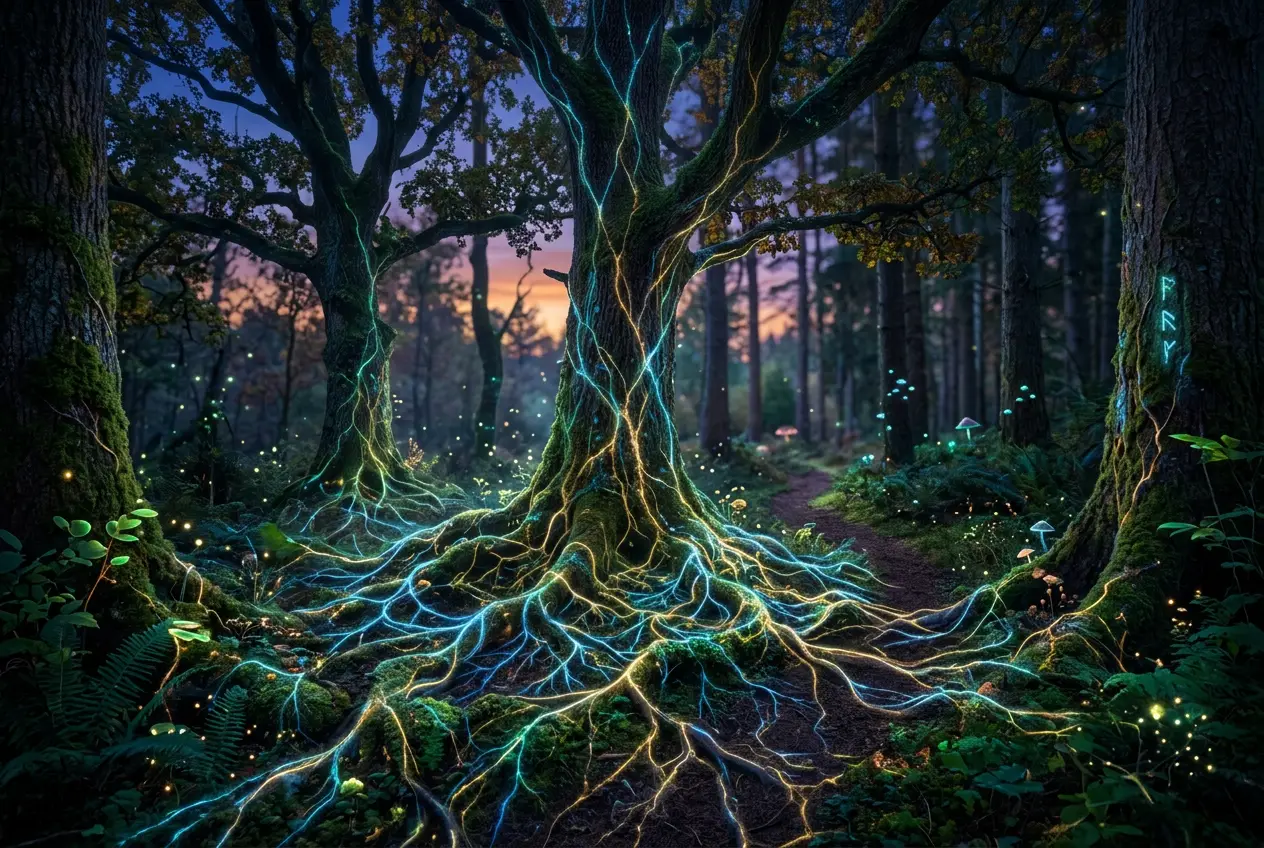
I recently took a walk in an ancient, old-growth forest, the kind where the trees reach for the sky like patient, green giants. The air was crisp, filled with the scent of pine and damp earth. As I stood there, surrounded by towering trunks and dappled sunlight, a thought struck me: what if these silent sentinels weren't so silent after all? What if, beneath my feet, an intricate, bustling network of information was flowing, a "digital" superhighway woven by roots and fungi, connecting every living thing in a vast, organic internet?
This isn't a whimsical fantasy, but a burgeoning field of scientific discovery. For decades, traditional botany often viewed trees as solitary organisms, competing for resources. However, modern research is revealing a profoundly interconnected world beneath the forest floor—a complex, decentralized communication system that scientists have dubbed the "Wood Wide Web."
Unearthing the "Wood Wide Web"
The concept of a forest's hidden network began to solidify with discoveries about mycorrhizal fungi. These aren't just decomposing organisms; they form a crucial symbiotic relationship with nearly all plants on Earth. Mycorrhiza literally means "fungus root," and it describes how fungal threads (hyphae) weave themselves into or around plant roots, extending the plant's reach far beyond what its own roots could achieve.
Imagine a single tree's root system. Now, picture that system vastly expanded by a microscopic, branching web of fungal filaments, so fine they can access tiny pockets of soil water and nutrients inaccessible to the tree itself. In return, the fungi receive sugars, or carbohydrates, produced by the trees through photosynthesis. It’s a classic win-win situation, a delicate dance of mutual benefit that underpins entire ecosystems.
But the story doesn't end with nutrient exchange. Recent research, spearheaded by scientists like Suzanne Simard, a professor of forest ecology at the University of British Columbia, has unveiled that these mycorrhizal networks are far more sophisticated. They act as actual communication channels, allowing trees to exchange information, share resources, and even warn each other of dangers. It’s like a biological internet, with fungi serving as the fiber-optic cables and trees as the networked computers.
How Trees "Talk": The Mechanisms of Communication
So, how exactly do trees communicate across this subterranean network? It’s not through spoken words, of course, but through a fascinating array of biochemical and bioelectrical signals.
1. Chemical Signaling: Trees can send and receive various chemical compounds through the fungal network. For instance, when a tree is attacked by pests like aphids or suffers from drought, it can release specific defense chemicals or hormones into the fungal network. Neighboring trees, connected to the same network, can detect these signals and ramp up their own defenses before they are even attacked. This early warning system can significantly improve a forest's overall resilience. Researchers have observed that trees can distinguish between their own kin and unrelated trees, often directing more resources and warnings to their offspring or close relatives. It’s a remarkably sophisticated form of ecological kinship. You can delve deeper into the complex world of these chemical messengers, known as allelochemicals, on Wikipedia (opens in a new tab).
2. Resource Sharing: Beyond warnings, the Wood Wide Web facilitates direct resource allocation. Older, taller "mother trees" or "hub trees" in a forest, often connected to hundreds of other saplings and mature trees, can transfer carbon, water, and nitrogen to younger, struggling plants in shaded areas. This support system ensures the survival of the next generation, fostering a healthier, more diverse forest. Imagine a bustling digital community where the most robust members actively upload resources to those in need—that’s essentially what’s happening underground. This intricate natural architecture makes me wonder about other forms of ancient data storage, like the fascinating theory of whether living rocks could be Earth's oldest data storage.
3. Electrical Signals: Perhaps one of the most astonishing discoveries is the presence of electrical signals in plants. Just like our nervous systems use electrical impulses, plants exhibit slow-moving electrical waves that can transmit information. While not as rapid as animal nerve impulses, these signals can travel through the fungal network, potentially relaying information about light availability, nutrient scarcity, or stress. These bioelectrical signals are still poorly understood, but they hint at a level of physiological complexity in plants that we are only beginning to grasp.
A Digital Analogy: The Forest's Internet
The term "digital" often implies binary code—0s and 1s. While plant communication isn't binary in the human computational sense, it does involve discrete, measurable signals (specific chemical compounds, distinct electrical patterns) that carry information. This is why the "digital" analogy holds true: it's an information network operating through defined units of data.
Consider the immense scale. A single gram of forest soil can contain miles of fungal hyphae. These networks can span vast areas, connecting entire groves of trees, some even across different species. It's a decentralized, self-organizing system, far more resilient than any human-made network. If one part of the network is damaged, information and resources can be rerouted through other pathways, maintaining the integrity of the whole. This resilience highlights nature's incredible engineering prowess, a natural internet that has evolved over millions of years.
Exploring plant communication reminds us that our planet is full of complex interactions, pushing us to ask if AI could one day unlock animal tongues. If plants can "talk" in such intricate ways, what other forms of communication are we yet to decipher in the natural world?
Implications for Ecology and Beyond
Understanding the Wood Wide Web has profound implications for forestry, conservation, and even climate change mitigation.
- Sustainable Forestry: Knowing how trees communicate and share resources can inform more sustainable logging practices. Instead of clear-cutting, which severs these vital networks, selective logging might preserve the existing infrastructure, allowing the forest to recover more quickly.
- Climate Change Resilience: If we understand how trees communicate stress signals related to drought or disease, we might be able to foster more resilient forests that can adapt to changing climatic conditions.
- Plant Intelligence: The existence of such complex communication fuels the ongoing scientific debate about plant intelligence. While plants lack brains, their ability to perceive, process information, learn, and even remember (as evidenced by some studies) challenges our anthropocentric definitions of intelligence. For more on this evolving scientific discourse, visit Wikipedia's plant intelligence section (opens in a new tab).
Just as we're uncovering these biological networks, we've long been fascinated by how ancient civilizations might have controlled sound waves for their own purposes, showing a persistent human curiosity in the hidden forces and networks of our world.
The Future of Forest Research
The journey into the Wood Wide Web is far from over. Scientists are still unraveling the specific chemical codes, the electrical patterns, and the environmental triggers that govern this subterranean dialogue. We need more sophisticated imaging techniques and genetic analyses to map these networks in greater detail.
What specific "messages" are being sent? Can we truly "eavesdrop" on their conversations? The potential for discovery is immense. It's a humbling reminder that nature, in its oldest and most silent forms, often holds the most sophisticated technological marvels, operating right beneath our feet, unseen and unheard until we learn to listen more closely.
As I left that quiet forest, I felt a renewed sense of wonder. The trees, once just tall plants, now felt like conscious nodes in a grand, living network, exchanging vital information and sustaining life in ways we are only just beginning to comprehend. The forest isn't just a collection of individual trees; it's a superorganism, a thriving, interconnected community with its own ancient, organic internet.



Conversation0
No comments yet. Be the first to share a thought — the best questions often become new stories.