


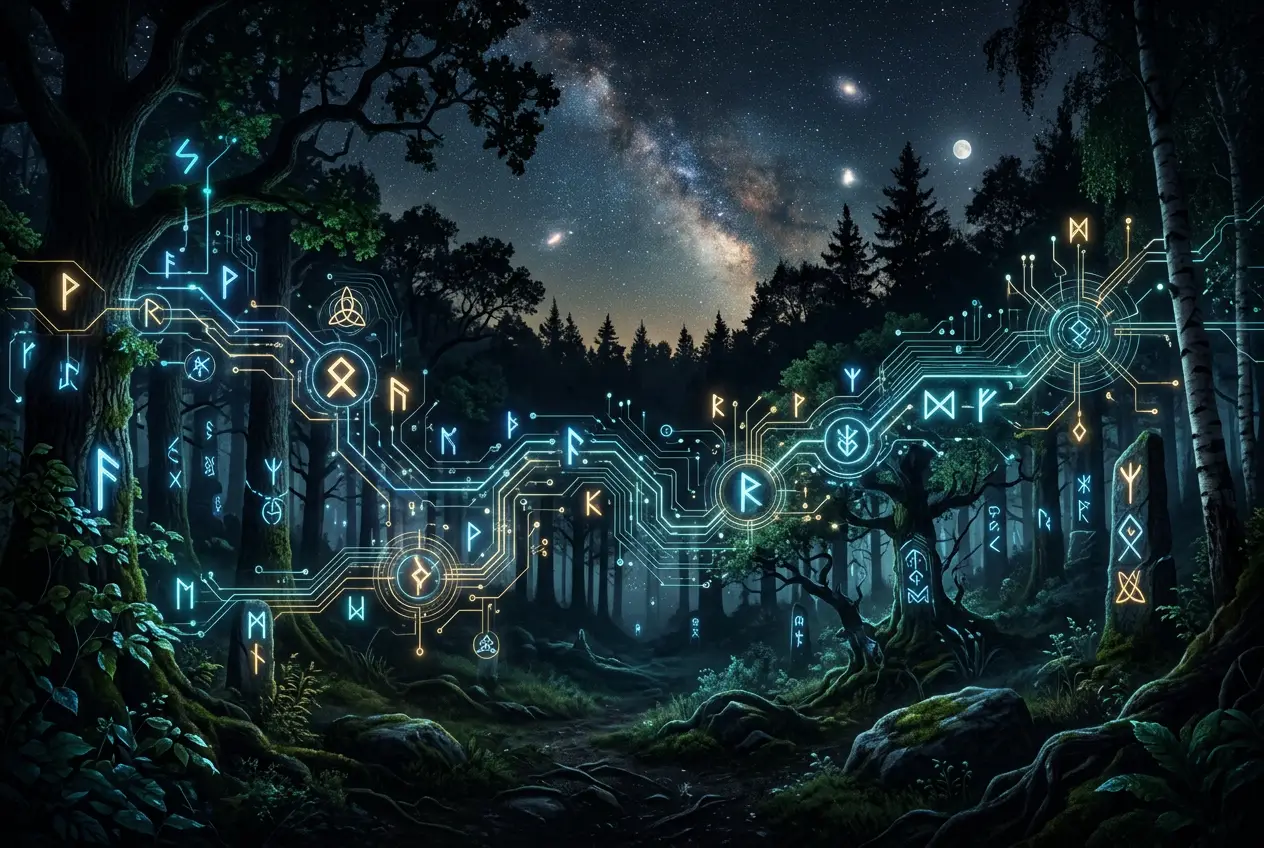
I remember the first time I truly looked at a runic inscription, not just as an ancient alphabet, but as something more profound. It was on a replica Viking sword in a small museum, and the angular lines seemed to hum with a silent language. It got me thinking: could these ancient symbols, etched into stone and wood by our ancestors, have served a purpose far beyond simple communication? Could they, in a way, have been an early form of data storage, akin to the digital code we rely on today?
It’s a bold question, one that bridges millennia and different ways of thinking about information. We live in an age where data is everything, quantified and transmitted in binary. But what if ancient civilizations, long before the advent of silicon chips, developed their own intricate systems for encoding complex information? The very notion sends a shiver down my spine, a mix of wonder and intellectual excitement. This isn’t about attributing impossible technology to the past, but about exploring the sophistication of their knowledge systems through a modern lens.
The Enigma of Runes: More Than Just Letters?
Runes are fascinating. Primarily associated with Germanic peoples, particularly the Norse, these ancient characters served as an alphabet (like the Elder Futhark or Younger Futhark). They were carved into monuments, tools, weapons, and jewelry from the 1st to the 17th centuries. Initially, historians focused on their linguistic function, seeing them as predecessors to modern alphabets. But a deeper dive reveals layers of potential meaning that extend beyond simple phonetic representation.
Many runic inscriptions aren’t just names or short phrases. Some appear to be magical invocations, protective charms, or records of significant events, imbued with symbolic power. Each rune often had a name (e.g., Fehu for cattle/wealth, Uruz for aurochs/strength) and was associated with concepts, deities, or forces of nature. This isn't just a letter 'F'; it's a concept, a data point in itself. It’s this multi-layered meaning that makes me wonder if they weren't just writing, but encoding.
Consider the structure. Our digital world operates on algorithms, sequences of instructions to achieve a specific outcome. Could certain runic sequences, beyond forming words, have functioned like ancient algorithms? A series of runes carved on a charm might not spell out a sentence, but rather represent a set of conditions or intentions, a program to influence fate or protection. The "meaning" isn't linear text but a composite, perhaps interactive, effect.
Information Theory: A Bridge Across Time
To understand if runes could store data "like code," we need to borrow a concept from the digital age: information theory. Developed by Claude Shannon, information theory quantifies how much information is contained in a message, regardless of its subjective meaning. In essence, it views information as the reduction of uncertainty. A single bit, a 0 or 1, reduces uncertainty by half.
If we apply this framework to runes, each rune choice from a limited set (e.g., 24 in Elder Futhark) carries a certain amount of information. When combined into sequences, the informational density increases. But it’s not just about the number of choices; it's about the context and structure. What if the spacing, the type of material, or even the location of the inscription added further layers of data? A stone rune might carry different implications than one carved on wood or metal. This non-linear, contextual data storage is something we still grapple with in modern AI and data science. For further reading on the fascinating world of runes and their historical context, you can explore their detailed history on Wikipedia (opens in a new tab).
Ancient Encryption and Symbolic Logic
The idea of runes as code isn't entirely new. There are historical examples of runic cryptography, where runes were deliberately obscured or altered to hide their meaning from outsiders. These "cipher runes" or "bind runes" were formed by combining several runes into a single character, creating a visual and semantic puzzle. This is a direct parallel to modern encryption methods, where information is transformed to protect its integrity and secrecy.
Moreover, the symbolic nature of runes lends itself to a form of symbolic logic. Just as a programmer uses symbols (like +, -, =, if, else) to build logical operations, ancient rune masters might have used their characters to represent logical relationships or states. Isa (ice) might represent stagnation or a barrier, while Kenaz (torch) could symbolize enlightenment or revelation. A sequence could then represent a narrative of cause and effect, a logical flow rather than just descriptive text.
This kind of intricate symbolic system also brings to mind other ancient forms of data storage, such as the Phaistos Disc, a mysterious artifact from Minoan Crete with an undeciphered spiral of symbols. Like runes, its true purpose—whether a prayer, a story, or something entirely different—remains debated, but its structure suggests a complex encoding system, much like the possibility we explored in our post on /blogs/phaistos-disc-ancient-data-or-lost-code-9785 (opens in a new tab).
The "Algorithm" of Runic Spells and Divination
Many runic inscriptions found are not simple records but appear to be spells, blessings, or curses. How would these work if not through a kind of ancient "program"? A sequence of runes carved with specific intent, perhaps at a particular time or in a certain ritualistic manner, could be seen as an instruction set.
Consider this hypothetical "rune algorithm":
- Input: A desire for protection (e.g., a warrior going to battle).
- Rune Sequence: Algiz (protection, elk), Tiwaz (justice, victory), Sowilo (sun, success).
- Operation: Carve sequence on a shield or weapon. Recite invocation.
- Output: Enhanced protection and courage for the warrior.
This is, of course, a simplified and metaphorical interpretation. We aren't suggesting ancient peoples had a literal concept of "algorithms" in the computer science sense. However, the structured, sequential application of symbols to achieve a desired outcome shares a conceptual lineage with what we now call an algorithm. For a deeper dive into what constitutes an algorithm, Wikipedia offers an excellent resource at https://en.wikipedia.org/wiki/Algorithm (opens in a new tab).
The use of runes in divination further supports their role as more than just an alphabet. Runic divination involves casting or drawing runes and interpreting their arrangement and individual meanings to gain insight into a situation. Each rune, in this context, acts as a data point, contributing to a larger "readout" of information. The diviner, in a sense, is the interpreter of this ancient data stream.
The Challenge of Decoding: Lost Context and Analog vs. Digital
The biggest challenge in viewing runes as "code" is the immense gap in context. We lack the full understanding of the cultural, spiritual, and practical frameworks in which runes were used. Their meanings were fluid, often orally transmitted, and highly dependent on the "programmer" (the rune master) and the "hardware" (the object they were carved into).
Modern digital data storage relies on absolute, unambiguous values (0s and 1s) to reduce error and ensure perfect replication. Ancient symbolic systems, however, thrived on ambiguity, layered meaning, and personal interpretation. They were analog in a world that was analog. A rune could mean multiple things simultaneously, depending on who was reading it and in what context. This flexibility, while beautiful, makes it hard to map directly onto our rigid binary systems.
Nevertheless, the exploration itself is valuable. It forces us to reconsider the sophistication of ancient knowledge systems. Just as the Inca’s quipu used knots and cords to record complex numerical and possibly narrative information, as detailed in our article on /blogs/quipu-did-inca-knots-encode-cosmic-data-5089 (opens in a new tab), runes might have served as a similar, albeit different, type of ancient data storage.
Beyond the Script: Runic Information Systems
When we think of modern data storage, we don’t just think of the hard drive itself, but the entire system: the file structures, the operating system, the algorithms for compression and retrieval. Could ancient runic practices have constituted an entire "information system"?
Imagine a community where a select few were trained not just in carving runes, but in the intricate art of rune-lore: understanding the specific sequence meanings, the ritualistic applications, the symbolic interplay, and how to interpret complex arrangements. This would be their equivalent of a data scientist or a system administrator, guarding and interpreting a powerful knowledge base. The lore itself, passed down through generations, could be considered the "software" that made the "hardware" (the runes) function.
The sheer volume and variety of runic inscriptions across different regions and time periods also suggest a robust, evolving system of information encoding. They were a durable medium, capable of preserving information for centuries, much like our long-term data archives, though perhaps with a less direct, more interpretive mode of access. The principles of data storage, from physical media to conceptual frameworks for retrieval, are explored thoroughly on Wikipedia (opens in a new tab).
Conclusion: A Glimpse into Ancient Logic
The idea that ancient runes stored data "like code" is more a conceptual metaphor than a literal historical claim. Ancient peoples didn't have transistors or binary logic gates. However, by examining runes through the lens of information theory and algorithmic thinking, we gain a profound appreciation for the sophistication and multi-dimensionality of their knowledge systems.
They were masters of symbolic representation, crafting characters imbued with phonetic, semantic, and spiritual weight. These symbols, arranged with intent and context, functioned as powerful communicators and perhaps even as complex instructions for interacting with their world. In a very real sense, they were encoding reality, much like we do with our digital zeroes and ones. It’s a testament to human ingenuity across the ages, a reminder that the quest to organize and understand information is as old as civilization itself. The whispers of ancient soundscapes, as discussed in /blogs/ancient-soundscapes-a-hidden-data-archive-7950 (opens in a new tab), offer another glimpse into how information might have been stored and transmitted in non-traditional ways.
So, the next time you see a runic inscription, don’t just see an old alphabet. See a potential window into an ancient mind, a subtle dance of data and meaning, a silent language waiting for its code to be fully cracked.




Conversation0
No comments yet. Be the first to share a thought — the best questions often become new stories.