


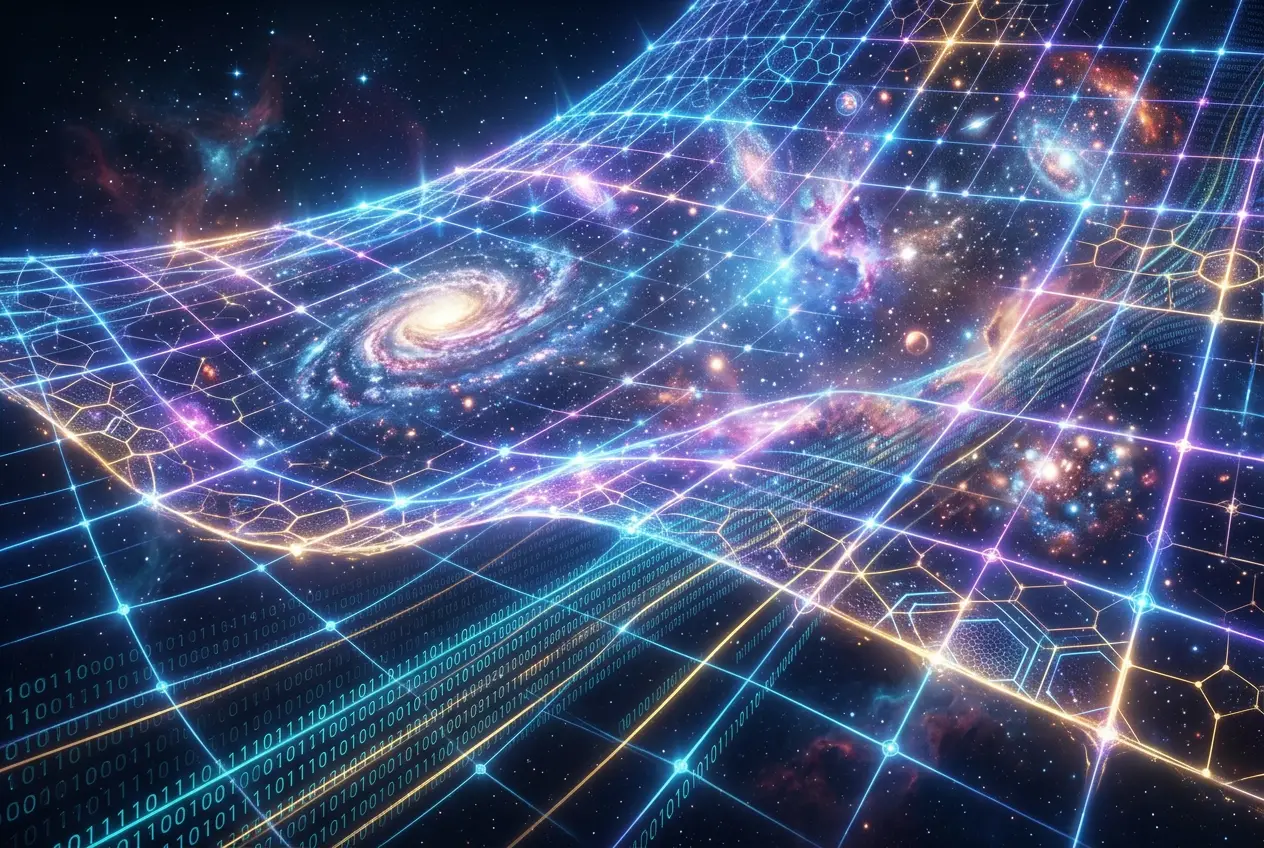
I’ve always been captivated by the idea of reality, not as a static, solid given, but as something far more intricate, perhaps even constructed. What if the world we perceive—the vast cosmos, the tangible objects, even our own bodies—is merely a projection, a grand illusion spun from information existing on a distant, two-dimensional surface? This isn't a plot from a sci-fi movie; it’s the core concept of the Holographic Principle, a profound idea gaining traction in theoretical physics that could fundamentally rewrite our understanding of the universe.
Recently, I delved deep into this mind-bending theory, and I must confess, it has left me utterly spellbound. It forces us to question everything we thought we knew about space, time, and the very fabric of existence. Is our three-dimensional universe merely a holographic image, encoded on a cosmic boundary far, far away?
The Genesis of a Radical Idea: Black Holes and Information
The journey to the Holographic Principle begins, strangely enough, with black holes. These cosmic behemoths are not just gravitational sinks; they are also profound theoretical laboratories. In the 1970s, Stephen Hawking and Jacob Bekenstein made revolutionary discoveries that linked black holes to thermodynamics. Bekenstein proposed that black holes have entropy, a measure of disorder or information. Critically, he showed that this entropy isn't proportional to the black hole's volume, as one might expect for a 3D object, but to the surface area of its event horizon—the point of no return.
This was the first major clue that something was profoundly different about information in gravity. If a black hole’s information capacity is measured by its surface, it suggests that all the information about what falls into a black hole might be "stored" on that 2D boundary, rather than lost forever within its 3D interior. This concept directly challenges our intuitive understanding of how information behaves in space.
Imagine a book. Its information content is usually thought of as residing in its 3D pages. But what if all the information of that book could be perfectly captured on its cover? That's the kind of shift in perspective Bekenstein's work hinted at.
The Holographic Principle: A Universe of Information
Building on Bekenstein's insights, physicists Leonard Susskind and Gerard 't Hooft formalized the Holographic Principle in the early 1990s. This principle posits that the description of a volume of space can be thought of as encoded on a lower-dimensional boundary to the region—much like a hologram. A regular hologram is a 2D plate that, when illuminated, reconstructs a 3D image. The Holographic Principle suggests our entire 3D (and 4D, with time) universe might be a projection from information inscribed on a distant, 2D surface.
"The universe, viewed from the outside, appears as a flat, information-rich surface," Susskind articulated, suggesting a profound shift in how we might model reality. This isn't to say we are a hologram in the pop-culture sense of a ghostly projection, but rather that our universe’s fundamental properties might be entirely derivable from a 2D "data sheet."
This idea is incredibly radical because it implies that our perceived reality, with all its depth and complexity, is merely an emergent phenomenon. It's like seeing a beautifully rendered video game; the experience is 3D, but all the data that creates it exists on 2D digital files.
AdS/CFT Correspondence: A Concrete Example
While the Holographic Principle initially arose from thought experiments about black holes, it found a powerful mathematical realization in 1997 with Juan Maldacena's AdS/CFT correspondence. This is a specific example of the Holographic Principle at work.
The AdS/CFT correspondence (Anti-de Sitter/Conformal Field Theory) is a duality that states that a theory of gravity in a specific type of curved spacetime (Anti-de Sitter space, which is negatively curved and has a boundary) is equivalent to a quantum field theory without gravity living on that boundary. In simpler terms, it's like having two completely different descriptions of the same physics: one in a higher-dimensional space with gravity, and one in a lower-dimensional space without gravity.
Think of it this way:
- The 3D "Bulk" (AdS space): Contains gravity and describes phenomena like black holes.
- The 2D "Boundary" (CFT): A quantum field theory (like the one describing elementary particles) that has no gravity.
The correspondence means that any calculation you do in the 3D gravitational theory has a perfect, corresponding calculation in the 2D non-gravitational theory, and vice-versa. This isn't just an analogy; it's a rigorous mathematical equivalence. It suggests that the information content of the 3D space is entirely encoded on its 2D boundary.
This discovery has been a monumental breakthrough, offering a powerful tool for theoretical physicists. It allows them to study strongly coupled quantum systems (which are notoriously difficult to calculate) by mapping them to easier-to-solve gravitational problems in a higher dimension. Conversely, it provides a non-gravitational description of quantum gravity, a long-sought goal in physics. You can read more about this fascinating duality on Wikipedia's AdS/CFT correspondence page (opens in a new tab).
Implications for Our Universe: From Pixels to Reality
The AdS/CFT correspondence, while a powerful mathematical tool, applies to Anti-de Sitter space, not our own universe, which is thought to be asymptotically flat (or positively curved, accelerating expansion). However, the principle it embodies—that gravity in higher dimensions can be described by quantum fields in lower dimensions—is a profound realization. It lends significant weight to the general Holographic Principle.
If our universe is indeed a hologram, what would that mean?
- Fundamental Nature of Reality: It suggests that the deepest level of reality isn't composed of particles or fields in 3D space, but rather bits of information on a 2D surface. Our 3D experience is just a sophisticated manifestation.
- Quantum Gravity: The Holographic Principle offers a potential pathway to reconcile general relativity (which describes gravity and the large-scale structure of the universe) with quantum mechanics (which describes particles and forces at the smallest scales). This is one of the biggest unsolved problems in physics.
- Information as Fundamental: It elevates information to a more fundamental status than matter or energy. The universe might be better understood as a cosmic data processor. This echoes concepts explored in "Is Our Reality a Digital Simulation?" which questions the ultimate nature of our existence, found at /blogs/is-our-reality-a-digital-simulation-decoding-the-universes-code-9313.
- Cosmic Pixels: The idea of a holographic universe implies there's a limit to how much information can be stored in a given volume of space. This suggests that space-time itself might not be infinitely divisible but could be "pixelated" at an extremely tiny scale, possibly at the Planck length. This resonates with discussions about the discrete nature of reality, similar to how are-tiny-strings-the-universes-secret-code-1701 explores fundamental constituents.
How Could We Test It?
Detecting the holographic nature of our universe is an immense challenge. If our reality is a projection from a 2D surface, there might be subtle "fuzziness" or a limit to resolution at the very smallest scales, much like a digital image when zoomed in too far. Experiments like those at Fermilab's Holometer aimed to look for this kind of "holographic noise" – a fundamental jitter in spacetime itself that would betray its pixelated nature. So far, no definitive evidence has emerged, but the search continues.
Furthermore, anomalies in cosmic data, such as unexpected correlations in the Cosmic Microwave Background (CMB) or subtle deviations in the distribution of dark matter, could hint at underlying non-local connections that a holographic universe might predict. The mystery of unseen dimensions or components of reality, as discussed in posts like does-dark-matter-hide-a-universe-we-cant-see-2793, might also tie into a holographic understanding.
It’s crucial to distinguish between a "hologram" in the popular sense and the scientific Holographic Principle. We're not talking about a projected image that can be walked through; rather, it’s a profound theoretical statement about the fundamental equivalence of physical descriptions in different dimensions. For a more detailed scientific explanation, you can explore the Holographic Principle on Wikipedia (opens in a new tab).
Beyond the Veil: A New Frontier of Understanding
The Holographic Principle is more than just a theoretical curiosity; it's a powerful framework that continues to inspire new avenues of research. From understanding the complexities of quantum entanglement – which itself suggests non-local connections that defy our everyday understanding of space and time, as explored in how-does-quantum-entanglement-defy-space-time-5424 – to constructing models of the early universe, this idea pushes the boundaries of our imagination.
What it truly implies is a deep interconnectedness and a fundamental efficiency in the universe's information storage. It suggests that reality, at its most basic level, is far stranger and more elegant than we could have ever imagined. Whether future experiments confirm or refute it, the Holographic Principle has already reshaped our cosmic perspective, inviting us to see the universe not just as a collection of objects, but as an emergent tapestry woven from pure information. It’s a compelling narrative that brings us closer to understanding the ultimate "operating system" of existence.






Conversation0
No comments yet. Be the first to share a thought — the best questions often become new stories.