I remember staring up at the night sky as a child, convinced I could see beyond the glittering tapestry of stars to the true edge of the universe. What I imagined was a neat, orderly expanse. But the cosmos, as I've come to learn, is far more complex, and often, more enigmatic than we can possibly conceive. We've charted superclusters of galaxies, seen grand spirals colliding, and even peered back to the universe's infancy. Yet, in the vast, seemingly empty spaces between these cosmic cities, known as **cosmic voids**, a new mystery is emerging: **ghost galaxies**.
These aren't the dramatic, swirling beacons we typically associate with galaxies. Instead, they are ethereal, almost invisible collections of stars and dark matter, barely clinging to existence in the universe's most desolate regions. The idea that such diffuse, faint structures could persist—or even form—in areas thought to be devoid of significant matter challenges much of what we understand about galaxy evolution and the fundamental architecture of the cosmos. Could these ghost galaxies be revealing hidden secrets about the fabric of our universe?
## The Universe's Hidden Architecture: Cosmic Voids
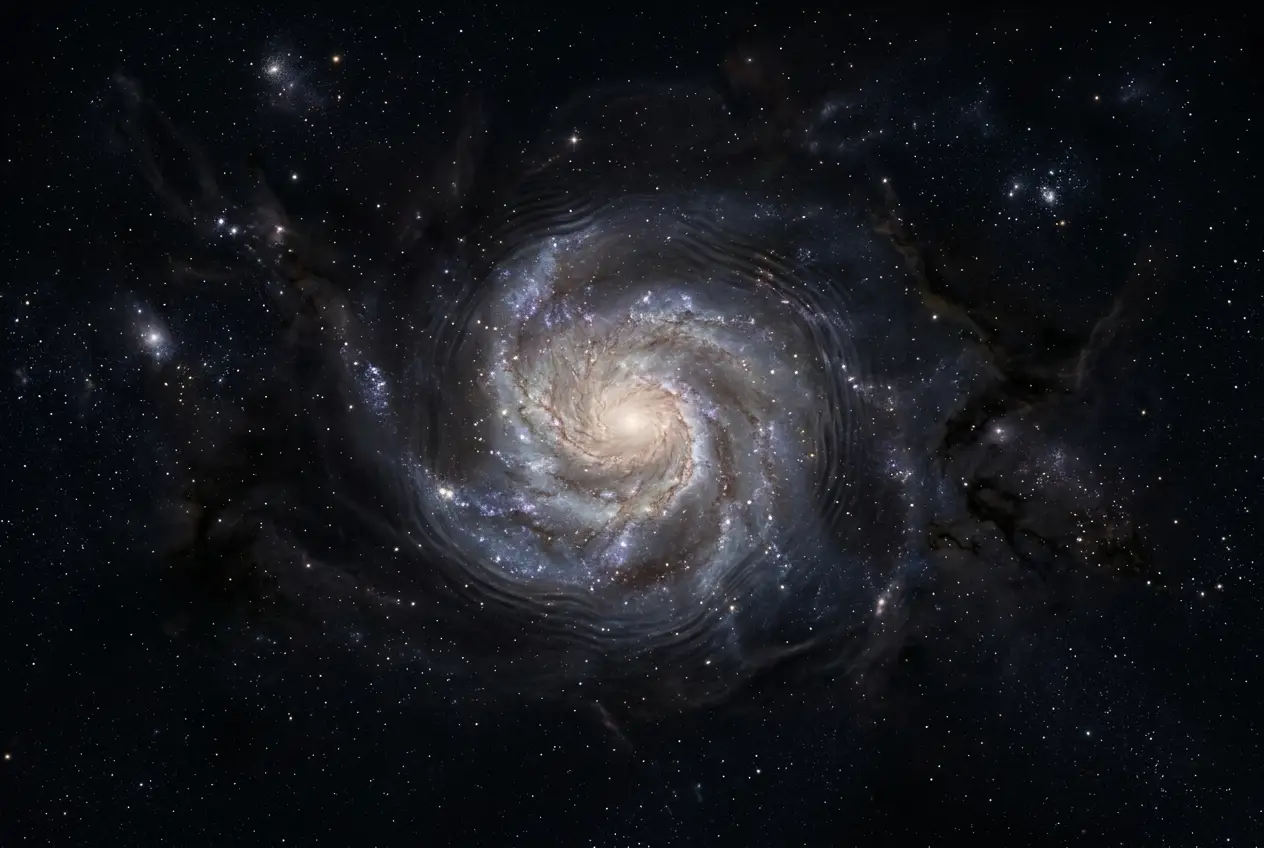
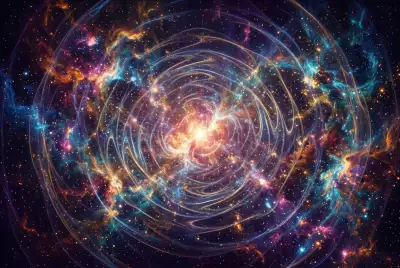
Before we dive into these spectral star systems, let's set the stage. Our universe isn't a uniformly distributed sprinkle of galaxies. Instead, it’s structured like a colossal, intricate web – the **cosmic web**. Imagine a giant sponge or a network of interconnected bubbles. The "walls" and "filaments" of this web are where most galaxies and galaxy clusters reside, pulled together by gravity into dense, luminous strands. Then there are the "superclusters," massive congregations of these filaments.
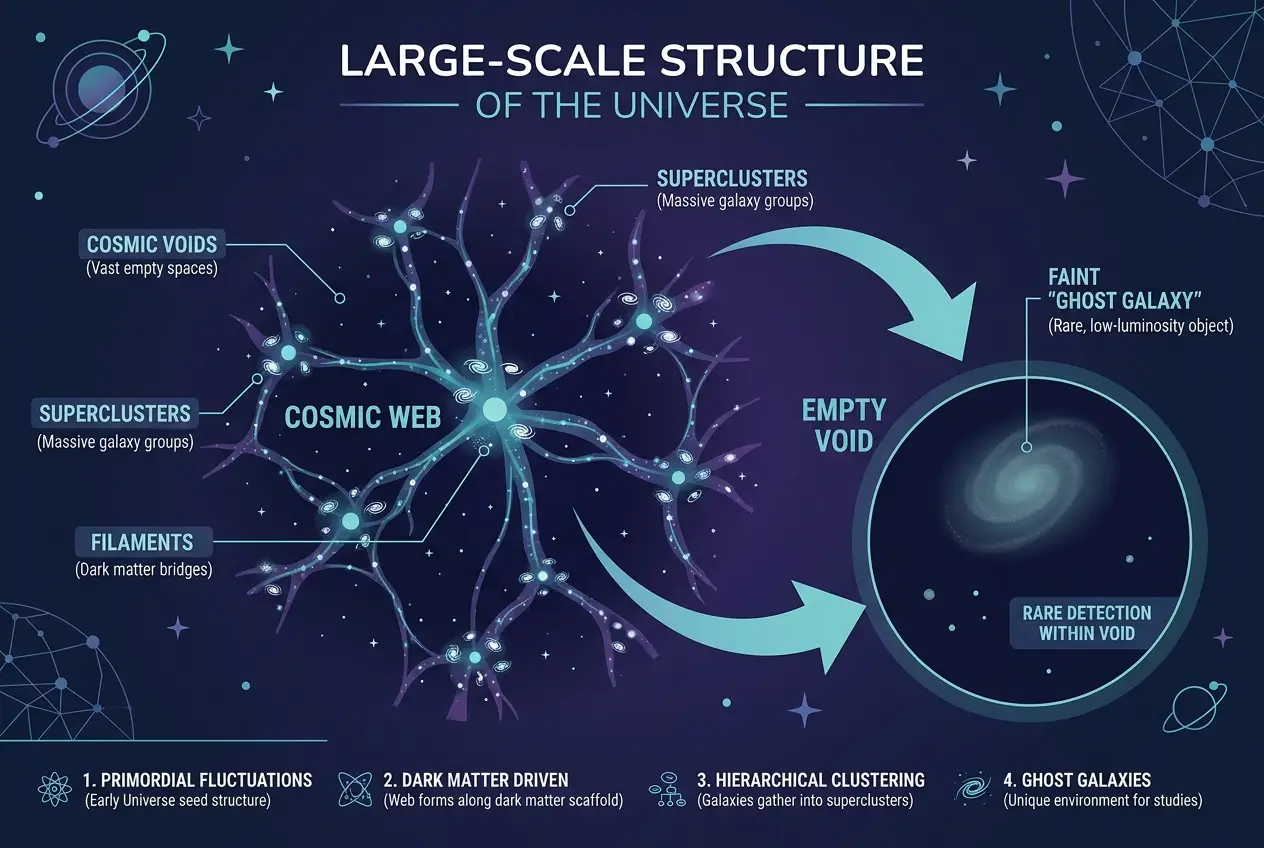
But what about the "holes" in this sponge? These are the **cosmic voids**. They are immense, spherical or elliptical regions spanning tens to hundreds of millions of light-years across, characterized by an exceptionally low density of matter – far fewer galaxies, gas, and dark matter than the cosmic average. For a long time, astronomers largely considered these voids as barren, galactic deserts, mostly empty space https://en.wikipedia.org/wiki/Void_(astronomy). However, recent observations are beginning to challenge this notion, suggesting that even these seemingly desolate regions might harbor cosmic secrets. The search for these hidden entities demands a keen eye and advanced technology, pushing the boundaries of what we can detect.
## Enter the Ultra-Diffuse Galaxies: Cosmic Phantoms
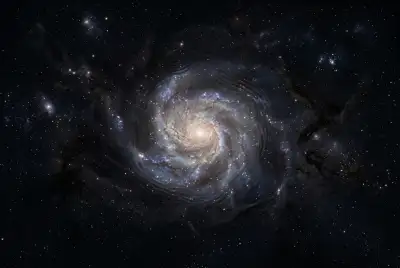
The term "ghost galaxy" often refers to a class of objects known as **Ultra-Diffuse Galaxies (UDGs)**. These are galaxies that are roughly the size of the Milky Way, sometimes even larger, but contain only about 1% of the stars our galaxy does. To put that into perspective, imagine a vast, sprawling city where only a handful of lights flicker faintly in the dark. Their stars are spread so thin that their surface brightness is incredibly low, making them exceptionally difficult to spot against the night sky, even with powerful telescopes.
The first definitive UDGs were discovered in the Fornax Cluster in the 1980s, but it wasn't until the mid-2010s, with improved imaging techniques, that astronomers began to find them in greater numbers, particularly within galaxy clusters. What really piqued my interest was the more recent discovery of these peculiar entities lurking within cosmic voids. Finding a UDG in a dense cluster, where strong tidal forces could strip away gas and suppress star formation, made some sense. But finding one in a void, where interactions are minimal and gas supply should be plentiful, was a head-scratcher.
* **Size:** Similar to the Milky Way (tens of thousands to hundreds of thousands of light-years across).
* **Star Count:** A tiny fraction of typical galaxies (e.g., 1% of the Milky Way's stars).
* **Brightness:** Extremely low surface brightness, making them almost invisible.
* **Gas Content:** Often gas-poor, which is surprising for isolated galaxies in voids.
As explained on Wikipedia, UDGs "challenge conventional models of galaxy formation and evolution" https://en.wikipedia.org/wiki/Ultra-diffuse_galaxy because their extreme properties don't easily fit into standard scenarios.
## Why Are They So Elusive? The Nature of a Ghost
Their "ghostly" nature isn't just a poetic description; it's a profound observational challenge. Imagine trying to find a wisp of smoke against a black velvet curtain. The low surface brightness of UDGs means that the light from their sparse stars is spread over such a large area that it barely registers above the background glow of the sky. This is compounded by their often blue, young stellar populations, suggesting inefficient star formation over their lifetime.
One of the defining characteristics of UDGs, whether in clusters or voids, is their surprising lack of active star formation. Even if they exist in a void with an apparent abundance of cold gas, they often appear to be "quenched," meaning their star-forming activities have ceased. This implies that some mechanism, perhaps internal or a subtle interaction, has prevented them from evolving into brighter, more typical galaxies. It's a riddle I find truly fascinating: why would a galaxy, seemingly isolated from destructive forces, fail to ignite its full stellar potential?
## Theories of Their Mysterious Origins
The existence of UDGs, especially in cosmic voids, has spawned several theories about their formation, each offering a glimpse into the subtle forces shaping the universe.
### 1. The "Failed Galaxy" Hypothesis
One leading theory suggests that UDGs are essentially "failed galaxies." They might have started as typical galaxy seeds in primordial regions of slight overdensity, containing substantial amounts of **dark matter** https://en.wikipedia.org/wiki/Dark_matter_halo. However, due to some factor—perhaps an early burst of star formation that expelled their gas, or simply an inefficient process—they never managed to accumulate enough baryonic (normal) matter to form a bright, star-rich galaxy. In voids, this inefficiency could be exacerbated by the extremely low density of surrounding matter, providing fewer opportunities for gas accretion.
### 2. Tidal Interactions (The "Stretching" Effect)
While this theory primarily applies to UDGs in dense galaxy clusters, where powerful gravitational forces from larger galaxies can stretch and puff up smaller galaxies, leading to their diffuse appearance, it might have a void-specific analogue. Perhaps UDGs in voids are remnants of small galaxies that *once* interacted, even minimally, with slightly larger structures at the edge of the void, getting "puffed up" before migrating deeper into the emptiness. This is less likely given the isolation of voids, but the idea of subtle gravitational nudges over cosmic timescales cannot be entirely ruled out.
### 3. Primordial Void Formation
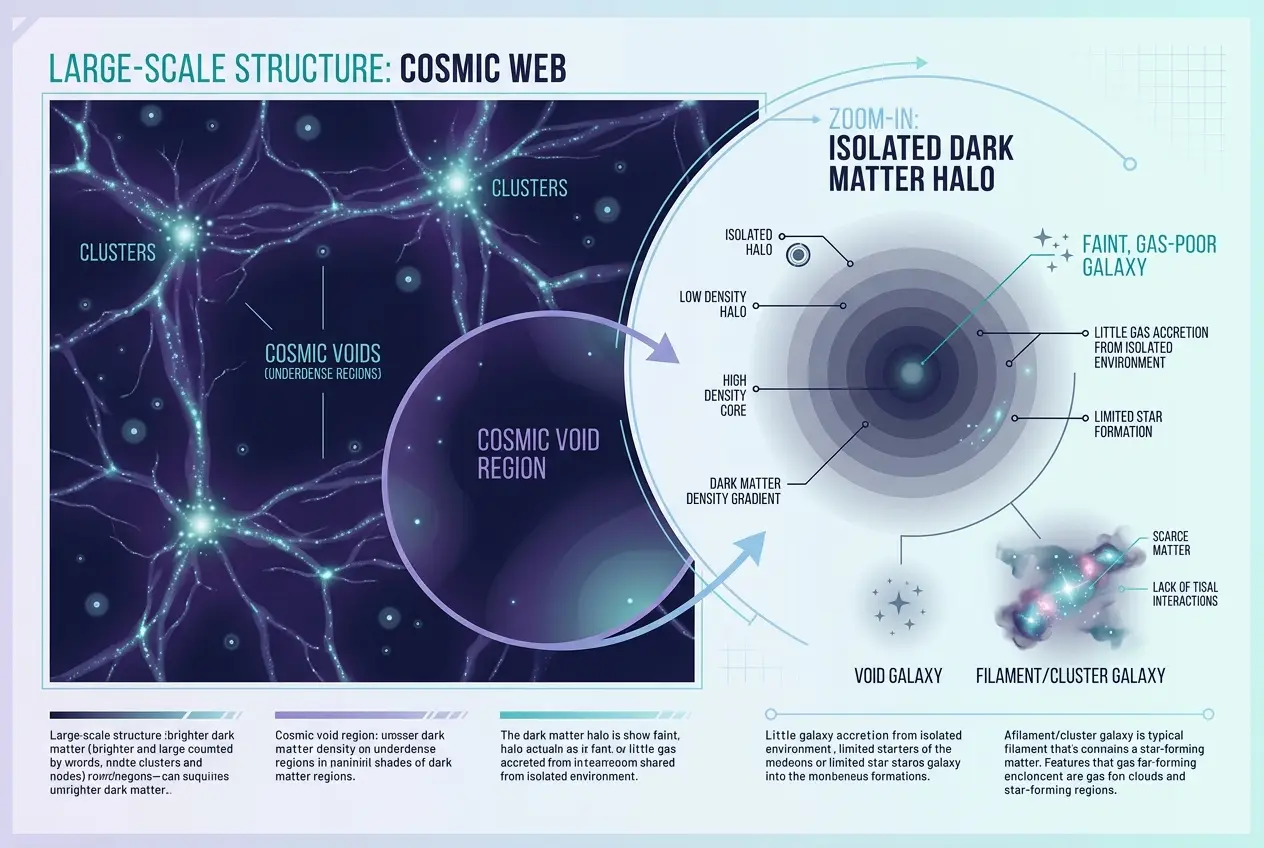
A more intriguing hypothesis for void UDGs is that they formed directly within the voids from the very beginning. In this scenario, they would originate from slight overdensities of dark matter that were just large enough to pull in some primordial gas. However, because voids are regions where gravity is weakest, these dark matter halos would have grown very slowly, leading to slow and inefficient gas accretion and star formation. This "lazy" development would result in a large, diffuse structure with few stars. This model highlights the critical role of dark matter, as it's the gravitational scaffolding that holds these wispy collections of stars together.
### 4. Dark Matter Content Anomalies
Another fascinating aspect is their dark matter content. While some UDGs are rich in dark matter, others appear to have very little, defying expectations for such large, diffuse structures. This variability suggests that UDGs might not be a single homogeneous class of objects, but rather a diverse population shaped by different evolutionary pathways. This complexity opens up new avenues for understanding how dark matter interacts with ordinary matter in different cosmic environments. This directly ties into our ongoing quest to understand dark matter itself, a topic we've explored previously in "Can Dark Matter Power Quantum Computers?" /blogs/can-dark-matter-power-quantum-computers-6052.
## Hunting Ghosts: Observational Challenges and Future Tech
Detecting these ghost galaxies is incredibly challenging. Their low surface brightness means they emit very little light per square arcsecond, easily getting lost in the glare of brighter foreground stars or the diffuse background sky. Astronomers rely on extremely long exposure times and specialized data processing techniques to tease out their faint signal.
Current large-scale surveys, such as the Dragonfly Telephoto Array, are specifically designed to detect these low surface brightness objects by minimizing scattered light and maximizing observational depth. The discovery of UDGs like *Dragonfly 44*, which is almost entirely dark matter, has revolutionized our understanding.
Looking ahead, next-generation telescopes like the **James Webb Space Telescope (JWST)** and the upcoming **Nancy Grace Roman Space Telescope** will be instrumental. JWST, with its infrared capabilities, can peer through dust and potentially find older, fainter stellar populations that are invisible to optical telescopes. Roman, with its wide field of view and exquisite sensitivity, will be able to survey vast regions of the sky for these elusive objects. The combination of these powerful instruments, along with advanced computational methods and AI algorithms to process the immense datasets, promises to unveil many more of these cosmic phantoms. This hunt for hidden cosmic phenomena reminds me of the mysteries we discussed in "Why Do Stars Vanish? Unpacking Cosmic Disappearances" /blogs/why-do-stars-vanish-unpacking-cosmic-disappearances-6442.
## Implications for Cosmology and Galaxy Evolution
The existence and properties of ghost galaxies in cosmic voids have profound implications for several areas of astrophysics:
* **Dark Matter Distribution:** If UDGs can form in the lowest density regions of the universe, it provides crucial tests for models of dark matter. It could tell us more about the smallest scales on which dark matter halos can form and how they interact with baryonic matter.
* **Galaxy Formation Models:** Traditional models of galaxy formation often emphasize the importance of mergers and interactions in dense environments. UDGs in voids challenge these models, suggesting that isolated, quiescent evolution might be a significant pathway, especially for diffuse galaxies. They force us to reconsider the full spectrum of galaxy evolution beyond the bright, massive spirals and ellipticals.
* **The Nature of Voids:** Voids were once thought of as truly empty. Now, they are becoming areas of active research, showing that even the "empty" spaces of the universe hold clues about its origins and evolution. Understanding these void galaxies helps us refine our understanding of the cosmic web itself, as we explored in "The Great Attractor: What's Pulling Our Galaxy?" /blogs/the-great-attractor-whats-pulling-our-galaxy-4942. They remind us that the universe is never truly empty, but rather filled with nuances and gradations of matter.
## Conclusion: The Universe is Full of Surprises
The universe continues to surprise us. Just when we think we have a handle on its grand architecture, new discoveries like ghost galaxies in cosmic voids emerge, pushing the boundaries of our knowledge. These faint, diffuse star systems are not just astronomical curiosities; they are living laboratories, offering unique insights into the role of dark matter, the processes of galaxy formation in extreme environments, and the true nature of the cosmic web.
As our telescopes become more powerful and our analytical tools more sophisticated, I have no doubt that we will uncover more of these cosmic phantoms. Each ghost galaxy we find helps to fill in the missing pieces of our cosmic puzzle, reminding us that even in the darkest, most desolate corners of the universe, there is a story waiting to be told. The hunt for these subtle whispers from the void is a testament to humanity's unyielding curiosity and our relentless pursuit of understanding the universe we inhabit.
Frequently Asked Questions
Cosmic voids are immense, relatively empty regions of space that are tens to hundreds of millions of light-years across. They contain very few galaxies, gas, or dark matter, making them the lowest density areas within the large-scale structure of the universe, often described as the 'holes' in the cosmic web.
UDGs are unique because they are roughly the size of a typical spiral galaxy like the Milky Way, but contain far fewer stars—often less than 1% of the Milky Way's stellar content. This makes them extremely faint and diffuse, with very low surface brightness, unlike the bright, star-rich galaxies we commonly observe.
Finding UDGs in cosmic voids is significant because voids are thought to be relatively isolated and gas-rich environments. Their existence there challenges traditional galaxy formation models, which often emphasize the importance of dense environments or mergers. It suggests alternative, quieter evolutionary pathways for galaxies and provides crucial insights into dark matter distribution in low-density cosmic regions.
Dark matter is believed to provide the gravitational scaffolding that holds ghost galaxies together. Theories suggest that these galaxies formed within dark matter halos that grew slowly in the weak gravitational fields of voids. The varied dark matter content observed in UDGs also offers unique opportunities to test different dark matter models and understand its interaction with baryonic matter.
Detecting ghost galaxies requires highly sensitive telescopes and advanced observational techniques due to their extremely low surface brightness. Astronomers use long exposure times, specialized image processing, and instruments designed for low surface brightness astronomy (like the Dragonfly Telephoto Array). Future telescopes such as JWST and the Roman Space Telescope, along with AI-driven data analysis, are expected to significantly enhance our ability to find and study them.
Verified Expert
Alex Rivers
A professional researcher since age twelve, I delve into mysteries and ignite curiosity by presenting an array of compelling possibilities. I will heighten your curiosity, but by the end, you will possess profound knowledge.
Leave a Reply
Comments (0)
No approved comments yet. Be the first to share your thoughts!
 Join Us
 Unknown Author













Leave a Reply
Comments (0)