I often find myself staring up at the night sky, awestruck by the sheer number of stars, each a distant sun, potentially orbited by its own worlds. It’s a profound thought that has captivated humanity for millennia: are we alone? But what if the question isn’t just about *life* out there, but *intelligence* – intelligence on a scale so vast that it literally reshapes its environment to harness the power of stars? This isn't just science fiction anymore; it’s a tantalizing possibility being seriously explored by astronomers through the lens of what we call **alien megastructures**.
Imagine a civilization so advanced that it could build on a cosmic scale, constructing colossal artifacts to capture energy directly from its parent star. Think of something far beyond our biggest dams or solar farms – structures so immense they could dwarf entire planets. These aren't just theoretical constructs in a physicist’s notebook; the hunt for them is very real, driven by perplexing astronomical anomalies that defy conventional explanation.
## The Whisper From KIC 8462852: Tabby's Star
Our journey into the realm of **cosmic engineering** truly gained momentum with the discovery of **KIC 8462852**, famously nicknamed **Tabby's Star** after astronomer Tabetha Boyajian. Located about 1,470 light-years away in the constellation Cygnus, this F-type main-sequence star should have been unremarkable. Yet, in 2015, data from the Kepler Space Telescope revealed something extraordinary and utterly baffling.
Unlike typical stars, which show predictable, slight dips in brightness when an orbiting planet passes in front of them, Tabby’s Star exhibited erratic and profound dimming events. Some of these dips were shallow, lasting days; others were unprecedented, with the star’s light plummeting by up to 22% for weeks at a time. This wasn't a one-off event, but a series of intermittent, asymmetrical fluctuations over years.
**The Great Dimming Puzzle**
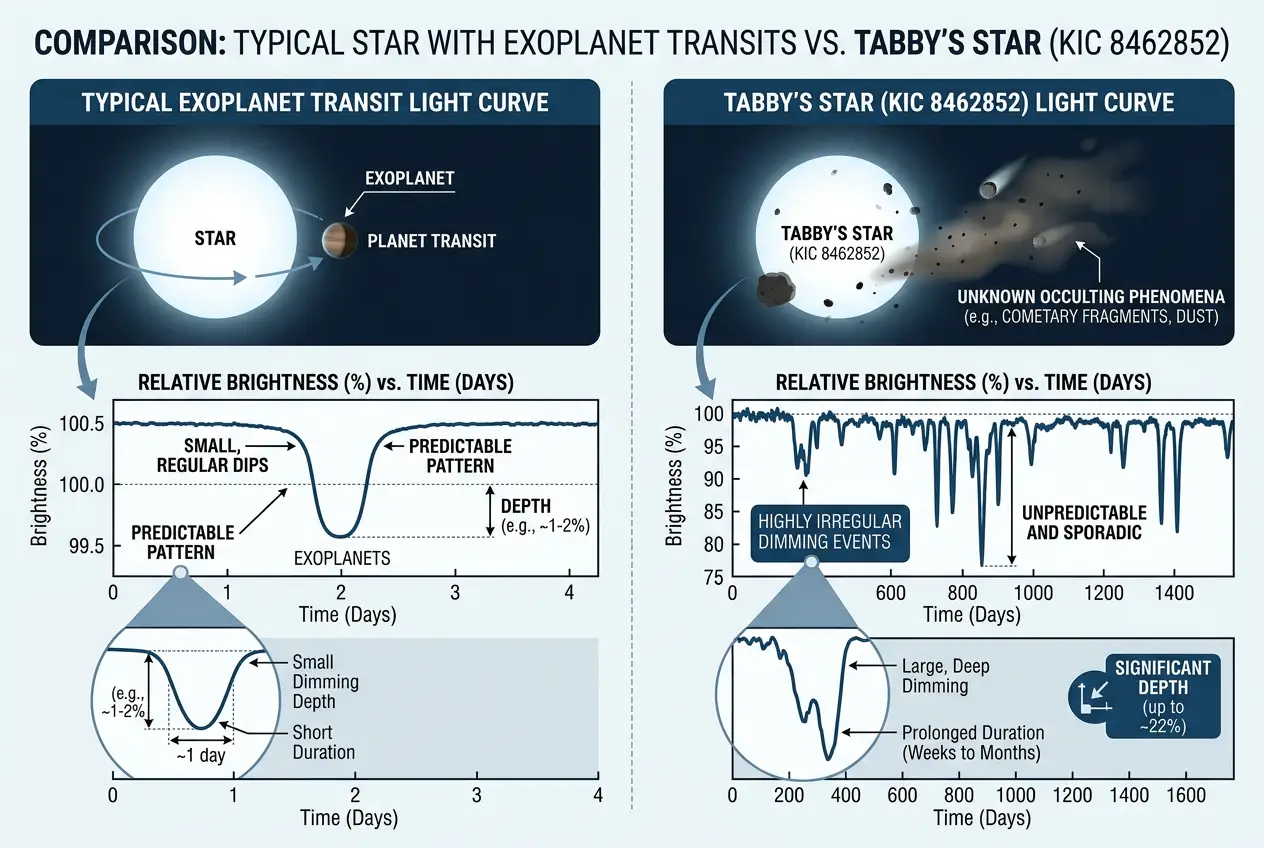
Initial explanations naturally focused on mundane, astrophysical phenomena. Could it be a swarm of comets? A huge ring of dust? Perhaps a planetary collision creating debris? While a large number of comets could obscure the star, the sheer scale required and the specific dimming patterns didn't quite fit the models. Dust rings would typically emit infrared light, which wasn't observed to the extent expected. No single natural explanation seemed to fully account for all the observed peculiarities.
It was astronomer Jason Wright who, along with Boyajian and others, suggested an audacious, albeit exciting, alternative: **alien megastructures**. Specifically, they proposed that the dimming could be caused by parts of a massive artificial structure, possibly a **Dyson swarm**, orbiting the star. The idea ignited the scientific community and captured the public imagination.
## The Blueprint of a Cosmic Dream: Dyson Spheres
The concept of a **Dyson sphere** was first popularized by physicist Freeman Dyson in 1960. He hypothesized that an advanced civilization, facing ever-increasing energy demands, would eventually need to harness the total energy output of its star. The most efficient way to do this would be to enclose the star with a vast shell or swarm of structures.
There are a few theoretical models for how such a structure might work:
* **Dyson Swarm:** This is perhaps the most plausible and common interpretation in current scientific discussions. It involves a decentralized collection of independent orbital structures (like solar panels, habitats, or industrial complexes) that orbit the star, collectively capturing a significant portion of its energy. This avoids the immense engineering challenges and material strain of a rigid shell.
* **Dyson Shell:** The original, more dramatic concept – a solid, hollow sphere completely enclosing the star. While theoretically offering maximum energy capture, the structural integrity, material requirements, and waste heat management for such a massive, rigid construct are almost unimaginable.
* **Dyson Bubble:** A variation using a static array of satellites held in place by light pressure, rather than orbit.
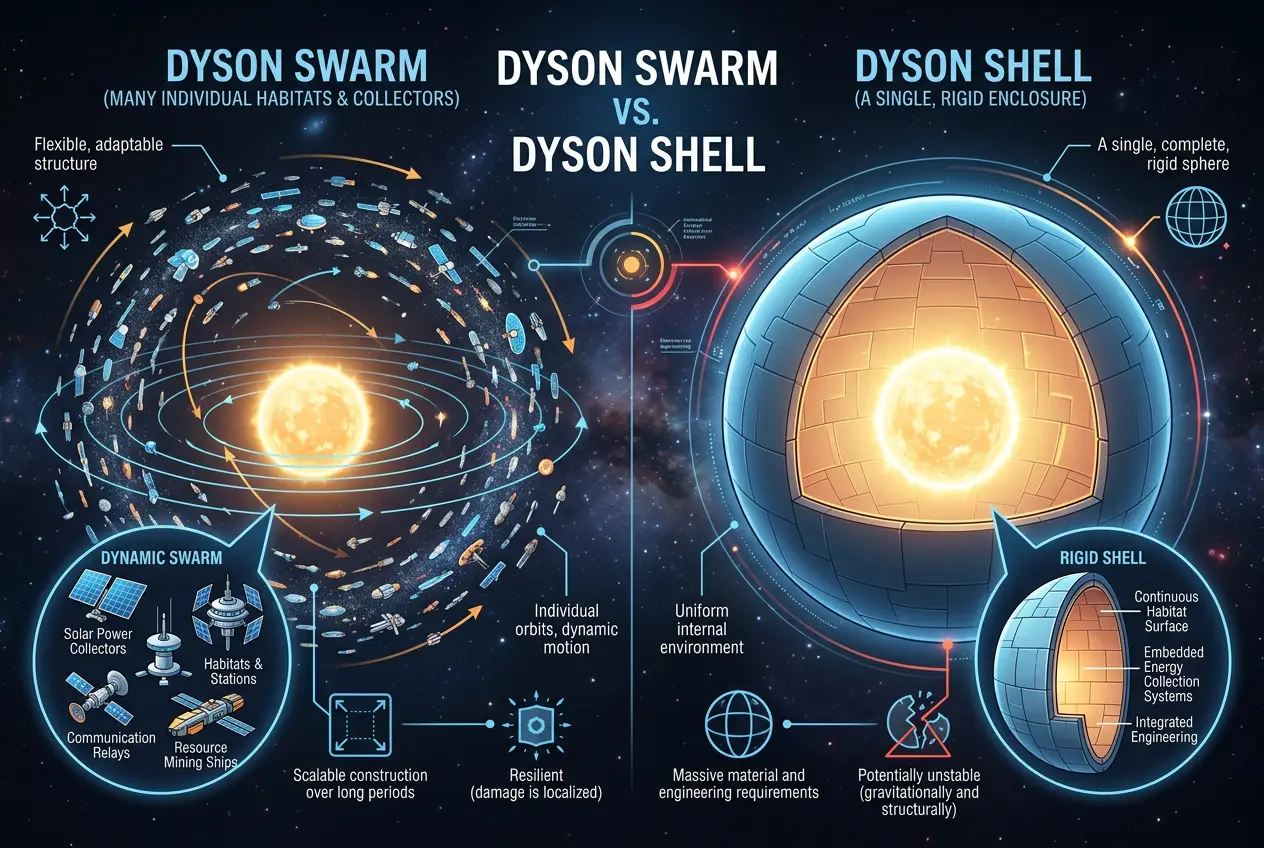
Such endeavors would represent the pinnacle of **advanced civilization technology**, classifying a species as a Type II civilization on the Kardashev Scale. To learn more about the theoretical framework behind these immense constructions, I recommend diving into the fascinating details on [Wikipedia's Dyson Sphere page](https://en.wikipedia.org/wiki/Dyson_sphere). The sheer scale is mind-boggling, requiring resources equivalent to entire planets and engineering capabilities we can barely conceive.
## Beyond Tabby's Star: The Broader Search
While Tabby's Star remains the most compelling candidate for a **cosmic megastructure**, it’s far from the only anomaly that has piqued the interest of astronomers searching for **extraterrestrial intelligence (SETI)**. The broader search involves looking for technosignatures – signs of technology – which could include not just partial eclipses but also unusual spectral emissions, waste heat signatures, or even artificial radio signals.
The **SETI program** itself has been scanning the heavens for decades, primarily listening for radio transmissions. However, the search for **alien megastructures** takes a different approach, relying on optical astronomy and looking for indirect evidence of monumental construction projects. This is an exciting extension of the traditional SETI efforts. You can delve deeper into the history and methods of this search on [Wikipedia's SETI page](https://en.wikipedia.org/wiki/SETI).
Other peculiar stellar behaviors have been observed, though none have reached the level of sustained, inexplicable dimming seen in Tabby's Star. These include stars with unusual infrared excesses (potentially waste heat from energy-collecting structures, though natural explanations are more common) or stars with strange, transient light variations. Each new anomaly becomes a puzzle, rigorously investigated by the scientific community. Sometimes, these discoveries also make me wonder about other grand cosmic puzzles, such as whether our very existence is part of a larger, engineered design, echoing questions explored in "Is Our Reality a Digital Simulation? Decoding the Universe's Code" (/blogs/is-our-reality-a-digital-simulation-decoding-the-universes-code-9313).
## The Scientific Rigor: Extraordinary Claims, Extraordinary Evidence
The scientific community approaches the **alien megastructure hypothesis** with extreme caution, and rightly so. The principle of "extraordinary claims require extraordinary evidence" is paramount. Before even whispering "aliens," every conceivable natural explanation must be thoroughly exhausted.
The scientific process for evaluating Tabby's Star, and any similar anomaly, involves:
1. **Observation:** Detailed, long-term monitoring of the star's light curve.
2. **Hypothesis Generation:** Proposing natural explanations (comets, dust, stellar activity) and artificial ones (megastructures).
3. **Modeling and Prediction:** Using physical models to see if the proposed explanations fit the observed data.
4. **Further Observation:** Seeking new data (e.g., infrared emissions, radial velocity changes) that could confirm or refute a hypothesis.
While the natural explanations for Tabby's Star have weakened over time, none have been definitively ruled out, nor has the megastructure hypothesis been proven. Recent studies, for example, have pointed to obscuration by dust clouds that are not heated by the star, offering a new natural contender. However, the mystery continues to evolve, pushing the boundaries of what we understand about stellar behavior.
## Why This Quest Matters
The search for **alien megastructures** isn't just about finding aliens; it's about pushing the boundaries of our understanding of the universe and our place within it.
* **Proof of ETI:** Confirming the existence of **extraterrestrial intelligence** through such a tangible artifact would be one of the most profound discoveries in human history. It would fundamentally change our worldview.
* **Technological Inspiration:** Studying theoretical megastructures helps us envision the ultimate limits of technology, challenging us to think about sustainable energy solutions and large-scale engineering.
* **Addressing the Fermi Paradox:** If advanced civilizations are common, why haven't we seen any direct evidence? The **Fermi Paradox** highlights this conundrum. Detecting a Dyson sphere would offer a powerful answer, suggesting that advanced civilizations might be out there, just incredibly difficult to spot, or perhaps their signs are just beginning to be deciphered. Delving into questions like the Fermi Paradox often leads to deeper cosmic quandaries, similar to those explored in "Is The Great Filter Real? Tech's Biggest Cosmic Test" (/blogs/is-the-great-filter-real-techs-biggest-cosmic-test-9538). I find myself frequently pondering these profound questions. You can read more on [Wikipedia's Fermi Paradox page](https://en.wikipedia.org/wiki/Fermi_paradox).
* **Understanding Cosmic Phenomena:** Even if all these anomalies turn out to be natural, the rigorous investigation forces us to understand our universe better, uncovering new types of stellar behavior or previously unknown astronomical phenomena. The cosmos is full of hidden wonders, some as enigmatic as the invisible components discussed in "Does Dark Matter Hide a Universe We Can't See?" (/blogs/does-dark-matter-hide-a-universe-we-cant-see-2793).
## The Future of the Search for Cosmic Architects
The future of this quest is bright, fueled by new generations of telescopes and advanced analytical techniques. Projects like the Vera C. Rubin Observatory, with its vast sky surveys, will provide unprecedented amounts of data, potentially revealing more Tabby's Star-like anomalies. Artificial intelligence and machine learning algorithms are increasingly being deployed to sift through this data, identifying patterns that human eyes might miss.
We are entering an era where our ability to observe and analyze the cosmos is rapidly accelerating. While the definitive evidence for **alien megastructures** remains elusive, the fact that we can even pose such a question, and have plausible, if extraordinary, candidates, speaks volumes about the progress of science and human curiosity.
Whether they turn out to be products of geology, biology, or technology, these cosmic anomalies remind us that the universe is far more complex and surprising than we can ever imagine. So, the next time you look up, remember that beyond the familiar twinkle of distant stars, there might just be signs of something truly immense, crafted by architects from another world, silently harnessing the power of a sun. The quest continues, and with every flicker of light from a distant star, we learn a little more about the grand tapestry of our universe.
Frequently Asked Questions
An alien megastructure refers to a hypothetical artificial construction built by an advanced extraterrestrial civilization on a cosmic scale, often designed to harness a star's energy, like a Dyson sphere or swarm.
Tabby's Star (KIC 8462852) is a star known for its unusual and erratic dimming patterns, which cannot be easily explained by typical astronomical phenomena. It became significant because these dips led astronomers to consider the possibility of orbiting alien megastructures as a potential explanation.
A Dyson sphere is a hypothetical mega-engineering project where an advanced civilization constructs a vast structure, either a solid shell or a swarm of habitats/solar collectors, around a star to capture all or most of its energy output. This concept helps explain how a Type II civilization on the Kardashev scale might operate.
While Tabby's Star is the most compelling candidate due to its unique dimming, astronomers continue to investigate other stellar anomalies, such as stars with unusual infrared excesses or transient light variations. However, none have exhibited the same combination of unexplained dimming as KIC 8462852.
The main challenges include the vast distances involved, the immense scale required for detection, and the need to exhaust all natural astrophysical explanations first. The principle of 'extraordinary claims require extraordinary evidence' means that definitive proof would require very strong, unambiguous data that cannot be explained otherwise.
Verified Expert
Alex Rivers
A professional researcher since age twelve, I delve into mysteries and ignite curiosity by presenting an array of compelling possibilities. I will heighten your curiosity, but by the end, you will possess profound knowledge.
Leave a Reply
Comments (0)
No approved comments yet. Be the first to share your thoughts!
 Join Us



 Alex Rivers



























Leave a Reply
Comments (0)