


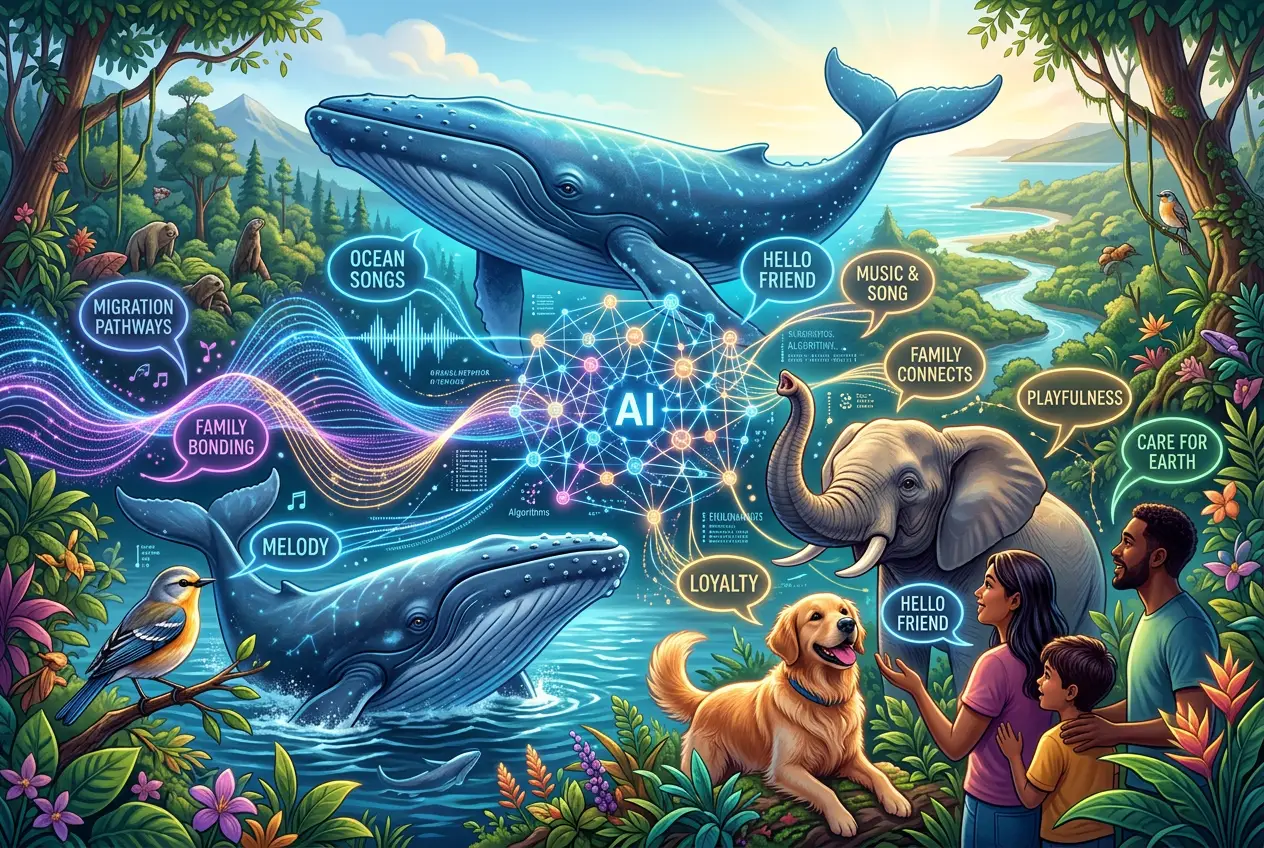
I remember vividly a childhood dream—a common one, I believe—of wishing I could speak to animals. To understand the barks of my dog, the chirps of birds, or the mysterious clicks of dolphins. It seemed like pure fantasy, a realm confined to fairy tales and animated movies. Yet, what if I told you that this long-held human dream is rapidly moving from the realm of fiction to a tangible scientific frontier, powered by the incredible leaps in Artificial Intelligence?
The idea of truly communicating with another species, not just through training or observation, but through a genuine exchange of information, has always captivated us. For centuries, humans have studied animal behavior, tried to interpret their calls, and even taught them to respond to our commands. But the dream was always to understand their language, their thoughts, their inner world. Now, thanks to the exponential growth of computational power and sophisticated machine learning algorithms, this profound biological barrier might finally be crumbling.
The Whisper of the Wild: A Long-Standing Quest
For generations, scientists have dipped their toes into the vast ocean of animal communication. We know animals communicate in incredibly complex ways: through vocalizations, body language, chemical signals, and even electrical impulses. A bird's song isn't just a random melody; it can be a territorial warning, a mating call, or an alarm for predators. A dolphin's whistle might be a "name" for another individual, while a prairie dog's bark can describe the exact type and size of a predator.
The challenge, however, has always been the sheer volume and complexity of this data. How do you distinguish meaningful patterns from random noise? How do you account for context, individual variation, and the vast differences in sensory perception between species? This is where traditional methods often hit a wall. It's like trying to understand a highly complex, alien language without a Rosetta Stone and with only fragmented recordings.
A New Era: Bioacoustics Meets Machine Learning
Enter AI. Specifically, the fusion of bioacoustics—the scientific study of sound production and reception in animals—with cutting-edge machine learning and deep learning techniques. AI thrives on finding patterns in massive datasets, a task that humans find arduous, if not impossible. By feeding AI systems vast quantities of animal vocalizations, coupled with contextual data (e.g., what the animal was doing, who it was with, environmental factors), researchers are beginning to uncover hidden structures in what we once perceived as mere animal noises.
"AI offers an unprecedented tool for deconstructing the 'languages' of other species," explains Dr. Anya Sharma, a lead researcher in bio-linguistics. "It's allowing us to move beyond simple correlation to actually identifying syntax, semantics, and even individual 'words' or 'phrases' within animal communication systems."
These advanced algorithms can perform tasks such as:
- Pattern Recognition: Identifying repeated sequences or unique acoustic signatures.
- Spectral Analysis: Breaking down sounds into their constituent frequencies to reveal hidden nuances.
- Clustering: Grouping similar vocalizations that might represent specific meanings or intentions.
- Predictive Modeling: Anticipating an animal's behavior based on its communication patterns.
This analytical power is leading to some truly mind-boggling breakthroughs that are reshaping our understanding of animal intelligence and communication. It makes me wonder, if we can unravel these complex patterns, what other hidden connections might we uncover, perhaps even connecting seemingly disparate concepts in the universe, much like the theoretical connections explored in discussions around Does Quantum Entanglement Connect Parallel Universes?.
Pioneering Projects & Promising Breakthroughs
Several ambitious projects are now at the forefront of this interspecies communication revolution:
Project CETI: Decoding the Language of Whales
Perhaps the most famous initiative is Project CETI (Cetacean Translation Initiative). This ambitious collaboration of marine biologists, linguists, and AI experts aims to decipher the communication of sperm whales. Sperm whales communicate using complex sequences of clicks called "codas." Researchers are deploying advanced hydrophones and AI-powered systems to record and analyze billions of these codas, hoping to map their structure and meaning.
Their goal is not just to understand the whales, but eventually to be able to "speak" back to them. Imagine the profound implications of genuine two-way communication with one of Earth's most intelligent, long-lived, and mysterious creatures. You can learn more about their incredible work and progress on their official website: Project CETI (opens in a new tab).
The Surprising Sophistication of Prairie Dogs
Another fascinating area of research involves prairie dogs. Dr. C.S. Slobodchikoff and his team have spent decades studying their alarm calls. They discovered that prairie dogs don't just alert others to danger; their barks encode detailed information about the predator, including its species, size, and even whether a human is carrying a gun. Using AI, Slobodchikoff’s team is developing an "animal language translation device" to translate these calls into English and vice versa. This work is groundbreaking because it moves beyond simple interpretation to attempting a form of direct translation. A fascinating look into this can be found in various scientific publications and articles discussing his work, such as on Wikipedia's entry for Con Slobodchikoff (opens in a new tab).
Dolphins and Their "Names"
Dolphins have long been known for their intelligence and complex social structures. Research has shown that dolphins develop unique "signature whistles" that act much like names. AI is helping scientists analyze these whistles, identify individual dolphins, and understand how they use these unique calls in their intricate social interactions. This research is paving the way for a deeper understanding of cetacean cognition and potentially, future communication attempts.
Beyond Sounds: Decoding Intent and Context
True communication isn't just about sound; it's about meaning, intent, and context. AI's capabilities extend beyond mere audio analysis. Researchers are also integrating visual data (body language, facial expressions in primates), chemical signals (pheromones in insects or mammals), and even physiological data (heart rate, stress levels) to build a holistic picture of an animal's state and message.
By correlating these diverse data points, AI can begin to infer the emotional state of an animal, its desires, and its warnings. This multi-modal approach is crucial because, just like humans, animals use a rich tapestry of cues to convey meaning. Understanding these intricate layers might even give us new perspectives on universal patterns of communication, sparking similar awe and curiosity that drives our search for extraterrestrial intelligence, much like the intense speculation surrounding The Wow Signal: Was it an Alien Radio Beacon?.
The Roadblocks and the Ethical Maze
While the progress is thrilling, the journey is fraught with challenges. The sheer volume of data required for robust AI models is immense, and collecting it ethically and consistently is a monumental task. Every species presents its own unique communication complexities, meaning there's no single "Rosetta Stone" for all animal languages. Moreover, we must be careful to avoid anthropomorphism—the projection of human traits and emotions onto animals—which can lead to misinterpretations.
Beyond the technical hurdles, a profound ethical question looms: Should we? If we could truly understand animals, what responsibilities would that entail? Would it lead to greater empathy and conservation, or could it open doors to exploitation? How would knowing their thoughts impact animal rights, agriculture, or even our concept of wilderness? These are questions that humanity will need to grapple with as our technological capabilities advance. As our capacity for understanding grows, so too does our ethical imperative to use that understanding wisely.
Implications: A World Reimagined
The successful decoding of animal communication could usher in a new era for humanity's relationship with the natural world:
- Conservation: Understanding distress calls, migratory patterns, or specific habitat requirements could revolutionize conservation efforts, allowing us to protect endangered species more effectively.
- Animal Welfare: Improved communication could lead to better welfare for domestic animals, livestock, and those in captivity, allowing us to cater to their needs and reduce stress.
- Scientific Discovery: It would unlock unparalleled insights into animal cognition, culture, and intelligence, expanding the very definition of consciousness.
- Beyond Earth: The technologies developed could even inform our search for and potential communication with extraterrestrial life.
I believe we stand at the precipice of one of humanity's most significant scientific achievements. The ability to bridge the communication gap with other species would fundamentally alter our perception of ourselves and our place within the global ecosystem. It would be a testament not just to human ingenuity, but to our growing capacity for empathy and connection. The silent world of animals may soon begin to speak, and I, for one, am eagerly waiting to listen.
External Sources:
- Wikipedia on Bioacoustics: https://en.wikipedia.org/wiki/Bioacoustics (opens in a new tab)
- Project CETI Official Website: https://www.projectceti.org/ (opens in a new tab)
- Wikipedia on Con Slobodchikoff: https://en.wikipedia.org/wiki/Con_Slobodchikoff (opens in a new tab)





Conversation0
No comments yet. Be the first to share a thought — the best questions often become new stories.