


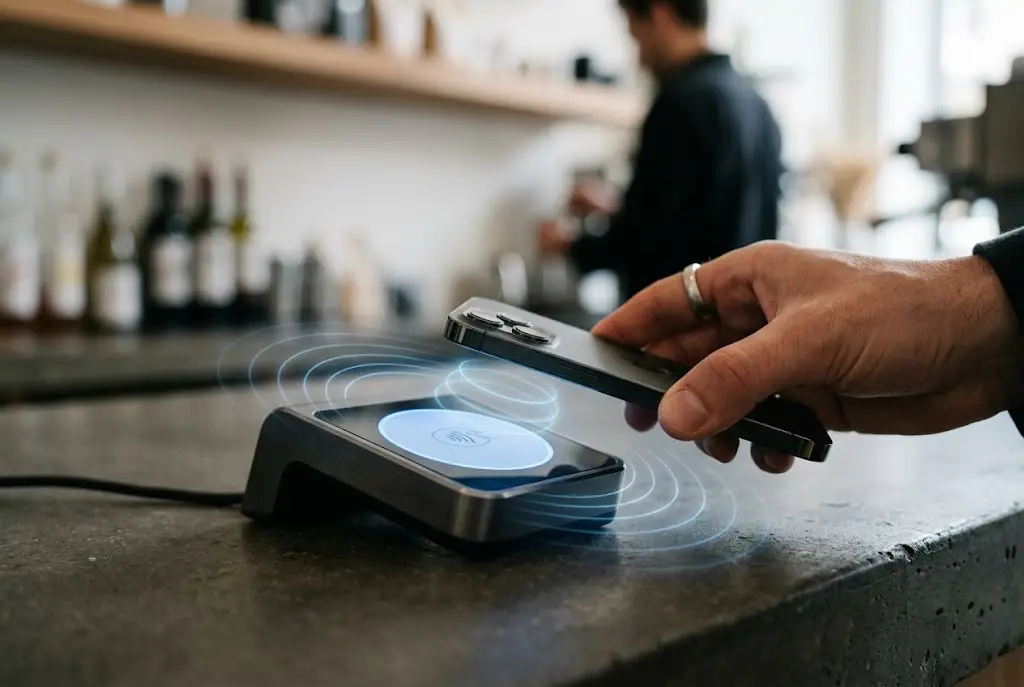
I was standing at my local grocery store checkout yesterday when I realized I had left my wallet in the car. A few years ago, this would have meant an embarrassing walk back to the parking lot, leaving my items behind. Instead, I pulled out my phone, double-clicked the side button, and tapped it against the terminal. Beep. Transaction complete.
It almost feels like magic. How can a phone—or a flat piece of plastic with absolutely no battery—instantly transfer money through thin air?
I decided to look into the science behind this everyday convenience. It turns out that contactless payments rely on a beautiful mix of electromagnetism and high-level cryptography. Let’s break down exactly how this technology works in your daily life.
The Card Has No Battery? Inductive Coupling Explained
To understand how your plastic card works, we first need to look at Radio-Frequency Identification (RFID) (opens in a new tab). Your contactless credit card is "passive," meaning it does not contain a battery. If you were to hold your card up to a strong light, you would see a tiny microchip and a thin, coiled copper antenna running along the outer edges.
So, how does a card with no power transmit data?
The secret lies in a physics principle called inductive coupling:
- The payment terminal acts as an active reader, constantly emitting a weak electromagnetic field.
- When you bring your card within a couple of inches of the terminal, the copper coil antenna intercepts this field.
- This magnetic interaction induces a tiny electric current inside the card's coil.
- This brief splash of energy is just enough to wake up the microchip, which then transmits your payment details back to the reader.
Real-Life Connection: This is why your card won’t work if it is too far away. The electromagnetic field is weak, usually requiring you to get within 2 inches. This prevents you from accidentally paying for someone else’s coffee while just standing in line!
The Mobile Upgrade: What is NFC?
When you use a smartphone or a smartwatch, the technology gets a bit of an upgrade. Phones use a specialized branch of RFID called Near-Field Communication (NFC) (opens in a new tab).
Since your phone has its own battery, it doesn't need to rely on the terminal's magnetic field to power up. Instead, it can act as both a passive tag and an active reader. This is why you can use your phone to read programmable NFC stickers or share contacts by tapping two devices together.
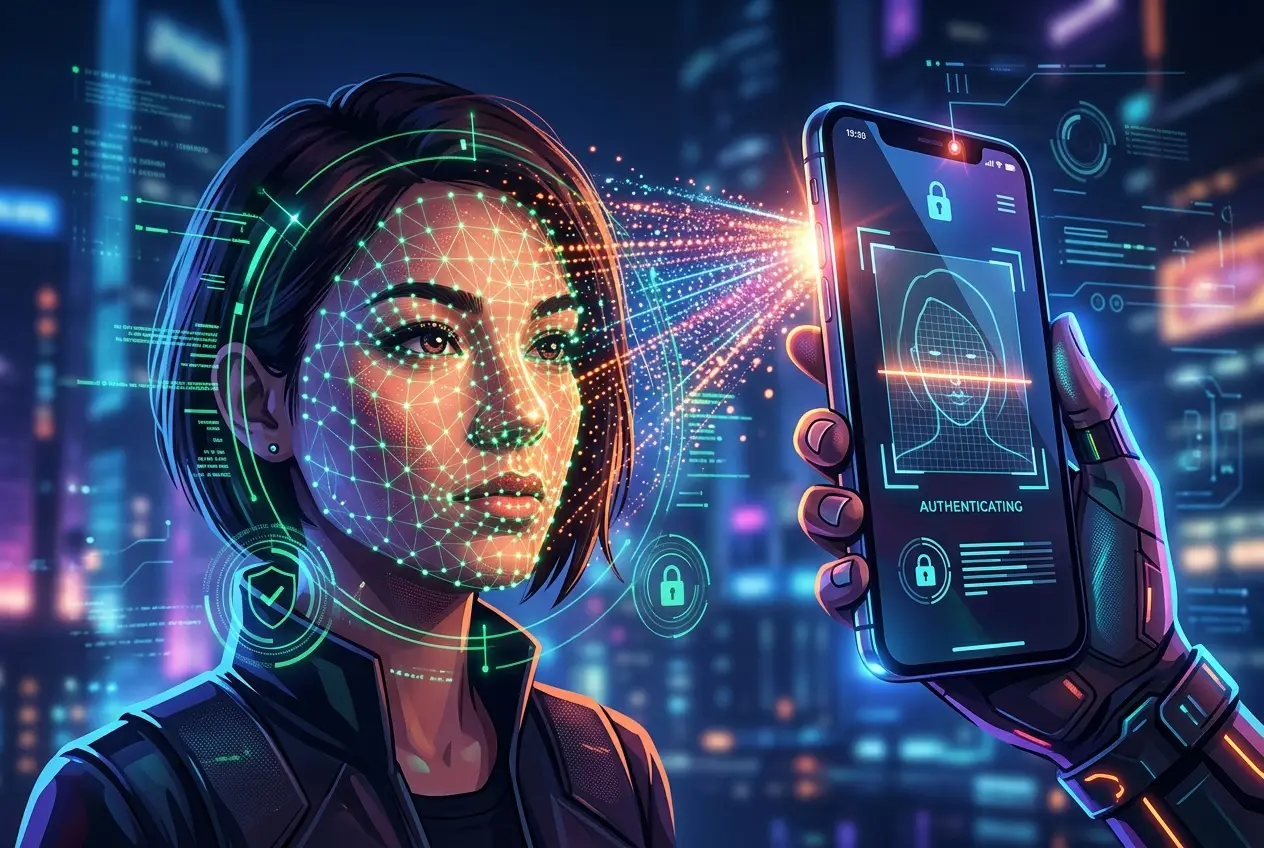
Similar to the security architecture we discussed when looking at how Face ID secures your phone, mobile NFC systems do not let standard apps touch your payment data. Everything is isolated in a dedicated hardware chip called the Secure Element (SE).
Step-by-Step of a Wireless Handshake
What actually happens in the fraction of a second between your tap and that satisfying beep? The communication process is incredibly fast:
- The Broadcast: The merchant's terminal sends out a steady 13.56 MHz radio signal.
- The Connection: You bring your phone or card close, powering up the transmission path.
- The Handshake: Instead of sending your actual 16-digit credit card number, the chip generates a one-time cryptographic code.
- The Authorization: The terminal sends this token to your bank, which verifies it and authorizes the payment.
This quick process is why we can buy items in under a second. Let's compare how this stacks up against old-school magnetic stripe cards:
| Feature | Traditional Swiping (Magstripe) | Tap-to-Pay (NFC / RFID) |
|---|---|---|
| Data Sent | Static Card Number (Always the same) | Unique, One-Time Cryptographic Token |
| Physical Contact | Required (Causes physical wear) | None (Operates within 4 cm) |
| Power Source | None (Mechanical swipe) | Inductive coupling or Device Battery |
| Security Risk | High (Vulnerable to magnetic skimming) | Very Low (Encrypted dynamically) |
Real-Life Connection: This is why cheap mobile phones sometimes lag when you tap them to pay. Their basic NFC processors take a split second longer to generate the encrypted token compared to high-end flagship phones.
Why You Can’t Be Easily Hacked in Public
When contactless payments (opens in a new tab) first went mainstream, I remember people worrying that thieves could walk through a crowd with a wireless reader and steal money straight out of people's pockets.
In reality, doing this is incredibly difficult. As security expert Bruce Schneier famously noted:
"Security is a process, not a product."
Contactless systems embody this by continuously changing the data they transmit instead of relying on static details. Here is why you are safe:
- Short Range: The electromagnetic field drops off sharply. A thief would practically have to touch your pocket with a large terminal.
- Tokenization: Thanks to tokenization (opens in a new tab), even if someone managed to sniff the radio signal, they would only capture a single-use token. This token cannot be used to make a second purchase or clone your card.
- Biometric Locks: Your phone won't broadcast its NFC signal unless you unlock it. Just like how capacitive touchscreens read your fingerprint, your device requires active human authorization before releasing the token.
Real-World Hiccups: Why Taps Fail
Have you ever tapped your wallet and had the terminal throw an error? This is called "card clash." When multiple contactless cards are stacked together, the reader's magnetic field powers all of them at once. Since they all try to speak at the same time, the reader gets confused and rejects the transaction.
Similarly, if you use a thick metal phone case, you might find that tap-to-pay stops working. Metal blocks electromagnetic fields. This is the exact principle behind RFID-blocking wallets—they act as a tiny Faraday cage, preventing external readers from waking up your cards.
What once felt like science fiction is now a basic tool of modern life. By combining simple electromagnetic induction with advanced secure chips, contactless technology keeps our transactions fast and incredibly safe. Next time you pay with a quick tap, you'll know exactly what's happening inside that invisible magnetic field.




Conversation0
No comments yet. Be the first to share a thought — the best questions often become new stories.