


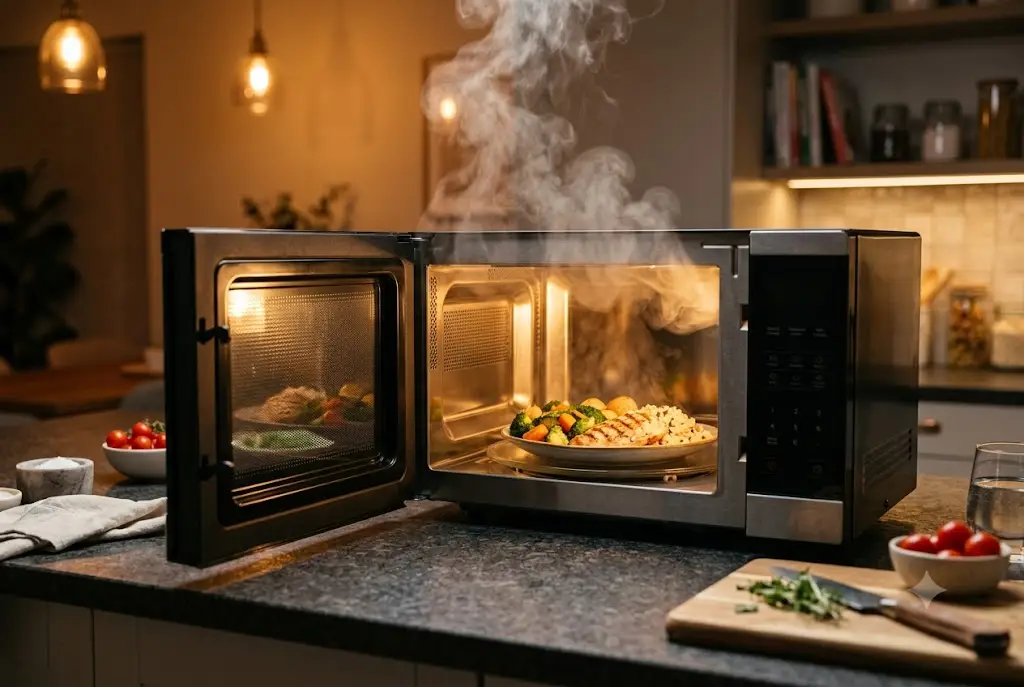
I stood in my kitchen yesterday, staring blankly at a bowl of leftover pasta. My stomach was growling, so I threw it in the microwave for two minutes. When the timer beeped, I grabbed the ceramic bowl—and immediately dropped it back onto the glass turntable with a gasp. The bowl was blistering hot, yet when I poked my fork into the pasta, the center was still practically frozen.
It felt like a glitch in physics. How could a kitchen appliance manage to heat up a heavy ceramic bowl to volcanic temperatures while leaving the actual food cold?
If you have ever burned your fingers on a "microwave-safe" plate, you are not alone. The way a microwave oven (opens in a new tab) interacts with different materials comes down to a clever mix of electrical engineering, molecular physics, and a phenomenon known as dielectric heating.
The Hidden Tech Inside the Box
To understand why your plates behave so weirdly, we first have to look at how a microwave operates. Unlike a traditional oven, which heats up the air inside the chamber to slowly cook your food from the outside in, a microwave does not generate ambient heat. In fact, if you ran an empty microwave (which you should never do!), the air inside would stay relatively cool.
At the heart of every microwave is a device called a cavity magnetron (opens in a new tab). This high-powered vacuum tube converts electricity into high-frequency radio waves. These waves are part of the electromagnetic spectrum (opens in a new tab), vibrating at a frequency of exactly 2.45 gigahertz (GHz)—or 2.45 billion times per second.
Much like how noise-canceling headphones manipulate physical sound waves to target and cancel noise, the microwave selectively directs electromagnetic waves to target specific molecules in your food.
Why Water is the Magic Key
So, why do these waves ignore the plate but attack your food? The answer lies in the chemistry of water, fats, and sugars.
These substances are made of polar molecules. A polar molecule has a slight positive charge on one end and a negative charge on the other—very much like a tiny microscopic magnet.
When the 2.45 GHz waves pass through your food, they create a rapidly alternating electromagnetic field. Because polar molecules want to align themselves with this field, they begin to twist back and forth at an unbelievable speed—billions of times per second. This process is called dipole rotation, which drives dielectric heating (opens in a new tab).
As these molecules rotate, they bump, rub, and collide with neighboring molecules. This rapid molecular friction generates heat, which quickly cooks or warms your food.
"Microwave energy is not heat energy; it is electromagnetic energy that the food itself converts into heat."
— Harold McGee, Food Scientist and Author of On Food and Cooking
Glass, paper, and high-quality ceramics do not contain polar molecules. Their atomic structures are tightly bound and neutral. Consequently, the microwaves pass right through them without causing any molecular rotation. This is why a high-quality glass dish can come out of the microwave feeling completely cool.
If Plates Are Non-Polar, Why Do They Get Hot?
If the physics is so straightforward, why did my ceramic bowl burn my hand? There are two main reasons for this frustrating kitchen phenomenon.
1. Thermal Conduction
This is the most common culprit. Even if your plate is 100% microwave-safe, it is still in direct contact with your food. As the water molecules inside your food heat up, they transfer that warmth to the container through simple thermal conduction (opens in a new tab). If you microwave a bowl of soup for five minutes, the soup will inevitably heat the bowl, making it hot to the touch.
2. The Danger of Porous Ceramics
This is where cheap or old dinnerware becomes a problem. Many ceramic plates are made of clay that must be sealed with a glaze. Over time, or through cheap manufacturing, tiny microscopic cracks form in this glaze.
When you wash these dishes, water seeps into the porous clay underneath and gets trapped. When you put that "dry" plate into the microwave, the magnetron targets the trapped water inside the plate's structure. The water heats up rapidly inside the ceramic, making the plate dangerously hot—sometimes even causing it to crack or shatter.
Material Guide: Safe vs. Unsafe
To make your daily kitchen routine easier, I put together this simple breakdown of how common kitchen materials interact with microwaves:
| Material | Reaction to Microwaves | Microwave Safe? | Real-World Context |
|---|---|---|---|
| High-Quality Glass / Pyrex | Waves pass straight through | Yes | Remains cool unless heated by the food inside. |
| Water, Fats, & Sugars | Absorbs waves and vibrates | Yes | This is what actually cooks your meal. |
| Porous Ceramics / Stoneware | Absorbs moisture into clay | No | Trapped moisture heats up, making the plate blisteringly hot. |
| Metals (Foil, Utensils) | Reflects waves and concentrates charge | No | Can cause sparks, electric arcs, and fire hazards. |
| Most Plastics | Can warp or leach chemicals | Variable | Only use plastics explicitly labeled "Microwave Safe." |
Getting the Most Out of Your Microwave
Understanding the science behind dielectric heating can actually help you cook and reheat your food much better. Here are a few practical tips:
- Sprinkle a Little Water: Because dry foods lack polar water molecules, they do not heat well. If you are reheating dry rice or bread, sprinkling a few drops of water on top gives the microwaves something to target.
- Arrange Food in a Ring: Microwaves can only penetrate about an inch into most foods. By placing your food in a ring pattern on your plate with an empty center, you ensure the waves can reach all sides evenly.
- Test Your Dishes: Not sure if a mug is microwave-safe? Put the empty mug in the microwave next to a separate glass of water. Microwave them for 30 seconds. If the mug gets hot while the water stays cool, the mug is absorbing microwaves and is not safe to use.
Just as modern capacitive touchscreens rely on the electrical properties of our bodies to function, our kitchen appliances rely on the unique molecular structure of our food. The next time you heat up a quick meal, you can appreciate the complex dance of billions of polar molecules spinning right in front of your eyes.



Conversation0
No comments yet. Be the first to share a thought — the best questions often become new stories.